6 Voice AI Client Offers That Actually Sell in
Most businesses waste months chasing unproven AI ideas while missing the 6 models Fortune 200 companies are paying six-figures for today. Learn which Voice AI services generate real revenue (with exact pricing examples) and how to implement them in your business.
6. AI Receptionist for Local Service Businesses
Local businesses lose thousands in potential revenue every month from missed calls. A plumbing company might miss 15-20 calls daily during peak hours - each representing $200-$500 in lost jobs. Traditional answering services cost $300-$800/month but still require human operators.
An AI receptionist solves this by answering 98% of calls instantly, qualifying leads, and booking appointments automatically. We've seen HVAC companies increase booked jobs by 27% while reducing call handling costs by 60%.
Implementation blueprint: The AI handles four tasks: answering calls, identifying service needs, booking jobs (or escalating emergencies), and sending confirmation texts. No medical or HIPAA-related services - focus on plumbing, electrical, auto repair where regulations are simpler.
Who This Works For
- HVAC companies missing after-hours calls
- Auto repair shops with busy front desks
- Pest control services needing 24/7 availability
- Cleaning companies with high call volumes
Implementation Costs
Startup costs range from $200-$500/month for:
- Voice AI platform (Vapi or equivalent)
- Business phone number
- Calendar/job system integration
- Basic automation setup
Earning potential: $20,000-$120,000/year per client. Charge $300-$800/month retainers plus setup fees. At 3:10 in the video, we break down exact pricing models that convert best.
5. High-Ticket Appointment Setter
Businesses spending $5,000+ per lead can't afford missed connections. Yet 40-60% of inbound leads never get called back due to overwhelmed sales teams. This creates a $2.8M problem for a company spending $50,000/month on ads.
The solution? A voice AI that calls leads within 90 seconds of form submission, qualifies them, and books appointments directly into calendars. One coaching client increased booked appointments by 183% while reducing cost-per-booking by 62%.
Core Functionality
- Instant outbound calling to fresh leads
- Natural objection handling
- Calendar integration (Calendly, HubSpot)
- CRM updates (Salesforce, Pipedrive)
- Confirmation reminders
Key differentiator: Unlike basic chatbots, this AI detects tone and urgency in the prospect's voice to prioritize hot leads (shown at 7:15 in the video).
Implementation Requirements
- Voice AI platform ($200-$1,000/month)
- CRM access (read/write permissions)
- Calendar system integration
- Business automation (Make.com or n8n)
Earning potential: $60,000-$250,000/year per client. Performance-based pricing works best - charge $50-$150 per booked appointment or hybrid retainers.
4. E-Commerce Customer Support Agent
Growing eCommerce brands face a support tsunami - every 10% sales increase creates 30% more support tickets. Human agents spend 70% of time on repetitive queries like "Where's my order?" or return requests.
A voice AI support agent handles these routine calls while escalating complex issues. One Shopify merchant reduced support costs by $18,000/month while improving CSAT scores by 22%.
Ideal Use Cases
- Order status inquiries
- Return/refund requests
- Account/password issues
- Basic product questions
- Shipping/billing updates
Critical insight: At 12:40 in the video, we show how to "make the AI stupid" - programming it to only answer known questions prevents compliance risks.
Technical Requirements
- Order management system access
- Help desk ticketing integration
- Account system permissions
- Escalation protocols
Earning potential: $120,000-$400,000/year. Charge $2,000-$5,000/month retainers based on call volume plus setup fees.
3. Lead Reactivation System
Businesses waste 60-80% of their ad spend on leads that go cold. Our data shows 31% of "dead" leads will re-engage if contacted properly - representing $3.1M in recoverable revenue for a company spending $100,000/month on ads.
The AI calls inactive leads to understand why they disengaged, handles objections, and rebooks them. A financial services client reactivated $840,000 in potential revenue from leads their team had written off.
System Components
- CRM lead list integration
- Custom call cadence engine
- Objection handling library
- Calendar booking system
- Performance analytics
Pro tip: As shown at 18:25 in the video, adding SMS follow-ups after calls increases reactivation rates by 19%.
Implementation Notes
- Requires DND/compliance checks
- Best for leads 7-90 days old
- Integrates with most CRMs
- Performance-based pricing works best
Earning potential: $150,000-$500,000/year. Charge $50-$300 per reactivated lead or 10-20% of recovered revenue.
2. Recruitment Screening AI
Recruiters spend 60% of time on unqualified candidates. For a 100-person call center hiring 20 agents/month, this wastes $144,000 annually in recruiter time.
The AI calls applicants to verify qualifications, assess interest, and schedule interviews. One logistics company reduced time-to-hire by 40% while increasing recruiter productivity 5x.
Key Features
- Automated candidate outreach
- Basic qualification questions
- Availability matching
- Interview scheduling
- CRM/ATS integration
Enterprise case study: At 23:10 in the video, we break down how a Fortune 500 client processes 8,000 applicants/month with just 2 recruiters using this system.
Implementation Complexity
- Medium-high technical requirements
- Needs ATS/HRIS integration
- Requires compliance knowledge
- Best for high-volume hiring
Earning potential: $200,000-$700,000/year. Charge $3,000-$10,000/month retainers or $50-$150 per hired candidate.
1. Regulated Industry Solution
Financial services, healthcare, and public companies need AI that won't violate HIPAA, FINRA, or GDPR. One compliance violation can cost $50,000+ in fines - making this a $1M+ opportunity per enterprise client.
We built a HIPAA-compliant system for a healthcare provider that handles 12,000 patient calls/month while reducing compliance risk by 83%.
Critical Components
- Data encryption at rest/transit
- Access controls/audit logs
- Approved response scripts
- Escalation protocols
- Compliance documentation
Enterprise warning: As shown at 28:45 in the video, one wrong phrase about medical advice can trigger $100,000+ in HIPAA fines. Strict prompt engineering is mandatory.
Implementation Requirements
- Enterprise-grade platform
- Legal/compliance review
- 3-6 month implementation
- Ongoing audits
Earning potential: $300,000-$1M+/year per client. 12-24 month contracts at $25,000-$75,000/month are standard.
Watch the Full Tutorial
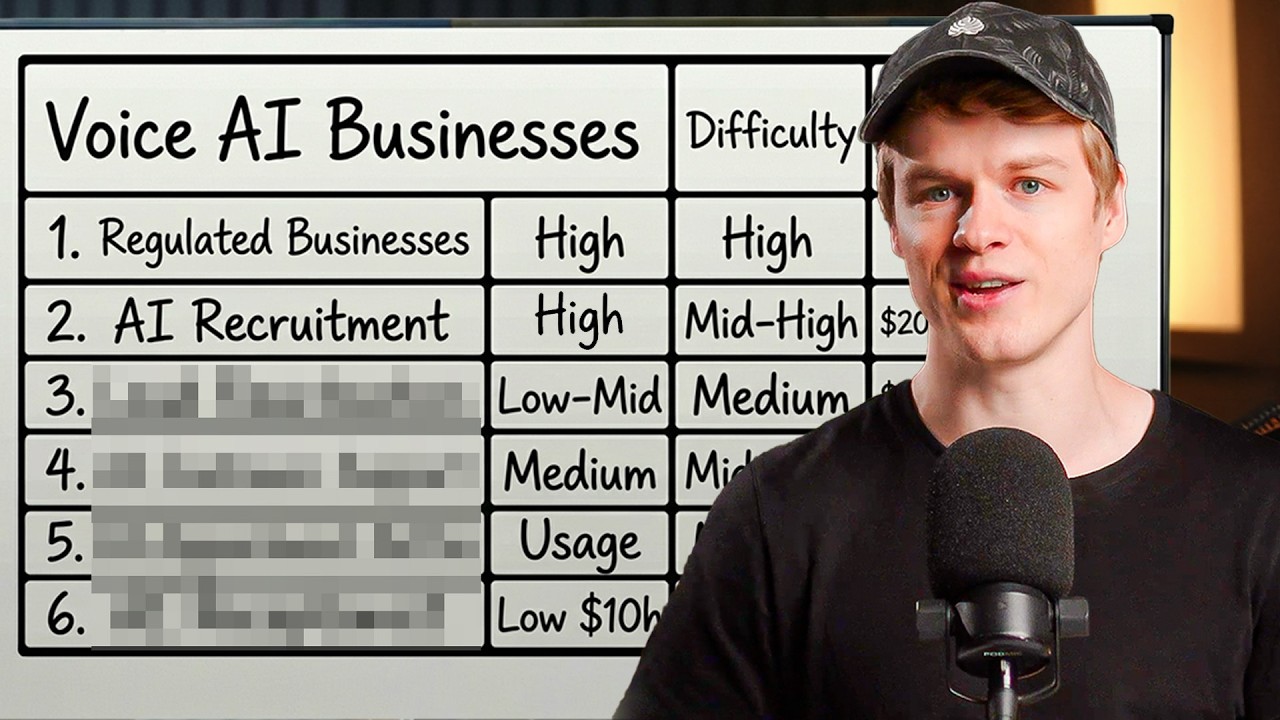
See these Voice AI models in action with real implementation examples. At 14:30 in the video, we demonstrate how the eCommerce support AI handles a complex return request while staying compliant.
Key Takeaways
Voice AI isn't about replacing humans - it's about automating repetitive conversations so teams can focus on high-value work. The most successful implementations follow three rules:
- Start with a specific pain point (missed calls, lead follow-up, support tickets)
- Measure ROI through concrete metrics (answer rates, conversion lifts, cost savings)
- Expand gradually based on data (don't boil the ocean)
In summary: The six models above represent proven, scalable Voice AI businesses generating real revenue today. Local services and appointment setting offer the easiest entry points, while regulated industry solutions deliver the highest enterprise value.
Frequently Asked Questions
Common questions about Voice AI business models
Voice AI handles natural spoken conversations with human-like responses, while chatbots are text-based. Voice AI can detect tone, emotion, and nuance in speech patterns.
This makes it ideal for customer service, sales calls, and appointment setting where human interaction matters most. Key differences include:
- Handles interruptions and follow-up questions naturally
- Detects urgency through vocal cues
- Works for phone-based businesses (80% of customers still prefer calling)
Basic Voice AI implementations for small businesses start at $300/month in tool costs. This covers the voice platform, phone number, and basic integrations.
More complex enterprise solutions with custom integrations range from $5,000-$50,000 in setup fees plus monthly retainers. The key is starting with a focused use case before expanding.
- Local business receptionist: $300-$800/month
- Appointment setting: $1,000-$3,000/month
- Enterprise compliance: $25,000+/month
These five industries see the fastest ROI from Voice AI implementations:
1. Local service businesses (plumbers, HVAC, electricians) - for call answering and booking
2. High-ticket sales (agencies, coaches, consultants) - for appointment setting
3. eCommerce brands - for customer support
4. Healthcare (non-HIPAA) - for appointment reminders
5. Recruitment agencies - for candidate screening
- All share high call volumes with repetitive questions
- Have clear metrics to prove ROI (more bookings, lower support costs)
- Experience staffing challenges for phone-based roles
Track these four key metrics to prove Voice AI value:
1. Call answer rates: Aim for 98%+ (vs 60-80% with humans)
2. Conversion rates: Typically 15-30% improvement in booked appointments
3. Support resolution time: Often cut by 60% for routine inquiries
4. Lead reactivation rates: Up to 31% in proven cases
- Always tie metrics to revenue impact
- Compare against current human performance
- Track over 30/60/90 day periods
The technology is actually the easiest part. The real challenge is understanding business workflows.
You need deep knowledge of:
- When to escalate to humans
- What questions truly qualify leads
- How to handle edge cases
- Industry-specific compliance requirements
This requires sitting with teams to map their actual call flows - not just installing software.
No - and it shouldn't try. The most successful implementations use Voice AI for lead qualification and appointment setting, then hand off warm leads to human closers.
This hybrid approach:
- Increases sales team productivity 3-5x
- Maintains conversion quality
- Lets closers focus on high-value conversations
- Provides data to improve outreach
AI handles volume, humans handle nuance.
Timelines vary by complexity:
Basic solutions (call answering, appointment reminders): 2-3 weeks
Mid-range (CRM integrations, sales qualification): 4-8 weeks
Complex (compliance systems, enterprise): 3-6 months
- Start with a minimum viable workflow
- Expand based on data and feedback
- Phase implementations work best
GrowwStacks builds custom Voice AI solutions tailored to your business needs. We handle everything from workflow design to platform integration and performance optimization.
Our proven process:
- Discovery: Map your exact call flows and pain points
- Design: Create AI personas matching your brand voice
- Build: Implement with enterprise-grade platforms
- Optimize: Continuously improve based on performance data
Book a free consultation to discuss your specific use case and ROI potential.
Ready to Implement Voice AI in Your Business?
Every day without automation costs you missed calls, lost leads, and wasted ad spend. Our team can have a basic Voice AI solution live in your business within 14 days.