Why Traditional Coding Frameworks Fail With AI Agents (And What to Use Instead)
The SDLC framework that powered software development for decades is failing with AI agents. Companies building on old processes face unpredictable errors and accountability gaps. Discover the new Agentic Development Life Cycle (ADLC) framework built specifically for AI-powered systems.
Why SDLC Fails for AI Systems
For decades, software development relied on the Software Development Life Cycle (SDLC) - a structured process with defined phases like design, development, testing and deployment. This worked when systems were deterministic, where the same input always produced identical outputs. But AI changes everything.
The fundamental mismatch comes from AI's non-deterministic nature. With traditional software, you could predict system behavior during planning. With AI agents, outputs depend on prompts, context, models and external tools - creating unpredictable variations even with identical inputs.
Key difference: SDLC treats software as static while ADLC treats it as living. AI agents continuously learn and adapt, requiring entirely new success metrics beyond simple pass/fail tests.
Introducing the ADLC Framework
The Agentic Development Life Cycle (ADLC) emerged as the solution for building reliable AI systems. While it maps to SDLC phases, each step adapts to handle AI's unpredictability.
ADLC's seven phases form a continuous loop rather than linear progression. This reflects how AI systems never truly stabilize - they require ongoing monitoring and refinement even after deployment.
- Preparation & Hypothesis
- Scope Definition
- Design
- Simulation & Proof of Value
- Implementation
- Testing
- Deployment & Beyond
Phase 1: Preparation & Hypothesis
This foundational phase replaces traditional requirements gathering. Instead of defining fixed specifications, you build hypotheses about how users will interact with the AI system and where automation can help.
Critical step: Map the human-agent responsibility model upfront. Unlike traditional software, AI systems require clear accountability boundaries since you can't fully predict agent behavior.
At 2:45 in the video, the presenter demonstrates using Claude Code's planning mode to prototype workflows before writing any code. This surfaces potential failure points early when changes are cheaper.
Phase 2: Scope Definition
Here you identify which processes AI will assist or automate, set technical boundaries, and define business KPIs like latency, cost and feasibility.
The key deliverable is documentation that explicitly defines workflow steps, KPIs and the human-agent responsibility model. This becomes your testing baseline and accountability framework.
Pro tip: Use AI tools during scope definition to model different architectures. At 5:20 in the video, Claude Code generates multiple workflow options showing how small prompt changes create entirely different solutions.
Phase 3: Design Phase
Designing AI systems requires planning across multiple layers SDLC never considered: prompts, models, tools and external services all influence behavior.
Critical design decisions include:
- Agent pattern (ReAct, Plan-and-Act, etc.)
- Data flow between components
- Token economics and cost structures
- Model selection and orchestration
Unlike traditional systems where design precedes implementation, ADLC requires continuous validation during design. At 7:15, the video shows how small prompt tweaks during design can prevent costly rework later.
Phase 4: Simulation & Proof of Value
This validation gate uses real-world data to test your hypotheses before full development. It answers the critical question: "Should we build this agent at all?"
Key activities include:
- Creating behavioral test datasets
- Building prototypes for high-risk assumptions
- Validating data quality and hallucination rates
The video demonstrates at 9:30 how failing this phase saves months of wasted effort by identifying unworkable concepts early.
Phase 5: Implementation
Here you finally develop the agent, but with crucial differences from traditional coding:
- Logic spreads across code, prompts and tools
- Context management becomes critical
- Testing happens continuously during development
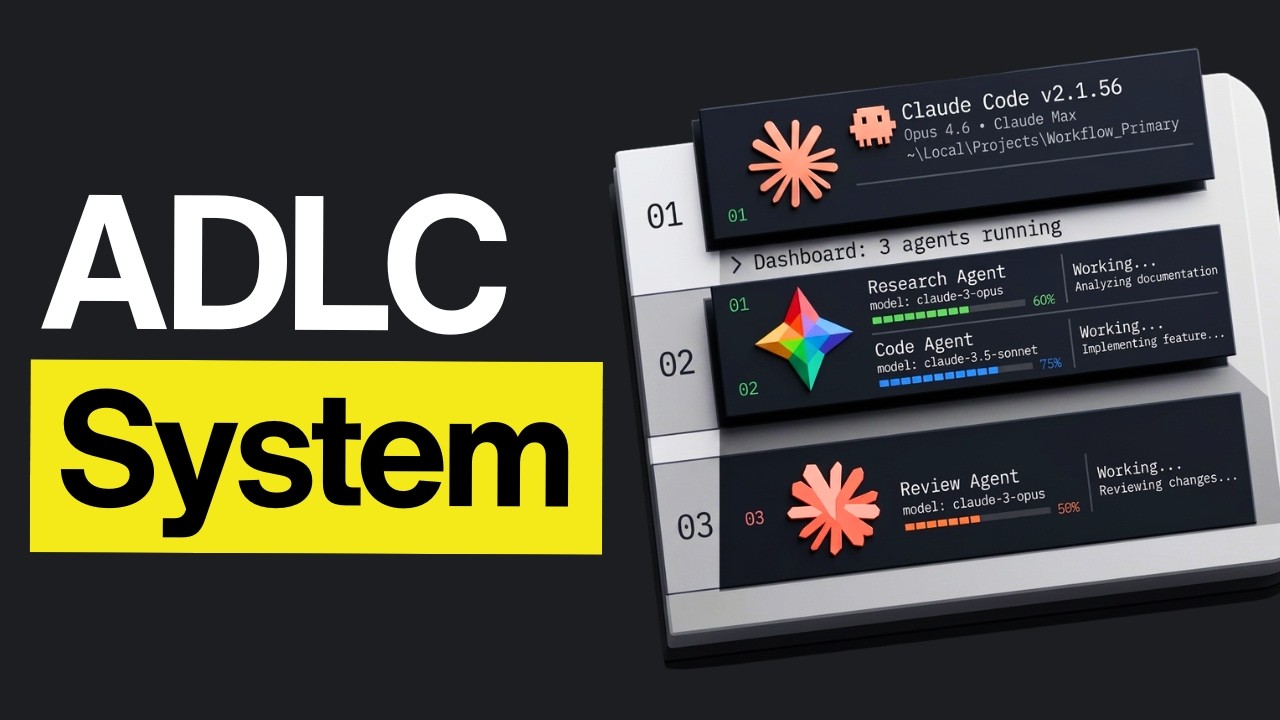
The video highlights Claude Code's agents view at 12:45 - a game-changer for orchestrating multi-agent workflows without managing separate sessions.
Implementation pitfall: Even with 1M token context windows, agents suffer attention spread without careful context management. The video shows specific techniques to prevent this at 13:20.
Phase 6: Testing
While testing begins during implementation, this phase subjects the complete system to production-like conditions.
ADLC testing shifts from SDLC's pass/fail metrics to measuring:
- Accuracy distributions
- Hallucination rates
- Cost per outcome
Frameworks like Ragas and DPV Val help evaluate reasoning, safety and tool use - critical since agents don't follow predictable paths.
Phase 7: Deployment & Beyond
Deployment marks the start of active monitoring, not the end of development. AI systems require ongoing:
- Behavioral metric tracking
- Model updates
- Context drift detection
The video recommends gradual rollouts starting at 15:00, using limited user groups to catch issues before full deployment.
Unlike traditional systems, ADLC becomes a continuous improvement cycle where user feedback directly enhances agent performance over time.
Watch the Full Tutorial
See the complete ADLC framework explained with live examples in Claude Code. The video demonstrates key moments like planning workflows (2:45), prototyping (9:30), and multi-agent orchestration (12:45).
Key Takeaways
The ADLC framework addresses AI's unique challenges where traditional SDLC falls short. By treating AI systems as living entities rather than static code, you can build reliable, accountable agentic workflows.
In summary: ADLC replaces SDLC's linear process with a continuous loop of planning, building and refining. Success requires new metrics, ongoing testing, and human oversight at every phase.
Frequently Asked Questions
Common questions about this topic
SDLC treats software as static with predictable behavior, while ADLC treats AI systems as living entities with probabilistic outputs.
The key distinction is in success metrics. SDLC focuses on functional correctness with pass/fail tests. ADLC measures accuracy distribution, hallucination rates, and cost per outcome since identical inputs produce varying results.
- SDLC assumes deterministic outputs
- ADLC plans for non-determinism
- Testing approaches differ fundamentally
Traditional software testing validates known code paths with clear pass/fail criteria. AI agents require continuous evaluation of reasoning, safety and tool use since they don't follow predictable execution paths.
With agents, the same input can produce different outputs based on context, model state and external factors. This demands probabilistic testing frameworks rather than binary pass/fail metrics.
- Agents don't execute predictable code paths
- Output quality exists on a spectrum
- Testing must be integrated throughout development
The preparation and hypothesis phase forms the foundation for everything that follows. Skipping this risks automating the wrong workflows or creating accountability gaps.
This phase establishes the human-agent responsibility model and tests core assumptions before committing resources. It's where you identify what truly needs automation versus what requires human oversight.
- Prevents automating wrong processes
- Establishes accountability boundaries
- Surfaces high-risk assumptions early
In SDLC, deployment marks the transition to stable operation. For AI agents, deployment begins active monitoring against model updates, context drift and environment changes.
ADLC treats deployment as a controlled activation with continuous observation. The system remains in active development as it learns from real-world use, requiring ongoing refinement.
- No true "stable state" exists
- Gradual rollouts reduce risk
- Monitoring focuses on behavioral metrics
Claude Code's agents view helps orchestrate multi-agent workflows through a single interface. Evaluation frameworks like Ragas and DPV Val provide metrics for continuous testing.
The key is choosing tools that support ADLC's iterative nature. Look for solutions that enable prototyping, behavioral testing, and ongoing monitoring throughout the lifecycle.
- Agent orchestration platforms
- Probabilistic testing frameworks
- Continuous monitoring tools
GrowwStacks specializes in implementing AI agent workflows using the ADLC framework. We help businesses navigate each phase from initial planning through ongoing maintenance.
Our team designs, builds and deploys agentic systems tailored to your operations with proper testing and monitoring safeguards in place. We ensure accountability and measurable ROI at every step.
- Custom ADLC implementation
- Responsible AI deployment
- Ongoing performance optimization
Ready to Build AI Agents That Actually Work?
Traditional development approaches create unreliable AI systems that fail in production. Our ADLC framework ensures your agents deliver consistent value while maintaining accountability.