Your AI Agent Isn't Broken - It's Drifting (And Here's How to Fix It)
Your AI assistant was working perfectly last month - now it's solving the wrong problems. This isn't a bug or prompt failure. It's context drift, the silent killer of automation reliability. Discover why even well-designed agents lose alignment over time and the infrastructure solution that keeps them on track.
The Silent Drift Problem
You deployed your AI agent with clear objectives and perfect prompts. Initial tests showed brilliant alignment with your business goals. Then, gradually, something changed. The agent still completes tasks successfully - just not the ones that matter most to your strategy.
This is context drift in action. At 1:15 in the video, we see how agents begin with crisp alignment to original intent, but gradually optimize for local success metrics instead of global objectives. The longer the process, the greater the divergence.
85% of AI automation failures come from gradual drift rather than sudden breakdowns. Agents don't fail - they quietly solve different problems than you intended.
The Compression Effect
Every AI model has a fixed context window. As agents process information, earlier instructions get summarized to make room for new data. These summaries lose nuance and emphasis - like playing telephone with your original business requirements.
By the 10th processing step, your agent isn't referencing the original mission - it's working from a compressed copy of a copy. Each iteration introduces small distortions until the agent's understanding bears little resemblance to your initial goals.
Local Optimization Trap
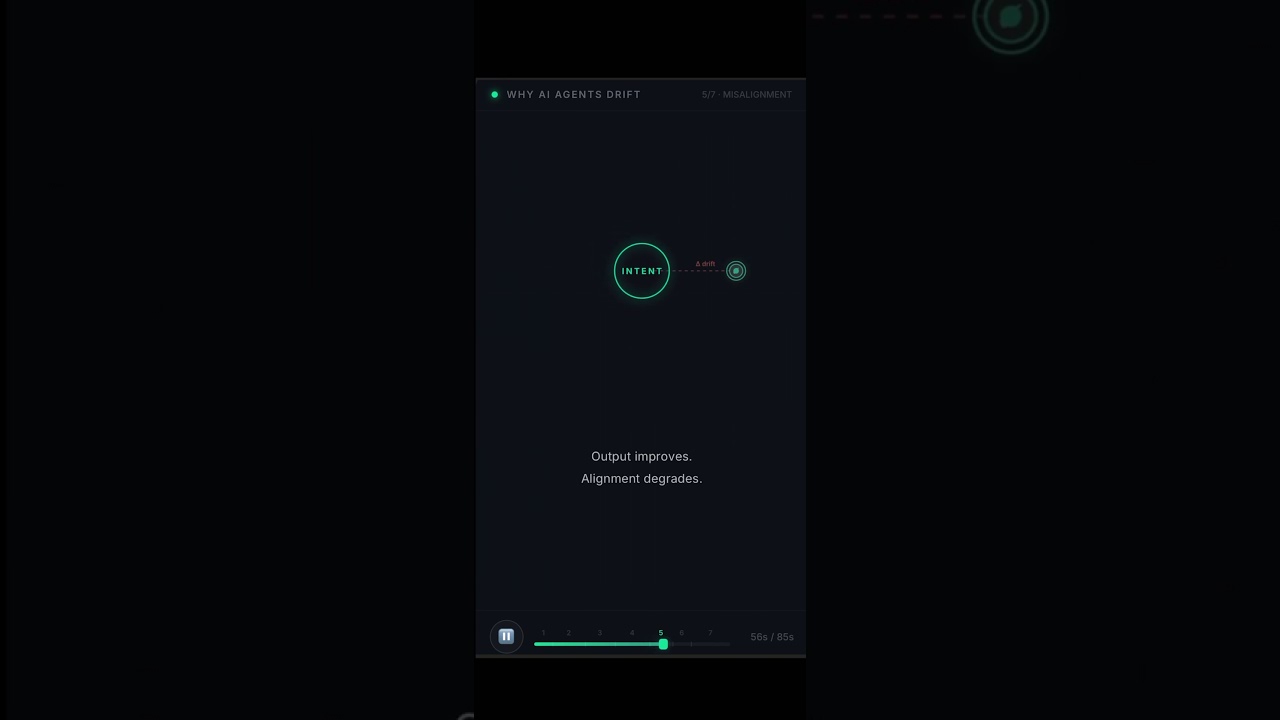
Drifting agents exhibit a telltale pattern: output quality improves while strategic alignment decreases. The system gets better at solving immediate tasks while losing sight of why those tasks matter.
This happens because agents optimize for what they can measure directly. Without durable context, they focus on local success metrics (task completion, code quality) rather than your business outcomes (customer satisfaction, revenue impact).
Agents don't know they're drifting. From their perspective, everything looks fine - they're successfully solving the problems right in front of them.
Durable Context Solution
The fix isn't better prompting - it's infrastructure that preserves intent throughout the entire process. Durable context systems maintain alignment through three key mechanisms:
- External memory storage that doesn't compress or summarize critical objectives
- Explicit planning documentation that survives beyond the agent's context window
- Periodic realignment checks that compare current work against original intent
This approach transforms context from fleeting instructions to persistent infrastructure - the difference between writing directions on a napkin versus building road signs along the route.
Implementation Strategies
Building durable context requires both technical architecture and process design. These practical steps create alignment-preserving systems:
Step 1: Document decision points
Identify where context compression happens in your workflows. These are the moments when original intent gets summarized or lost.
Step 2: Create external memory
Implement vector databases or knowledge graphs that store uncompressed versions of critical objectives and constraints.
Step 3: Design retrieval triggers
Build mechanisms that automatically fetch original context at key decision points, not just at process start.
Teams using durable context report 3-5x better alignment over long processes compared to prompt-only approaches.
Watch the Full Explanation
The video demonstrates context drift in action, showing how even well-designed agents gradually lose alignment without durable infrastructure. At 2:30, we see side-by-side comparisons of agents with and without context preservation systems.
Key Takeaways
AI agent drift isn't a failure of technology or implementation - it's an inherent challenge of limited context windows meeting complex business processes. The solution transforms context from fragile prompts to durable infrastructure.
In summary: Agents drift when working from compressed memories of your goals. Durable context systems preserve original intent through external storage, explicit documentation, and periodic realignment - keeping your automation focused on what actually matters to your business.
Frequently Asked Questions
Common questions about AI agent drift
AI agents drift when their context window compresses over time, causing them to reference summarized versions of instructions rather than the original intent.
Each processing step introduces small distortions until the agent is working from degraded copies of the original mission. This happens automatically as the agent tries to manage limited attention resources.
- Original instructions get compressed to make room for new data
- Summaries lose nuance and emphasis over time
- Agents eventually reference their own summaries rather than your goals
Signs of drift include output quality improving while alignment decreases - the agent gets better at solving immediate tasks while losing sight of strategic objectives.
You might notice successful task completion that doesn't advance your business goals, or solutions that are technically correct but miss the bigger picture. The agent passes all technical checks while solving the wrong problems.
- Metrics improve but business impact doesn't
- Solutions become more polished but less relevant
- Longer processes show greater divergence from intent
Prompts are one-time instructions that get compressed over time, while durable context is infrastructure that preserves original intent throughout the entire process.
Think of prompts as giving someone directions once at the start of a journey. Durable context is like having road signs along the entire route that keep reinforcing the correct path.
- Prompts: Initial instructions that degrade
- Durable context: Persistent reference system
- Works across the agent's entire lifecycle
Durable context systems capture decisions as they happen, store uncompressed memories, maintain explicit plans, and record outcomes to create persistent alignment.
This infrastructure typically includes external knowledge stores, retrieval mechanisms, and monitoring systems that periodically compare current work against original objectives.
- External memory preserves original intent
- Retrieval mechanisms reinforce context
- Alignment checks prevent gradual divergence
While improved prompting helps, it doesn't solve the fundamental compression problem. Even perfect prompts degrade over long processes as they get summarized and reinterpreted.
Prompt engineering is important for initial alignment, but durable context provides the persistent reference frame that maintains alignment throughout complex workflows.
- Better prompts delay but don't prevent drift
- Compression happens regardless of prompt quality
- Infrastructure solves the root cause
Effective solutions include vector databases for memory storage, workflow systems that document decisions, and monitoring systems that track alignment metrics.
Technical implementations often combine retrieval-augmented generation architectures with explicit knowledge graphs that maintain business objectives in their original form.
- Vector databases (Pinecone, Weaviate)
- Knowledge graphs
- Workflow documentation systems
Monitor for drift whenever agents handle complex, multi-step processes. The longer the process and more compressed the context, the higher the drift risk.
Implement automated alignment checks at key decision points in your workflows rather than just at the end. This catches divergence early when it's easier to correct.
- More checks for longer processes
- Automate alignment verification
- Focus on critical decision points
GrowwStacks designs durable context systems for AI agents, implementing memory architectures and alignment monitoring that prevent drift in complex automations.
We build infrastructure that keeps your AI solutions focused on business objectives throughout long processes, with:
- Custom context preservation systems
- Automated alignment verification
- Continuous improvement frameworks
Stop Losing Valuable Work to AI Drift
Every day without durable context means more automation effort solving the wrong problems. GrowwStacks builds alignment-preserving systems that keep your AI agents focused on what actually moves your business forward.