AI Agents in 2026: The Secret Weapon for Small Businesses
Most small business owners are drowning in repetitive tasks while struggling to keep up with larger competitors. AI agents are changing that equation - these autonomous digital workers can handle customer support, social media, scheduling and more while you sleep. Discover why is the year every small business needs to implement AI agents.
The AI Evolution: From Tools to Workers
In , we've moved beyond simply using AI as a tool - we're now working with AI as autonomous colleagues. The journey began with learning how to talk to AI in 2024, progressed to mastering prompts in 2025, and has now reached the era of AI agents that can actually run parts of your business while you sleep.
Most business owners are familiar with AI tools like ChatGPT that respond to prompts but don't take action. AI agents represent the next evolutionary step - they don't just answer questions, they complete tasks. Imagine having a digital employee who can handle customer support, manage your social media, and organize your schedule without constant supervision.
Key insight: AI agents combine the intelligence of large language models with the ability to take action, making them more like digital workers than tools. This shift is enabling solo entrepreneurs to compete with much larger businesses by automating key operations.
LLM vs. AI Agent: What's the Difference?
To understand AI agents, we first need to distinguish them from the AI technology most people are familiar with - large language models (LLMs) like ChatGPT. Think of an LLM as a brain in a jar: incredibly knowledgeable but unable to act on its own.
LLMs excel at generating text, answering questions, and brainstorming ideas when given specific prompts. However, they operate in a linear fashion - you ask, they answer, and the conversation ends. They're powerful tools, but like a hammer, they only work when you're actively using them.
AI agents take this foundation and add three critical capabilities:
- Reasoning: They can determine how to accomplish a task rather than just responding to prompts
- Tool access: They can interact with other software and systems to complete tasks
- Memory: They learn from past interactions to improve future performance
This combination transforms AI from a tool you use into a worker you delegate to.
Workflows vs. Agents: The Key Distinction
Many businesses have started using AI workflows - predefined sequences that combine multiple AI tools to accomplish more complex tasks. For example, a workflow might scan news sites, summarize articles, and email you the results each morning.
While powerful, workflows still require human input at each step. You need to specify exactly how the task should be performed. The workflow can't adapt or make decisions on its own - it's like a hammering machine that needs precise programming.
AI agents represent a fundamental shift because they can determine how to accomplish tasks independently. Instead of programming every step, you simply tell the agent what needs to be done, and it figures out the best approach. Using our analogy, if workflows are hammering machines, agents are like hiring a carpenter who knows when and how to hammer without constant supervision.
The breakthrough: AI agents combine the flexibility of human workers with the scalability of software. They can handle unexpected situations, learn from experience, and work autonomously - all at digital speed and scale.
How AI Agents Are Transforming Businesses in
In , we're seeing solopreneurs and small businesses achieve results that previously required teams of employees, thanks to AI agents. These digital workers are handling a wide range of business functions:
Customer Support Agents
Modern AI agents go beyond simple FAQ responses. They can process returns, check shipping statuses, handle complaints, and even make judgment calls on refunds - all while maintaining brand voice and customer service standards.
Social Media Managers
AI agents can research trending topics, create content calendars, generate posts, schedule publications, and even engage with followers - creating a complete social media presence that grows your brand while you focus on other priorities.
Executive Assistants
From scheduling meetings across time zones to detecting when you're overbooked, AI agents handle calendar management with human-like understanding but digital efficiency. They can reschedule appointments, send reminders, and even prepare briefing materials.
These examples represent just the beginning. As AI agents become more sophisticated, they're taking on increasingly complex business functions, enabling small teams to compete with much larger organizations.
Why is the Perfect Time to Start
A common concern we hear is: "Did I miss the boat on AI agents?" The answer is a resounding no - in fact, might be the ideal time to implement this technology in your business.
Two years ago, building AI agents required coding skills and technical expertise. Today, the no-code revolution has made agent creation accessible through natural language interfaces. The barrier to entry has never been lower, while the capabilities have never been higher.
Early adopters faced immature technology, limited integrations, and steep learning curves. Now, the ecosystem has matured with:
- Reliable platforms that simplify agent creation
- Pre-built templates for common business functions
- Robust integration with popular business tools
- Proven best practices from thousands of implementations
Strategic advantage: Businesses implementing AI agents now benefit from mature technology without suffering through the early-adopter phase. You get the power without the pain.
How to Get Started With AI Agents
Implementing AI agents in your business doesn't require a complete overhaul. The most successful adopters start small with focused implementations, then expand as they see results.
Step 1: Identify Automation Candidates
Look for tasks that are:
- Repetitive and time-consuming (20+ minutes daily)
- Rule-based with clear success criteria
- Currently creating bottlenecks in your operations
Step 2: Document Current Processes
Before automating, clearly outline:
- How the task is currently performed
- Decision points and variables
- Desired outcomes and quality standards
Step 3: Choose the Right Platform
Select an AI agent platform that:
- Matches your technical comfort level
- Integrates with your existing tools
- Specializes in your target use case
Step 4: Implement and Refine
Start with a pilot project, monitor performance, and gradually expand the agent's responsibilities as it proves effective.
Quick win: Customer service inquiries are one of the easiest places to start with AI agents. They're repetitive, rule-based, and often create significant time drains for small business owners.
Watch the Full Tutorial
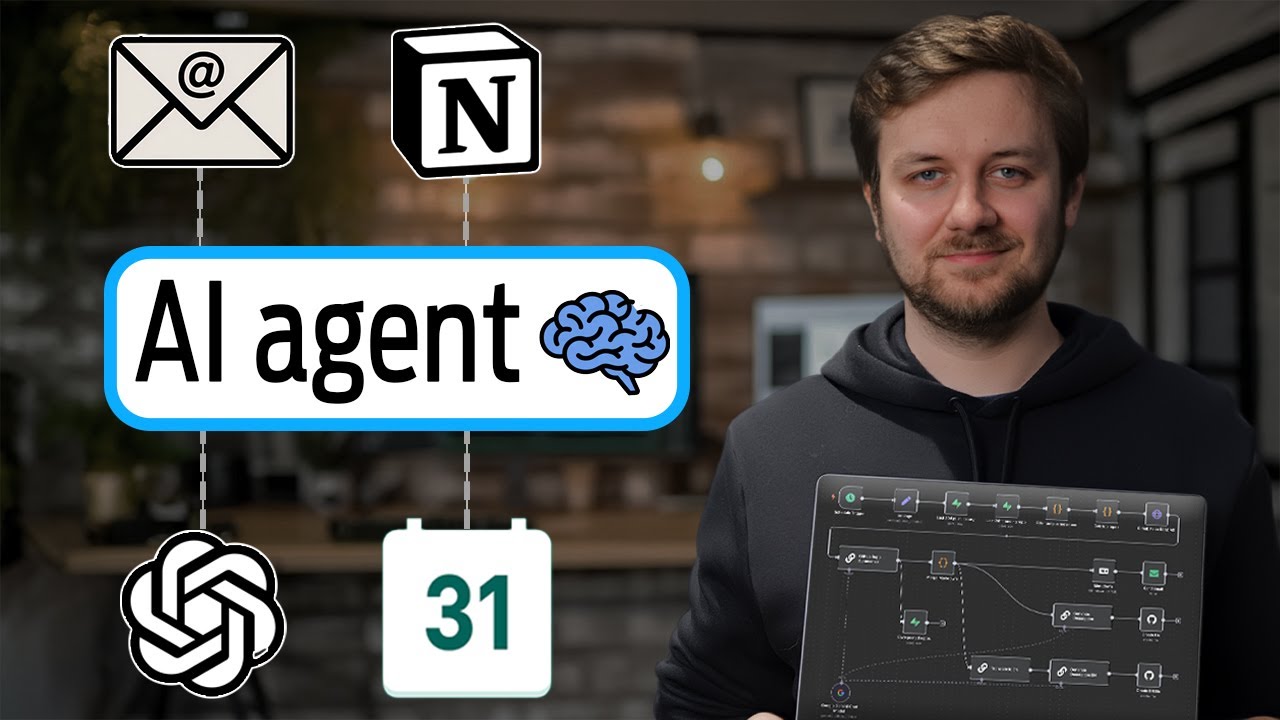
For a deeper dive into implementing AI agents in your business, watch our complete video tutorial (timestamp 3:45 covers the no-code revolution making agents accessible in ).
Key Takeaways
AI agents represent a fundamental shift in how small businesses can leverage technology. Unlike traditional AI tools that require constant input, agents work autonomously to handle complex business functions.
In summary: LLMs are the brains, agents are the workers. is the year this technology becomes essential for small businesses to remain competitive. The no-code revolution means you don't need technical skills to benefit - just the willingness to delegate repetitive tasks to your digital workforce.
Frequently Asked Questions
Common questions about this topic
An AI agent is an autonomous digital worker that can perform tasks without constant human input. Unlike traditional AI tools that require specific prompts, agents can reason, access data and tools, and remember past interactions to complete complex tasks independently.
They represent the next evolution beyond simple chatbots and AI workflows, combining the intelligence of large language models with the ability to take action in the real world through integrations with other software systems.
- Autonomous - works without constant supervision
- Action-oriented - doesn't just answer questions
- Adaptable - can handle unexpected situations
ChatGPT is a large language model (LLM) that responds to prompts but doesn't take action. An AI agent uses LLMs as its brain but can actually perform tasks - like a worker rather than just a tool.
While ChatGPT answers questions, an agent might handle your customer support, manage your calendar, or run your social media strategy autonomously. The key difference is agency - the ability to initiate and complete tasks without human prompting at each step.
- ChatGPT = knowledge worker
- AI agent = task executor
- Same underlying intelligence, different capabilities
In , AI agents commonly handle customer support (including processing returns and checking shipping statuses), social media management (researching trends and executing plans), calendar management (scheduling across time zones), and much more.
They're particularly effective for repetitive tasks that take more than 20 minutes of human time daily. Common implementations include lead qualification, appointment scheduling, content distribution, and basic accounting tasks like invoice processing.
- Customer service - 24/7 support without human intervention
- Content creation - research, writing, and distribution
- Operations - scheduling, reminders, and coordination
No, is actually an ideal time to start. The no-code revolution for AI agents means you no longer need programming skills to implement them. The tools are more powerful yet easier to use than ever before.
Businesses starting now benefit from mature technology without the early-adopter challenges. Platforms have stabilized, best practices are established, and integration options have expanded dramatically in the past year.
- No-code tools eliminate technical barriers
- Proven templates available for common use cases
- More reliable than early versions from 2024-2025
Start by listing your daily tasks and identifying those that are repetitive, rule-based, and time-consuming. The best candidates are tasks that take more than 20 minutes daily, follow predictable patterns, and don't require deep human creativity or emotional intelligence.
Look for processes where you find yourself doing the same thing repeatedly, or where delays in these tasks create bottlenecks in your business. Customer service inquiries and appointment scheduling are common starting points that deliver quick wins.
- Time-consuming repetitive tasks
- Rule-based decision making
- Processes with clear success metrics
AI agents complement rather than replace human workers in most cases. They handle repetitive tasks, freeing humans for strategic, creative work. Many businesses using agents actually expand their operations rather than reduce staff.
The most successful approach is human-AI collaboration where each focuses on their strengths. Agents excel at scale, speed, and consistency, while humans provide creativity, empathy, and complex judgment calls.
- Agents handle repetitive tasks at scale
- Humans focus on strategy and creativity
- Most businesses see expanded capabilities rather than reduced staff
The first step is identifying one repetitive task to automate. Document the current process, desired outcomes, and any decision points. Then explore no-code AI agent platforms that can handle this specific task.
Many businesses start with customer support or social media management as their first agent implementation. These areas typically offer clear ROI and are supported by mature agent solutions with proven templates.
- Start with one high-impact, repetitive task
- Document current workflow thoroughly
- Choose a specialized platform for your use case
GrowwStacks specializes in implementing AI agent solutions for small businesses. We analyze your operations to identify the highest-impact automation opportunities, then design and deploy custom AI agents tailored to your needs.
Our no-code approach means you get powerful automation without technical complexity. We handle platform selection, workflow design, integration with your existing tools, and ongoing optimization to ensure your AI agents deliver maximum value.
- Free consultation to identify automation opportunities
- Custom agent design for your specific business needs
- Ongoing support and optimization
Ready to Delegate Your Repetitive Tasks to AI Agents?
Every day you delay implementing AI agents, your competitors gain an edge. GrowwStacks can have your first AI agent up and running in days - not months.