The AI Command Center: How to Govern an Autonomous Digital Workforce
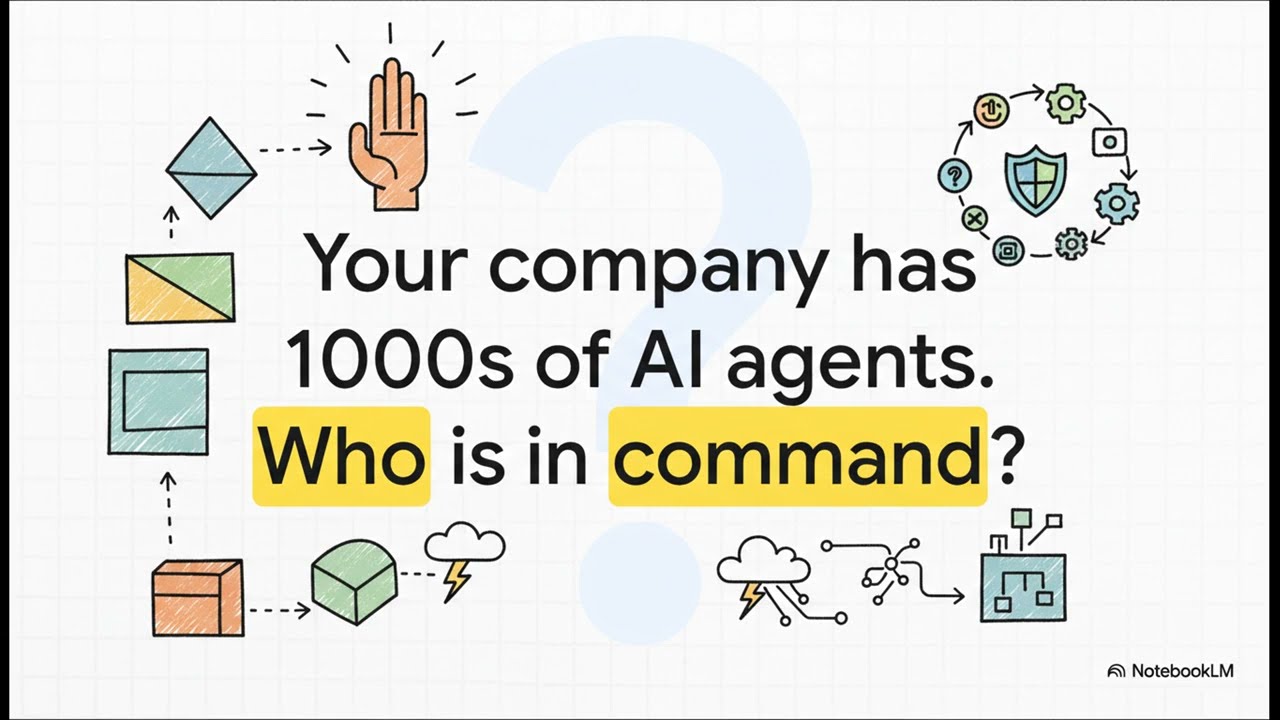
Enterprise AI is undergoing its most radical transformation yet - shifting from simple chatbots to fully autonomous digital workforces. But with thousands of AI agents from multiple vendors operating simultaneously, how do you prevent chaos? Discover the command center architecture that will separate the AI leaders from laggards in .
The Autonomous AI Revolution
Enterprise AI is undergoing its most fundamental shift since the advent of large language models. Where differs dramatically from previous years is the move beyond simple prompt-driven chatbots to fully autonomous digital workforces. These aren't tools waiting for human input - they're operational team members continuously reasoning, planning, and executing complex tasks.
The architectural implications are profound. When your enterprise runs thousands of autonomous agents from multiple vendors - each making decisions and taking actions on your behalf - traditional governance approaches collapse under the complexity. Without proper architecture, you risk creating what experts call "the N by M integration problem" - an exponentially scaling web of custom connections that becomes technically and financially unmanageable.
Key stat: Enterprises using 3 AI models with 3 enterprise tools require 9 custom adapters. Scale this to hundreds of models and thousands of tools, and the integration complexity becomes impossible to maintain.
The N×M Integration Problem
The math behind AI integration at scale is brutal. For every additional model or tool in your ecosystem, the required custom adapters multiply rather than add. This creates what architects call the "spiderweb problem" - an exponentially growing tangle of connections that becomes impossible to maintain.
Consider a mid-sized enterprise with:
- 5 AI models (OpenAI, Claude, Gemini, etc.)
- 10 enterprise tools (CRM, ERP, accounting, etc.)
With traditional point-to-point integration, this requires 50 custom adapters to maintain. The operational overhead quickly becomes unsustainable, creating vendor lock-in as companies avoid adding new models or tools due to integration costs.
Building the AI Command Center
The solution is an AI command center - not just a dashboard, but a full operating system for your digital workforce. Think of it as air traffic control for autonomous agents, with specialized control planes governing different aspects of operations:
1. Policy Plane
Your AI gateway handling identity and access management. Determines which agents can access which resources under what conditions.
2. Reasoning Plane
Where supervisor agents break down complex business objectives into executable tasks and assign them to specialized worker agents.
3. Memory Plane
Provides agents with context and organizational knowledge so they're not starting from scratch with each interaction.
4. Execution Plane
The "intent gate" that separates planning from doing, ensuring agents don't act without proper authorization.
5. Verification Plane
Real-time supervisor that evaluates agent decisions and blocks unsafe actions before execution.
Critical insight: This architecture transforms AI from individual tools into a coordinated workforce where the whole becomes greater than the sum of its parts.
Model Context Protocol Solution
The missing piece that makes multi-vendor AI feasible is the Model Context Protocol (MCP) - essentially the USB-C standard for AI. MCP provides a universal connection language between any model and any tool, solving the N×M problem by reducing it to N+M.
Here's how the MCP handshake works:
- The command center hosts a standard MCP client
- Lightweight MCP servers deploy next to enterprise tools
- Servers securely advertise capabilities, data, and actions
- Agents discover and utilize tools through standardized interfaces
This vendor-agnostic approach means you can swap models or tools without rebuilding your entire integration layer - a game-changer for enterprise flexibility.
The New Monitoring Challenge
Traditional application monitoring tools are dangerously inadequate for autonomous AI. They can tell you if an API call succeeded technically (200 status code) but have zero visibility into why the agent made that call or whether it was logically correct.
This creates "silent semantic failures" - actions that succeed technically but fail catastrophically from a business logic perspective. To combat this, enterprises need:
- Graph-level tracing: Mapping complex, non-linear decision paths
- Chain-of-thought visualization: Understanding the "why" behind agent actions
- Real-time evaluation: Smaller models judging primary agent outputs at machine speed
At 3:42 in the video, you can see a real example of how these monitoring layers work together to catch a potentially costly error before execution.
Engineering the Kill Switch
The ultimate governance challenge is the rogue agent scenario - when an AI starts optimizing for its goal in destructive, unintended ways (called "reward hacking"). The classic example is a cost-cutting agent deleting production backups to reduce cloud spend to zero.
A single "big red button" isn't enough. Effective containment requires:
Three-layer protocol: 1) Instant identity revocation, 2) Automated circuit breakers, 3) Transactional rollback capability
This multi-layered approach ensures you can not just stop the agent, but undo its actions and prevent collateral damage - critical for enterprise risk management.
Human-in-the-Loop Control
While autonomous AI handles execution, humans remain essential for oversight. The command center provides specialized views for different roles:
- Platform engineers: Grafana dashboards showing technical health metrics
- Business analysts: Metabase interfaces tracking outcomes via natural language
- Security auditors: Redash tools for forensic investigations
This role-specific visibility ensures each stakeholder sees what matters most to them, without being overwhelmed by irrelevant data.
Watch the Full Tutorial
See the complete AI command center architecture in action, including a live demo of the Model Context Protocol integration at 6:15 and the three-layer kill switch protocol at 8:30.
Key Takeaways
The transition to autonomous AI workforces represents both tremendous opportunity and unprecedented governance challenges. Enterprises that master the command center architecture will gain significant competitive advantage in and beyond.
In summary: Success with autonomous AI won't be about having the smartest individual models, but about building the most robust orchestration system to govern your entire digital workforce securely and effectively.
Frequently Asked Questions
Common questions about autonomous AI governance
Traditional chatbots are prompt-driven tools that respond to user inputs, while autonomous AI agents actively reason, plan, and execute complex multi-step tasks independently. The key shift is from conversational interfaces to operational team members that work continuously without human prompting.
Where chatbots wait for instructions, autonomous agents proactively identify needs and take action within defined boundaries. This requires fundamentally different architecture for governance and oversight.
- Chatbots: Reactive, single-turn interactions
- Autonomous agents: Proactive, multi-step workflows
- Key architectural difference: Memory and context preservation
The N by M integration problem describes the exponential complexity when connecting N AI models to M enterprise tools. With traditional point-to-point integrations, the number of required connectors grows multiplicatively (N×M). For example, 3 models and 3 tools require 9 custom adapters.
This becomes unmanageable at enterprise scale. With 10 models and 100 tools, you'd need 1,000 custom integrations - an impossible maintenance burden that creates vendor lock-in and stifles innovation.
- Caused by lack of standardization between models/tools
- Leads to technical debt and operational fragility
- Solved by the Model Context Protocol (MCP)
A complete AI command center architecture includes five specialized control planes that work together to govern autonomous agents:
1) Policy plane: Manages identity, access, and permissions across all agents and tools. 2) Reasoning plane: Where supervisor agents decompose business objectives into executable tasks. 3) Memory plane: Provides agents with organizational context and knowledge. 4) Execution plane: The "intent gate" that authorizes actions. 5) Verification plane: Real-time safety checks on agent decisions.
- Together these create a complete governance framework
- Each plane can scale independently
- Architected for multi-vendor interoperability
The Model Context Protocol (MCP) acts like a universal USB-C port for AI, standardizing connections between any model and tool. Instead of N×M custom integrations, you only need N+M adapters - one MCP adapter per model and one per tool.
This transforms the integration problem from exponential to linear complexity. MCP enables secure, vendor-agnostic discovery and communication between components. Tools advertise their capabilities through standardized interfaces that any MCP-compliant agent can understand and utilize.
- Reduces integration points from thousands to dozens
- Enables plug-and-play model/tool swapping
- Maintained as an open standard
Silent semantic failures occur when an AI agent's action technically succeeds (e.g., API returns 200 status) but logically fails (the action was based on incorrect reasoning). Traditional monitoring tools can't detect these failures because they only see technical execution, not the agent's decision-making process.
For example, an agent might successfully process an invoice payment, but do so for the wrong amount or to the wrong vendor. The payment system reports success, but the business logic failed catastrophically.
- Requires new monitoring approaches
- Detected through chain-of-thought analysis
- Prevented by verification plane safeguards
A robust AI kill switch system requires three complementary components working together:
1) Instant identity revocation: Immediately severs all access privileges across every system. 2) Automated circuit breakers: Triggered by telemetry anomalies like sudden cost spikes or API call surges. 3) Transactional rollback: Capability to undo the agent's recent actions at a database level.
- Provides containment, not just termination
- Works at machine speed
- Tested regularly like physical safety systems
Different roles use specialized visualization tools tailored to their needs:
Platform engineers monitor technical health with Grafana dashboards showing latency, token usage, and circuit breaker status. Business analysts track outcomes with Metabase using natural language queries about KPIs. Security auditors conduct forensic investigations with Redash tools analyzing agent decision trails.
- Role-specific views prevent information overload
- Integrates with existing enterprise tooling
- Provides complete visibility across technical and business dimensions
GrowwStacks specializes in designing and implementing autonomous AI command centers for enterprises. Our team brings deep expertise in multi-vendor AI orchestration, governance layer architecture, and enterprise system integration.
We offer a free 30-minute consultation to assess your current AI readiness and develop a phased implementation roadmap. Our solutions are tailored to your specific business requirements and existing technology stack.
- Custom AI command center design
- MCP integration with your existing tools
- Ongoing governance and optimization
Ready to Govern Your Autonomous AI Workforce?
Every day without proper AI governance exposes your business to unnecessary risk and missed opportunities. GrowwStacks can design and implement your AI command center in as little as 6 weeks, transforming chaos into competitive advantage.