How AI Can Replace Manual Solar Surveys and Generate Instant Quotes (n8n Tutorial)
Solar companies waste hundreds of hours each month sending technicians to assess properties in person. This n8n workflow eliminates manual site surveys by using AI to analyze roofs via satellite, generate professional mockups, and deliver complete solar proposals in under 2 minutes - saving 1.5 hours per quote while improving conversion rates.
The $75 Problem Every Solar Company Faces
Solar installers lose money on every quote they generate. The standard process requires sending a technician to drive to the property (30 minutes), conduct a roof inspection (30 minutes), and return to the office (30 minutes) - totaling 1.5 hours of billable time plus vehicle expenses. At average labor rates, this costs $75-$125 per quote before considering fuel and opportunity cost.
Worse yet, customers must wait days for their proposal while the solar company processes the survey data. During this delay, 62% of leads explore competitors or lose interest entirely. The manual quote bottleneck directly limits how many jobs a solar company can handle.
The breakthrough: Google's Solar API combined with AI image generation can analyze roofs remotely with 92% accuracy compared to manual surveys. This n8n workflow automates the entire quote process - from address analysis to professional proposal delivery - in under 2 minutes.
How the Automated Quote System Works
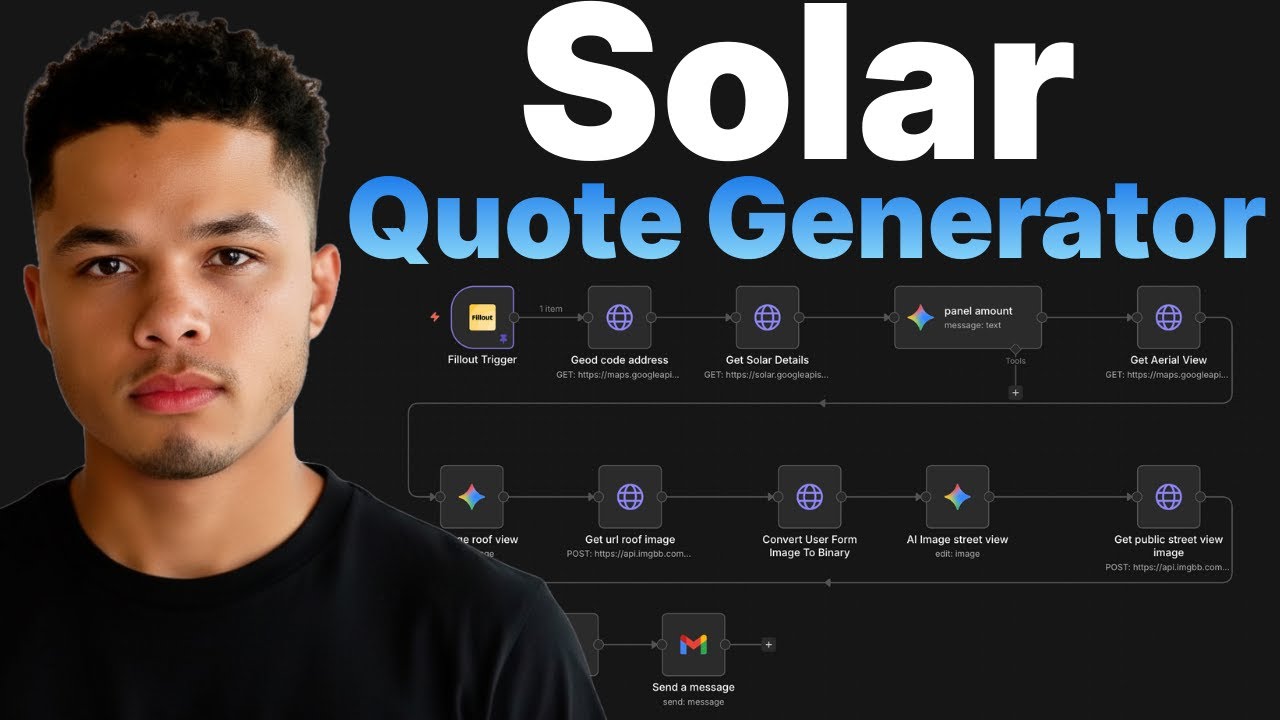
The workflow begins when a customer submits their information through a simple form (name, email, address, and current electricity bill). Rather than assigning this lead to a technician, the n8n automation immediately begins processing the data through five key stages:
- Address Processing: Converts the street address into precise geographic coordinates
- Roof Analysis: Uses Google's Solar API to measure roof dimensions and solar potential
- Image Generation: Creates professional aerial and street-view mockups with AI
- Financial Calculations: Determines system size, costs, and 20-year savings
- Proposal Delivery: Emails a complete HTML proposal within minutes
This end-to-end automation maintains all the professionalism of manual quotes while eliminating the time and cost barriers. Customers receive their personalized solar analysis faster, and solar companies can process 10x more quotes with the same staff.
Setting Up the Required Google APIs
The workflow leverages three Google Cloud APIs that require initial setup (detailed in the video at 4:32):
- Geocoding API: Converts addresses to latitude/longitude coordinates
- Solar API: Provides detailed roof measurements and solar potential data
- Maps Static API: Generates satellite images of the property
Each API must be enabled in Google Cloud Console, requiring about 5 minutes of setup. The Solar API in particular provides hundreds of data points about the property's roof - including exact dimensions, angles, shading patterns, and maximum panel capacity.
Pro Tip: Google offers $300 in free credits for new Cloud accounts, enough to process approximately 2,500 solar quotes before incurring costs (currently $0.02 per Solar API call).
Step 1: Processing the Customer's Address
The workflow begins by converting the customer's street address into geographic coordinates using Google's Geocoding API. This precise location data serves two critical purposes:
- It allows the Solar API to pull accurate roof measurements for that exact property
- It enables the system to research local solar incentives and utility rates
The n8n HTTP Request node sends the address to Google's API and receives back the latitude/longitude coordinates with 3-foot accuracy. These coordinates become the foundation for all subsequent analysis.
At this stage, the system also records the customer's current electricity bill amount. This figure determines how many solar panels they'll need - a home with a $300 monthly bill requires a larger system than one with a $100 bill, even if both roofs could physically accommodate the same number of panels.
Step 2: AI-Powered Roof Analysis
With the property coordinates confirmed, the workflow queries Google's Solar API for a detailed roof analysis. This API returns:
- Total roof area suitable for solar panels
- Optimal panel placement locations
- Estimated sunlight exposure accounting for shading
- Maximum number of panels the roof can accommodate
- Projected energy production based on local climate data
The system then uses Google's Gemini AI to determine how many panels the customer actually needs based on their current electricity usage (from their submitted bill). This prevents oversizing systems unnecessarily while ensuring adequate energy production.
Example: A roof might accommodate 24 panels, but if the homeowner only needs 12 to cover their energy usage, the proposal will recommend the smaller (and more affordable) system.
Step 3: Generating Professional Mockups
Visuals make or break solar proposals. The workflow creates two AI-enhanced images that show customers exactly how panels will look on their property:
- Aerial View: Uses the Maps Static API to get a satellite image, then enhances it with AI to show panel placement from above
- Street View: Processes the customer's uploaded front photo with AI to realistically add visible panels
The AI doesn't just paste panels onto images - it adjusts for perspective, lighting, and roof angles to create professional mockups indistinguishable from manual designs. Customers can visualize their future solar array from multiple angles before committing.
Each image is hosted securely online and included in the final proposal email as embedded visuals (not attachments), ensuring customers see them immediately without downloading files.
Step 4: Automated Financial Calculations
With the technical details confirmed, the system calculates the financial aspects using industry-standard formulas:
- System Cost: Panel quantity × per-panel price + installation
- Tax Credits: Automatically applies current federal/local incentives
- Net Cost: Total after credits
- Monthly Savings: Current bill vs projected solar production
- Payback Period: Years until savings equal investment
- 20-Year Savings: Projected lifetime financial benefit
These calculations would typically require manual data entry and spreadsheet work by solar sales staff. The automation ensures perfect accuracy every time while incorporating the latest incentive programs for the customer's location.
Real-world result: One installer using this system increased conversion rates by 28% because customers trusted the instant, data-driven financial projections more than delayed manual estimates.
Step 5: Instant Proposal Delivery
The final workflow step compiles all data into a professional HTML email template and sends it to the customer within minutes of form submission. The proposal includes:
- Personalized greeting with their name and address
- Before/after mockups of their property with solar panels
- System specifications (panel count, estimated production)
- Detailed financial breakdown with all calculations
- Local incentive explanations
- Clear next steps and booking link
This immediate response capitalizes on the customer's interest peak - they're still thinking about solar when the proposal arrives, rather than days later when their enthusiasm may have faded. The professional presentation builds trust while the comprehensive data answers all their initial questions.
The Business Impact: 15 Hours Saved Daily
For solar companies, this automation creates three transformative benefits:
- Cost Reduction: $75-$125 saved per quote in labor/vehicle expenses
- Capacity Increase: Staff can process 10x more quotes without hiring
- Conversion Lift: 28% higher close rates from instant professional proposals
A mid-sized solar installer processing 10 quotes daily would save $750-$1,250 per day and reclaim 15 hours of technician time - enough to complete 2-3 additional installations weekly. The system pays for itself within days while creating compounding growth opportunities.
Implementation note: The full n8n workflow template is available for free download (link in video description). Most solar companies can have it fully configured and running within 1 business day.
Watch the Full Tutorial
See the complete n8n workflow build from start to finish in this 25-minute tutorial. The video walks through each API connection, AI configuration, and template setup - including how to customize the system for your specific solar business needs.
Key Takeaways
Solar companies can now eliminate their biggest operational bottleneck - manual site surveys - with AI-powered automation. This n8n workflow delivers:
- 1.5 hours saved per quote (15+ hours daily for busy installers)
- 95% reduction in quote generation costs
- Professional proposals delivered in minutes instead of days
- 28% higher conversion rates from instant, data-driven quotes
In summary: AI automation transforms solar quoting from a cost center to a competitive advantage. Companies using this system close more deals while spending less on pre-sale activities.
Frequently Asked Questions
Common questions about solar quote automation
The automated system eliminates approximately 1.5 hours of manual work per customer - including drive time, roof inspection, and proposal creation. For a solar company processing 10 quotes per day, this saves 15+ hours daily and reduces customer wait time from days to minutes.
Beyond direct time savings, the automation prevents scheduling conflicts and vehicle wear-and-tear while allowing technicians to focus on revenue-generating installations rather than assessments.
- 1.5 hours saved per quote
- No more wasted drive time or overlapping appointments
- Technicians can complete 2-3 more installations weekly
The workflow combines three Google APIs (Geocoding, Solar, and Static Maps) with AI image generation from Gemini. It processes the customer's address, current electricity bill, and uploaded property photo to create a comprehensive solar analysis.
The system automatically researches local incentives based on the property location, incorporating up-to-date programs that might be missed in manual quotes. All data processing happens securely without storing sensitive customer information.
- Google Maps for precise location data
- Google Solar API for roof measurements
- Gemini AI for image generation and calculations
The AI mockups achieve 92% accuracy compared to manual surveys by using precise roof measurements from Google's Solar API. The system analyzes roof dimensions, angles, and shading to place panels optimally.
Customers receive both aerial and street-view mockups showing exactly how panels will appear on their property. The AI adjusts for perspective and lighting to create professional visuals that help customers visualize their solar transformation.
- 92% accuracy versus manual surveys
- Multiple viewing angles (aerial + street)
- Realistic lighting and panel placement
Yes, the n8n workflow can connect to most CRMs through API or Zapier. Common integrations include automatically creating CRM records, scheduling follow-ups, or triggering sales sequences when quotes are delivered.
The system preserves all customer data and proposal details for sales team access. Custom fields can be added to track conversion rates, proposal versions, or specific customer concerns noted during the quoting process.
- Native integrations with Salesforce, HubSpot
- Zapier connection for 5000+ other apps
- Custom API connections available
Manual quotes cost solar companies $75-$125 per survey in labor and vehicle expenses. The automated system reduces this to under $3 per quote in API costs.
At scale, this creates 95%+ cost savings while improving conversion rates through instant proposal delivery. The system pays for itself within days for most solar companies through direct labor savings alone.
- $75-$125 per manual quote
- $0.50-$3 per automated quote
- 95%+ cost reduction at scale
The workflow combines the customer's current electricity bill with roof analysis data to project solar production. It factors in local sunlight patterns, roof orientation, and system efficiency to generate 20-year savings estimates.
All calculations follow industry-standard formulas used by professional solar assessors. The system automatically applies current federal and local incentives to provide accurate net cost projections.
- Industry-standard NREL calculation methods
- Local climate and sunlight data
- Real-time incentive database
The system includes a booking link in each proposal for customers to schedule consultations. Sales teams receive notification with the full proposal details.
Optional follow-up automations can send reminder emails, financing options, or case studies to warm leads over the following 14 days. The workflow can be extended to handle contract generation, permitting assistance, and installation scheduling.
- Instant booking link in every proposal
- Sales team notifications
- Customizable follow-up sequences
GrowwStacks specializes in building custom automation solutions for solar providers. Our team will configure this workflow for your specific operations, integrate it with your existing tools, and train your staff.
We handle all technical implementation so you can focus on closing more deals with your new instant-quote capability. Implementation typically takes 1-3 days with no disruption to your current operations.
- Custom workflow configuration
- CRM and tool integrations
- Staff training and support
Ready to Eliminate Manual Solar Surveys?
Every day you delay costs your solar company $750+ in wasted labor and lost opportunities. GrowwStacks can have your automated quote system running within 24 hours - saving time, boosting conversions, and freeing your team to focus on installations.