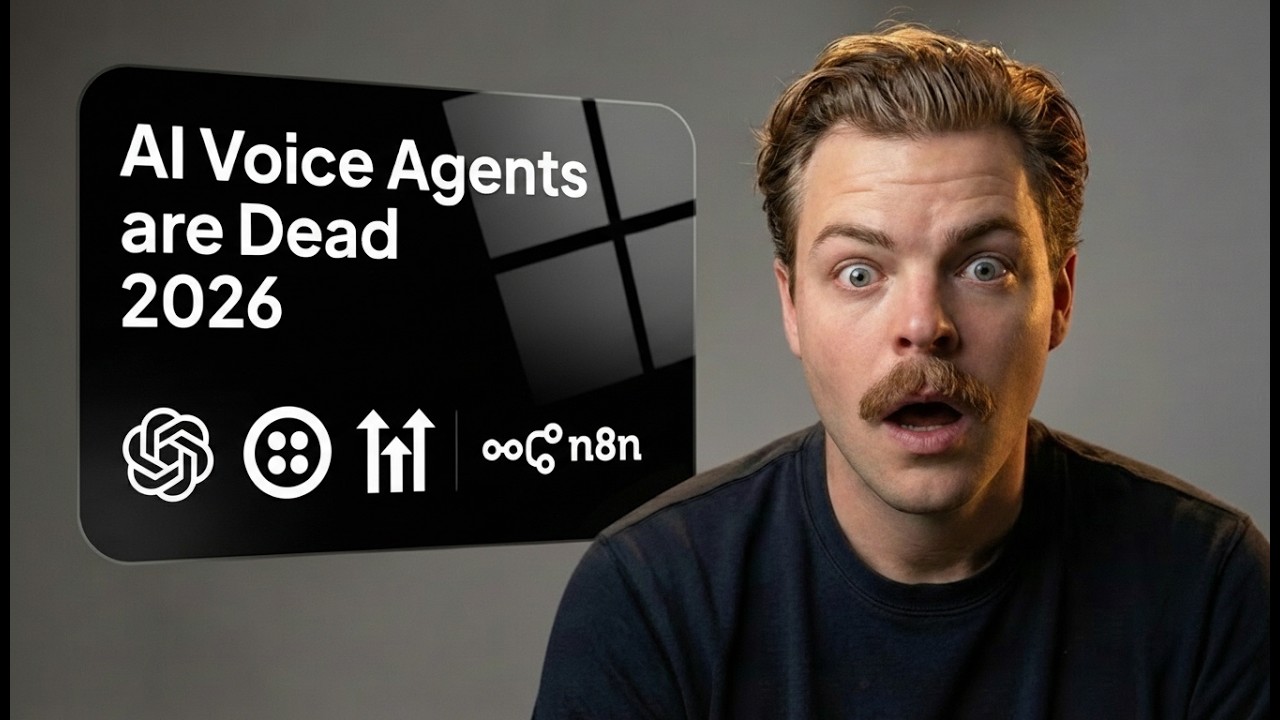
AI Voice Agents Are DEAD — Here's the Profitable Business System That Actually Works in
If you've invested in AI voice agents or considered adding them to your business, you're about to discover why 90% of implementations fail within 12 months. The standalone voice AI gold rush is over—but the real opportunity in integrated business systems is just beginning. Learn the six fatal flaws killing voice AI and the triple-threat framework that separates winners from losers.
The AI Voice Agent Graveyard: Why 90% Fail
You're sitting there at 9 PM after another long day, scrolling through YouTube videos promising AI voice agents will solve your lead generation problems. You've seen the demos—the smooth-talking AI that never sleeps, never gets tired, and converts leads 24/7. It sounds like the solution you've been waiting for.
But here's the brutal truth nobody's telling you: 90% of AI voice agent implementations will fail within the next 12 months. This isn't speculation—it's based on market dynamics, margin compression, and the fundamental misunderstanding of what businesses actually need. The AI voice agent space has been commoditized faster than crypto, faster than dropshipping, and faster than Shopify stores.
The problem isn't the technology—it's the business model: Most people getting into AI voice agents are holding onto quicksand. They're watching YouTube videos, taking courses from people who've never built real businesses, and thinking they'll make $50K a month reselling Vapi or Bland AI. But the middleman business is dead.
What's actually happening is a massive shift in the market. The early adopters made money when voice AI was cutting-edge. Now we're in the commoditization phase where every kid with a laptop can spin up a voice agent. The differentiation is gone, and the value perception drops daily. This is the natural lifecycle of technology, and voice AI has reached the point where standalone products can't survive.
The Six Fatal Flaws Killing AI Voice Implementations
Understanding why AI voice agents fail requires examining the six critical flaws that destroy most implementations. These aren't minor issues—they're fundamental business model problems that make standalone voice AI unsustainable.
1. Margin Compression: The Race to Zero
Most agencies are reselling someone else's SaaS product—Vapi, Bland AI, Synflow—and marking it up 2-3x. But there's no meat on the bone. If you're paying 5 cents per minute and charging 10 cents, you're making 5 cents profit. Do the math: 10,000 calls at 3 minutes each is 30,000 minutes—$1,500 monthly profit for 40+ hours of work, customer support, and troubleshooting. That's not a business; it's a job with extra steps.
2. Platform Inadequacy: Drunk Robots Don't Close Deals
Spin up a voice AI agent right now and make 100 test calls. Count how many actually accomplish the objective without sounding like a drunk robot. The technology works, but not well enough for most businesses to justify the risk. One bad call that goes viral can destroy years of reputation building. Business owners are risk-averse with their brands, and they should be.
3. Deployment Disaster: Skipping the Boring Stuff
Nobody follows proper deployment protocols. They skip testing, fail-safes, call quality monitoring, human escalation paths, and industry-specific training. Proper deployment requires a pilot phase with 50-100 test calls, manual review of every call, edge case identification, and continuous optimization. Most agencies deploy and disappear.
4. Market Mismatch: Selling to the Wrong Businesses
Not every business needs voice AI. Yoga studios, nail salons, and coffee shops don't have the volume or ticket size. The right businesses are high-ticket, high-volume service companies doing $1M+ annually: roofers, HVAC, restoration, law firms, solar companies. These have the lead volume, customer value, and pain points that justify AI implementation.
5. Pricing Pathology: Cost Centers vs. Value Creators
Pricing per minute turns your service into a cost center that clients constantly scrutinize. Instead, price based on outcomes—appointments booked, revenue generated, transformation delivered. When a roofing company books 20 qualified appointments that close at $12,000 each ($96,000 revenue), they're thinking about ROI, not your per-minute charges.
6. Commoditization Catastrophe: No Barrier to Entry
Voice AI has become a commodity with no differentiation. The winners will be those who sell complete systems with transformation attached, not standalone products. You can't sell AI voice agents alone—you need to sell them as part of a complete business operating system.
The Triple-Threat System: Voice AI + CRM + Workflow Automation
Here's where the real opportunity lies—the system that separates winners from losers. The triple-threat approach combines three essential components that create a complete business operating system rather than a disconnected tool.
The triple-threat framework transforms AI from a novelty into a necessity: Voice AI is the mouth, CRM automation is the brain, and workflow builders are the nervous system. Most people are selling just the mouth and wondering why it doesn't work.
Component 1: Voice AI (The Mouth)
This is the conversational interface—Vapi, Bland AI, or similar platforms. It handles the actual phone conversations, answers questions, qualifies leads, and books appointments. But alone, it's just a talking head without context or intelligence.
Component 2: CRM Automation (The Brain)
Your CRM (GoHighLevel, HubSpot, Salesforce) stores customer data and manages workflows. It knows who customers are, what they've done, and what needs to happen next. Integrated with voice AI, it provides real-time context for every conversation.
Component 3: Workflow Builders (The Nervous System)
Platforms like n8n, Make.com, or Zapier connect everything together. They make decisions, trigger actions, and ensure seamless data flow between systems. This is what transforms separate tools into a coordinated system.
When these three components work together, magic happens. A roofing company gets 100 leads after a storm. The workflow automation scrapes and prioritizes leads by home value and damage severity. Voice AI calls the top 50 within 30 minutes. Qualified leads autobook appointments, unqualified leads enter nurture sequences, the CRM updates in real-time, and the sales team gets instant notifications. This isn't just automation—it's business transformation.
Who Actually Needs AI Voice Automation?
One of the biggest mistakes in the voice AI space is targeting the wrong businesses. Not every company needs or can benefit from voice automation. Understanding the ideal customer profile is crucial for success.
The perfect AI voice automation candidate meets three criteria: They're doing at least $1 million in annual revenue, they have existing lead volume they're not effectively contacting, and they operate in a high-ticket service industry where speed-to-lead matters.
Ideal industries for voice AI automation: Roofing companies (50-100 leads per storm), HVAC (emergency call overflow), restoration (disaster response), law firms (consultation bottlenecks), solar companies (aggressive outbound). These businesses have the volume, value per customer, and pain points that make AI a no-brainer.
Businesses that shouldn't implement voice AI include local service providers with low ticket sizes, companies without existing phone-based lead generation, and organizations where customers prefer digital communication. Trying to force voice AI into these contexts leads to frustration and failure.
The key insight is that AI voice works best for specific use cases: appointment setting, lead qualification, payment reminders, and basic customer service. It fails at complex sales conversations, emotional support, technical troubleshooting, and sensitive customer service issues. Knowing the boundaries is as important as knowing the capabilities.
Pricing Transformation, Not Technology
How you price your AI voice services determines whether you're selling a commodity or a transformation. Most agencies make two critical pricing mistakes that destroy their profitability and client relationships.
Mistake #1: Pricing too low. Offering AI voice agents for $500/month devalues your entire service. The client thinks of it as a commodity, and when it breaks, they're furious because they're only paying $500. You end up providing $5,000 worth of support for $500 in revenue.
Mistake #2: Pricing per minute. Charging 10 cents per minute turns you into a cost center. Every call costs the client money, so they're hyper-sensitive to costs and constantly questioning whether it's worth it. This mental frame ensures they'll eventually look for cheaper alternatives.
The solution: Price based on outcomes and value. When a roofing company books 20 qualified appointments that close at $12,000 each ($96,000 revenue), they're not thinking about your charges—they're thinking about the ROI you delivered. Value-based pricing shifts the conversation from cost to transformation.
Effective pricing models include percentage of revenue generated, flat fees based on appointments booked, or tiered pricing that scales with business outcomes. The key is aligning your success with the client's success—when they win, you win. This creates partnerships rather than vendor relationships and ensures long-term retention.
5 Critical Implementation Mistakes That Destroy Results
Even with the right technology and pricing, implementation failures can destroy AI voice projects. Here are the five most common mistakes that cause 90% of implementations to fail.
1. No Clear Success Metrics
Most people deploy AI without defining what success looks like. Is it calls made? Appointments booked? Revenue generated? Without clear metrics, you can't measure performance or demonstrate value. Define success upfront and measure it obsessively.
2. Lack of Human Oversight
AI is powerful but not perfect. You need human escalation pathways, quality assurance systems, and weekly call reviews. Most agencies deploy and disappear, which is why clients quickly become frustrated and cancel.
3. Wrong Use Case Selection
Voice AI works for appointment setting, lead qualification, and reminders. It fails at complex sales, emotional support, and technical troubleshooting. Automating the wrong processes guarantees failure.
4. Bad Data Foundation
Garbage in, garbage out. If your CRM is a mess, your AI will be a mess. Clean data, update systems, and ensure accurate information before deployment.
5. No Iteration Process
The first version is never perfect. You need weekly iterations based on real performance data. Review calls, identify patterns, make improvements, and redeploy. Continuous optimization is non-negotiable.
Proper implementation requires discipline, not speed: A successful deployment includes a pilot phase with 50-100 test calls, manual review of every interaction, edge case identification, exception handling protocols, and continuous optimization based on real-world performance.
Real-World Examples: From 19% to 39% Close Rates
The theory behind the triple-threat system sounds compelling, but real-world results prove its effectiveness. Here are concrete examples of businesses that transformed their operations using integrated AI systems.
HVAC Company Case Study: A $2M HVAC company was paying $1,200/month for a standalone AI receptionist. It answered calls politely but didn't qualify leads properly, confirm appointments, or trigger follow-ups. The sales team didn't trust it and called leads anyway—essentially paying for a fancy voicemail system.
After implementing the triple-threat system, the results were dramatic. When a lead calls, AI answers and qualifies them, books appointments based on technician availability, sends confirmation texts and emails, triggers follow-up sequences for unavailable leads, and provides real-time notifications to sales teams. The close rate increased from 19% to 39% within 60 days—more than doubling their conversion efficiency.
The power of integration over standalone tools: The same AI technology produced dramatically different results when connected to a complete system. This demonstrates that the value isn't in the voice AI itself, but in how it integrates with CRM and workflow automation.
Roofing Company Transformation: A roofing company getting 100 leads after storms previously had sales reps manually calling leads, connecting with 30, and losing 70 to competitors with faster response times. With the triple-threat system, workflow automation prioritizes leads by home value and damage severity, voice AI calls the top 50 within 30 minutes, qualified leads autobook appointments, and the CRM updates in real-time with sales team notifications.
The analogy is perfect: Buying standalone voice AI is like buying a steering wheel and expecting to drive. You need the complete vehicle—engine, wheels, transmission, brakes. The triple-threat system provides the complete vehicle, not just individual components.
Watch the Full Tutorial
Want to see the triple-threat system in action? Watch the full video tutorial where we break down exactly how to implement this framework in your business. At the 12:30 mark, you'll see a live demo of how voice AI, CRM automation, and workflow builders work together seamlessly.
Key Takeaways
The AI voice agent landscape has fundamentally shifted from standalone products to integrated systems. The companies that thrive in will be those that understand this transition and adapt accordingly.
In summary: Standalone voice AI is dying due to commoditization and implementation failures, but integrated systems combining voice AI, CRM automation, and workflow engines are creating massive competitive advantages for businesses that implement them correctly. The key is selling transformation, not technology, and focusing on outcomes rather than features.
If you're a service-based business owner doing $1M+ annually, this represents the single best competitive advantage you can build right now. Not better marketing, not better sales training, not better hiring—better systems. And the time to act is now, not in , because the businesses that implement these systems today will dominate their markets while competitors struggle with manual processes.
Frequently Asked Questions
Common questions about AI voice automation and business systems
AI voice agent implementations fail due to six critical flaws that make standalone voice AI unsustainable as a business model. The primary issue is margin compression from reselling commoditized technology where agencies make minimal profits while handling extensive support work.
Additionally, most platforms aren't robust enough for real business value, deployment protocols are skipped, wrong markets are targeted, pricing models are based on cost rather than value, and the technology has become a commodity with no differentiation. 90% of implementations fail within 12 months because they treat voice AI as a standalone product rather than part of an integrated system.
- Margin compression makes reselling unsustainable
- Platform limitations prevent real business value delivery
- Poor deployment protocols lead to client dissatisfaction
The triple-threat system combines three essential components that create a complete business operating system rather than disconnected tools. This framework transforms AI from a novelty into a necessity by integrating voice AI, CRM automation, and workflow builders into a seamless platform.
Voice AI serves as the conversational interface (the mouth), CRM automation manages customer data and workflows (the brain), and workflow builders like n8n or Make.com connect everything together (the nervous system). For example, when a roofing company gets 100 leads after a storm, the system automatically prioritizes leads, calls top prospects within 30 minutes, books appointments, updates the CRM, and triggers follow-ups—all without manual intervention.
- Voice AI handles conversations and qualification
- CRM automation manages data and workflows
- Workflow builders connect systems and automate decisions
The ideal businesses for AI voice automation are high-ticket, high-volume service-based companies doing at least $1 million in annual revenue. These businesses have the lead volume, customer value, and operational pain points that justify AI implementation and can absorb the costs while appreciating the transformational benefits.
Perfect candidates include roofing companies getting 50-100 leads per storm, HVAC companies with emergency call overflow, restoration companies responding to disasters, law firms with consultation booking bottlenecks, and solar companies with aggressive outbound strategies. Businesses like yoga studios, nail salons, or local coffee shops typically don't have sufficient volume or ticket size to benefit from voice AI systems.
- Minimum $1M annual revenue requirement
- High-ticket service industries with phone-based lead generation
- Businesses where speed-to-lead determines conversion success
AI voice services should be priced based on value and outcomes rather than cost per minute or flat monthly fees. Pricing models that charge per minute turn the service into a cost center that clients constantly scrutinize, while value-based pricing aligns your success with the client's transformation.
Effective pricing strategies include percentage of revenue generated, flat fees based on appointments booked, or tiered pricing that scales with business outcomes. For example, if an AI system helps a roofing company book 20 qualified appointments that close at $12,000 each ($96,000 revenue), the pricing should reflect that value rather than the minutes used. This shifts the conversation from cost to ROI.
- Price based on outcomes, not inputs
- Use percentage of revenue or appointments booked models
- Align pricing with client transformation and ROI
The most common deployment mistakes include lacking clear success metrics, skipping human oversight pathways, targeting wrong use cases, working with messy data, and failing to iterate after initial deployment. These errors ensure that even well-intentioned implementations fail to deliver measurable results.
Proper deployment requires a disciplined approach including a pilot phase with 50-100 test calls, manual review of every interaction, identification of edge cases, creation of exception handling protocols, human escalation systems, and weekly performance reviews with continuous improvements. Most agencies deploy quickly and disappear, which is why clients quickly become frustrated and cancel services.
- Define success metrics before deployment
- Implement human oversight and escalation pathways
- Continuously iterate based on real performance data
The triple-threat system dramatically improves lead conversion through immediate response times, intelligent prioritization, and seamless follow-up automation. By integrating voice AI with CRM data and workflow engines, the system ensures that leads are contacted within minutes rather than hours, which is critical for conversion success.
In one HVAC company example, the close rate increased from 19% to 39% within 60 days by implementing the complete system. The AI answers calls immediately, qualifies leads based on specific criteria, books appointments directly to technician calendars, sends confirmation communications, triggers automated follow-up sequences, and provides real-time notifications to sales teams. This eliminates the 6-hour response delays that cause most leads to go cold.
- 30-minute lead response vs. 6-hour industry standard
- Intelligent prioritization based on CRM data
- Seamless automation from first contact to appointment
Selling AI tools means providing standalone voice AI agents that handle specific tasks like answering calls or qualifying leads. Selling AI platforms means delivering complete operating systems that integrate voice AI with CRM automation and workflow engines to create transformational business outcomes.
The key difference is that tools are commodities that clients can easily replace, while platforms create dependency and deliver measurable business transformation. The analogy is selling a steering wheel versus selling a complete vehicle—the steering wheel alone doesn't drive, but the vehicle provides transportation. Platforms scale businesses by creating integrated systems, while tools often create additional complexity without solving underlying operational challenges.
- Tools are replaceable commodities
- Platforms create business transformation
- Integrated systems deliver measurable outcomes
GrowwStacks helps businesses implement complete AI automation systems tailored to their specific operations and revenue goals. We don't just install standalone voice AI tools—we build integrated platforms combining voice AI, CRM automation, and workflow engines that deliver measurable business outcomes and competitive advantages.
Our team begins with a comprehensive audit of your current lead flow and operational bottlenecks. We identify where you're losing money through slow response times, missed opportunities, and inefficient processes. Then we design and deploy a custom automation infrastructure that scales with your business, complete with proper deployment protocols, continuous optimization, and outcome-based pricing models that align our success with your transformation.
- Custom AI automation systems built for your business
- Integration with your existing tools and platforms
- Free consultation to discuss your automation goals
Ready to Transform Your Business with AI Automation That Actually Works?
Stop losing deals to competitors with faster response times and watch your conversion rates stagnate. Let GrowwStacks build you a complete AI automation system that books appointments 24/7, prioritizes hot leads, and integrates seamlessly with your existing operations—delivering measurable results in 30 days.