AI Voice Agents: The Future of Sales Follow-Up (And Why Email is Dead)
Most businesses lose 85% of leads because they can't follow up fast enough. AI voice agents are changing that - booking 650 meetings in 90 days while doubling conversion rates. Here's how they work (and why your email campaigns can't compete).
Why Email Follow-Ups Are Failing (And What Works Better)
Every sales leader knows the frustration: leads that go cold because follow-up comes too late. Research shows 78% of buyers purchase from the first company to respond - yet most businesses take 48+ hours to follow up on web inquiries. By then, the prospect has moved on.
AI voice agents solve this by initiating contact within 90 seconds of form submission. As Will de Principe explains in the interview: "There's going to be no point in time where you submit a form and you don't get a personalized follow-up." This immediacy creates a 3-5x improvement in engagement compared to email.
Key insight: Prospects don't dislike follow-ups - they dislike delayed follow-ups. When contacted immediately after expressing interest, 95% of buyers welcome the conversation regardless of whether it's human or AI.
The data shows why traditional methods fail: email open rates hover around 20-30%, with response rates at just 5-10%. Text messages perform slightly better at 30-40% open rates, but still can't handle objections or questions in real-time. Voice AI changes this equation completely.
The 3X Advantage of Voice Over Email and Text
What makes voice so much more effective than digital channels? The answer lies in three key advantages:
1. Real-Time Objection Handling
When a prospect says "I'm busy," an email chain ends. A voice agent can immediately respond: "Would tomorrow at 3pm work better?" This dynamic interaction keeps conversations alive that would die via text-based channels.
2. Emotional Connection
The human voice carries tone, pacing, and emphasis that text cannot replicate. Even synthetic voices create 40% stronger emotional engagement than written words alone, according to MIT studies.
3. Completion Rates
Will shares a powerful case study: "Within 90 days they had 650 meetings booked directly with advisers. They saw close rates jump from 15% to 30%." This 2X improvement comes from the ability to actually complete the scheduling during the initial interaction rather than hoping the prospect will take action later.
Implementation tip: Start with your most valuable abandoned leads - prospects who showed interest but didn't convert. These see the fastest ROI from voice re-engagement.
The Transparency Paradox: Why Honesty Boosts Retention
Early voice AI implementations tried to mimic humans perfectly, leading to distrust when prospects realized they'd been "tricked." Modern best practices embrace transparency - and see 95% retention rates as a result.
As Will explains: "We come at it with complete transparency... 'This is Tessa calling from Saltley. Calling because you recently showed interest in AI voice agents like myself.'" This approach satisfies ethical concerns while maintaining professionalism.
The psychology behind this is fascinating: when companies disclose the AI nature upfront, prospects focus on whether the interaction is helpful rather than whether it's human. This shifts the evaluation criteria in the AI's favor - most people judge machines more leniently than humans for service interactions.
Where Voice AI Works Best: The B2C Breakthrough
Not all businesses benefit equally from voice AI. The strongest results come from B2C companies with:
- High-consideration purchases (mortgages, financial services, education)
- Complex offerings requiring explanation
- Large volumes of inbound leads
Will notes: "For the big mortgage company, these are high consideration B2C leads... That's not going to be done inside of an email. That's not going to be done inside of a text message, but it can easily be done inside of a call."
The pattern is clear - voice AI excels when the product requires discussion rather than just information delivery. This makes it ideal for:
- Financial services
- Healthcare
- Education
- Professional services
Simple ecommerce transactions or SaaS trials may not see the same dramatic improvements, as those purchases often require less conversation.
The B2B Challenge: Gatekeepers and IVRs
While B2C sees dramatic improvements, B2B implementations face unique hurdles:
- Gatekeepers: Receptionists and assistants trained to filter sales calls
- IVR systems: Automated menus that block non-human callers
- Decision complexity: Multi-stakeholder purchases requiring human nuance
Will shares: "AI voice agents will oftentimes get weeded out... Press one to get to this person, press two to get to that person. That's tough." This doesn't mean B2B is impossible - just that it requires different strategies than B2C.
The most successful B2B applications today focus on:
- Customer success check-ins
- Appointment confirmations
- Account updates (like medical billing status)
As the technology evolves to handle more complex interactions, B2B adoption will increase - but for now, temper expectations compared to B2C results.
Case Study: Medical Billing Status Updates at Scale
One of the most promising B2B applications comes from healthcare revenue cycle management. Will describes a breakthrough use case:
"We call into medical fields. We ask about a current customer status. We get that status. We return it back to the CRM... There are hundreds of thousands of people worldwide doing this daily, 12 hours a day, just dialing these medical institutions."
This application demonstrates voice AI's ability to:
- Handle repetitive information-gathering tasks
- Integrate with existing CRM systems
- Operate at scales impossible for human teams
The results? Faster revenue cycles, reduced staffing costs, and complete audit trails of all billing inquiries. This pattern applies to any industry requiring status updates:
- Insurance claims
- Shipping logistics
- Service tickets
- Legal case updates
Implementation insight: Start with your most repetitive phone-based workflows. These deliver the fastest ROI while building internal confidence in voice AI.
Implementation Timeline: What to Expect
Successful voice AI deployment follows a clear timeline:
Days 1-7: Configuration
• CRM integration setup
• Call scripts development
• Compliance checks
Days 8-14: Testing
• Internal call simulations
• Script refinements
• Performance benchmarking
Days 15-30: Soft Launch
• Limited lead volume
• Real-world tuning
• Team training
Days 31-90: Full Deployment
• Full lead volume
• Performance optimization
• Expansion planning
Will notes that most clients see measurable results within the first 30-60 days: "People see results within those first 30 to 60 days and then they're hooked." This phased approach minimizes risk while maximizing learning.
The Future: Omni-Channel AI Personas
The next evolution of voice AI goes beyond phone calls to create true AI personas that maintain context across channels. Will shares:
"This AI is going to be able to communicate on all different platforms while having context of their previous conversations... Therefore, you do have ultimately a complete AI employee through and through."
This means an interaction could begin with a voice call, continue via text message, and conclude over email - with the AI remembering all details across each touchpoint. The implications are profound:
- Seamless handoffs: No more repeating information to different reps
- Channel preference: Prospects choose how they want to engage
- Deeper relationships: Continuous context builds trust over time
Early implementations suggest this omni-channel approach could improve conversion rates by an additional 30-50% over voice-only solutions. The key will be maintaining natural transitions between channels while preserving conversation history.
Watch the Full Tutorial
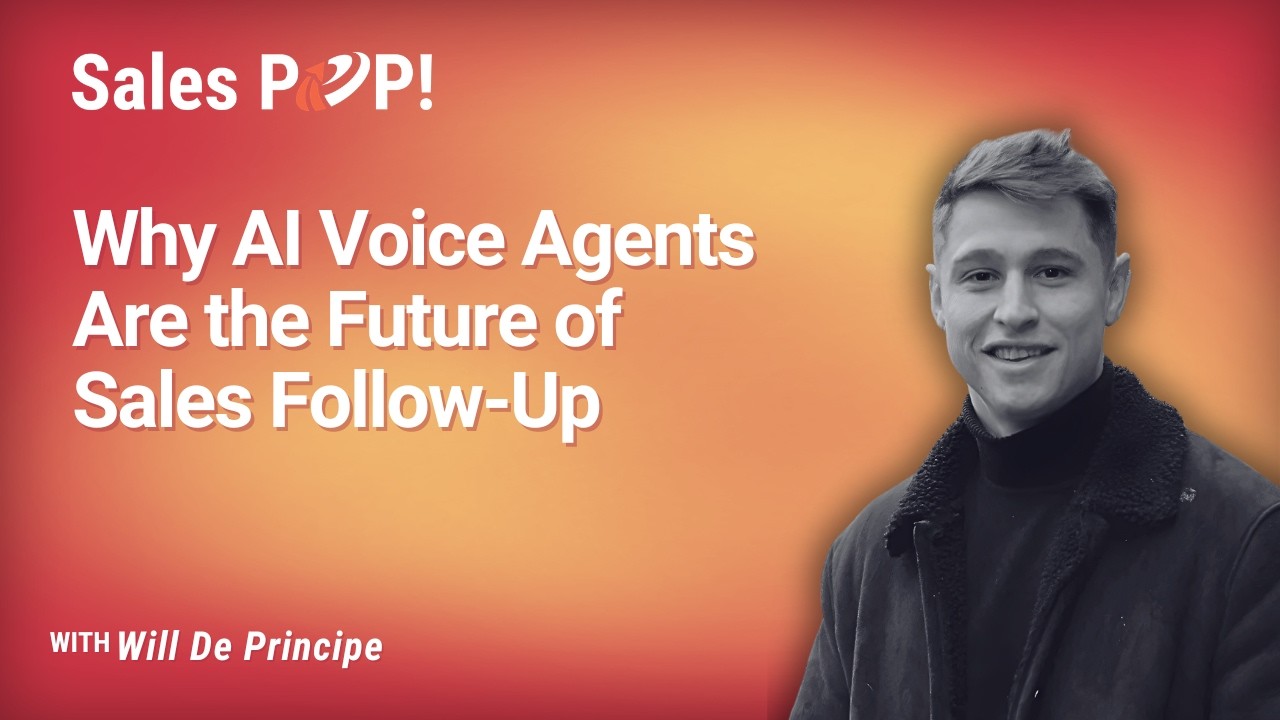
For a deeper dive into how AI voice agents transform sales pipelines, watch the full interview with Will de Principe (starting at 4:30 for the most impactful case studies).
Key Takeaways
The shift to AI-powered voice outreach represents the most significant change in sales follow-up since the invention of email. Companies adopting this technology now gain a decisive competitive advantage.
In summary: Voice AI delivers 3-5x better results than email by enabling immediate, personalized follow-up at scale. The most successful implementations focus on high-consideration B2C sales, embrace transparency, and integrate seamlessly with existing CRMs.
Frequently Asked Questions
Common questions about AI voice agents
Mortgage companies and property management firms see the strongest results with AI voice agents, achieving 90-95% retention rates when re-engaging leads.
These industries benefit because their leads require nurturing - prospects need to discuss options rather than just receive information. High-value B2C services with complex offerings (like financial products) particularly benefit from the conversational approach.
- Best for: Mortgage lending, insurance, education, professional services
- Moderate fit: Healthcare, real estate, automotive
- Challenging: Simple ecommerce, SaaS trials, low-consideration purchases
Case studies show businesses booking 650 meetings within 90 days of implementation, with conversion rates jumping from 15% to 30%.
The fastest results come from re-engaging existing leads who previously showed interest but didn't convert. Unlike email campaigns that take months to show ROI, voice agents demonstrate impact within the first 30-60 days.
- First 30 days: 20-40 meetings booked
- 60 days: Conversion rates begin improving
- 90 days: Full impact visible with 2-3x improvements
Transparency increases retention rates by 90-95%. Successful implementations clearly identify the AI nature of the call while maintaining professionalism.
Example scripts might say: "This is Tessa calling from Acme Corp about your recent inquiry. I'm an AI assistant here to schedule your consultation. Is now a good time?" This approach satisfies compliance concerns while maintaining engagement.
- Best practice: Disclose AI nature within first 10 seconds
- Effective phrasing: "I'm an automated assistant calling to..."
- Avoid: Attempting to perfectly mimic human speech patterns
Voice agents outperform email by 3-5x in response rates. Where email might get a 5-10% response rate, voice agents achieve 30-50% engagement.
The key difference is the ability to handle objections in real-time - if a prospect says they're busy, the agent can immediately offer to call back at a better time rather than ending the interaction.
- Email: 5-10% response rate
- Text: 15-25% response rate
- Voice: 30-50% engagement rate
The biggest myth is that voice AI feels intrusive. In reality, 95% of prospects appreciate immediate follow-up after they express interest.
The data shows people want timely responses - the problem with traditional methods isn't the contact itself, but the days or weeks of delay before human teams can respond.
- Truth: People want fast responses to their inquiries
- Myth: Automated calls feel spammy
- Reality: Professionalism and transparency determine perception
Modern voice AI platforms connect directly to popular CRMs like Salesforce, HubSpot, and Pipedrive. They log call outcomes, update lead statuses, and can even trigger follow-up workflows based on conversation results.
Some advanced implementations use the CRM data to personalize call scripts in real-time based on the lead's history. For example: "I see you downloaded our guide to retirement planning last week - would you like to schedule time with a specialist?"
- Supported CRMs: Salesforce, HubSpot, Pipedrive, Zoho
- Data synced: Call recordings, dispositions, follow-up tasks
- Advanced: Dynamic script personalization from CRM data
The next evolution is omni-channel AI personas that maintain conversation context across email, text, voice, and social platforms.
Imagine an AI that continues a discussion started via phone through LinkedIn messages while remembering all previous interactions. This creates a seamless experience where the communication method doesn't interrupt the relationship building.
- Coming soon: Cross-channel memory and context
- Future: AI that escalates to human reps at the right moment
- Long-term: Fully autonomous sales agents handling entire pipelines
GrowwStacks designs and deploys custom voice AI solutions tailored to your sales process. We handle the technical integration, conversation design, and performance optimization so you can focus on closing deals.
Our implementations typically show a 2-3x improvement in lead conversion rates within the first 90 days. We start with a free consultation to analyze your current pipeline and identify the highest-impact opportunities for automation.
- Free 30-minute consultation
- Custom conversation design
- Ongoing performance optimization
Ready to Transform Your Sales Follow-Up?
Every day you delay is another day losing 85% of leads to slow response times. GrowwStacks can have your custom voice AI solution live in 30 days - booking more meetings while your team focuses on closing deals.