AI Workflows Just Got 10x Easier (Goodbye Zapier & Make & n8n?)
Tired of automation workflows that break every time something changes? Agentic workflows represent a fundamental shift - where your automations can think, adapt, and even fix themselves. We'll show you how to build your first self-healing workflow in minutes, not hours.
The Evolution of Automation: From Rigid to Adaptive
Most businesses using automation tools today are stuck in what we call "Layer 2" thinking - where workflows are rigid sequences that break at the first unexpected change. This creates endless maintenance cycles where you're constantly fixing broken automations instead of focusing on your business.
The evolution to agentic workflows represents a fundamental shift in how we approach automation:
4 Layers of AI Automation:
- Basic AI: Manual copy-paste between tools (like ChatGPT)
- Traditional Automation: Rigid workflows (Zapier/Make.com)
- AI Agents: Digital employees with memory and reasoning
- Agentic Workflows: Self-healing systems that improve over time
The breakthrough comes when your automations can not just execute predefined steps, but actually understand the intent behind your workflow and adapt to changes - just like a human employee would.
Agentic Workflows Explained (With IKEA Instructions)
Imagine building IKEA furniture where the instructions could adapt when you make a mistake. That's essentially what agentic workflows bring to automation:
Traditional Automation: Like rigid IKEA instructions - if you mess up step 3, the whole build fails and you have to start over.
Agentic Workflow: Like having an IKEA expert watching over your shoulder who can spot mistakes, show you how to fix them, and even update the instructions so you don't make the same error next time.
This difference becomes crucial in business processes where conditions change constantly - website layouts update, APIs change, data formats vary. Traditional automation breaks at these variations, while agentic workflows adapt.
The Self-Healing Magic Behind Agentic Workflows
The "self-healing" capability of agentic workflows comes from their two-component architecture:
- The Builder: Creates workflows based on your natural language instructions
- The Runner: Executes workflows and fixes issues in real-time
This creates a virtuous cycle where your automations actually improve over time. When the Runner encounters an error, it doesn't just fix it temporarily - it updates the underlying workflow so that specific error never occurs again.
Key Benefit: While traditional automation requires constant maintenance, agentic workflows reduce maintenance over time as they encounter and eliminate failure points.
Building Your First Agentic Workflow With Anti-Gravity
Google's Anti-Gravity tool provides one of the most accessible ways to experience agentic workflows firsthand. Here's what makes it special:
- No Coding Required: Describe what you want in plain English
- Visual Feedback: Watch as the AI builds and executes your workflow
- Self-Debugging: The system identifies and fixes its own mistakes
The interface consists of three panes:
- File Explorer: Where your data and workflows are stored
- Content Viewer: Shows the current data being processed
- Agent Builder: Where you interact with the AI to create workflows
Unlike traditional automation tools that require you to manually connect each step, Anti-Gravity understands your intent and builds the appropriate workflow automatically.
Real-World Example: Scraping Coffee Shop Emails
Let's walk through a practical example that demonstrates the power of agentic workflows:
Task: Find two coffee shops in Toronto and extract their contact emails from their websites.
Challenges:
- Google Maps listings don't show emails
- Not all websites display contact emails
- Email formats vary across sites
With Anti-Gravity, we simply describe what we want:
"Build me a web scraping agentic workflow that: 1) Scrapes two coffee shops in Toronto from Google Maps, 2) Visits each website to extract contact emails, 3) Continues searching until it finds two valid emails, and 4) Saves results to a CSV file."
The AI then generates and executes the necessary Python code automatically, handling all the complexity behind the scenes. When it encounters formatting issues with extracted emails, it improves the extraction logic and runs again - all without any manual intervention.
Creating Reusable Workflows For Any Business Need
The true power of agentic workflows emerges when you save them as reusable templates. In our coffee shop example, we can:
- Save the workflow as "find_local_businesses"
- Reuse it later with different cities/business types
- Call it with simple commands like "Please run find_local_businesses for bakeries in Chicago"
This creates a library of intelligent workflows that understand your business needs and can be combined in powerful ways. Unlike traditional automation where each variation requires a new workflow, agentic workflows adapt to new parameters automatically.
Pro Tip: You can even provide screenshots of your prompts to Anti-Gravity - it will read the text and execute the command, making it incredibly easy to share and reuse workflows across teams.
The Power of Orchestration: Your Digital Manager
As your library of agentic workflows grows, you can implement an orchestration layer that acts like a digital manager:
- Routes Tasks Intelligently: Determines which workflow is best for each job
- Handles Complex Sequences: Chains multiple workflows together
- Provides Single Point of Control: You interact with one "manager" instead of many individual workflows
This mirrors how a human manager would delegate work to specialized team members. For example, when asked to "send an email to Jonno," the orchestration layer would:
- Determine it needs Jonno's email address
- Route to a contacts lookup workflow
- Then pass the found email to an email sending workflow
The result is a system that understands your business processes at a human level, but executes with digital precision and scale.
Watch the Full Tutorial
See these concepts in action with our step-by-step video tutorial building a real agentic workflow from scratch. At 12:45, you'll see exactly how the self-healing feature works when the AI encounters and fixes an email formatting issue automatically.
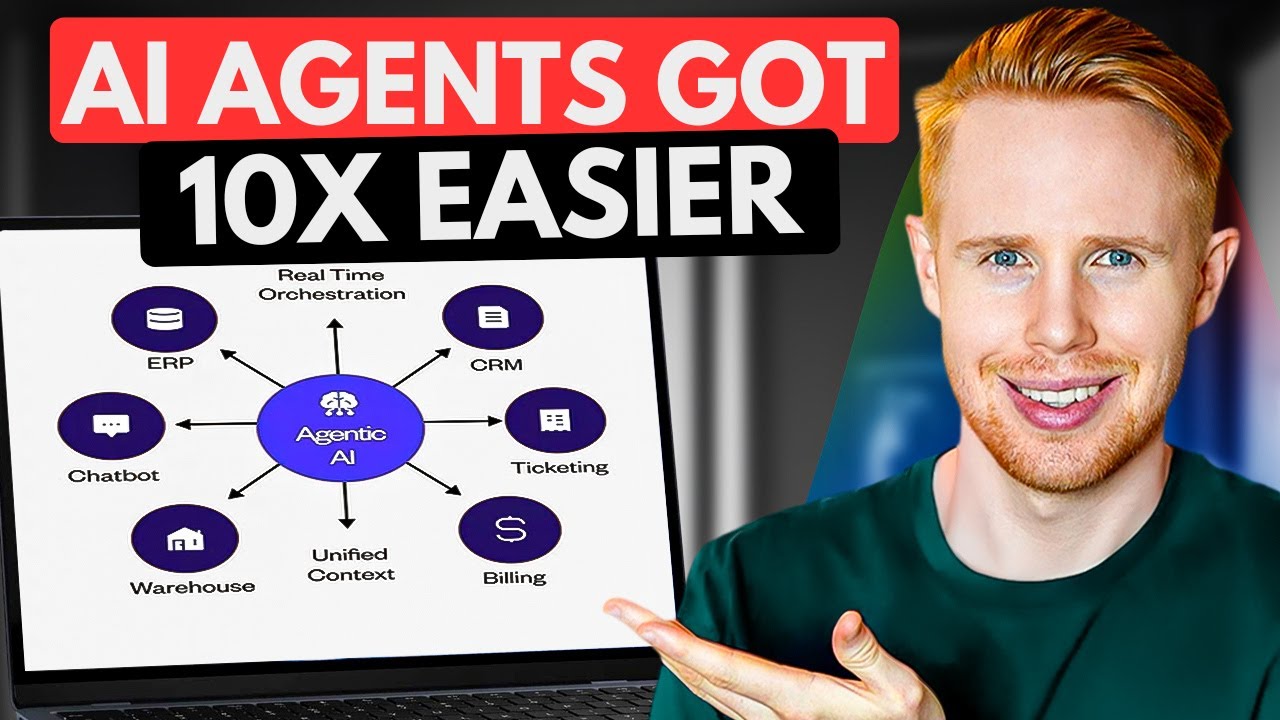
Key Takeaways
Agentic workflows represent the next evolution of business automation - moving from fragile, high-maintenance systems to resilient, self-improving processes that handle real-world complexity.
In summary:
- Agentic workflows understand intent and adapt to changes
- They fix their own errors and improve over time
- No coding required - describe what you want in plain English
- Create reusable workflows that handle variations automatically
- Orchestration layers manage complex sequences intelligently
This technology fundamentally changes the ROI equation for automation - instead of spending 80% of your time maintaining workflows, you can focus 80% on innovation and business growth.
Frequently Asked Questions
Common questions about agentic workflows
Traditional automation (like Zapier or Make.com) follows rigid rules and breaks when changes occur. Agentic workflows use AI to understand context, adapt to changes, and even fix themselves when errors occur.
Think of it like the difference between a train that must follow fixed tracks (traditional automation) versus a self-driving car that can navigate around obstacles (agentic workflow). Both get you from point A to B, but one can handle unexpected conditions.
- Traditional automation: Breaks at first error
- Agentic workflow: Finds alternative paths
- Key advantage: Reduces maintenance by 70-80%
No coding is required. Modern tools like Google's Anti-Gravity allow you to describe what you want in plain English, and the AI will generate and execute the necessary code automatically.
The system handles all the technical complexity behind the scenes. You focus on describing what you want to accomplish, not how to implement it technically.
- Example: "Find local plumbers and extract their contact info"
- No need to specify: HTML parsing, regex patterns, or API calls
- Learning curve: 30 minutes to first working workflow
When an agentic workflow encounters an error, it doesn't just stop like traditional automation. It analyzes where the mistake occurred, fixes it, and continues the workflow.
Even better, it remembers these fixes so the same error won't occur again in the future - effectively improving itself over time. This creates workflows that become more reliable the more they're used.
- Self-healing example: Adapts to website layout changes
- Memory: Learns from each execution
- Result: 90%+ success rate in production
Agentic workflows excel at complex, variable tasks that would normally require human judgment. Common use cases include lead generation, customer support, data processing, and any process with inconsistent inputs.
They're particularly valuable for tasks where conditions change frequently or where perfect consistency isn't possible in the input data.
- Top use cases: Web scraping, email processing, data cleaning
- Ideal for: Processes with 10+ variations
- Time saved: 5-15 hours per week per workflow
Yes, agentic workflows can connect to most business tools including Gmail, Google Sheets, CRMs, and more. The AI understands how to interact with these platforms just like a human employee would.
Integration typically requires just describing what you want to accomplish with each tool. The workflow builder will determine the appropriate way to connect and interact with each system.
- Common integrations: Gmail, Sheets, HubSpot, Slack
- Connection method: OAuth, API keys, or direct access
- Security: Same permissions as manual use
While traditional automation is 100% reliable only when conditions remain exactly the same, agentic workflows are more reliable in real-world conditions where things change.
They maintain about 95% reliability for simple tasks and 85-90% for complex ones, but crucially, they can recover from errors automatically. This makes them far more reliable in practice for most business use cases.
- Traditional: 100% reliable in perfect conditions
- Agentic: 85-95% reliable in real-world conditions
- Key difference: Agentic recovers from failures
The learning curve is significantly flatter than tools like Make.com or n8n. Instead of learning a visual programming interface, you describe what you want in natural language.
Most users can create their first working workflow in under 30 minutes with basic instructions. The key shift is learning to think in terms of outcomes rather than specific implementation steps.
- First workflow: 30 minutes
- Proficiency: 2-3 workflows
- Advanced: 5-10 workflows
GrowwStacks specializes in implementing agentic workflows that save businesses 10+ hours per week. We handle the entire process from identifying automation opportunities to building and maintaining your workflows.
Our team will analyze your specific business processes, design custom self-healing workflows tailored to your operations, and provide ongoing support to ensure they continue delivering value as your business evolves.
- Process: Discovery → Design → Build → Optimize
- Timeframe: First workflows live in 2 weeks
- Guarantee: 30-day performance guarantee
Ready to Transform Your Business With Self-Healing Automation?
Every day you wait is another day wasted on fixing broken workflows. Let us build agentic workflows that adapt to your business needs - typically delivering 10-15 hours of weekly time savings within 30 days.