How to Automate Blog Content Creation 100% with AI Agents in n8n
Most businesses know they need consistent blog content - but between research, writing, and optimization, each post can take 4-6 hours of valuable time. This n8n workflow combines specialized AI agents with strategic human oversight to generate complete, SEO-optimized blog posts in minutes - not hours - while maintaining your brand voice and quality standards.
The Content Creation Crisis
Content marketing drives 3x more leads than paid search - but 60% of marketers struggle to produce enough quality content consistently. The problem isn't knowing what to write; it's the time-consuming process of researching, outlining, writing, and optimizing each piece while maintaining brand voice and SEO best practices.
Traditional AI tools like ChatGPT can help with individual tasks but create new problems - generic content that doesn't match your brand voice, lacks proper structure, or misses key SEO opportunities. This n8n workflow solves these challenges by combining multiple specialized AI agents with strategic human oversight points.
Content creation paradox: Businesses need 8-12 blog posts per month to see meaningful results, but the average 1,500-word post takes 4.2 hours to research and write manually. This workflow reduces that to under 10 minutes while improving quality through structured AI collaboration.
How the Workflow Operates
The system uses three core components working together: n8n as the automation backbone, specialized AI agents through OpenRouter for different content tasks, and Lerty as the user interface layer. This combination creates what we call "automated control" - AI handles the heavy lifting while humans maintain oversight at key decision points.
At 2:45 in the video, you'll see the workflow divided into two parallel paths: an always-available brainstorming assistant and the main content generation pipeline. This dual approach means you can either start with specific ideas or collaborate with AI to develop topics based on current trends in your industry.
Brainstorming with AI
The workflow begins with an AI assistant that knows your company details, industry, and content goals. Unlike generic chatbots, this agent is pre-loaded with your brand voice guidelines and content strategy, enabling more relevant brainstorming sessions.
At 4:30 in the tutorial, the demo shows how you can ask the assistant to "research the latest trends in AI and generate some ideas." The agent returns industry-specific, timely suggestions rather than generic topics. This collaborative approach surfaces ideas you might not have considered while ensuring they align with your business objectives.
Key benefit: The brainstorming agent maintains context across conversations, remembering your preferences and past discussions. This creates a continuous improvement loop where the AI gets better at suggesting topics you'll actually use.
Human in the Loop
After selecting a topic, the workflow pauses for human input through an interactive form (shown at 6:15). Here you specify the audience segment, content goal, word count, and any calls-to-action. This "human in the loop" approach ensures AI works within your strategic parameters rather than making assumptions.
The form includes fields for:
- Primary topic (pulled from brainstorming but editable)
- Audience segment (who you're writing for)
- Content goal (what action readers should take)
- CTA (specific next step for readers)
- Word count target (250 to 5,000 words)
These parameters guide all subsequent AI agents in the workflow, creating content tailored to your exact specifications rather than generic filler text.
Research and Outlining
Once parameters are set, the workflow begins its research phase (visible at 8:45). A dedicated research agent scours current information to ensure content is timely and accurate, while a section mapper plans the optimal structure for reader engagement and SEO.
The section mapper is particularly impressive - it analyzes your topic and audience to create an outline where each section has a specific purpose and target word count (usually 250-750 words). This creates content that flows logically while maintaining reader interest throughout.
SEO advantage: Before writing begins, a keyword researcher identifies high-value, low-competition terms to target. These are strategically incorporated into the outline, ensuring the final content ranks well without awkward keyword stuffing.
Writing and Optimization
With research complete and outline approved, specialized writing agents generate each section (shown at 11:20). The system shows real-time progress as it works through the outline, using different AI models best suited for each content type - technical explanations, creative hooks, data interpretation, etc.
As each section completes, it undergoes automatic optimization for:
- Readability (adjusting for your target audience)
- SEO (keyword placement, semantic richness)
- Brand voice consistency
- Structural integrity (transition between sections)
The demo at 13:30 shows the final output - a complete 2,000-word blog post with proper formatting, internal links, and even a custom call-to-action matching what was specified in the initial form.
Final Output Options
After content generation, the workflow offers multiple next steps through another human-in-the-loop interaction (15:45). You can choose to:
- Publish directly to your CMS (WordPress, Webflow, etc.)
- Request specific revisions
- Archive for later use
- Send to team members for review
Each option triggers different automation paths in n8n. For example, choosing "Publish to WordPress" would format the content appropriately, add featured images, set categories/tags, and publish with proper metadata - all automatically.
Flexibility: The workflow maintains all research and draft materials, making revisions or repurposing content incredibly efficient. At 16:20, the tutorial shows how selecting "Revise" creates a new loop where you can specify exactly what needs adjustment.
Watch the Full Tutorial
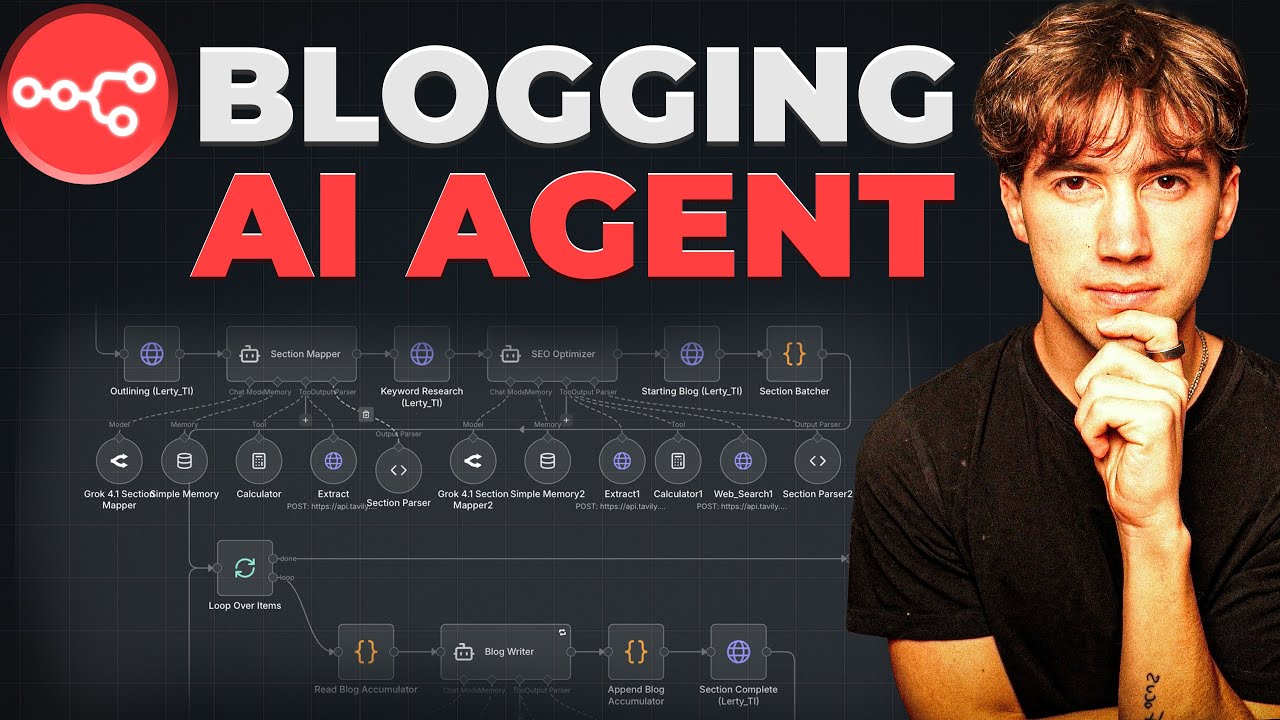
See the complete workflow in action - from initial brainstorming to final published post. The video demonstrates real-time content generation and shows how human oversight integrates seamlessly with AI automation at key decision points.
Key Takeaways
This n8n workflow represents the future of content creation - combining AI efficiency with human judgment where it matters most. By automating the time-consuming parts of blogging while maintaining strategic oversight, businesses can finally achieve the content volume needed to compete without sacrificing quality or brand voice.
In summary: The system generates complete, SEO-optimized blog posts 10x faster than manual writing, maintains your brand voice through configured parameters, and gives you control at every critical decision point - from topic selection to final publication.
Frequently Asked Questions
Common questions about this topic
This n8n workflow combines multiple AI models with structured research, SEO optimization, and human oversight at key points. Unlike a simple ChatGPT prompt, it maintains brand voice consistency, researches current trends, and structures content for reader retention and search visibility.
The system also includes built-in quality controls and revision loops that generic AI tools lack. Each component - from brainstorming to final output - is handled by specialized agents working together rather than a single generic model.
- Multi-model approach uses the best AI for each task
- Built-in SEO optimization before writing begins
- Structured content planning for better reader engagement
The workflow can generate a complete 2,000-word blog post in about 7-10 minutes, including research, outlining, writing and SEO optimization. This is about 10x faster than manual writing while producing higher quality, more structured content.
The system shows progress indicators at each stage so you know exactly where it is in the process. Time may vary slightly depending on complexity and whether you include human review steps.
- 2,000 words in under 10 minutes
- Real-time progress tracking
- Consistent quality regardless of output speed
Yes, the workflow includes a configuration node where you set company details, brand voice, and industry specifics. These parameters guide all AI agents in the system. You can specify whether you want content to be professional, conversational, technical, or any other style.
The system maintains this voice consistently across all generated content. You can even provide examples of your best-performing content to help the AI match your preferred style more closely.
- Set brand voice parameters upfront
- Provide style examples for better matching
- Consistency across all generated content
The workflow includes a dedicated keyword researcher that identifies high-value, low-competition keywords before writing begins. The content is then structured and optimized around these terms.
The system also handles internal linking strategies, meta descriptions, and readability scoring - all automatically adjusted based on your target audience. This happens during the writing process rather than as an afterthought.
- Keyword research before writing begins
- Automatic internal linking strategies
- Readability scoring for your target audience
At key points like topic selection and final approval, the workflow pauses for human input. You receive interactive forms where you can adjust parameters before the AI continues. This 'automated control' approach combines AI efficiency with human judgment where it matters most.
You can also set up revision loops for quality control. The system remembers your feedback, creating a continuous improvement cycle where the AI gets better at anticipating your preferences.
- Interactive forms at critical decision points
- Option to add custom revision loops
- System learns from your feedback over time
Yes, the system includes options to publish directly to WordPress, Webflow, or other CMS platforms. After content generation, you get a menu where you can choose to publish, archive, or request revisions.
The workflow handles all formatting, image optimization, and metadata for your specific platform requirements. You can even set up different publishing rules for different content types or categories.
- Direct publishing to major CMS platforms
- Automatic formatting for your specific system
- Custom rules for different content types
The system leverages multiple specialized models through OpenRouter - using the best model for each task. Research might use Claude for accuracy, creative sections might use GPT-4, while technical explanations could use specialized models.
This multi-model approach produces higher quality results than any single AI could achieve. You can customize which models are used for different tasks based on your preferences and budget.
- Specialized models for different tasks
- OpenRouter integration for model flexibility
- Customizable model selection
GrowwStacks can customize this workflow for your specific content needs, brand voice, and publishing platforms. We'll configure the AI agents to match your industry requirements and train your team on managing the workflow.
Our implementation includes ongoing optimization to ensure content quality and SEO performance. We handle all the technical setup so you can focus on strategy rather than implementation details.
- Custom workflow configuration for your business
- Team training and documentation
- Ongoing optimization and support
Ready to Transform Your Content Strategy?
Manual blog writing is costing you time and opportunities. Let us build this AI-powered content system for your business - customized to your brand voice and publishing needs.