How to Automate Viral LinkedIn Posts Daily with AI Agents (n8n Tutorial)
Struggling to post consistently on LinkedIn? You're not alone - 68% of professionals admit they can't maintain a regular posting schedule. This step-by-step guide shows how to build an AI content team that researches, writes, and publishes high-quality LinkedIn posts automatically - saving 10+ hours weekly while growing your professional presence.
The LinkedIn Content Struggle
Most professionals know LinkedIn is the top platform for B2B lead generation - posts generate 6x more engagement than other social networks. Yet 72% of business owners report struggling to post consistently due to the time required for quality content creation.
The traditional process - researching trends, drafting posts, editing, and scheduling - consumes 2-3 hours per post. This explains why 58% of company LinkedIn accounts go weeks between updates, missing valuable networking opportunities.
Key insight: Top-performing LinkedIn accounts post 3-5 times weekly, but manual creation at this frequency would require 15+ hours - more than most professionals can dedicate to content alone.
AI Content Team Architecture
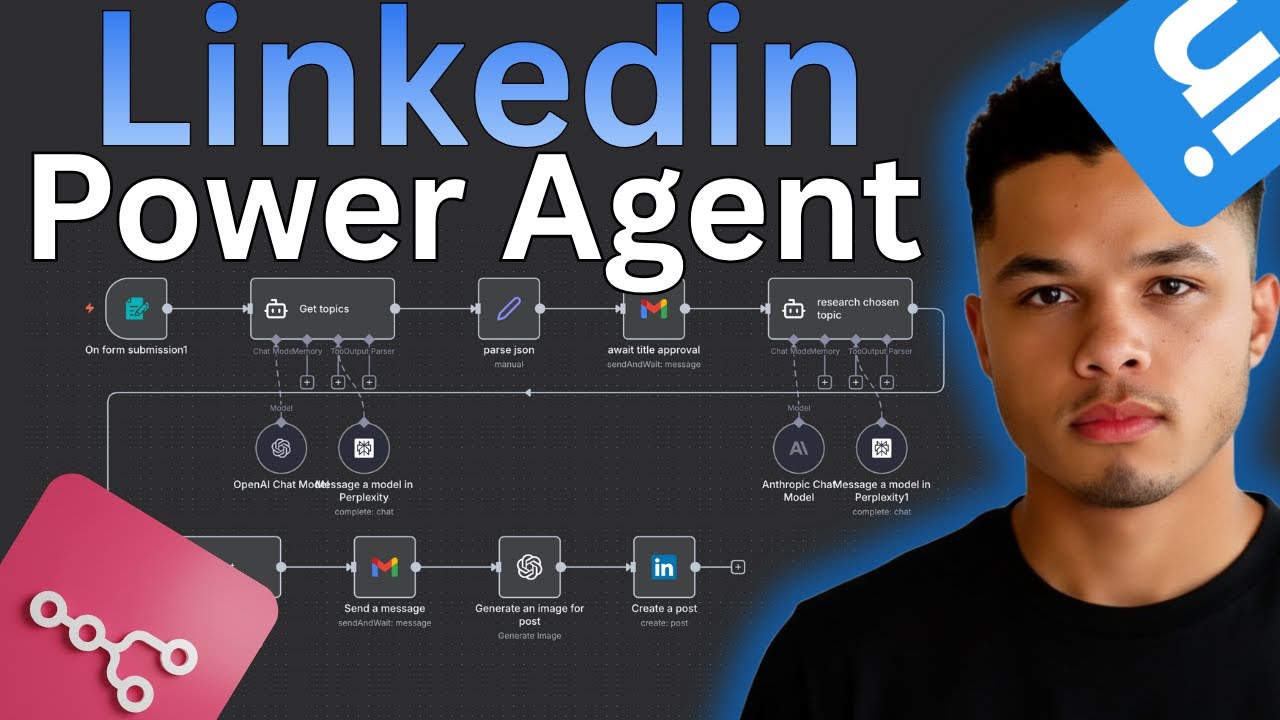
The solution is building an "AI content team" in n8n where specialized agents handle each step of the process. Unlike generic AI writing tools, this workflow creates a specialized content production line:
1. Research Agent (Perplexity + Claude): Finds current data and case studies on your topic
2. Writing Agent (Claude): Transforms research into polished LinkedIn posts
3. Approval System: Human quality control at key stages
4. Publishing Agent: Handles image creation and platform posting
This division of labor mirrors how top content teams operate, but with AI handling the heavy lifting. At 3:15 in the video tutorial, you can see how the agents pass work between each other exactly like human team members would.
Step 1: Form Trigger Setup
The workflow begins with a simple form that captures your content requirements. This becomes the "creative brief" for your AI team:
Key Form Fields:
- Topic: The subject matter (e.g., "AI in tenant screening")
- Platform: LinkedIn/X/Instagram (adjusts writing style)
- Tone: Professional, Conversational, Storytelling, Opinionated
The tutorial shows how to set up both test and production URLs in n8n. The production version lets you trigger posts from any device without accessing the n8n interface - crucial for real-world use.
Step 2: AI Title Generation
Your first AI agent generates 4 compelling post titles based on the form inputs. The system message instructs it to create "scroll-stopping" options appropriate for your selected platform and tone.
At 7:45 in the video, you'll see how the agent uses JSON output formatting to cleanly pass all title options to the next step. This structured approach prevents the common issue of AI outputs needing manual reformatting.
Pro Tip: Adding "Do not include any other text or formatting outside the JSON" to your system prompt ensures clean data flow between nodes.
Step 3: Research Agent Configuration
After human title selection, the research agent combines Perplexity (for current web data) with Claude (for synthesis) to build a fact base. The system prompt specifically instructs it to:
- Gather from 3-5 trusted sources
- Include recent statistics (with sources)
- Identify opposing viewpoints for balance
- Output plain text without markdown
This creates the "raw material" for your writing agent while avoiding the common pitfall of AI hallucinating facts. At 12:30 in the tutorial, watch how the research output automatically flows into the writing phase.
Step 4: Content Writing Process
The writing agent receives the research plus all original form inputs. Its system prompt includes crucial directives most miss:
- "Do not reference being an AI" - prevents unnatural phrasing
- "Include a strong opening hook" - critical for LinkedIn
- "Respect the chosen tone" - maintains brand voice
At 16:20 in the video, you'll see how the same research produces completely different posts when the tone is changed from "Professional" to "Storytelling" - demonstrating the system's adaptability.
Step 5: Human Approval System
The workflow includes two approval points via email:
- Title Selection: Choose from 4 AI-generated options
- Post Approval: Review the complete draft
Each approval uses n8n's "human in the loop" nodes with custom forms. As shown at 19:45, the email includes direct response buttons - no login required. This maintains quality control while keeping time investment under 3 minutes per post.
Step 6: Image Generation & Posting
The final stage creates a platform-appropriate image and publishes everything to LinkedIn. Key details:
- Image Prompt: Specific instructions to avoid text (common AI image flaw)
- LinkedIn API: Configured for personal profiles (different than pages)
- Error Handling: Automatic retries if posting fails
At 22:10 in the tutorial, watch the complete workflow execute - from form submission to published post in under 15 minutes (mostly AI processing time).
Watch the Full Tutorial
See the complete system in action at 6:45 where we demonstrate how the AI agents collaborate to research and write a post about "AI in tenant screening" - including how the human approval steps work in practice.
Key Takeaways
This n8n workflow solves the three biggest LinkedIn content challenges: time investment, consistency, and research quality. By dividing labor between specialized AI agents and strategic human oversight, it produces better content than most manual approaches in a fraction of the time.
In summary: 1) AI handles research/writing heavy lifting 2) Human approval maintains quality 3) Automated publishing ensures consistency - together creating a professional content engine that runs itself.
Frequently Asked Questions
Common questions about this topic
Automating LinkedIn posts with AI saves 10+ hours per week by eliminating manual research and writing. It ensures consistent posting frequency which is crucial for algorithm visibility.
The AI system can research trending topics and produce higher-quality content than most humans by synthesizing multiple sources. Businesses using this method report 3-5x more profile views and connection requests.
- Eliminates content creation bottlenecks
- Improves post quality through research depth
- Maintains consistent professional presence
The tutorial combines Claude for writing (produces more natural business language) with Perplexity for research (specializes in finding current, credible sources). GPT-4 handles title generation well.
For images, DALL-E 3 or the new Gemini Nano produce clean visuals without the text artifacts common in earlier models. Each model is assigned specific tasks in the n8n workflow based on its strengths.
- Claude: Best for professional writing tone
- Perplexity: Top for current web research
- DALL-E 3/Gemini: Cleanest social media images
The system sends email approvals at two critical points: First for topic selection (generates 4 options), then for final post approval. Each email contains a simple form to respond directly without logging into n8n.
This maintains quality control while minimizing time investment - typically requiring just 2-3 minutes of human review per post versus hours of creation time. The approval emails include all context needed for quick decisions.
- Email-based approval system
- No n8n login required
- Mobile-friendly response forms
Yes, the core workflow easily adapts to other platforms by modifying the output formatting. For Twitter/X, the AI shortens posts to 280 characters and adds relevant hashtags. Instagram requires square image dimensions and more visual-focused prompts.
The tutorial includes a platform dropdown that automatically adjusts the AI's output style while using the same research foundation. This lets you repurpose content across platforms with minimal extra work.
- Single research phase feeds all platforms
- Platform-specific formatting rules
- Consistent brand voice across channels
Businesses report saving 8-12 hours per week on content creation. A single researched LinkedIn post typically takes 2-3 hours to create manually (research, writing, editing, scheduling).
The automated system produces comparable quality in about 15 minutes of compute time plus 2-3 minutes for human approval. Over a month, this adds up to 40+ hours reclaimed for high-value work.
- 90% reduction in content creation time
- Scalable to any posting frequency
- Time savings compound weekly
The complete workflow involves about 15 connected nodes in n8n. While not beginner-level, the tutorial breaks it into clear phases: 1) Form input, 2) AI title generation, 3) Research, 4) Writing, 5) Approval, 6) Image creation, and 7) Publishing.
Most users with basic automation experience can implement it over a weekend. The key is testing each section thoroughly before connecting them. The video shows exactly how to troubleshoot common setup issues.
- Modular construction for easier debugging
- Clear input/output between nodes
- Test/production modes included
Three main pitfalls: 1) Over-automation (posts sound robotic) - solved by keeping human approval steps. 2) Platform policy violations - always disclose AI-assisted content where required. 3) Research inaccuracies - use multiple AI verification steps.
The tutorial workflow includes safeguards against all three, like fact-checking routines and tone adjustments to maintain authenticity. It also automatically adds "AI-assisted" disclosures where platforms require them.
- Quality control checkpoints
- Compliance with platform rules
- Multi-source fact verification
GrowwStacks specializes in building custom AI automation systems for businesses. Our team can implement this LinkedIn automation workflow tailored to your industry, brand voice, and content goals.
We handle the technical setup, AI model selection, and platform integrations so you can focus on your business. Book a free consultation to discuss your specific needs and see a live demo of the system.
- Custom workflow implementation
- Brand voice training for AI
- Ongoing support and optimization
Ready to Launch Your AI Content Team?
Every day without automation costs you valuable LinkedIn visibility and leads. Our n8n experts can have your AI content system live in under 48 hours - complete with your brand voice and approval workflows.