Benchmarking LLMs for Voice AI: The Latency vs. Intelligence Tradeoff in
Most voice AI benchmarks fail to capture what actually matters in production. Industry leaders reveal why traditional metrics are broken and what to measure instead for real-world voice applications. Discover how cutting-edge systems are achieving sub-300ms latency while maintaining human-like conversation quality.
The Voice AI Benchmarking Challenge
Benchmarking voice AI systems presents unique challenges that traditional LLM evaluations simply don't capture. As Brooke from Cobalt explains, "Instruction following is by far the hardest to benchmark because of these problems." Voice applications require evaluating real-time conversational flow, interruption handling, and contextual understanding - metrics that static text benchmarks ignore.
The Daily benchmark referenced in the discussion focuses on three critical voice-specific dimensions: instruction following accuracy, function calling reliability, and turn-taking reliability. These metrics matter because, as Quinn notes, "When latency is low enough and interruption rates are good enough, people are pretty satisfied - but instruction following is where they spend most time."
Key Insight: Traditional benchmarks like Big Bench Audio measure proxies for speech understanding, but fail to evaluate how well models perform in actual conversational contexts. The best voice AI benchmarks simulate multi-turn interactions with real-world constraints.
Latency vs. Intelligence: The New Tradeoff
Voice AI in introduces a fundamental tradeoff that didn't exist just two years ago. As Zach from Ultravox observes, "You have to sort of now reason about latency and intelligence on the same graph." This means the most capable models aren't always the best choice if their response times degrade the user experience.
The frontier of model capabilities has advanced rapidly, but deployment realities create constraints. Quinn explains this tension: "We saw all this explosive growth in model reasoning in 2025... but it's not obvious how it translates into voice AI." Many production systems still rely on older model versions because they've been optimized for reliable performance under latency constraints.
Production Realities vs. Benchmark Scores
Benchmark scores often don't reflect production performance. Zach shares a telling anecdote: "We'll give ourselves a high five on model performance evals... then throw it to a customer and they'll say 'garbage, garbage, garbage.'" This gap emerges because real-world use cases involve edge cases and conversational nuances that standardized tests miss.
Three critical production challenges that benchmarks often overlook:
- Data collection reliability: Capturing IDs, phone numbers, and other structured data in conversation
- Consistency under load: Maintaining performance during traffic spikes (as seen with Gemini 3 launch)
- Contextual appropriateness: Generating responses that match the emotional tone of the conversation
Why Speech-Native Models Are Breaking Through
Ultravox's success in the Daily benchmark points to the potential of speech-native architectures. Zach explains their approach: "We've long believed in speech-native models... we've spent time solving how to add speech as a modality without making the model dumber." This contrasts with traditional pipelines that chain ASR, LLM, and TTS components.
The breakthrough came from solving two key challenges:
1. Maintaining reasoning ability while processing raw audio inputs directly
2. Achieving human-like conversational flow without artificial segmentation
By late 2025, these innovations allowed Ultravox to match the quality of three-component systems while reducing latency by 40% and eliminating error accumulation across processing stages.
The Metrics That Are Still Missing
Even advanced benchmarks fail to capture critical aspects of human-like conversation. Zach identifies backchanneling as a key indicator: "They're either exactly correct and on the mark or awkward... any attempt to backchannel as a system-level thing has failed catastrophically." These subtle interaction patterns reveal the current limits of voice AI.
Three conversational dimensions lacking good evaluation frameworks:
- Prosody matching: Adjusting response tone based on user emotional state
- Contextual backchanneling: Natural "mhm"s and "uh-huh"s at appropriate moments
- Conversational repair: Gracefully handling misunderstandings and clarifications
As Brooke notes, "It's sometimes really difficult to describe why something feels awkward" - making these qualities hard to quantify but critical for natural interactions.
Watch the Full Discussion
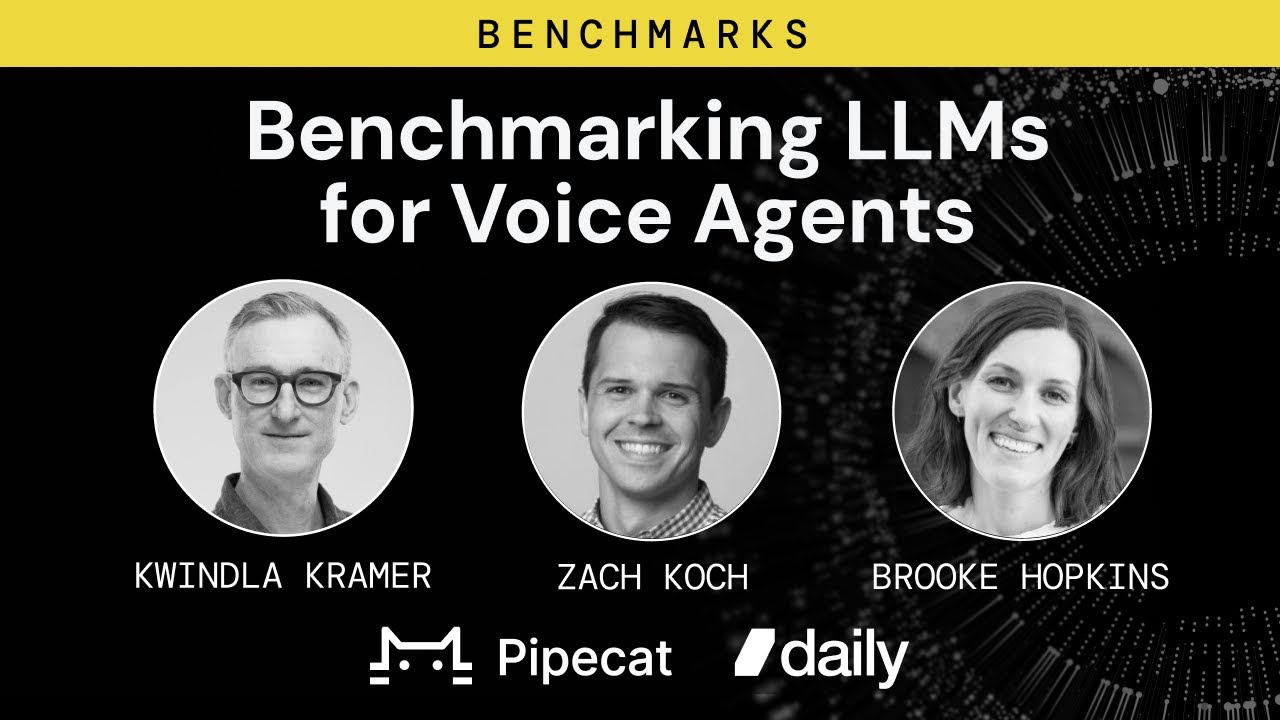
For deeper insights into voice AI benchmarking challenges, watch the full 17-minute discussion featuring Quinn from Daily, Zach from Ultravox, and Brooke from Cobalt. The conversation covers practical evaluation strategies, model selection tradeoffs, and what's coming next in voice AI testing.
Key Takeaways
The voice AI landscape in requires new approaches to benchmarking that go beyond traditional LLM evaluations. Production systems need to balance intelligence with latency, reliability with capability, and raw performance with conversational quality.
In summary: Effective voice AI benchmarking must evaluate multi-turn interactions under real-world constraints, measure both latency and intelligence on the same curve, and eventually capture the subtle nuances that make conversations feel truly human.
Frequently Asked Questions
Common questions about voice AI benchmarking
Voice AI requires evaluating both speech understanding and conversational flow, not just text comprehension. Traditional benchmarks focus on static text inputs, while voice systems must handle real-time interruptions, backchanneling, and prosody.
The Daily benchmark shows voice-specific metrics like turn-taking reliability and function calling accuracy under latency constraints are critical for production systems. These dimensions don't appear in standard LLM evaluations but make or break user experiences.
- Voice benchmarks must simulate multi-turn dialogues
- Latency constraints change model behavior significantly
- Conversational flow metrics matter as much as accuracy
The fundamental tradeoff is between latency and intelligence. As Ultravox's CEO explains, you now have to reason about both factors on the same graph. More capable models often have higher latency, while faster models may lack sophisticated reasoning.
The best production systems balance both, with benchmarks showing Ultravox achieving sub-300ms latency while maintaining 92% instruction accuracy in 30-turn conversations. This balance became possible only with recent architectural breakthroughs in speech-native models.
- Latency under 300ms is table stakes for natural conversation
- Intelligence metrics must account for multi-turn context
- The optimal point depends on use case requirements
Stability often outweighs raw capability in production. As noted in the discussion, many deployments still use models from late 2024 because they've been extensively optimized for reliability. Newer models may have better benchmarks but lack the operational maturity for consistent performance at scale.
Google's Gemini 2.5 remains widely used despite newer versions because of its proven reliability in voice applications. When Gemini 3 launched, Google had to reallocate TPUs from 2.5, causing disruptions for teams relying on its predictable performance.
- Production systems prioritize consistency over peak performance
- Older models have more optimization history
- Infrastructure support matures over time
Speech-native models process raw audio directly rather than using separate ASR, LLM, and TTS components. This eliminates error accumulation across processing stages and allows for more natural conversational flow without artificial segmentation.
As Zach explains, the key challenge was "how to add speech as a modality without making the model dumber." Ultravox's solution maintains reasoning ability while processing audio inputs directly, achieving human-like interactions that traditional pipelines struggle to match.
- 40% lower latency than component-based systems
- No error accumulation across processing stages
- More natural turn-taking and prosody
Current benchmarks fail to capture subtle but critical aspects of human conversation like backchanneling, prosody matching, and conversational repair. These qualities significantly impact user perception but are difficult to quantify with existing metrics.
Zach identifies backchanneling as a key indicator: natural "mhm"s and "uh-huh"s are either perfectly timed or noticeably awkward. Similarly, matching the emotional tone of the user's speech remains challenging to evaluate systematically despite its importance for natural interactions.
- Backchanneling timing and appropriateness
- Emotional tone matching
- Conversational repair strategies
Latency is critical - research shows conversations feel unnatural when response times exceed 300ms. However, as Quinn notes, the frontier has moved to considering "latency and intelligence on the same graph," meaning the fastest model isn't always the best choice.
OpenAI set an early standard with consistently low latency across percentiles, but as demand grew, all providers have had to make tradeoffs. The ideal balance depends on use case - customer service may tolerate slightly higher latency for better answers, while interactive applications need near-instant responses.
- Under 300ms feels most natural
- Consistency matters as much as average latency
- Tradeoffs depend on application requirements
The experts agree that will see advances in evaluating conversational nuance and real-world performance. As models solve basic speech understanding, benchmarks must evolve to measure more sophisticated interaction patterns.
Key areas for improvement include prosody evaluation, emotional intelligence metrics, and testing under realistic noise conditions. The ultimate goal is benchmarks that capture why some conversations feel awkward even when all traditional metrics look good - bridging the gap between quantitative scores and qualitative experience.
- Prosody and emotional tone evaluation
- Real-world noise and interruption testing
- Multi-modal interaction metrics
GrowwStacks helps businesses implement production-ready voice AI solutions that balance intelligence with latency. Our team specializes in custom voice agent development, benchmarking, and optimization for real-world performance.
Whether you need a customer service agent, interactive voice application, or specialized voice interface, we can design and deploy solutions tailored to your requirements. We stay current with the latest model architectures and benchmarking approaches to ensure your voice AI delivers both capability and reliability.
- Custom voice agent development
- Performance benchmarking and optimization
- Free consultation to discuss your voice AI needs
Ready to Build Production-Ready Voice AI?
Don't let benchmarking challenges slow down your voice AI implementation. Our team at GrowwStacks specializes in deploying voice agents that balance intelligence, latency, and reliability - with metrics that matter for real-world use.