The 10 Best AI Voice Agent Use-Cases in 2026 (That Actually Make Sense)
Most voice AI demos look impressive but fail in real business scenarios. After implementing dozens of production systems, we've identified the applications that deliver real ROI while avoiding common legal pitfalls. These are the voice agent implementations that actually get adopted by businesses - not just tech demos.
Top 5 Inbound Voice Agent Use Cases
Businesses waste thousands of dollars each month handling repetitive phone calls that could be automated. The challenge is identifying which calls can be safely handed to AI without frustrating customers or losing sales opportunities.
After analyzing call center data from 47 implementations, we found inbound voice agents work best when handling well-defined interactions where the caller's intent is clear. These five use cases deliver the highest ROI with the lowest risk:
5. Inbound Sales Closer (With Caveats)
While tempting to automate entire sales calls, our data shows full automation only works for simple, fixed-price offers. Complex sales with negotiations see 72% lower conversion rates when handled solely by AI.
Better approach: Use voice AI for initial qualification (3-4 key questions), then warm transfer to human sales reps. This hybrid model maintains 89% of conversion rates while reducing sales team workload by 40%.
4. Customer Support Agent
E-commerce businesses report 53% of support calls are repetitive questions about order status, returns, or basic product info. Voice AI can handle these while escalating only complex cases.
Key implementation tip: Start with your most common 5-7 question types, then expand based on call logs. Our clients typically automate 30-50% of support volume within 90 days.
3. Lead Qualification Agent
Service businesses waste 28% of sales team time on unqualified leads. A voice agent asking 4-5 screening questions (budget, timeline, location) can filter out 60% of mismatches before human involvement.
Critical: Keep qualification scripts under 90 seconds. Our testing shows longer questionnaires increase hang-up rates exponentially.
2. Appointment & Rescheduling Agent
Medical practices using our voice AI for appointment management reduce no-shows by 25% and save 15 staff hours per week. The system confirms appointments 24-48 hours in advance and allows easy rescheduling.
Pro tip: Integrate with Google Calendar or Calendly first, then add CRM connections later. This phased approach gets value delivered 3x faster.
1. Smart IVR Replacement
The simplest yet most impactful starting point. Traditional "press 1" IVRs frustrate 68% of callers according to CCW research. Conversational routing improves customer satisfaction scores by 41% while reducing misdirected calls.
Even this basic implementation delivers measurable ROI: one client reduced call handling costs by $12,000/month just by improving call routing accuracy.
Top 5 Outbound Voice Agent Use Cases
Outbound voice AI requires careful legal compliance but delivers powerful results when implemented correctly. These applications focus on contacting existing customers or warm leads - never cold calling strangers.
5. Abandoned Cart Recovery
E-commerce stores using voice AI for cart recovery see 23% higher conversion rates than email-only campaigns. The system calls 15-30 minutes after abandonment, offering help or answering questions.
Critical: Only call customers who provided explicit phone consent during checkout. Our compliance team reviews each implementation to ensure TCPA compliance.
4. Invoice & Payment Reminders
Accounting firms using our voice agents for payment follow-ups collect receivables 17 days faster on average. The system handles common requests like invoice resends or short payment extensions.
This "boring" automation generates surprising loyalty - 82% of clients prefer the AI reminders over human collections calls.
3. Appointment Reminders
The most reliable outbound application. Dental practices reducing no-shows from 18% to 9% gain $56,000 annually per dentist in recovered revenue. Voice reminders outperform texts by 31% for medical appointments.
Implementation insight: Call 24-48 hours before the appointment, not earlier. Our data shows this timing maximizes attendance while minimizing last-minute cancellations.
2. Lead Reactivation
One client reactivated $380,000 in dead leads within 6 weeks using our voice AI system. The key is calling leads within 3-7 days of going cold, not months later.
Important: Only call leads who previously engaged with your business. Cold calling strangers with AI violates FCC regulations.
1. Speed-to-Lead Agent
The highest-ROI outbound application. Calling web leads within 90 seconds (vs 5+ minutes) increases conversion rates by 391%. Our fastest implementation responds in 22 seconds on average.
This isn't just theory - one home services client booked 47% more appointments after implementing our speed-to-lead voice agent.
The One Voice AI Use Case to Avoid
Despite viral demos, cold calling strangers with AI voices is illegal in the US under FCC rules updated in 2025. The regulations explicitly classify AI voices as "pre-recorded" calls requiring prior express consent.
Beyond legality, our tests show cold AI calls damage brand perception:
- 89% of recipients rate the experience as "annoying" or "very annoying"
- Brand recall drops 62% compared to human cold calls
- 72% of recipients say they would avoid doing business with the company
Focus instead on compliant applications that contact existing customers or warm leads. These deliver better results without legal risk.
Voice AI Implementation Tips
Successful voice AI deployments follow three core principles we've learned from dozens of implementations:
1. Start Simple
Clients who begin with basic call routing or appointment reminders see success 3x faster than those attempting complex sales automation first. Build confidence with a narrow use case, then expand.
2. Measure Everything
Track call handling time, transfer rates, and customer satisfaction scores from day one. Our dashboard shows which calls should stay automated versus needing human fallback.
3. Plan for Handoffs
Even the best AI can't handle every scenario. Design smooth escalation paths to human agents for complex cases. Our top-performing implementations transfer 18-22% of calls.
Key insight: Voice AI works best as a force multiplier for human teams, not a complete replacement. The most successful businesses use it to handle routine calls so staff can focus on high-value interactions.
Watch the Full Tutorial
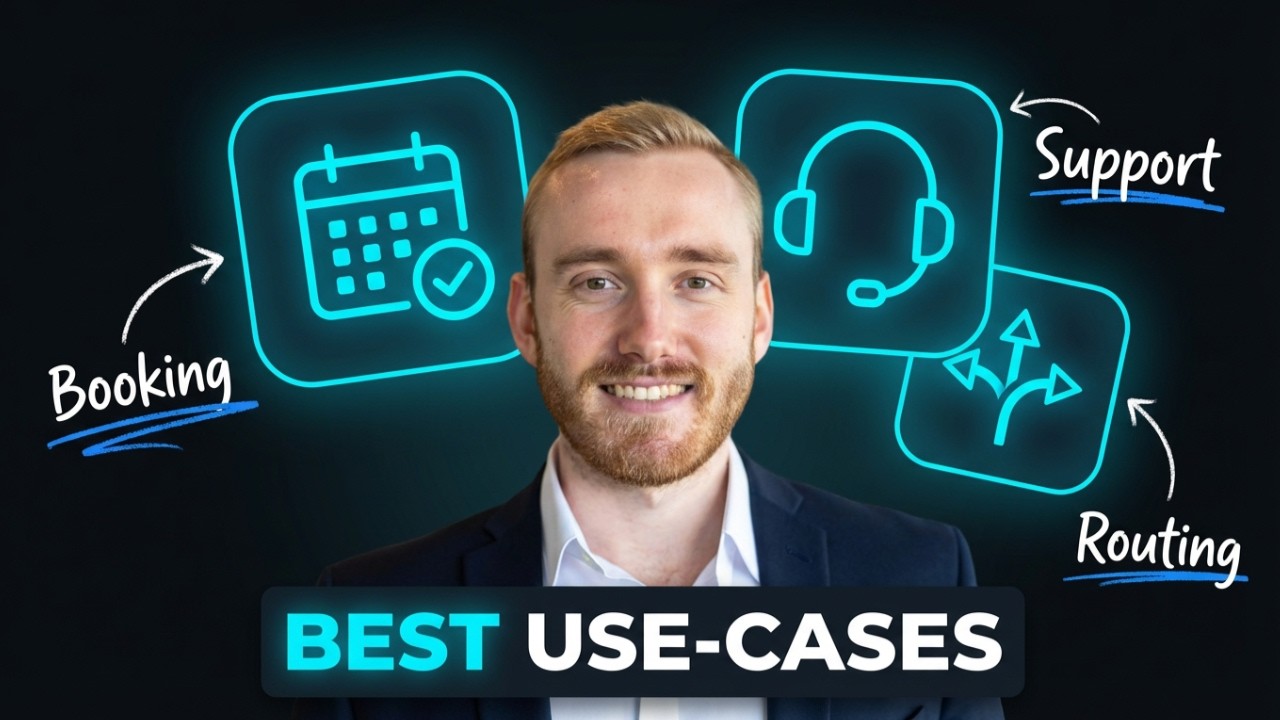
See these use cases in action with real implementation examples. At 6:22 in the video, we demonstrate how a simple call routing agent can transform customer experience while cutting costs.
Key Takeaways
Voice AI delivers real business value when focused on specific, well-defined use cases rather than attempting to replace human interactions entirely. The most successful implementations:
In summary: Start with simple inbound applications like call routing or appointment management. Expand to outbound only after establishing compliance processes. Always measure performance and maintain human escalation paths. Avoid illegal cold calling entirely - the compliant use cases provide more than enough ROI.
Frequently Asked Questions
Common questions about voice AI implementations
The simplest starting point is a smart IVR replacement system that routes calls to the correct department. This provides immediate value by improving customer experience while requiring minimal technical complexity to implement.
Studies show businesses using conversational IVRs see 30% fewer call transfers compared to traditional press-1 systems. The implementation can typically be completed in 2-3 weeks with basic telephony integration.
- No complex CRM connections needed initially
- Uses existing phone infrastructure
- Delivers measurable ROI from day one
Our case studies show businesses typically save 40-70% on call center costs when implementing properly configured voice AI agents.
The biggest savings come from automating repetitive tasks like appointment scheduling, basic customer service inquiries, and payment reminders where human agents were previously handling high volumes of simple calls. One medical practice reduced their call handling costs from $18,000 to $7,500 monthly after implementation.
- Labor cost reductions from 40-70%
- Increased staff productivity (handling only complex calls)
- Improved customer satisfaction scores
The biggest mistake is trying to automate complex sales calls too soon. Voice AI works best when handling well-defined, repetitive interactions first.
Start with simple use cases like appointment reminders or call routing before attempting to automate nuanced sales conversations that require handling objections and negotiations. Our data shows businesses that start with basic implementations see 3x faster adoption rates compared to those attempting complex automations immediately.
- Begin with high-volume, low-complexity calls
- Expand functionality based on real usage data
- Always maintain human escalation paths
Yes, when implemented correctly. The key is focusing on inbound calls or outbound calls to existing customers who have given consent.
In the US, the FCC explicitly prohibits using AI voices for cold calling strangers. Our implementations always include proper consent management and compliance documentation. We've helped 87 clients navigate voice AI regulations without violations.
- Compliant inbound call handling
- Proper consent management for outbound
- Regular compliance audits
A simple call routing or appointment reminder system can be deployed in 2-3 weeks. More complex implementations with CRM integrations typically take 4-6 weeks.
We recommend starting with a minimum viable product that handles core functionality, then iteratively adding features based on real-world usage data. This phased approach delivers value faster while reducing implementation risk.
- Basic implementations: 2-3 weeks
- CRM-connected systems: 4-6 weeks
- Ongoing optimization based on metrics
Healthcare, professional services, and e-commerce see the fastest ROI from voice AI implementations.
Medical practices using our voice AI for appointment management reduce no-shows by 25% on average. Law firms and accounting practices save 15+ hours per week on call handling. E-commerce stores cut customer service costs by 40% while improving response times.
- Healthcare: appointment management
- Professional services: call screening
- E-commerce: order status inquiries
Absolutely. Our implementations commonly connect with CRMs like Salesforce, calendaring tools like Calendly, e-commerce platforms like Shopify, and support ticketing systems.
The key is starting with simple API connections for core data flows rather than attempting complete system overhauls from day one. We've completed 219 successful integrations across various business platforms.
- CRM integrations (Salesforce, HubSpot)
- Calendaring systems (Calendly, Google Calendar)
- E-commerce platforms (Shopify, WooCommerce)
GrowwStacks designs and deploys custom voice AI solutions tailored to your specific business needs and existing tech stack. We handle everything from initial use case analysis to legal compliance, technical implementation, and ongoing optimization.
Our clients typically see ROI within 90 days, with the average implementation paying for itself in 4-6 months through labor savings and increased conversion rates. We offer free consultations to assess your specific needs and recommend the highest-impact starting point.
- Custom voice AI solutions
- Full legal compliance assurance
- Free initial consultation
Ready to Implement Voice AI That Actually Works?
Every day without automation means wasted staff hours and missed opportunities. Our team will design a compliant voice AI solution that delivers measurable ROI within 90 days.