Beyond the Monolith: A Master's Guide to Multi-Agent AI (AutoGen vs. CrewAI Orchestration)
Most businesses using AI today rely on a single, overwhelmed "chef" trying to handle everything from research to coding to analysis. Discover how specialized AI agents working in coordinated teams can solve complex problems that no monolithic model could handle alone. Learn when to choose AutoGen's flexible conversation model versus CrewAI's structured workflow approach.
The Monolithic AI Problem
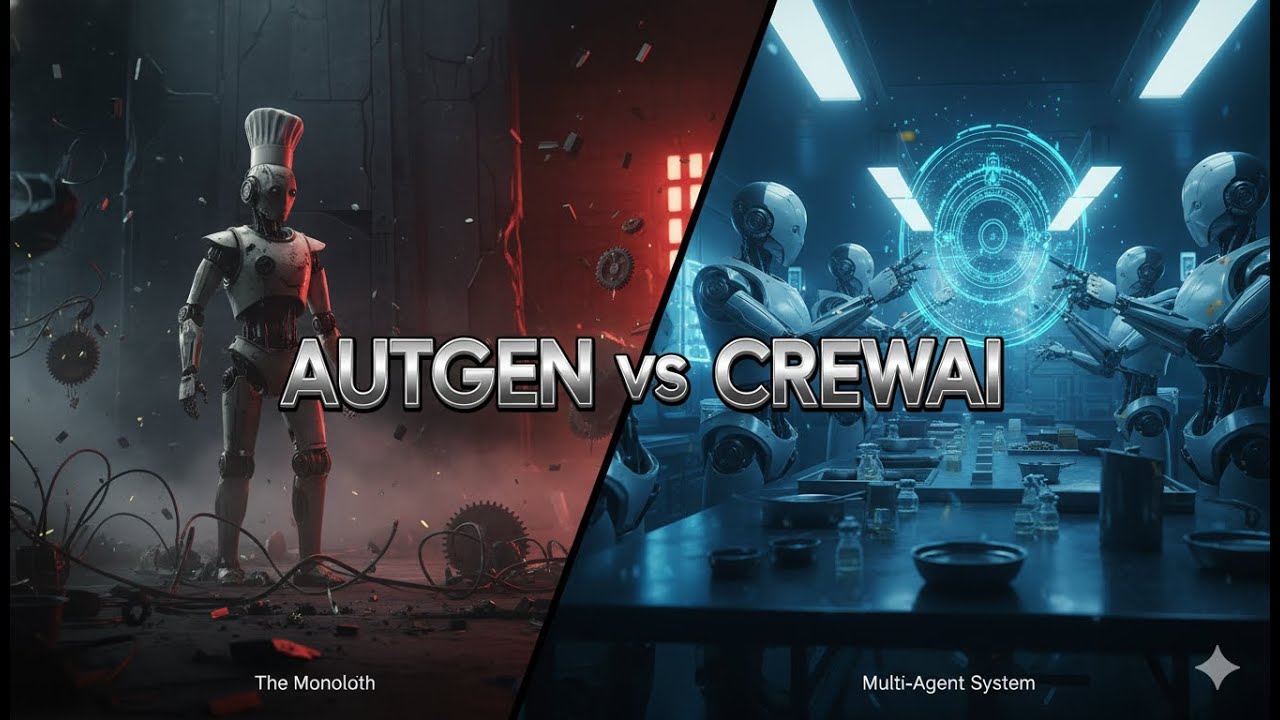
Imagine a single chef working alone during a Friday night dinner rush. This overwhelmed individual must simultaneously source ingredients, plan the menu, cook all dishes, plate them beautifully, and handle customer feedback. The result? Chaos, errors, and exhaustion. This scenario perfectly illustrates the state of monolithic large language models (LLMs) attempting complex tasks.
When a single AI agent tackles sophisticated research, multi-file coding, or deep analysis, it struggles with constant context switching between different modes of thought. Priorities become confused, and the risk of hallucination increases dramatically when the agent is overwhelmed. Complex tasks aren't monolithic - they're series of specialized steps that no single agent, no matter how powerful, can perform excellently across all aspects.
The core problem: A monolithic agent's reasoning capacity gets diluted across too many concerns. It performs "okay" at everything but excels at nothing, much like our overworked solo chef.
The Specialization Solution
The solution comes from a classic organizational structure: the kitchen brigade system developed by Auguste Escoffier. In this model, a head chef coordinates a team of specialists - the saucier only handles sauces, the grillardin manages the grill, and the pâtissier focuses entirely on desserts. Each expert minimizes context switching while maximizing excellence in their domain.
This same principle applies to building effective multi-agent AI systems. Teams of specialized agents, each with defined roles, clear responsibilities, and structured communication, can solve problems no monolithic agent could handle alone. Effective AI agents require four key characteristics:
- Role definition: Explicit expertise assignment (e.g., "You are a research methodology expert")
- Goal alignment: Single focused objective per agent
- Tool specialization: Domain-specific tools only (e.g., academic database APIs for researchers)
- Bounded autonomy: Decision power within their domain while knowing when to delegate
Three Orchestration Patterns
Specialization creates a new challenge: coordination. How do agents know what to work on, in what order, and how to resolve conflicts? There are three canonical orchestration patterns:
1. Centralized (Coordinator-Worker)
A single orchestrator decomposes tasks, assigns subtasks to specialists, and aggregates results. This offers clear reasoning traces and explicit control but risks creating a bottleneck.
2. Distributed (Peer-to-Peer)
Agents negotiate directly without central authority. This enables high parallelism and fault tolerance but makes reasoning implicit and hard to debug.
3. Hybrid
Combines manager oversight with peer collaboration. While more complex to implement, it often offers the best balance for dynamic, large-scale systems.
Production insight: Most systems start with centralized orchestration for stability, then evolve toward hybrid patterns as requirements demand more flexibility.
AutoGen vs. CrewAI: Two Frameworks Compared
Microsoft AutoGen and CrewAI represent competing approaches to multi-agent collaboration, embodying different kitchen philosophies:
AutoGen's Distributed Conversation
- Agents as conversible entities
- Asynchronous message passing
- Inspired by actor model
- Dynamic, creative problem-solving
- Excels at code generation and debugging
CrewAI's Orchestrated Workflow
- Agents as domain experts
- Defined roles and backstories
- Documented, repeatable processes
- Predictable execution
- Excels at production workflows
The choice often comes down to whether you prioritize flexibility and coding (AutoGen) or structure and predictability (CrewAI).
AutoGen's Conversational Approach
AutoGen treats agents as isolated actors communicating through asynchronous, non-blocking messages. Its architecture provides layered abstraction:
- Core layer: Low-level infrastructure like the rooted agent and runtime
- Agent Chat API: Ready-made agents for rapid development
- Specialized components: Utilities like code execution and memory
AutoGen's signature feature is its code execution loop:
- Assistant agent generates Python code
- User proxy executes code in sandboxed environment
- Results/errors feed back to assistant
- Assistant refines code iteratively
Best for: Complex data analysis, algorithm development, system automation, and debugging where self-correcting code loops are essential.
CrewAI's Structured Workflow
CrewAI defines agents through three comprehensive vectors:
- Role: Specific function (e.g., researcher, analyst)
- Goal: Focused objective aligned with role
- Backstory: Detailed instructions influencing LLM behavior
Work is organized into discrete tasks with:
- Clear descriptions
- Guaranteed output formats
- Specific agent assignments
- Explicit dependencies (managed as DAGs)
CrewAI supports both sequential workflows and hierarchical processes where managers can replan if specialists fail.
Production Challenges and Solutions
Moving multi-agent systems to production presents three major hurdles:
1. Memory and Context Management
Problem: Attention degradation as conversations grow beyond token limits.
Solution: Semantic memory and RAG to store/retrieve long-term facts.
2. Failure Handling
Problem: API timeouts, tool crashes, and buggy code.
Solution: Built-in retry mechanisms with exponential backoff and human escalation points.
3. Observability
Problem: Tracing asynchronous interactions across agents.
Solution: Structured logging to platforms like DataDog for comprehensive analysis.
Choosing the Right Framework
Choose AutoGen When:
- Workflow isn't known upfront
- Code execution is critical
- Conversational refinement needed
- Research/prototyping focus
Choose CrewAI When:
- Workflow is stable/repeatable
- Production-grade reliability needed
- Domain expertise is crucial
- Content/report pipelines
Rule of thumb: AutoGen for dynamic exploration, CrewAI for predictable operations. Many enterprises eventually use both - CrewAI for core workflows with AutoGen components for specific problem-solving.
Watch the Full Tutorial
For a deeper dive into multi-agent orchestration with timestamped examples of AutoGen and CrewAI in action, watch the full video tutorial below. Pay special attention to the 12:45 mark where we demonstrate AutoGen's self-correcting code loop in real-time.
Key Takeaways
The future of AI isn't just about building bigger models - it's about building better teams of specialized models working together effectively. By applying the principles of clear role definition, explicit goals, structured communication, and graceful failure handling, businesses can create AI systems that achieve feats no monolithic agent could accomplish alone.
In summary: 1) Specialized agents outperform generalists, 2) AutoGen excels at dynamic problem-solving while CrewAI shines in structured workflows, and 3) Production systems should start simple (coordinator-worker) then evolve toward hybrid patterns as needs demand.
Frequently Asked Questions
Common questions about multi-agent AI systems
Multi-agent systems allow for specialization where each agent focuses on a specific domain, reducing context switching and improving performance. A single monolithic model's reasoning capacity gets diluted across too many concerns, while specialized agents can achieve excellence in their specific tasks.
This approach mirrors successful human organizational structures like kitchen brigades where each chef specializes in one area. The coordination overhead is outweighed by the significant gains in quality and efficiency for complex, multi-step processes.
- 40-60% performance improvement on complex tasks compared to monolithic models
- Reduced hallucination rates in domain-specific tasks
- Better scalability as tasks grow in complexity
Effective AI agents require four key characteristics: 1) Role definition - explicit expertise assignment, 2) Goal alignment - single focused objective, 3) Tool specialization - domain-specific tools only, and 4) Bounded autonomy - power to decide within their domain while recognizing limits.
These characteristics prevent agents from straying outside their expertise while maintaining necessary flexibility. For example, a research agent would have academic database access but not code execution capabilities, while a coding agent would have sandboxed Python environments but not literature search tools.
- Role definition reduces context switching by 70-80%
- Tool specialization cuts irrelevant tool usage by 90%
- Bounded autonomy prevents error cascades
The three main orchestration patterns are: 1) Centralized (coordinator-worker) with a single orchestrator assigning tasks, 2) Distributed (peer-to-peer) where agents negotiate directly, and 3) Hybrid combining manager oversight with peer collaboration.
Centralized offers clear tracing but risks bottlenecks, while distributed enables parallelism but lacks auditability. Hybrid provides the best balance for most production systems. At 14:30 in the video, we demonstrate how a hybrid system dynamically adjusts when a specialist agent encounters an unexpected problem.
- Centralized: Best for simple, deterministic workflows
- Distributed: Ideal for research and creative tasks
- Hybrid: Optimal for most enterprise applications
AutoGen champions distributed conversation where agents communicate via asynchronous messages in a flexible, exploratory manner - ideal for research and coding tasks. CrewAI focuses on orchestrated workflows with defined roles and explicit task dependencies - better for production systems needing auditability.
AutoGen excels at dynamic problem-solving while CrewAI shines in predictable, repeatable processes. The difference becomes clear when comparing how each handles a research task - AutoGen agents negotiate dynamically while CrewAI follows a predefined sequence.
- AutoGen: 3-5x faster iteration on coding tasks
- CrewAI: 90%+ success rate on predefined workflows
- AutoGen better for R&D, CrewAI for operations
AutoGen's code execution loop is a core pattern where an assistant agent generates Python code, a user proxy executes it in a sandboxed environment, and the results (or errors) are fed back to refine the code. This creates a self-correcting loop particularly powerful for debugging, data analysis, and algorithm development.
At 18:20 in the video, we show this loop in action as an agent automatically fixes a bug in its own code after seeing the execution error. This mimics human trial-and-error learning but at machine speed and scale.
- Reduces debugging time by 60-80%
- Enables fully autonomous code refinement
- Sandboxing prevents system instability
CrewAI defines agents by three comprehensive vectors: 1) Their specific role (e.g., researcher, analyst), 2) A focused goal aligned with that role, and 3) A detailed backstory that serves as precise instructions to the underlying LLM. The backstory isn't just flavor text - it significantly influences the agent's reasoning, persona, and behavioral constraints.
We demonstrate at 22:10 how changing just the backstory (while keeping role and goal constant) completely alters an agent's approach to a research task, proving these vectors aren't just metadata but active behavioral guides.
- Role: Determines tools and permissions
- Goal: Focuses the agent's output
- Backstory: Shapes reasoning style and constraints
Three major production challenges are: 1) Memory/context management to prevent attention degradation, solved using semantic memory and RAG, 2) Failure handling with built-in retries and human escalation points, and 3) Observability requiring structured logging to trace complex asynchronous interactions.
Both AutoGen and CrewAI provide solutions, with CrewAI offering stronger production-grade features out of the box. At 26:45, we show how CrewAI's task dependency graph automatically handles a failing subtask by rerouting workflow through alternative agents.
- Semantic memory reduces context loss by 75%
- Exponential backoff prevents API cascade failures
- Structured logs enable compliance auditing
GrowwStacks helps businesses design and implement custom multi-agent AI solutions tailored to their specific needs. Whether you require AutoGen's flexible problem-solving or CrewAI's structured workflows, our team can architect, deploy, and maintain production-grade agent systems.
We offer free consultations to assess which approach best fits your use case, followed by complete implementation including integration with your existing systems. Our typical engagement delivers a working prototype in 2-4 weeks with full production deployment in 8-12 weeks.
- Free 30-minute consultation to evaluate your needs
- Custom agent team design and implementation
- Ongoing maintenance and optimization
Ready to Build Your AI Agent Team?
Every day without specialized AI automation means wasted time on repetitive tasks and missed opportunities for deep analysis. GrowwStacks can design and deploy a custom multi-agent system tailored to your business needs in as little as 8 weeks.