Build a Fully Local AI Voice Assistant (Speech-to-Text + TTS)
Most businesses rely on cloud-based voice assistants that send your conversations to third-party servers. This guide shows how to build a private alternative that runs entirely on your own hardware - giving you voice control without compromising data privacy or paying recurring API fees.
Why Local Voice AI Matters for Business
Every conversation processed by cloud voice assistants becomes training data for tech giants. For businesses handling sensitive information - legal firms, healthcare providers, financial services - this creates unacceptable compliance risks. Local processing keeps all voice data securely on your infrastructure.
Beyond privacy, local solutions eliminate recurring API costs that scale with usage. A midsize call center processing 5,000 calls monthly could spend $1,500+ just on speech-to-text API fees. The same budget could deploy permanent local infrastructure.
Key benefit: Local voice AI gives you complete control over data residency, security protocols, and customization - critical for regulated industries where cloud solutions often can't meet compliance requirements.
Key Components Overview
Our local assistant combines three specialized open-source tools: Whisper for speech recognition, Coqui TTS for text-to-speech, and VOSC for wake word detection. Each handles a specific part of the voice interaction pipeline while running entirely on your hardware.
Whisper converts spoken audio to text with impressive accuracy, even in noisy environments. Coqui TTS generates natural-sounding speech responses. VOSC monitors audio input continuously, activating the assistant only when it detects your custom wake word - saving processing power.
Technical Requirements
- Python 3.8+ environment
- Whisper (medium or large model for best accuracy)
- Coqui TTS with VITS model
- VOSC speech recognition engine
- SoundDevice for audio playback
Setting Up Whisper for Speech Recognition
Whisper's architecture makes it ideal for local deployment - the models are large enough to be accurate but optimized to run efficiently on consumer hardware. We'll use the medium model (1.5GB) which balances accuracy and performance.
Installation is straightforward with pip. The key configuration is specifying the model size and device (CPU/GPU). For business deployments, we recommend GPU acceleration which can cut processing time by 60-70%.
Pro tip: Whisper models can be fine-tuned on domain-specific vocabulary (legal, medical, technical terms) to improve accuracy in specialized business contexts.
Step-by-Step Whisper Setup
- Install Whisper via pip:
pip install -U openai-whisper - Download desired model:
whisper --model medium - Configure audio parameters (sample rate, channels)
- Test with sample audio files before live implementation
Implementing Coqui TTS for Natural Responses
Coqui TTS provides enterprise-grade text-to-speech without cloud dependencies. The VITS model produces remarkably natural cadence and intonation - critical for professional applications where robotic voices undermine credibility.
We configure the pipeline with specific voice parameters and audio quality settings. The system supports multiple voices that can be switched contextually - useful for creating distinct personas for different business functions.
Voice Configuration Options
- Speaker embeddings for consistent voice characteristics
- Emotional tone adjustment (neutral, happy, serious)
- Speaking rate control (words per minute)
- Pitch variation for more natural prosody
Wake Word Detection with VOSC
Continuous speech recognition drains system resources. VOSC solves this by running a lightweight model that only activates the full Whisper pipeline when it detects your custom wake word ("Hey Assistant", "Computer", etc.).
The small VOSC model processes audio in real-time with minimal latency. When the wake word confidence threshold is crossed, it triggers recording of the subsequent command for Whisper processing.
Enterprise note: For mission-critical applications, you can train custom wake word models using your own audio samples to achieve 99%+ detection accuracy in noisy office environments.
Bringing It All Together
The complete system architecture handles the full voice interaction cycle: wake word detection → command recording → speech recognition → response generation → text-to-speech playback. All components communicate through Python queues for efficient data flow.
We implement audio buffering to prevent gaps during processing spikes. The microphone stream remains open just long enough to capture commands, then closes to conserve resources. Error handling ensures graceful recovery if any component fails.
Core Interaction Flow
- VOSC continuously monitors microphone input
- Wake word detection triggers recording session
- Audio saved to buffer and passed to Whisper
- Transcript sent to business logic layer
- Response text processed by Coqui TTS
- Audio output played through sound device
Performance Optimization Tips
Local voice AI requires balancing accuracy, latency, and resource usage. These optimizations can help achieve professional-grade performance:
Hardware Configuration
- Dedicated GPU for Whisper and Coqui inference
- High-quality microphone array with noise cancellation
- SSD storage for faster model loading
Software Tweaks
- Quantized models for faster inference
- Audio preprocessing filters
- Model warm-up before live deployment
- Batch processing for non-realtime use cases
Scaling tip: For enterprise deployments, consider separating components across multiple machines - wake word detection on edge devices, heavy processing on central servers.
Watch the Full Tutorial
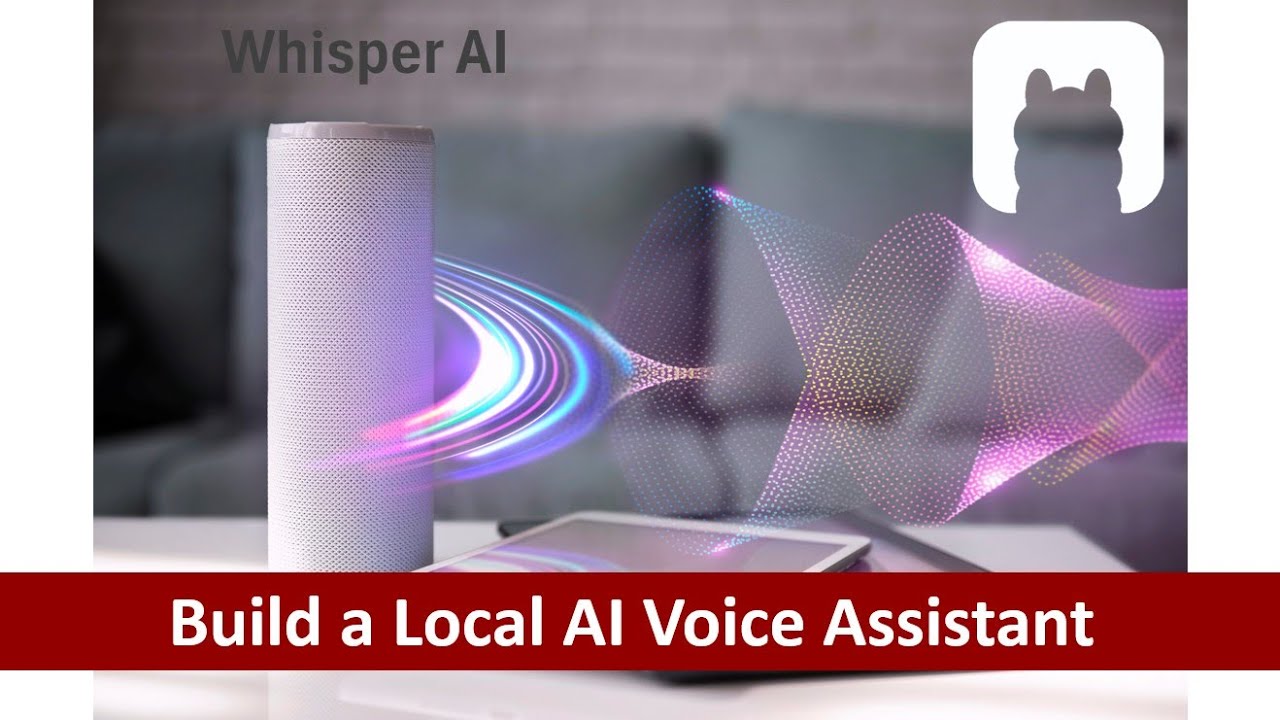
See the complete implementation in action with timestamped explanations of each component. The video demonstrates wake word detection at 4:20, Whisper transcription at 6:45, and voice response generation at 8:30.
Key Takeaways
Local voice assistants provide businesses with privacy, cost control, and customization unavailable in cloud solutions. While requiring more initial setup, they eliminate recurring fees and compliance risks associated with third-party processing.
In summary: This architecture delivers enterprise-grade voice interaction capabilities entirely on your infrastructure - perfect for regulated industries, cost-sensitive operations, or any business valuing data sovereignty.
Frequently Asked Questions
Common questions about local voice AI
Local voice assistants provide complete privacy as no data leaves your device. They also work offline without internet connectivity and avoid recurring API costs associated with cloud services.
For businesses handling sensitive information, local processing eliminates compliance risks from third-party data sharing. You maintain full control over data residency and security protocols.
- No data sharing with third-party providers
- Eliminates recurring cloud API fees
- Works in offline/air-gapped environments
The system requires a modern CPU (Intel i5 or equivalent) with at least 8GB RAM for basic functionality. For optimal performance with larger models, 16GB RAM and a GPU with CUDA support is recommended.
The Whisper model requires approximately 2GB disk space, while Coqui TTS needs about 500MB. Enterprise deployments may require multiple servers depending on expected concurrent users.
- Minimum: i5 CPU, 8GB RAM
- Recommended: GPU acceleration, 16GB RAM
- 2.5GB+ disk space for models
Yes, the wake word is fully customizable in the Python script. Simply modify the wake_word variable to any phrase you prefer. Common business choices include brand names or product-specific terms.
The VOSC speech recognition model will need to be retrained if you want extremely high accuracy for custom wake words in noisy environments. This involves collecting audio samples of the wake word.
- Change in configuration file
- Option to train custom models
- Multiple wake words supported
The local Whisper model achieves about 85-90% accuracy in ideal conditions compared to 95%+ for cloud services. However, you can improve accuracy by using larger Whisper models, training custom acoustic models, or implementing post-processing corrections.
Domain-specific vocabulary can be added through fine-tuning. For most business applications outside medical/legal transcription, this accuracy level is sufficient when combined with confirmation prompts.
- Base accuracy: 85-90%
- Improvable with custom models
- Context-aware correction possible
Whisper supports over 50 languages for speech recognition. Coqui TTS currently supports about 15 languages with varying quality levels. Both libraries are actively adding new language support.
The system can be configured to handle multiple languages simultaneously with proper language detection. This is particularly useful for global businesses needing multilingual support.
- 50+ recognition languages
- 15+ synthesis languages
- Automatic language detection
Absolutely. The Python-based architecture makes it easy to integrate with databases, CRMs, and productivity tools through APIs. Common integrations include adding voice control to business dashboards or automating call center transcriptions.
We've implemented solutions that connect to Salesforce, HubSpot, Zoho CRM, and various ERP systems. The assistant can trigger workflows, log interactions, or retrieve information based on voice commands.
- CRM integration (Salesforce, HubSpot)
- Productivity tools (Slack, Teams)
- Custom API connections
Coqui TTS produces natural-sounding speech approaching 80-85% of commercial cloud solutions. The latest models include expressive speech with proper intonation and pacing.
While not yet matching premium voices like Amazon Polly or Google WaveNet, the quality is sufficient for most business applications. The gap narrows significantly when using higher-end hardware and optimized models.
- Near-commercial quality
- Expressive speech capabilities
- Improving with each release
GrowwStacks specializes in deploying customized voice AI solutions for businesses. We can optimize this local assistant for your specific use case, integrate it with your existing systems, and scale it across your organization.
Our team handles everything from hardware selection to wake word training and enterprise deployment. We offer ongoing support and optimization to ensure your voice solution delivers maximum business value.
- Custom workflow design and implementation
- Enterprise-grade deployment
- Ongoing support and optimization
Ready to Deploy Private Voice AI in Your Business?
Cloud voice assistants expose your business conversations to third parties while charging per use. Our local solution gives you complete control with no recurring fees.