How to Build Profitable AI Agent SaaS Products in (Beginner Friendly)
Businesses waste thousands each month on repetitive tasks that AI could automate - content creation, competitor research, lead generation. The opportunity? Package these automations as standalone SaaS products that customers pay for monthly. This guide reveals the exact tech stack and business model that lets non-technical founders build and sell AI agents profitably.
The Untapped Opportunity in AI Agent SaaS
Every business has repetitive workflows they pay employees or freelancers to do manually - writing client content, researching competitors, generating lead lists, creating reports. These tasks consume hours each week and cost thousands in labor, yet they follow predictable patterns perfect for AI automation.
The breakthrough realization? These automations don't need to be internal tools. When packaged as standalone SaaS products with simple interfaces, businesses will pay monthly for the time savings. At 2:15 in the video, Oliver shares how his PaperSchedule.com generates daily content for clients automatically - a task that would normally require dedicated writers.
The AI agent SaaS opportunity: Identify workflows where businesses currently spend $500-$2000/month on human labor, then build an agent that does it for $47-$197/month. The value proposition sells itself when you're saving customers 80% of their current costs.
5 Painful Workflows Ripe for Automation
Not all business tasks make good AI agent candidates. The sweet spot is workflows that are repetitive, time-consuming, and have some creative/mental component that makes them expensive to outsource. Here are the five most profitable categories:
1. Content Creation
Marketing agencies spending $1000+/month per client on blog posts and social media content. An agent can analyze competitors, generate SEO-optimized articles, and format them for publishing - exactly what Oliver's Content Forge example does at 14:30 in the video.
2. Competitor Research
Ecommerce stores manually tracking competitor pricing, promotions, and new products. An agent can scrape this daily, analyze trends, and alert when important changes occur.
3. Lead Research & Outreach
Sales teams spending hours researching companies and crafting personalized emails. At 16:45, the Lead Intel example shows how an agent automates scraping company sites, finding pain points, and generating outreach.
4. Data Analysis & Reporting
SEO agencies creating weekly client reports by manually compiling data from 5+ tools. An agent can pull all metrics automatically, highlight key insights, and generate polished PDFs.
5. Customer Support
Businesses fielding the same 20 questions via email daily. An agent can handle common inquiries, only escalating truly unique cases to humans.
Validation tip: Before building, DM 20 target customers asking: "How many hours per week does your team spend on [task]? What do you currently pay for solutions?" Real data beats assumptions.
The Beginner-Friendly Tech Stack
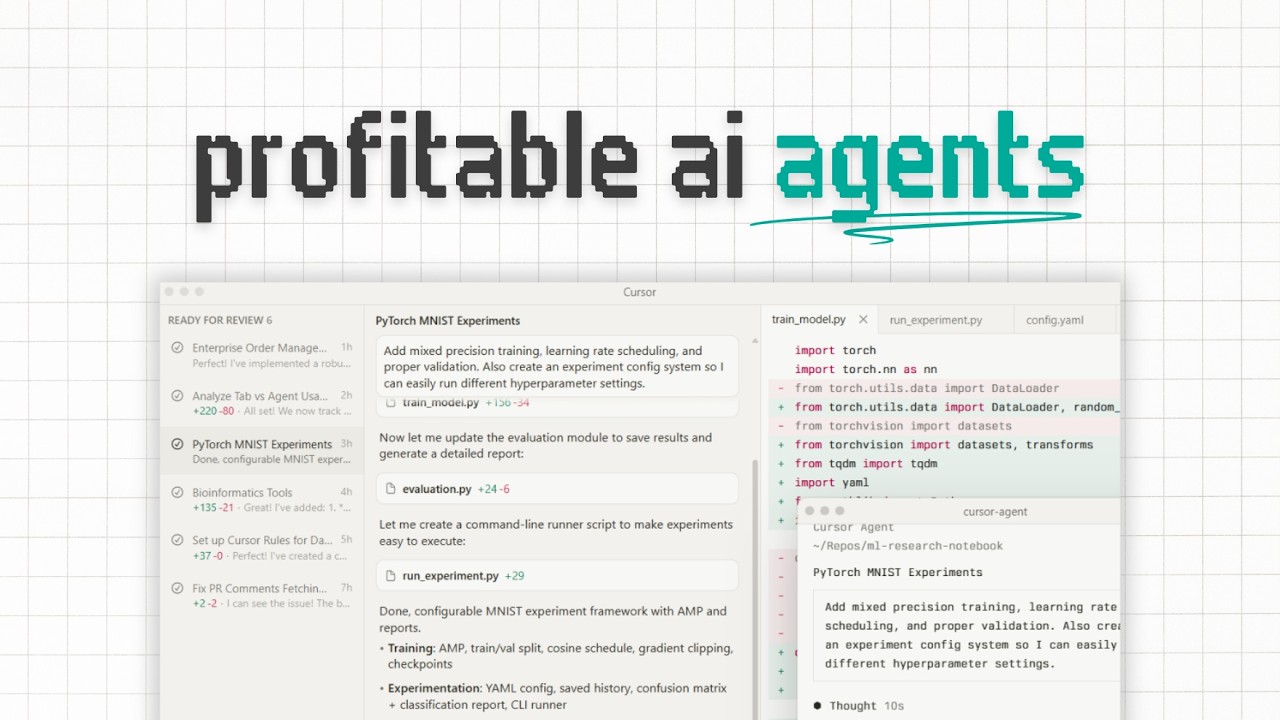
The traditional barrier to building SaaS products - complex coding - disappears with modern AI-assisted tools. At 8:10 in the tutorial, Oliver walks through the exact stack that lets non-technical founders create production-ready agents:
Cursor ($20/month)
AI-powered code editor that helps you build the frontend and backend of your SaaS. You describe what you want in plain English, and Cursor helps write the code.
Trigger.dev (Free tier)
The secret sauce for running agents at scale. Unlike Make.com or n8n, Trigger.dev handles long-running tasks (hours/days), automatic retries, and scheduling - critical for production SaaS. At 11:30, Oliver shows his agent running for 23 minutes to generate client content.
Supabase (Free tier)
Database that securely stores each customer's data separately. Handles authentication and lets you build customer dashboards.
Claude API (~$0.50/customer/month)
The AI brain that does the actual work - writing content, analyzing data, generating insights. Far cheaper than human labor at scale.
Firecrawl (~$0.30/customer/month)
Reliable web scraping that handles pagination, JavaScript sites, and paywalls - crucial for research agents.
Key advantage: This stack costs under $1.50 per customer to run while delivering $47-$197/month in value. At 19:20, Oliver breaks down how his PaperSchedule.com costs just $0.50 per user for AI but charges $19-$59/month.
The Profitable Business Model
AI agent SaaS products thrive on simple, predictable subscription revenue. The pricing model follows one rule: charge based on the value you deliver, not your costs. Here's how to structure it:
Tiered Monthly Pricing
- Basic ($19-$47/month): Saves 5-10 hours/month (e.g., generates 10 blog posts or researches 50 leads)
- Professional ($97-$127/month): Replaces part-time help (20+ hours/month)
- Team/Agency ($197+/month): Multiple users, higher limits, white-labeling
Free Trials vs. Pilots
For higher-priced tiers, offer a 7-14 day pilot where you manually deliver the service before automating it. This proves value before asking for payment.
Revenue Share Options
For agents that directly generate revenue (e.g., sales outreach), consider taking 5-10% of closed deals instead of flat fees.
Customer lifetime value: With churn under 5% (common for workflow tools), each customer is worth $500-$2000+ over their lifetime. At 22:40, Oliver shares how his $19/month product generates $228/year per user with minimal support.
3 Example Products You Can Build
Concrete examples help crystallize the opportunity. Here are three proven AI agent SaaS models you can adapt (all demonstrated in the video):
1. Content Forge (14:30)
What it does: Marketing agencies connect client competitor blogs. Every morning, the agent scrapes new content, analyzes the strategy with Claude, generates 30 SEO article ideas, writes 3 full posts, and delivers them in a client dashboard.
Target customer: SEO/content agencies with 5-20 clients spending $1000+/month on writers.
Time to build: 1-2 weeks using the tech stack above.
2. Lead Intel (16:45)
What it does: Sales teams upload prospect lists. The agent scrapes company sites with Firecrawl, researches news with Exa, generates pain points with Claude, and organizes everything in a searchable dashboard with Slack alerts.
Target customer: B2B sales teams spending 10+ hours/week on lead research.
Unique feature: Real-time progress tracking shows the agent working (17:30 in video).
3. Social Atom (18:20)
What it does: Users input topics. The agent researches with Exa, generates 20 LinkedIn posts with hooks/data/CTAs using Claude, and schedules them via API.
Target customer: Founders and consultants building personal brands who need daily quality content.
Oliver's version: PaperSchedule.com does this for X, LinkedIn, Reddit - his demo at 12:45 shows the output.
Start here: Pick one workflow you understand well (or have contacts in). Build the core automation first, then add polish. As shown at 20:10, your MVP needs just: 1) The automation, 2) Basic dashboard, 3) Stripe checkout.
The Staggering ROI Calculation
The math behind AI agent SaaS products reveals why they're so profitable. Let's break down the numbers using the Lead Intel example from the video:
Customer Perspective
- Current cost: 10 hours/week of sales rep time at $50/hour = $2000/month
- Your price: $97/month for equivalent research
- Their savings: $1903/month (95% reduction)
Your Costs
- Firecrawl scraping: $0.30 per 100 leads researched
- Claude analysis: $0.50 per company profiled
- Trigger.dev runtime: $0.10 per daily execution
- Total cost: ~$1.50 per active customer/month
Business Impact
- At 60 customers: $5820 MRR vs $90 costs = 98.5% gross margin
- Lifetime value: $1164 at 12-month average retention
- Acquisition cost: $0 if you do outreach yourself initially
Scale secret: As shown at 19:50, Trigger.dev runs the same code for 1 customer or 1000 at near-zero marginal cost. Your profits compound as you grow.
Getting Started: Path to $5k MRR
Oliver outlines a realistic 7-month roadmap to $5000 in monthly recurring revenue (24:30 in the video). Here's how to adapt it:
Month 1: Build & Launch
Focus exclusively on the core automation. For a content agent, this means: 1) Scrape input sources, 2) Analyze with AI, 3) Save results to a basic dashboard. Launch with a simple landing page and Stripe checkout.
Month 2: First Paying Customers
Reach out to 50+ potential customers via LinkedIn, Twitter/X, and cold email. Offer free trials to 5-10 in exchange for testimonials. Convert 2-3 to paying at $47-$97/month.
Months 3-4: Systematic Outreach
Double down on what works - if LinkedIn DMs convert best, message 20/day. Add case studies from early users showing time/money saved.
Months 5-6: Word of Mouth & Scale
Happy customers refer others. Consider paid ads now that you have proven conversions. Expand to related niches (e.g., from marketing agencies to coaches).
Month 7: $5k MRR
At 50-100 customers paying $47-$97/month, you'll cross $5000 MRR. With churn under 5%, this becomes reliable passive income.
Key insight: As shown at 25:10, Oliver's PaperSchedule.com reached $5k MRR by month 7 through consistent outreach - no magic, just proving value to the right customers.
Common Mistakes to Avoid
After helping hundreds build AI agent businesses, Oliver shares the pitfalls that derail most founders (26:20 in the video):
Mistake 1: Building for Yourself
Wrong approach: "I need this tool, so others must too." Right approach: "I've talked to 10 potential customers who will pay for this."
Mistake 2: Over-Engineering
Wrong approach: Spending 3 months building every feature before launch. Right approach: Launch with just the core automation, then add features customers request.
Mistake 3: Choosing the Wrong Workflow
Wrong approach: Automating tasks done rarely or taking <5 minutes manually. Right approach: Focus on frequent, time-consuming workflows with clear pain.
Mistake 4: Ignoring the User Experience
Wrong approach: Technical backend with confusing interface. Right approach: Simple dashboard that makes the agent's output immediately useful (like Oliver's at 12:45).
Validation checklist: Before building, ensure: 1) The task is done weekly+, 2) Takes 30+ minutes manually, 3) Businesses currently pay for solutions, 4) You can explain the value in one sentence.
Watch the Full Tutorial
See Oliver's complete walkthrough of building an AI agent SaaS from scratch, including live demos of his PaperSchedule.com dashboard (12:45), Trigger.dev execution logs (11:30), and the exact tech stack setup (8:10).
Key Takeaways
The AI agent SaaS opportunity is massive because every business has workflows they'd happily pay to automate. The key is identifying those where your solution delivers 5-10x ROI compared to current manual costs.
In summary: 1) Find painful, frequent workflows in industries you understand, 2) Build the core automation with Cursor+Trigger.dev, 3) Package it as a simple SaaS with tiered pricing, 4) Acquire customers through targeted outreach proving time/money saved. At $50-$200/month per customer with 95% margins, even 100 users generates life-changing income.
Frequently Asked Questions
Common questions about AI agent SaaS products
An AI agent SaaS product is a software service that automates specific business workflows using artificial intelligence. Unlike general automation tools like Make.com or n8n, these are specialized products that solve one particular problem extremely well.
For example, an agent that automatically researches competitors and writes SEO articles for marketing agencies, or one that generates personalized LinkedIn posts from research. The key is they're packaged as standalone products with their own interface and pricing, not just workflows in an automation platform.
- Specialized: Solves one workflow deeply rather than being a general tool
- Recurring revenue: Customers pay monthly subscriptions
- Turnkey solution: Works out-of-the-box without complex setup
The best workflows to automate are repetitive tasks that businesses currently pay employees or freelancers to do manually. This includes content creation (blog posts, social media), competitor research, lead generation and outreach, data analysis and reporting, and customer support tasks.
The ideal workflow is done frequently (daily/weekly), takes significant time (hours per week), and has some creative/mental component that makes it expensive to outsource. Avoid automating processes that happen rarely or take less than 5-10 minutes manually.
- Frequency: Done at least weekly (daily is ideal)
- Time consumption: Takes 30+ minutes per instance
- Current cost: Businesses already pay for solutions
Most successful AI agent products use tiered monthly subscription pricing based on the value they deliver. Common tiers are $19-$47 for basic (saving a few hours per week), $97-$127 for professional (replacing part-time help), and $197+ for agencies/teams.
Pricing should be based on the time/value saved - if your agent replaces $2000/month in labor costs, you can charge $97-$197/month. Some products also use usage-based pricing (per article/research task) or revenue-sharing models where you take a percentage of value created.
- Value-based: Price at 10-20% of what you save customers
- Tiered: Basic/Pro/Team plans with clear differentiation
- Annual discounts: Offer 10-20% off for yearly payments
With modern tools like Cursor (AI-assisted coding), Trigger.dev (agent execution), and Supabase (database), you can build a production-ready SaaS with minimal traditional coding experience. The key is focusing on the business logic rather than infrastructure.
Many successful AI agent founders learn as they build, using AI to help with the coding. The most important skills are understanding the business problem deeply and being able to break down the workflow into clear steps that can be automated.
- No CS degree needed: AI handles much of the coding
- Critical skill: Workflow decomposition
- Learning curve: 2-4 weeks to become productive
The main costs are the AI APIs (Claude/Gemini at ~$0.50-$1 per customer/month), web scraping (Firecrawl at ~$0.30/customer), and research tools (Exa at ~$0.20/customer). Infrastructure costs are minimal - Trigger.dev is free for small volumes, Supabase has a generous free tier, and Vercel hosts frontends for free.
For a product charging $47/month, your costs might be $1.50-$2 per customer, leaving healthy margins. Scale actually improves profitability as fixed costs spread across more users.
- AI costs: Claude/Gemini API usage
- Scraping: Firecrawl/Exa for research
- Hosting: Often free at small scale
Start by manually reaching out to 20-50 potential customers in your target market (agencies, ecommerce stores, etc.) with personalized messages explaining how your agent solves their specific pain point. Offer free trials or pilot programs to get initial users.
Many founders find their first 10-20 customers through LinkedIn outreach, Twitter/X engagement, or niche communities where their ideal customers gather. Once you have a few happy customers, case studies and referrals become powerful growth channels.
- Outreach: Personalized LinkedIn/X messages
- Trials: 7-14 day free pilots prove value
- Referrals: Happy customers bring others
The biggest mistakes are: 1) Building for yourself without validating demand (talk to 10+ potential customers first), 2) Over-engineering the first version (launch with just the core automation), 3) Choosing workflows that are too rare or quick to do manually, and 4) Not focusing enough on the user experience - your dashboard needs to make the agent's output immediately useful.
Successful founders start small, get paying customers quickly, then iterate based on feedback. The goal is to validate that businesses will pay for your solution before investing months in development.
- #1 mistake: No customer validation
- MVP mindset: Launch fast with core features
- UX focus: Make results instantly usable
GrowwStacks helps businesses implement AI agent automation by identifying high-value workflows, designing the technical architecture, and building the complete SaaS product. Whether you need a content generation agent, research automation tool, or custom AI workflow, our team can design and deploy a solution tailored to your business needs.
We handle everything from the AI integration to the customer dashboard, allowing you to focus on growing your SaaS business. Our expertise with Cursor, Trigger.dev, and Claude API ensures your agent is built efficiently and scales reliably.
- Workflow identification: Find the most valuable processes to automate
- Full-stack development: From backend AI to customer-facing UI
- Free consultation: Discuss your idea and get a roadmap
Ready to Build Your AI Agent SaaS?
Every day you delay is another day businesses waste thousands on manual workflows. In just 30 minutes, we'll help you identify the most profitable automation opportunity for your skills and network.