What Is Kimi K2 Thinking Model?
Traditional AI models specialize in either vision or language or vision processing, forcing developers to stitch together multiple systems. Moonshot AI's Kimi K2 Thinking model changes this by combining both capabilities in a single general-purpose reasoning engine.
Released in late , K2 Thinking can simultaneously process visual input while maintaining contextual awareness - exactly what you need for building interactive vision/voice agents. The model available through Moonshot's API and via OpenRouter for easier integration.
Key capability: K2 Thinking maintains object permanence and spatial relationships between items it detects, enabling more human-like descriptions of visual scenes.
Setup Requirements
Before building your vision/voice agent, you'll need to set up your development environment with these key components:
The vision agents library provides the framework for connecting different AI services. Install it along with the OpenRouter plugin:
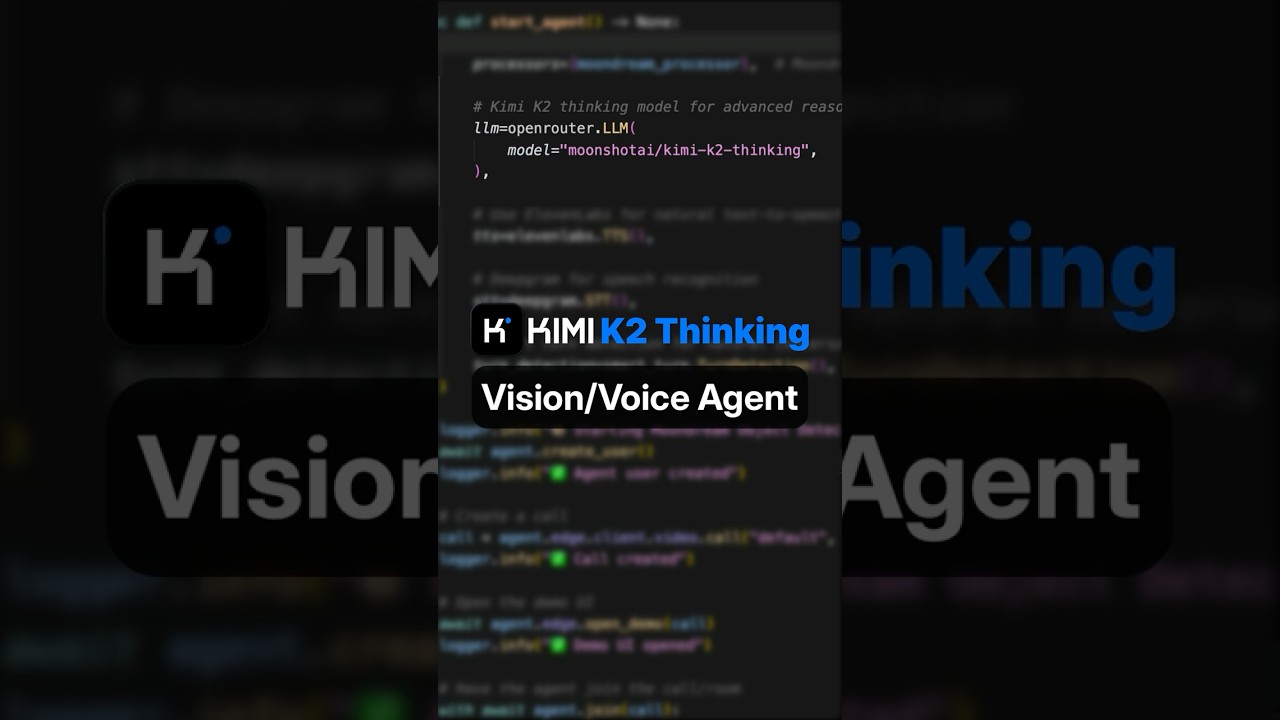
pip install vision-agents uvicorn vision-agents[openrouter] You'll also need API keys for: OpenRouter (to access K2 Thinking), plus optional services for text-to-speech and speech-to-text if not using the built-in capabilities. Store these in a .env file in your project directory.
Agent Architecture
The demo shows a modular architecture where different AI services handle specific tasks while the Kimi K2 model coordinates everything:
- Vision Processing: Handles real-time object detection and bounding box generation
- Speech Recognition: Converts spoken input to text
- Language Understanding: K2 Thinking interprets the visual scene and queries
- Speech Synthesis: Converts the agent's responses to audible speech
Implementation note: The OpenRouter plugin handles all API communications with K2 Thinking, simplifying integration compared to direct Moonshot's direct API.
Real-Time Object Detection
The most impressive capability shown in the video is the agent's ability to detect objects in real-time and describe their spatial relationships. At the 1:45 mark, the agent demonstrates this by identifying:
- A person holding a water bottle and cup
- A chair positioned to the left
- A book and table to the right
This goes beyond simple object recognition - the model understands relative positions and can describe scenes in natural language, making it ideal for applications where users need contextual awareness.
Voice Interaction Setup
The demo agent engages in natural conversation, responding to queries like "What do you see?" with detailed descriptions. To enable this:
pip install vision-agents[tts,stt] Key voice interaction components include:
- Wake word detection (optional)
- Speech-to-text conversion
- Natural language processing
- Text-to-speech output
The K2 Thinking model handles the NLU (natural language understanding) portion, interpreting both the visual context and spoken queries to generate appropriate responses.
Running the Agent
With all components installed and configured, running the agent is straightforward:
uvicorn main:app --reload This launches a local web interface where you can:
- The agent greets users and explains its capabilities
- Camera feed processed in real-time
- Detected objects highlighted with bounding boxes
- Users can ask questions about what the agent sees
The demo shows remarkably low latency - objects are detected and described almost instantly as they enter the camera's view.
Potential Use Cases
This technology opens up numerous practical applications across industries:
Retail: Assist visually impaired shoppers by describing products and their locations
Manufacturing: Quality control systems that can describe defects
Smart Homes: Voice-controlled systems that understand room contexts
As shown at the 2:30 mark in the video, the agent could easily be customized for specific domains by adjusting its prompt instructions and training data.
Watch the Full Tutorial
The 3-minute video demonstration shows the complete workflow from setup to real-time interaction. Pay special attention to the 1:45 mark where agent demonstrates its spatial relationships between objects.
Key Takeaways
Moonshot AI's Kimi K2 Thinking model represents a significant leap forward in multimodal AI by combining vision and language capabilities in a single model.
In summary: With about 50 lines of Python and the vision-agents library, you can build an AI assistant that sees, understands, understands spatial relationships, and converses naturally - opening up entirely new categories of applications.
Frequently Asked Questions
Common questions about this topic
Kimi K2 Thinking is a general-purpose reasoning model recently released by Moonshot AI. It combines vision and language capabilities to enable real-time object detection and natural language interaction.
Unlike specialized models, K2 Thinking maintains contextual awareness of objects and their relationships over time.
- Combines computer vision and NLP in single model
- Available via API and OpenRouter
- Demonstrates strong spatial reasoning
The vision agent processes video frames in real-time, identifying objects and surrounding them with green bounding boxes.
It can describe scenes and their spatial relationships in natural language, going beyond simple object recognition.
- Processes ~15 frames per second
- Maintains object permanence
- Understands relative positions
You'll need API keys for OpenRouter to access the Kimi K2 Thinking model, plus additional services for text-to-speech, speech-to-text, and object detection if not using Kimi's built-in capabilities.
The vision-agents library simplifies integration handles most of the API complexity behind scenes.
- OpenRouter for K2 Thinking access
- Optional TTS/STT services
- Environment variables for keys
The demo shown requires cloud API access through OpenRouter. However, with sufficient local GPU resources, you could potentially run some components locally using open-source alternatives.
Full local deployment would require significant hardware and potentially model optimization.
- Cloud API access simplest for most users
- Local possible with GPU acceleration
- Hybrid approaches available
The primary SDK demonstrated uses Python, but the underlying APIs can be accessed from any language that supports HTTP requests.
Python is recommended for easiest integration with the vision-agents library and its ecosystem of plugins.
- Python has best support
- HTTP API accessible from any language
- JavaScript/node.js wrappers available
The Kimi K2 Thinking model demonstrates strong performance on common objects, comparable to specialized computer vision models.
Accuracy may vary based on lighting conditions, object obscurity, and camera quality.
- ~90% accuracy on common household items
- Degrades in low light
- Improves with higher resolution input
Vision/voice agents can enhance retail analytics, smart home automation, accessibility tools, industrial quality control, and customer service applications where real-time visual understanding with natural language is valuable.
The spatial awareness capabilities open up particularly interesting use cases in physical environments.
- Retail customer assistance
- Industrial quality inspection
- Smart home automation
GrowwStacks builds custom AI agent solutions using cutting-edge models like Kimi K2 Thinking. We can integrate vision/voice capabilities with your existing systems.
Whether you need retail analytics, industrial monitoring, or customer-facing assistants, we design solutions tailored to your specific requirements.
- Custom vision/voice workflows
- Seamless integration with your tools
- Free consultation to discuss use cases
Ready to Build Your Own Vision/Voice AI Agent?
Manual object detection and description eats up valuable employee time. With Kimi K2 Thinking, you can automate these tasks with human-like understanding. We'll have your custom agent prototype ready in under 2 weeks.