Build Voice Agents from Scratch: The $1 Trillion Opportunity in AI Voice Interfaces
Most AI interactions still happen through typing - but voice is becoming the natural way we communicate. Building conversational voice agents requires solving unique challenges like interrupt-driven dialogues, managing pauses, and minimizing latency. This guide shows how leading companies are implementing voice-first AI solutions.
The Voice Revolution: Why Typing Is Dying
Industry leaders from Google's Sundar Pichai to NVIDIA's Jensen Huang have declared voice as the future of human-AI interaction. The numbers back this up - voice interfaces are projected to become a $1 trillion market by as they replace traditional typing-based interactions.
The appeal is obvious: speaking is more natural than typing, especially when multitasking. Many professionals now interact with AI assistants while walking, driving, or performing other tasks where typing is impractical. As Dr. Sridhar Panat notes in the video at 1:45, "I like interacting with my large language model by just speaking to it so that it can speak back to me... this almost feels like a conversation with a friend."
Key insight: Voice isn't just about convenience - it creates fundamentally different interaction patterns. Natural conversations involve interruptions, pauses, and turn-taking that traditional chat interfaces can't replicate.
The Hidden Technical Challenges of Voice Agents
At first glance, voice agents seem simple - just connect speech-to-text (STT) to an LLM and text-to-speech (TTS). But production systems face complex challenges:
- Latency: Conversations feel unnatural if responses take more than 300ms
- Interruptions: Humans naturally interrupt - the system must detect and respond
- Pause detection: Distinguishing thinking pauses from sentence completion
- Context management: Maintaining conversation flow across turns
As highlighted in the video at 3:20, "When you are interrupting a conversation, how does the large language model know that the output has to stop immediately so that the input can be taken in to create the next output?" These nuances separate basic voice assistants from true conversational agents.
Voice Agent Architecture: More Than Just STT + LLM + TTS
A complete voice agent system requires specialized components working in harmony:
1. Speech Recognition Layer
Real-time speech-to-text conversion using models like Whisper, optimized for low-latency streaming
2. Conversation Manager
Handles interrupt detection, pause interpretation, and turn-taking logic
3. LLM Reasoning Layer
Generates context-aware responses while supporting streaming output
4. Voice Synthesis
Text-to-speech with emotional inflection and natural pacing
Critical detail: Each component must support streaming processing to minimize latency. Batch processing creates unnatural delays that break conversation flow.
7 Real-World Applications for Business Voice Agents
Voice agents are transforming both customer-facing and internal operations:
- AI Receptionists: Handle incoming calls with natural conversation
- Scheduling Assistants: Manage calendars via voice commands
- Meeting Assistants: Participate in and summarize discussions
- Desktop Companions: Voice-controlled productivity tools
- Therapeutic Agents: Provide counseling through conversation
- Sales Coaches: Train teams with simulated customer interactions
- Internal Helpdesks: Voice-first IT and HR support
As mentioned at 6:50 in the video, "At the end of this boot camp, you will have something ready which you can actually ship - meaning it could be an AI receptionist or it could be a scheduling agent." The flexibility of voice interfaces allows adaptation to nearly any business process.
The 8-Week Development Process for Production-Ready Agents
Building a production-quality voice agent follows a structured timeline:
Weeks 1-2: Foundation
Set up speech components and basic conversation flow
Weeks 3-4: Optimization
Reduce latency and implement interruption handling
Weeks 5-6: Specialization
Tune for specific use cases and domains
Weeks 7-8: Deployment
Integrate with business systems and scale testing
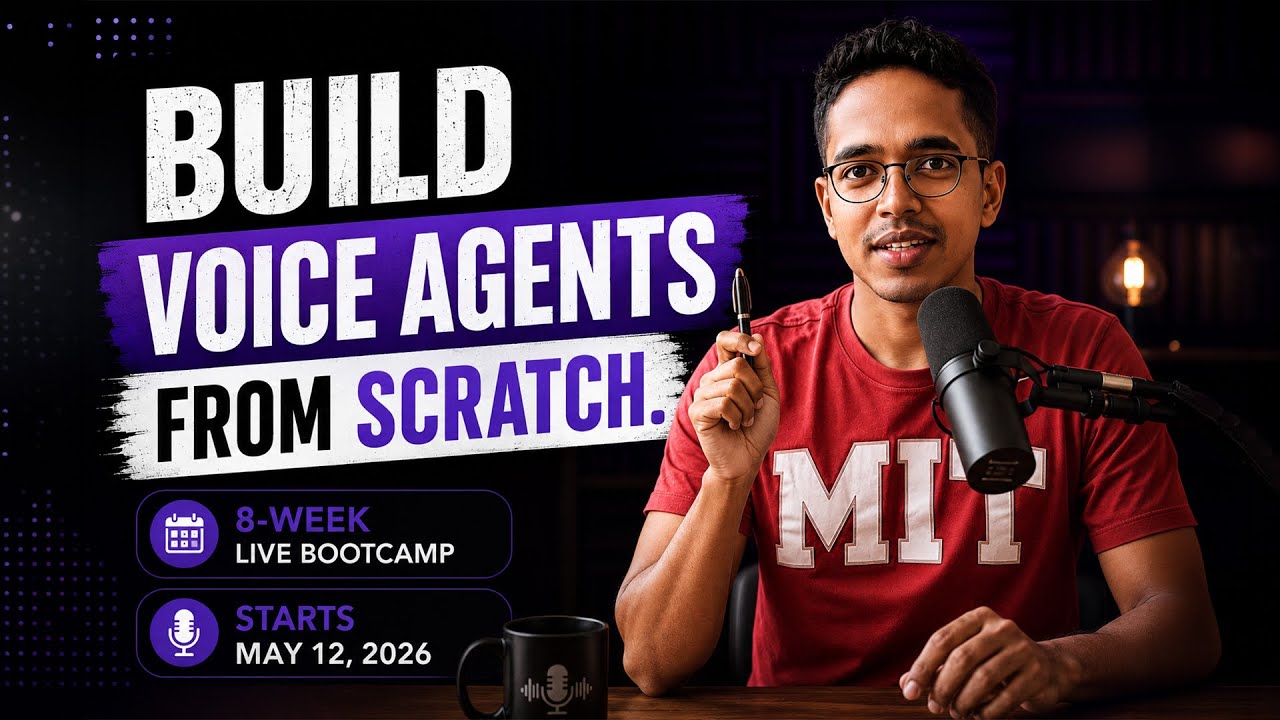
The video outlines this process at 7:30: "We will be meeting for 8 weeks. Every week we'll be meeting on Tuesday for around 2 hours... there will be hands-on assignments and we'll be coding things from scratch." This structured approach ensures practical, deployable results.
Watch the Full Tutorial
For a deeper dive into building interrupt-driven voice agents with low latency, watch Dr. Sridhar Panat's complete tutorial. The video demonstrates real-time conversation handling and pause detection techniques mentioned at 4:15.
Key Takeaways
Voice interfaces represent the next major evolution in how humans interact with AI systems. Unlike traditional chat interfaces, voice agents must handle the complexities of natural conversation - interruptions, pauses, and rapid turn-taking.
In summary: Building production-ready voice agents requires specialized architecture beyond simple STT+LLM+TTS pipelines. Focus on latency optimization, interruption handling, and natural conversation flow to create truly engaging voice experiences.
Frequently Asked Questions
Common questions about this topic
Voice interaction is more natural and convenient than typing, especially when multitasking. Many users prefer speaking to AI assistants while walking, driving, or working.
Industry leaders predict voice interfaces will become a trillion-dollar market as they replace traditional typing interactions with LLMs. The conversational flow creates more engaging experiences compared to text-based chats.
- More natural than typing for most users
- Enables multitasking during interactions
- Projected to be a $1T market by
The biggest challenges include managing latency for real-time responses, handling interruptions gracefully, detecting meaningful pauses versus thinking pauses, and creating smooth conversation flows.
These require specialized approaches beyond simple speech-to-text and text-to-speech conversions. The system must understand conversational context and respond appropriately to natural speech patterns.
- Keeping latency under 300ms for natural flow
- Detecting and responding to interruptions
- Differentiating thinking pauses from sentence ends
A production-ready voice agent requires speech-to-text conversion, an LLM reasoning layer for generating responses, text-to-speech synthesis, plus specialized modules for handling interruptions, managing pauses, and minimizing latency throughout the conversation pipeline.
Additional components often include noise cancellation, voice authentication, and emotional inflection modules to create more natural interactions. All components must support real-time streaming processing.
- Speech-to-text with streaming capability
- Conversation management layer
- LLM with streaming response generation
- Text-to-speech with emotional inflection
Voice agents can serve as AI receptionists, scheduling assistants, meeting assistants, desktop companions, or specialized therapists. They're valuable for both customer-facing applications and internal business processes where voice interaction improves efficiency.
Specific implementations include handling customer service calls, managing employee calendars through voice commands, participating in and summarizing meetings, and providing voice-controlled access to internal knowledge bases.
- Customer service automation
- Internal productivity tools
- Specialized therapeutic applications
- Meeting participation and summarization
Building a fully functional voice agent typically takes 8-12 weeks of focused development. This includes time for integrating speech components, optimizing latency, testing conversation flows, and deploying the solution for real-world use cases.
The process involves iterative testing and refinement to handle edge cases in natural conversation. More complex implementations with custom domain knowledge may require additional development time.
- 8-12 weeks for basic implementation
- Additional time for domain specialization
- Ongoing optimization post-deployment
Python is the primary language for building voice agents due to its extensive libraries for AI and speech processing. Key frameworks include Whisper for speech recognition, various LLM APIs, and real-time streaming text-to-speech systems.
Some implementations may incorporate JavaScript for web-based interfaces or specialized languages like Rust for performance-critical components. The choice depends on the specific use case and deployment environment.
- Python for core AI components
- JavaScript for web interfaces
- Specialized languages for performance modules
Voice agents handle complex, interrupt-driven conversations with low latency, while basic assistants typically process complete voice commands sequentially. Agents manage natural conversation flows, pauses, and interruptions just like human conversations.
The key differentiators are the ability to handle overlapping speech, interpret pauses contextually, and maintain conversation state across multiple turns. This creates more natural and productive interactions compared to command-based systems.
- Handle interrupt-driven conversations
- Maintain context across turns
- Interpret pauses intelligently
GrowwStacks builds custom voice agent solutions tailored to your business needs. We handle the full implementation from speech components integration to LLM customization and latency optimization.
Our team can deploy voice agents for customer service, internal operations, or specialized applications with natural conversation flows. We offer end-to-end development or can augment your existing team with specialized expertise.
- Custom voice agent development
- Latency optimization
- Domain-specific training
- Ongoing support and maintenance
Ready to Build Your Custom Voice Agent?
Every day without voice automation means lost productivity and missed customer connections. GrowwStacks delivers production-ready voice agents in 8-12 weeks - complete with natural conversation flows and domain-specific tuning.