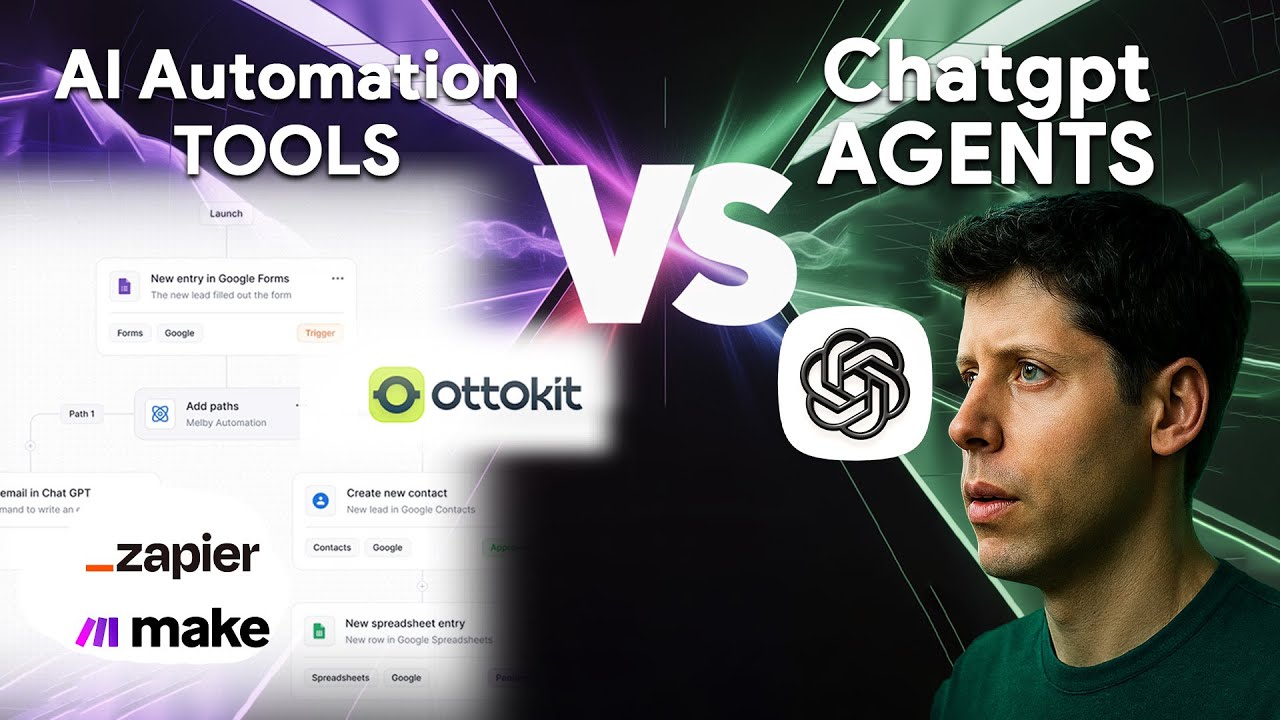
ChatGPT Agents vs Real AI Automation Tools: Zapier, Make & OttoKit Compared
Business owners are flooding ChatGPT with automation requests - only to discover its agents fail when handling real business workflows. We tested the top automation platforms to reveal which solution delivers reliable execution at 70% less than the big names.
Why ChatGPT Agents Fail at Business Automation
Business owners excited about ChatGPT's agent mode are discovering a harsh reality - while brilliant for conversation and content creation, these AI agents consistently fail when handling mission-critical business automation. The promise of an AI assistant that can seamlessly connect your apps and execute workflows remains just that - a promise.
After months of testing, three critical failure points emerged. Connections to business apps randomly drop without warning. Complex workflows fail silently with no error notifications. Most critically, there's no way to guarantee execution reliability - the foundation any business automation must have.
Key insight: ChatGPT agents currently excel at planning workflows and generating content, but the platforms built specifically for automation (like OttoKit, Zapier, and Make) remain essential for reliable execution.
OttoKit: The Automation Game Changer
Originally launched as SureTriggers, OttoKit was rebuilt from the ground up with one mission - deliver enterprise-grade automation at small business prices. While flying under the radar compared to Zapier and Make, OttoKit has been quietly transforming how savvy businesses handle their workflows.
What sets OttoKit apart is its ruthless focus on solving real business problems without the bloat and over-engineering of larger platforms. The team obsessively optimizes for reliability first, then affordability, then ease of use - a priority sequence that resonates with business owners tired of overpaying for features they never use.
Price Comparison: How Much You Can Save
The cost differences between OttoKit and the established players aren't just significant - they're game-changing for small businesses. OttoKit's free plan offers 1,000 monthly tasks - 10 times Zapier's meager 100-task allowance that most businesses exhaust in days.
For growing businesses, OttoKit's $9/month Starter plan provides 5,000 tasks and unlimited workflows. Compare this to Zapier's $30/month plan for similar functionality, and the annual savings exceed $250. Lifetime deal options (currently available) can reduce costs even further by eliminating recurring fees altogether.
Cost breakdown: What costs $30+/month on Zapier delivers equivalent functionality for just $9 on OttoKit - a 70% savings that compounds year after year.
Perfect WordPress Integration
For WordPress-based businesses, OttoKit delivers capabilities the big platforms can't match. Native integration with over 100 popular plugins (WooCommerce, Gravity Forms, LearnDash, etc.) means no more wrestling with unstable API connections or paying for middleware services.
The WordPress-specific features shine where others fall short. Automate between multiple WordPress sites effortlessly. Trigger workflows based on complex conditions across plugins. Handle post-purchase sequences, user registrations, and course completions without writing custom code. For WordPress professionals, these aren't nice-to-haves - they're essential.
Real World OttoKit Power in Action
A WooCommerce store owner needed to automate their entire post-purchase workflow. With OttoKit, they created a single automation that: adds customers to their CRM, sends order details to accounting software, saves invoices to Google Drive, triggers personalized email sequences, updates inventory systems, and notifies their team via WhatsApp.
This complex, multi-app workflow runs reliably every time - something ChatGPT agents consistently failed to achieve during testing. Even better, the entire automation costs just $9/month on OttoKit versus $50+ on competing platforms.
Zapier: The Overpriced Pioneer
Zapier deserves credit for popularizing automation, but their pricing model creates painful traps for growing businesses. The severely limited free plan (100 tasks/month) forces upgrades almost immediately. Their task-based counting means every tiny action increments your bill - turning simple workflows into budget busters.
Advanced features like webhooks and premium apps cost extra on top of already high monthly fees. There's no self-hosting option, locking you into their cloud. Most frustratingly, Zapier charges 200% more than OttoKit for equivalent functionality - a premium that delivers no additional value for most small businesses.
Make.com: The Complex Alternative
Make (formerly Integromat) offers powerful automation capabilities but suffers from overwhelming complexity. Their flowchart interface looks impressive in demos but requires weeks to master. Beginners face paralysis from too many options just to create simple automations.
Make's WordPress integration remains limited compared to OttoKit's deep plugin support. Their credit-based pricing creates budgeting nightmares since predicting actual monthly costs proves nearly impossible. For WordPress-focused businesses needing reliable automation without a PhD in flowcharts, Make's learning curve often outweighs its benefits.
Watch the Full Tutorial
See OttoKit in action with a detailed walkthrough of setting up a complex WooCommerce automation workflow (starting at 4:32 in the video). The tutorial shows exactly how to connect multiple apps and test the automation's reliability - something ChatGPT agents consistently failed to achieve during our testing.
Key Takeaways
While ChatGPT agents represent fascinating AI potential, they currently fail at reliable business automation. Established platforms like Zapier and Make deliver reliability but at premium prices (Zapier) or with overwhelming complexity (Make). OttoKit emerges as the smart choice - offering enterprise-grade automation at small business prices with WordPress-specific features the others can't match.
In summary: For WordPress businesses needing reliable automation without enterprise pricing, OttoKit delivers 70% cost savings versus Zapier while being dramatically easier to use than Make.com.
Frequently Asked Questions
Common questions about this topic
ChatGPT agents frequently fail to maintain stable connections with business apps and lack the reliability needed for mission-critical workflows. While excellent for content creation and planning, they're not designed for the consistent execution required in business automation scenarios.
During testing, we observed three primary failure modes: random disconnections from business apps, silent failures in complex workflows, and no guaranteed execution reliability. These limitations make them unsuitable for business processes where failure isn't an option.
- Connections drop without warning
- Complex workflows fail silently
- No execution reliability guarantees
OttoKit offers 10 times more tasks on their free plan (1,000 vs Zapier's 100) and their paid plans start at just $9/month for 5,000 tasks. Comparable functionality on Zapier costs over $30/month, making OttoKit 70% more affordable for equivalent automation capabilities.
The savings compound over time. A business using OttoKit's $9/month plan instead of Zapier's $30/month equivalent saves $252 annually. Lifetime deal options (when available) can eliminate recurring costs altogether for even greater long-term savings.
- Free plan: 10x more tasks than Zapier
- Paid plans start at 70% less
- Lifetime deals available (no recurring fees)
OttoKit provides native integration with over 100 WordPress plugins including WooCommerce, Gravity Forms, and LearnDash. It enables automation between multiple WordPress sites and handles common WordPress workflows like post-purchase sequences and user registrations without requiring custom coding.
Unlike platforms that treat WordPress as an afterthought, OttoKit was built with WordPress professionals in mind. Deep integration with popular plugins means no more unstable API connections or paying for middleware services just to connect your WordPress tools.
- 100+ native WordPress plugin integrations
- Automate between multiple WordPress sites
- Specialized for eCommerce and membership workflows
Make.com has a steep learning curve with its complex flowchart interface, limited WordPress integration, and confusing credit-based pricing system that makes cost prediction difficult. These factors make it challenging for beginners and WordPress-focused businesses.
During testing, we found that simple automations that take minutes to set up in OttoKit required hours in Make.com due to its overwhelming number of options and settings. The platform's strengths shine for enterprise users with dedicated automation teams, but prove excessive for most small businesses.
- Flowchart interface has steep learning curve
- Limited WordPress plugin support
- Credit system makes budgeting unpredictable
Yes, OttoKit supports complex workflows across 700+ apps. For example, it can connect WooCommerce purchases to CRM updates, accounting software, Google Drive, email sequences, inventory systems, and team notifications - all in one automated workflow.
The platform handles these multi-app connections reliably while maintaining an intuitive interface. During testing, we successfully automated workflows connecting up to 8 different business applications without failures - something ChatGPT agents couldn't achieve consistently.
- Connects 700+ business applications
- Handles workflows across 8+ apps simultaneously
- Maintains reliability in complex scenarios
Online businesses running WordPress sites, eCommerce stores using WooCommerce, course platforms, membership sites, and any business needing reliable automation between multiple apps without enterprise-level pricing benefit most from OttoKit's capabilities.
The platform shines for businesses that have outgrown basic automation but don't need (or can't justify) the complexity and cost of enterprise solutions. WordPress professionals particularly benefit from OttoKit's deep plugin integration and multi-site automation features.
- WordPress-based businesses
- WooCommerce stores
- Course and membership platforms
OttoKit offers a drag-and-drop builder that's simpler than Zapier and more intuitive than Make's flowchart system. Users report being able to create working automations in minutes rather than hours, with clear visualization of workflows without overwhelming complexity.
During testing, we found OttoKit's balance between power and simplicity ideal for business owners who need robust automation without dedicating weeks to learning a platform. The interface provides enough detail to understand what's happening without drowning users in technical options.
- More intuitive than Make's flowcharts
- Simpler than Zapier's interface
- Enables automation creation in minutes
GrowwStacks helps businesses implement automation workflows, AI integrations, and scalable systems tailored to their operations. Whether you need a custom workflow, AI automation, or a full multi-platform automation system, the GrowwStacks team can design, build, and deploy a solution that fits your exact requirements.
Our automation experts handle everything from initial consultation to implementation and ongoing optimization. We specialize in creating reliable systems that save time and reduce operational costs - whether you're using OttoKit, Zapier, Make, or custom solutions.
- Custom automation workflow design
- Multi-platform integration
- Ongoing support and optimization
Ready to Automate Your Business Without Overpaying?
Every day without reliable automation costs your business time and money. GrowwStacks can implement OttoKit workflows tailored to your operations in as little as 48 hours - at 70% less than you'd pay for equivalent Zapier automations.