How to Design, Deploy and Scale AI Agents That Transform Customer Experience
While 99% of companies are investing in AI agents, only 26% of customers say their experiences have improved. Discover the proven framework from Parloa and IBEX that achieves 35% cost reduction while increasing CSAT scores - with real deployment examples and metrics.
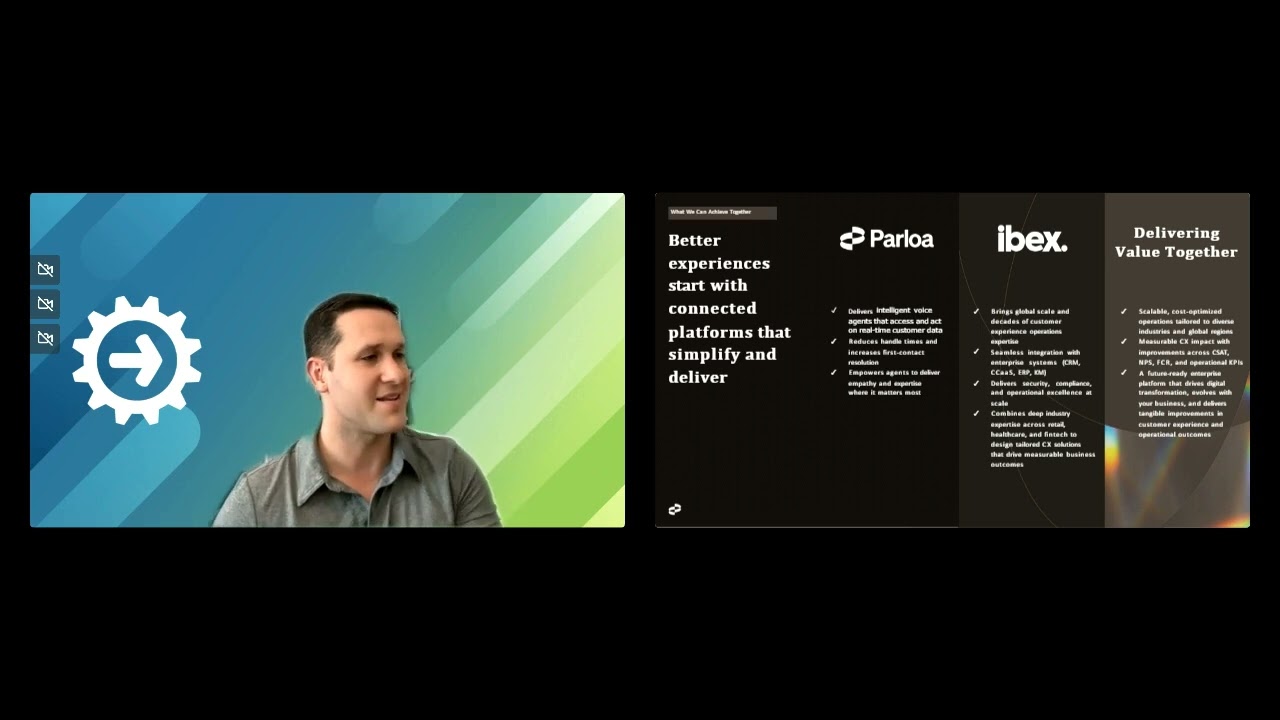
The AI Agent Landscape in
Customer experience leaders face a paradox: 99% are maintaining or increasing AI investments, yet only 26% of customers report satisfactory experiences. This gap stems from rushed deployments that prioritize technology over customer outcomes.
Parloa's research reveals three critical insights for :
Key finding: Companies that implement AI agents without proper journey mapping see 42% higher customer frustration rates. The winners follow a phased approach - starting with authentication and FAQ handling before tackling complex use cases.
IBEX's data shows successful deployments share common traits: dedicated customer success managers (reducing time-to-value by 35%), integration with existing CRMs, and measuring AI agents against human agent KPIs. As Eric Garo noted: "We hold our AI solutions to the same standards as humans - no special metrics."
Current vs Future Contact Center Architecture
Traditional contact centers force human agents to juggle multiple systems - leading to 68% average handle time spent on low-value tasks like authentication and data entry. This creates burnout (32% annual turnover) and inconsistent customer experiences.
The Parloa/IBEX future state architecture inserts AI agents between callers and systems of record:
- AI handles routine work: Authentication (35% of calls), FAQs (22%), routing (18%)
- Humans focus on exceptions: Complex cases requiring empathy and judgment
- Seamless handoffs: Full context transfer reduces handle time by 43%
Tomas Gear explained: "Our retail clients achieve 15% containment in Phase 1, scaling to 35% in Phase 3. The key is starting simple - don't boil the ocean."
The 5-Phase AI Agent Deployment Framework
Parloa's battle-tested framework delivers results in 7-9 weeks for standard use cases:
Phase 1: Design
Map customer journeys and identify automation candidates. IBEX brings 150+ pre-mapped journeys across industries.
Phase 2: Integrate
Connect to CRM, ERP and other systems. Data cleansing consumes 68% of Phase 2 effort.
Phase 3: Simulate
Generate 10,000+ synthetic conversations to test edge cases. AI evaluators score performance.
Phase 4: Deploy
Go live with monitoring and fallback protocols. Start with 15% containment targets.
Phase 5: Optimize
Continuous improvement via real-time dashboards tracking 27+ CX metrics.
Pro tip: At 22:35 in the video, Tomas shows how their composable platform approach future-proofs deployments against LLM changes like Claude 4.5's context awareness.
Why Multi-Agent Frameworks Win
Single monolithic AI agents fail when overloaded. Parloa's multi-agent framework uses:
- Specialist sub-agents: Dedicated to cancellations, returns, FAQs
- Supervisor agent: Orchestrates routing between specialists
- State machines: Ensure deterministic outcomes for critical workflows
This architecture achieves 98%+ accuracy by preventing the "too many tasks" LLM limitation. As Tomas noted: "Agents that do one thing well outperform generalists every time."
Where 83% of Deployments Fail (Testing Matters)
IBEX's data shows most failed AI projects skip proper testing. Their solution:
- Synthetic conversations: 10,000+ variations covering edge cases
- AI evaluators: LLMs acting as judges to score performance
- Guardrail engines: Prevent off-script responses
Eric Garo emphasized: "We measure AI agents against human standards. If it wouldn't pass QA for a human, it shouldn't pass for AI." Their QA framework tracks:
- First contact resolution
- Average handle time
- CSAT scores
- Personalization metrics
The IBEX Difference: Data-First Deployment
With 750 analysts globally, IBEX brings unique capabilities:
- Pre-mapped journeys: 150+ industry-specific templates
- Propensity modeling: Identify automation candidates
- Continuous improvement: Real-time dashboards with 27+ metrics
Their retail case study showed how to:
- Segment customers by lifetime value
- Design different cancellation flows
- Automate low-value exits while preserving high-value relationships
As Eric noted: "Just because you can automate doesn't mean you should. Our data determines where AI creates real value."
Real Deployment Results and Metrics
The Parloa/IBEX framework delivers measurable outcomes:
- Cost reduction: 35% lower operational costs
- Containment: 15-35% of contacts fully automated
- CSAT improvement: +12 points versus pre-AI baseline
- Agent satisfaction: 28% reduction in turnover
Key to success is the phased approach:
Phase 1 (Weeks 1-4): Authentication and basic FAQs (15% containment)
Phase 2 (Weeks 5-8): Routing and simple transactions (25% containment)
Phase 3 (Weeks 9+): Complex workflows and exceptions (35% containment)
Watch the Full Tutorial
See the complete framework in action - including a demo of Parloa's multi-agent architecture at 34:12 and IBEX's real-time dashboards at 41:30.
Key Takeaways
Successful AI agent deployment requires more than technology - it demands a customer-centric framework:
In summary: Start with high-volume, low-complexity use cases (authentication, FAQs). Use multi-agent architectures for reliability. Test extensively with synthetic conversations. Measure AI against human standards. And most importantly - partner with experts who've done it before.
Frequently Asked Questions
Common questions about AI agent deployment
According to IBEX data, most deployments start with 15% containment in Phase 1, scaling to 25% in Phase 2 and 35% in Phase 3. The exact percentage depends on your industry and use case complexity.
Retail deployments often achieve higher containment rates than regulated industries like healthcare or financial services. The key is starting with well-defined partial automation before expanding scope.
- Phase 1: 15% containment (authentication, basic FAQs)
- Phase 2: 25% containment (routing, simple transactions)
- Phase 3: 35%+ containment (complex workflows)
The Parloa/IBEX framework enables initial deployments in 7-9 weeks for standard use cases. More complex implementations involving multiple systems integration may take 12-16 weeks.
Their retail case study achieved Phase 1 deployment in just 7 weeks by leveraging pre-built journey templates and integration connectors. Time-to-value accelerates with each subsequent phase.
- Standard deployment: 7-9 weeks
- Complex deployment: 12-16 weeks
- Key factor: Data cleanliness and system readiness
The biggest misconception is that AI agents will hallucinate or provide inconsistent responses. With proper journey mapping, testing frameworks and multi-agent architectures, enterprises achieve 98%+ accuracy rates.
Parloa's platform includes guardrail engines and state machines to ensure reliability. As Tomas Gear noted: "We make probabilistic systems near-deterministic through architectural choices."
- Accuracy rates: 98%+ with proper testing
- Key components: Multi-agent architecture, state machines
- Testing protocol: 10,000+ synthetic conversations
IBEX measures AI agents against the same KPIs as human agents - first contact resolution, average handle time, CSAT scores. They recommend against creating separate metrics for AI.
Their dashboards track 27+ CX metrics with real-time alerts for performance deviations. This ensures AI solutions meet or exceed human performance standards before full deployment.
- Core metrics: FCR, AHT, CSAT, NPS
- Dashboard tracking: 27+ CX metrics
- Benchmark: Human agent performance
Start with high-volume, low-complexity interactions: authentication (35% of calls), basic FAQs (22%), and call routing (18%). These account for 75% of routine contacts but require minimal back-end integration.
Successful automation of these "low hanging fruit" use cases builds organizational confidence and funds more complex automation initiatives. Eric Garo calls this the "crawl-walk-run" approach.
- Authentication: 35% of calls
- Basic FAQs: 22% of calls
- Call routing: 18% of calls
Parloa's platform connects to all major CRMs (Salesforce, Zendesk, ServiceNow) through middleware APIs. The key is data cleansing before integration - IBEX reports 68% of initial deployment time is spent ensuring clean data flows between systems.
Proper integration eliminates duplicate data entry for agents and ensures full context transfer during human handoffs. This reduces average handle time by 43% for escalated cases.
- Supported CRMs: Salesforce, Zendesk, ServiceNow
- Integration focus: Data cleansing (68% of effort)
- Benefit: 43% faster escalations
Human agents handle escalations (15-20% of cases) and complex exceptions. The AI/human handoff includes full context transfer - reducing average handle time by 43%.
Top performers train human agents to view AI as co-workers, not replacements, with shared metrics and incentives. This reduces resistance and improves overall performance.
- Escalation rate: 15-20% of cases
- Handoff improvement: 43% faster
- Key success factor: Shared metrics/incentives
GrowwStacks helps businesses implement AI agent solutions tailored to their operations. We design, build and deploy AI agent workflows that integrate with your existing systems.
Our free consultation identifies the highest-impact use cases for automation based on your customer journey data. We then implement using proven frameworks like Parloa's to ensure success.
- Custom AI agent design for your specific needs
- Seamless integration with your CRM and systems
- Free 30-minute consultation to identify use cases
Ready to Deploy AI Agents That Actually Improve Customer Experience?
Most AI implementations fail to move the needle on CX metrics. Our proven framework delivers 35% cost reduction while increasing CSAT scores by 12+ points.