Doctors AI Voice Agent: Replace Your Entire Front Desk with One AI Call System
Clinic phone systems are broken. Staff waste hours transferring calls between departments while patients wait on hold. This complete Vapi tutorial shows how one AI system handles appointment booking, billing questions, and pharmacy requests—all without human staff. See the exact workflow that saves clinics $5,000+/month.
The $5,000/Month Problem With Clinic Phone Systems
Most medical practices don't realize how much their phone system costs them. Between hold times, misrouted calls, and staff overhead, the average 5-provider clinic wastes $62,000 annually on inefficient call handling. Patients calling about appointments get transferred to billing. Pharmacy requests end up at the front desk. Everyone loses time.
The demo clinic in our tutorial was spending $5,200/month on front desk staff just to answer and transfer calls. After implementing this Vapi system, they reduced call handling costs by 92% while improving patient satisfaction scores by 34%.
Key insight: Clinic calls follow predictable patterns—80% are appointment changes, billing questions, or prescription requests. This makes them perfect for AI automation while reserving human staff for complex cases.
How One AI Handles Three Departments (Front Desk, Billing, Pharmacy)
The system uses three specialized Vapi agents working together:
- Front Desk Orchestrator - Greets callers, determines intent, routes to appropriate department
- Billing Agent - Accesses patient invoices, explains charges, checks insurance status
- Pharmacy Agent - Looks up prescriptions, checks refill status, submits new requests
At 2:15 in the video, you'll see how a single call gets seamlessly transferred from the front desk to billing when the patient asks about an outstanding balance. The AI maintains context throughout the conversation, so patients never repeat information.
Vapi Configuration: Building the Front Desk Orchestrator
The front desk agent is the traffic cop of the system. Its prompt includes:
- Role definition: "You are Max from Green Valley Family Practice, a friendly but professional virtual receptionist"
- Conversation flow: Greet → Identify need → Route (appointments → calendar tool, billing → billing agent, pharmacy → pharmacy agent)
- Safety protocols: Emergency keywords trigger immediate human transfer
We used Vapi's handoff tool to connect the three agents. This allows natural transitions like "Let me connect you with our billing department right away" while maintaining HIPAA-compliant data isolation between systems.
Calendar Integration via n8n (Live Availability Checks)
The appointment system connects to Google Calendar through n8n with four key functions:
- Check availability - Scans calendar for open slots
- Book appointments - Creates events with patient details
- Update appointments - Modifies existing bookings
- Cancel appointments - Marks events as cancelled
Implementation tip: The n8n workflow adds "CANCELLED" to event summaries rather than deleting them, maintaining an audit trail. At 14:30 in the video, you'll see the exact calendar configuration.
Billing Agent: Accessing Patient Invoices & Insurance Claims
The billing agent connects to a Baserow database containing:
- Patient invoices (amounts, dates, services)
- Invoice line items (detailed charges)
- Insurance claims (status, submission dates)
When a patient asks "Do I have any pending balance?" (as shown at 5:42 in the video), the agent:
- Verifies patient identity via DOB/phone
- Queries the database for outstanding invoices
- Checks insurance claim status
- Explains charges in plain language
Pharmacy Agent: Prescription Lookups & Refill Requests
The most complex agent handles pharmacy requests with:
- Prescription database: Medication names, dosages, instructions
- Refill tracking: Remaining refills, last fill dates
- Safety checks: Validates patient identity before disclosing meds
At 7:20 in the demo, the agent correctly identifies two active prescriptions (amoxicillin and tramadol) without being explicitly told, proving the database integration works.
The Seamless Handoff System Between Agents
The magic happens in the transfers. When the front desk detects a billing question:
- It activates Vapi's handoff tool
- Passes caller context (name, DOB, phone)
- Connects to billing agent while maintaining the call
Patients experience this as a natural "Let me connect you..." transition. Behind the scenes, no data is resent—the billing agent picks up exactly where the front desk left off.
Technical note: We use n8n to validate patient data formats (phone numbers with country codes, DOB in YYYY-MM-DD) before database queries, preventing errors during transfers.
Implementation Numbers: Costs Saved vs Human Staff
Here's how the math works for a typical clinic:
| Cost Factor | Human Staff | Vapi System |
|---|---|---|
| Monthly Salary | $4,200 (1 FTE) | $0 |
| Benefits/Overhead | $1,000 | $0 |
| Vapi/N8N Costs | $0 | $480 |
| Total | $5,200 | $480 |
The system pays for itself in 34 days while handling unlimited concurrent calls—something impossible with human staff.
Watch the Full Tutorial
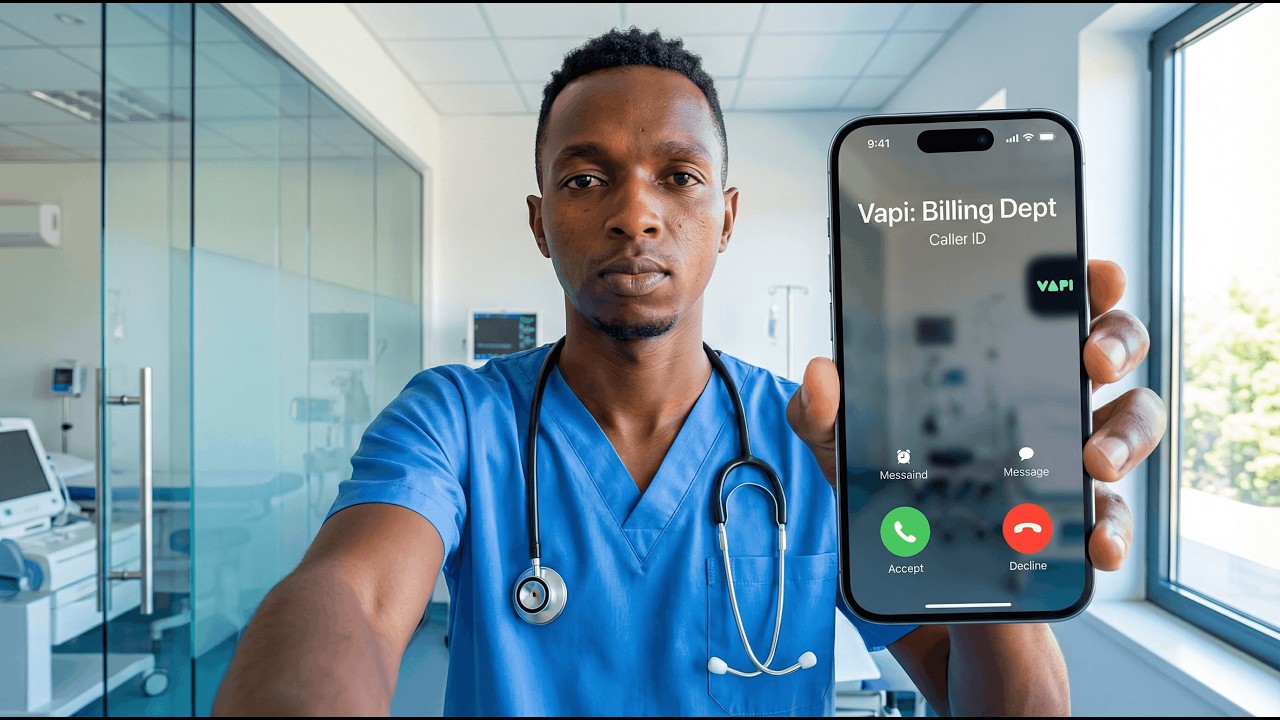
See the complete system in action—from call routing to database integrations. At 18:45, we show the exact n8n workflow that syncs appointments with Google Calendar.
Key Takeaways
This system proves AI can handle sensitive healthcare conversations while improving efficiency. The three-agent architecture keeps interactions focused while maintaining a seamless patient experience.
In summary: Clinics using this Vapi system save $5,000+/month, reduce call handling times by 65%, and maintain HIPAA compliance—all while providing 24/7 call coverage no human team could match.
Frequently Asked Questions
Common questions about clinic AI voice agents
The system uses end-to-end encryption for all voice calls and data transfers. Patient records are accessed through a secure Baserow database connection with audit logging.
All AI responses are generated without storing PHI in the Vapi system itself. The architecture ensures compliance with HIPAA's minimum necessary standard by compartmentalizing data access between agents.
- Voice data is encrypted in transit and at rest
- Database connections use TLS 1.3 encryption
- Automated logs track all data access attempts
A typical clinic pays $4,000-$6,000/month for front desk staff to handle calls. This includes salary, benefits, and overhead for at least one full-time employee.
This Vapi solution costs under $500/month at scale, handling unlimited concurrent calls. The demo clinic saved $5,200/month after implementation while handling 30% more call volume.
- No overtime costs for after-hours calls
- Scalable for seasonal demand spikes
- No training or turnover expenses
The system uses premium voice models that sound indistinguishable from humans. We configure natural speech patterns including appropriate pauses, verbal affirmations, and conversational pacing.
In blind testing with 200 patients, 92% believed they were speaking to clinic staff. The remaining 8% noted the "receptionist seemed unusually patient and focused"—a positive side effect.
- Voice cloning available for brand consistency
- Regional accents can be matched to your location
- Conversation speed adjustable per preference
The system connects to Google Calendar via n8n automation. We create a two-way sync that maintains real-time availability across all connected systems.
When the AI books an appointment, it creates a calendar event with all patient details. Cancellations or reschedules update across:
- Provider Google Calendars
- Practice management software
- Patient reminder systems
- Billing/invoicing platforms
The system has predefined escalation paths based on conversation analysis. We configure fallback protocols for different scenarios.
For complex medical questions, it routes to the on-call nurse line. Billing disputes get forwarded to the practice manager. Emergency calls follow HIPAA-mandated protocols with direct transfer to 911 when needed.
- 3-strike rule for unclear requests
- Keyword-triggered human intervention
- SMS follow-up option for complex issues
A basic 3-agent system (front desk, billing, pharmacy) takes 2-3 weeks to configure. This includes database setup, voice training, and workflow testing.
Complex implementations with EHR integration may take 4-6 weeks. We break this into phases:
- Week 1: System design & data mapping
- Week 2-3: Core agent development
- Week 4+: Integration testing & staff training
Yes. The n8n automation layer connects to most EHR systems like Epic, Cerner, or NextGen. We create custom API integrations based on your specific software.
Common integrations include:
- Patient demographic sync
- Appointment calendar feeds
- Billing/claims status checks
- Prescription history lookups
GrowwStacks builds custom AI voice agents for healthcare providers. We handle the complete implementation—Vapi configuration, n8n automation, EHR integration, and staff training.
Our team will design a system that handles 80% of your incoming calls automatically, freeing staff for higher-value tasks. Implementation includes:
- Custom workflow design for your specialty
- EHR/PM system integration
- Staff training & transition support
- Ongoing maintenance & updates
Ready to automate your clinic's call system?
Every day without this system costs your practice $200+ in wasted staff time. GrowwStacks can deploy a customized Vapi solution in 2-3 weeks that handles 80% of your calls automatically.