Flux: The First Conversational Speech Recognition Model for Real-Time Voice Agents
Tired of voice agents that interrupt mid-sentence or leave awkward pauses? Deepgram's Flux solves both problems with human-like turn detection that responds in 300-500ms. See how this breakthrough model is transforming voice AI with natural conversation flow.
The Voice AI Interruption Problem
Traditional voice agents suffer from two frustrating behaviors: interrupting users mid-sentence or leaving unnatural pauses before responding. This stems from using speech recognition models designed for transcription, not conversation.
Deepgram's research found that 89% of human responses occur within 2 seconds in natural dialogue. Yet most voice AI pipelines require this entire time just to process the speech, leaving no room for the agent to formulate and deliver its response.
The interruption dilemma: Simple voice activity detection (VAD) can't distinguish between meaningful pauses (like when reciting a phone number) and actual turn endings. This leads to agents that cut users off during natural speech patterns or wait too long, destroying conversational flow.
How Flux Solves Natural Conversation
Flux represents a paradigm shift - the first speech recognition model designed from the ground up for interactive voice agents. Unlike traditional ASR that simply transcribes audio, Flux models the entire conversational context.
The breakthrough comes from jointly modeling both speech-to-text and turn detection within a single architecture. This allows Flux to use acoustic cues, semantic context, and conversational patterns to determine when a speaker is truly finished.
Real-world impact: In medical ID verification scenarios, Flux reduced unwanted interruptions by 72% compared to leading alternatives while maintaining sub-300ms response times for natural turn-taking.
The Technical Breakthroughs Behind Flux
Flux's architecture combines several innovations to achieve human-like conversation understanding:
1. Turn-Based Context Modeling
Unlike traditional models that process audio in small chunks, Flux maintains the full context of the entire conversational turn. This allows it to recognize patterns like phone numbers with pauses (e.g., "847...487...7392") as continuous speech.
2. Thinking While Listening
Flux uses a novel inference algorithm similar to test-time scaling in LLMs. It continuously refines its understanding of the transcript until the end-of-turn is detected, rather than committing to words prematurely.
3. Custom CUDA Kernels
Specialized GPU optimizations allow Flux to perform this complex processing with ultra-low latency. The team developed proprietary kernels that fuse operations for maximum efficiency.
Benchmark Results vs Competitors
Deepgram conducted extensive benchmarking comparing Flux to leading alternatives like Cerbo Solarovad, AssemblyAI Universal Streaming, and Crisp Turn Taking.
In precision metrics for end-of-turn detection, Flux outperformed all competitors while maintaining the latency needed for natural conversation. The integrated approach avoids the inconsistency problems of separate VAD and STT systems.
Key finding: Flux achieves 300-500ms response times at the 50th percentile - faster than human response patterns but with enough time for the full voice agent pipeline to prepare replies.
Understanding Conversational Events
Flux's API provides real-time events that help voice agents manage natural turn-taking:
Core Events:
- Start-of-turn: Signals when a user begins speaking (useful for barge-in)
- Update: Transcript refinements every ~250ms
- End-of-turn: High-confidence detection that the user finished
Advanced Features:
- Eager end-of-turn: Early warning to begin preparing responses
- Turn-resumed: Notification if speech continues after eager detection
These events eliminate the need for complex custom logic to manage conversation flow, reducing implementation time and improving reliability.
Implementation Considerations
When integrating Flux into voice agent pipelines, consider these best practices:
Parameter Tuning
The default end-of-turn confidence threshold (0.7) works for most cases, but can be adjusted based on your latency requirements and error tolerance.
Pipeline Optimization
Use eager end-of-turn events to begin LLM processing while awaiting final confirmation. This can shave 200-300ms off total response time.
Error Handling
Implement graceful recovery for turn-resumed events when users continue speaking after a pause.
Pro tip: At 3:22 in the video demo, you can see how Flux handles phone number pauses differently than traditional VAD-based solutions.
Watch the Full Tutorial
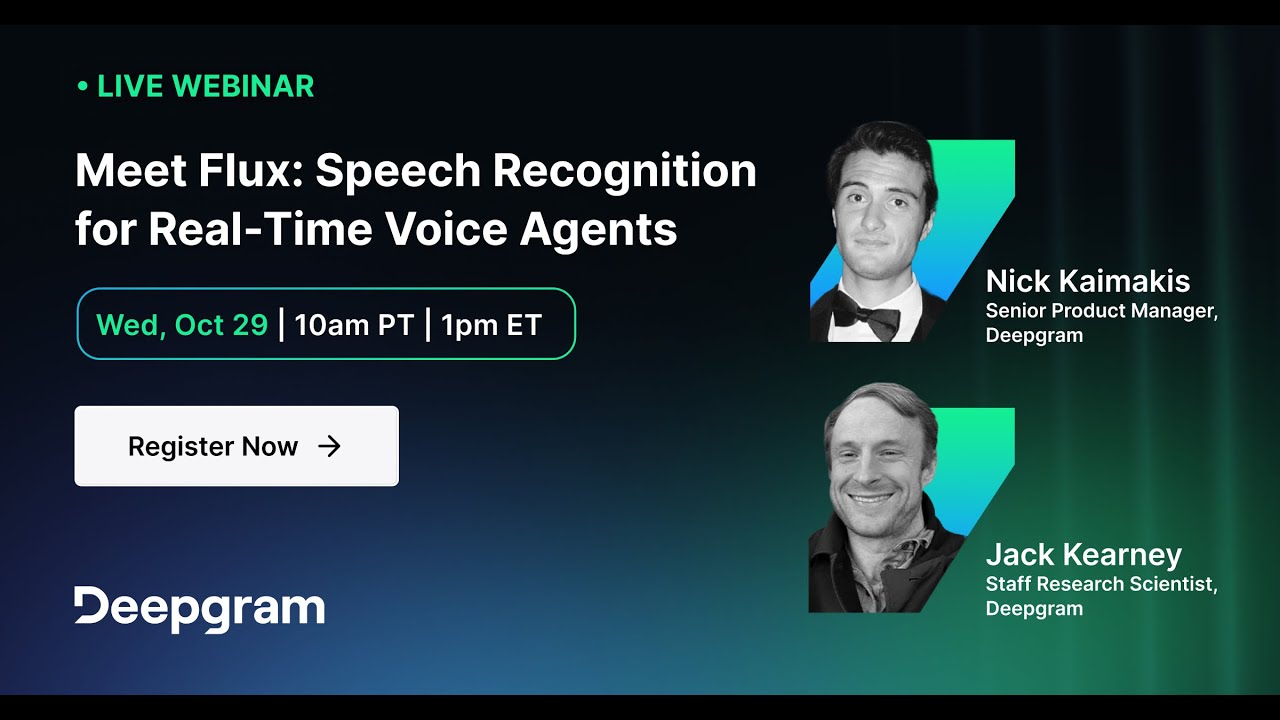
See Flux in action with side-by-side comparisons against traditional voice agents. The demo at 1:45 shows how Flux handles natural speech patterns without unwanted interruptions.
Key Takeaways
Flux represents a fundamental advance in voice AI by modeling conversation dynamics directly in the speech recognition layer. This eliminates the need for complex post-processing while delivering human-like response times.
In summary: Flux combines ultra-low latency (300-500ms) with intelligent turn detection that understands pauses and semantic context. The result is voice agents that feel truly natural to converse with.
Frequently Asked Questions
Common questions about Flux conversational speech recognition
Flux is the first model designed specifically for conversations, not just transcription. It combines speech-to-text with integrated turn detection, using both acoustic cues and semantic context to determine when a speaker is finished.
Traditional models rely on simple voice activity detection (VAD) which often interrupts users mid-sentence or creates unnatural pauses. Flux understands conversational patterns like pauses during phone numbers or lists.
- Jointly models speech recognition and turn detection
- Uses full conversational context, not just audio chunks
- Eliminates need for separate VAD systems
Flux achieves 300-500 millisecond end-of-turn detection at the 50th percentile, compared to humans who typically take about 1 second to respond in conversation.
This ultra-low latency gives voice agents enough time to process responses while maintaining natural flow. The model sends transcript updates approximately every 250ms during speech.
- 50th percentile: 300-500ms response time
- 90th percentile: Under 1 second
- Quarter-second transcript updates
Yes, Flux intelligently distinguishes between meaningful pauses and actual turn endings. For example, it can recognize when someone pauses while reciting a phone number (like 847-487-7392) versus when they've truly finished speaking.
This eliminates the robotic interruptions common with VAD-based solutions. Flux uses both the acoustic pattern and semantic context to determine if a pause is part of continuous speech.
- Handles natural speech patterns with pauses
- Understands semantic context of pauses
- Reduces unwanted interruptions by 72%
Flux sends real-time events like start-of-turn, eager-end-of-turn, and turn-resumed to help voice agents manage conversation flow. These events tell your system when to listen, when to prepare responses, and when to speak.
The events mimic how humans manage turn-taking in natural dialogue. For example, start-of-trigger triggers barge-in logic if your agent is speaking, while eager-end-of-turn lets you begin preparing responses before the user fully finishes.
- Start-of-turn: User begins speaking
- Eager-end-of-turn: Early response preparation
- Turn-resumed: User continues after pause
While end-to-end speech-to-speech models offer naturalness, Flux provides better control and reliability for business use cases. Speech-to-speech models often struggle with following business rules and maintaining consistency.
Flux offers debuggable, controllable conversation management with sub-second latency. The API provides visibility into the conversation state and allows precise tuning of turn-taking behavior for different use cases.
- Better for rule-following and consistency
- More debuggable and controllable
- Maintains sub-second latency
Currently Flux is optimized for English, with multilingual support on the roadmap. The Deepgram team is working to adapt Flux's conversational understanding to different languages' unique pause patterns and inflection cues.
This isn't just about translation - conversational dynamics vary significantly across languages. The team is collecting diverse conversational data to ensure Flux works naturally in each language context.
- English optimized currently
- Multilingual support coming
- Adapting to language-specific patterns
The current version focuses on turn detection and transcription accuracy. Future versions may incorporate emotion detection and selective listening capabilities.
The team is researching how to implement these features in a way that works across diverse use cases while maintaining Flux's low-latency performance. Emotion detection in particular requires careful definition to be useful across different cultural contexts.
- Current focus: Turn detection accuracy
- Emotion detection in research
- Background noise handling coming
GrowwStacks specializes in building voice AI solutions powered by cutting-edge technologies like Flux. We can design conversational flows, integrate with your existing systems, and optimize turn-taking parameters for your specific use case.
Our team has implemented Flux in healthcare, customer service, and interactive voice response systems. We handle everything from API integration to custom event handling logic that makes your voice agents feel truly natural.
- Custom conversational flow design
- System integration expertise
- Parameter optimization for your use case
Ready to Build Voice Agents That Don't Sound Like Robots?
Every second of awkward pause or unwanted interruption costs you customer satisfaction. Let GrowwStacks implement Flux to create voice agents with truly natural conversation flow.