From Zero to AI-First: How to Scale AI Across Your Entire Company
Most organizations struggle with AI adoption - trapped between fear of disruption and FOMO. Discover how one company transformed from zero AI usage to full-scale AI-first operations in just 18 months, achieving 300% productivity gains in key departments while maintaining security and compliance.
The Problem: Information Silos and Productivity Drain
Before their AI transformation, the organization faced the same challenges plaguing most enterprises: critical business data trapped in dozens of disconnected systems. Customer success managers needed to check 8 different platforms just to prepare for a single client meeting. Marketing teams wasted hours compiling reports from fragmented analytics tools. Executives made decisions without comprehensive data visibility.
The breaking point came during a company offsite in Ireland, where cross-functional teams mapped out their daily frustrations. "We realized we were spending more time finding information than actually using it," recalls Martin Hemtock, VP of Platform Engineering. "It was like trying to complete a massive jigsaw puzzle where the pieces were scattered across different buildings."
Key Insight: Employees were spending 65% of their time on repetitive information-gathering tasks rather than high-value work. The opportunity cost of these productivity drains was costing the organization an estimated $4.2M annually in lost capacity.
The Breakthrough Moment
The offsite sparked a radical idea: What if AI could serve as the connective tissue between all these systems? Rather than forcing employees to navigate multiple interfaces, they could interact with a single AI assistant that had access to all organizational knowledge.
Martin and his team prototyped a solution using Libra Chat - an open-source interface that could connect to multiple AI providers (OpenAI, Google Gemini, Anthropic Claude) via API. This multi-model approach proved critical, as different tasks required different AI strengths. Sales teams preferred Claude for email drafting, while engineers found Gemini better for code assistance.
The prototype focused initially on customer success use cases. CSMs could now type a customer name and instantly receive a consolidated report showing:
- Open support tickets and resolution status
- Recent product usage patterns
- Upcoming contract renewal dates
- Key contacts and communication history
What previously took 2-3 hours of manual research now took seconds.
Tool Selection: Why Libra Chat Won
The team evaluated several enterprise AI platforms before settling on Libra Chat for three key reasons:
1. Model Agnostic Architecture: Unlike vendor-locked solutions, Libra Chat could connect to any major AI provider's API, allowing the organization to mix-and-match models based on task requirements.
2. Cost Efficiency: Consumer-facing AI tools charge per-user subscriptions ($20/user/month for ChatGPT Enterprise). With Libra Chat's API-based pricing, they only paid for actual usage across 800+ employees.
3. Existing Enterprise Agreements: The company already had API access contracts with major AI providers, making integration seamless from a procurement perspective.
At 4:22 in the video, Martin demonstrates how employees can easily switch between different AI models within the same interface based on their needs - a flexibility that proved critical for broad adoption.
Implementation Roadmap
The rollout followed a carefully phased approach:
Phase 1: Silent Beta (Weeks 1-4)
- Deployed to 20 "power users" across departments
- Focused on core customer data aggregation use case
- Collected feedback and refined prompts
Phase 2: Departmental Rollout (Weeks 5-8)
- Expanded to entire Customer Success and Sales teams
- Added integrations with CRM and support systems
- Conducted weekly training sessions
Phase 3: Enterprise Launch (Week 9+)
- Company-wide announcement and demos
- "Build Your Own Agent" contest with prizes
- Monthly showcase of innovative use cases
Critical Success Factor: The team prioritized ensuring the first experience was flawless. "If someone has a bad first experience," Martin notes, "you're on an uphill battle to get them to come back after you fix it."
Transformative Use Cases
As adoption grew, unexpected applications emerged across departments:
1. CEO's Shadow Board
The most surprising innovation was an agent that simulates conversations with historical business leaders like Steve Jobs and Warren Buffett. Executives use it to pressure-test strategies against simulated perspectives of legendary minds.
2. Content Production Pipeline
The marketing team automated their entire content workflow:
- Podcast recording to published YouTube video: 3 hours (previously 3 days)
- Transcript to SEO-optimized blog post: 30 minutes
- Brand voice consistency checks: Instant
3. Google Analytics Navigator
Non-technical users can now ask natural language questions like:
- "What were our top performing pages last week?"
- "Did the campaign drive expected traffic?"
- "What time of day do we get most signups?"
At 18:45 in the video, the host demonstrates how this saves 2-3 hours per analytics report.
Employee Adoption Strategies
Driving widespread adoption required more than just technical implementation. Key strategies included:
Gamification: "We bought Amazon vouchers and ran contests for best agent creation," Martin recalls. Winning entries included a Berlin transport planner and automated release note generator.
Grassroots Innovation: Rather than positioning it as an IT initiative, they encouraged employees to build solutions for their own pain points. The fitness assistant and travel planner emerged from this organic approach.
Executive Sponsorship: When the CEO began using the shadow board agent for strategic planning, it sent a powerful signal about the tool's legitimacy.
Community Sharing: A dedicated Slack channel became a hub for sharing prompt templates and use cases across departments.
Measuring the Impact
Six months post-launch, the organization tracked impressive results:
| Department | Time Saved | Quality Improvement |
|---|---|---|
| Customer Success | 65% reduction in prep time | 22% higher CSAT scores |
| Marketing | 80% faster content production | 40% more consistent branding |
| Sales | 50% less research time | 15% increase in win rates |
| Engineering | 30% faster documentation | Fewer support tickets |
Perhaps most importantly, employee surveys showed 87% of staff felt more empowered in their roles, with 92% reporting reduced work-related stress.
The Next Frontier: Agent Orchestration
The team is now working on "master agents" that can coordinate specialized sub-agents - essentially creating AI project managers.
Martin shares his vision: "Imagine telling your AI executive assistant, 'Book a meeting with Michael about the Q3 campaign.' It would:
- Check calendars via Google Workspace integration
- Draft agenda points based on previous discussions
- Generate pre-read materials from relevant files
- Send invites and later transcribe notes
This level of orchestration represents the next evolution in enterprise AI - moving from single-purpose tools to intelligent workflows that understand context and delegate appropriately.
Coming Soon: Libra Chat's beta feature for chaining agents together promises to make this vision a reality, potentially unlocking another 50% productivity gain.
Watch the Full Tutorial
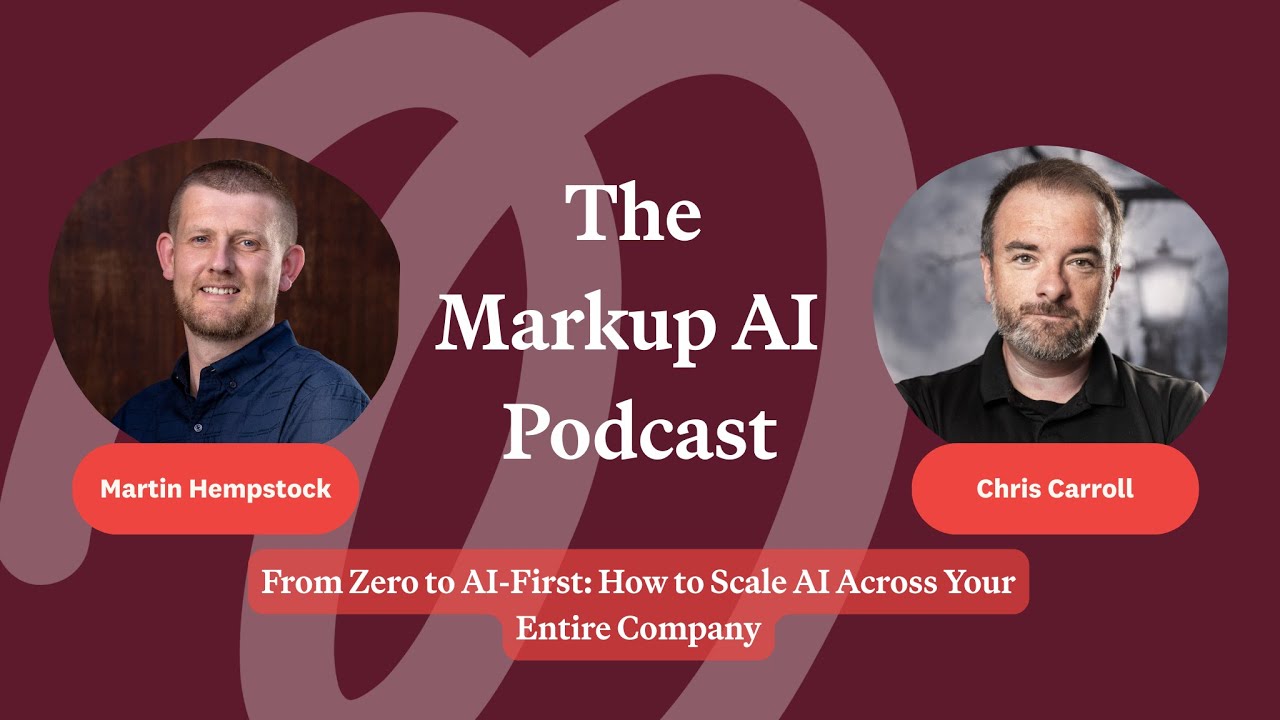
For a deeper dive into their implementation approach, watch the full interview with Martin Hemtock. At 12:15, he demonstrates the multi-model interface that lets employees switch between AI providers based on task requirements.
Key Takeaways
The organization's journey from zero to AI-first offers actionable lessons for any business looking to scale AI adoption:
In summary: Start with high-impact use cases, ensure flawless first experiences, embrace multi-model flexibility, and foster grassroots innovation. The biggest barrier isn't technology - it's organizational mindset.
Their results prove that with the right approach, enterprises can achieve dramatic productivity gains while maintaining security and compliance. The key is viewing AI not as a replacement for workers, but as an amplifier of human potential.
Frequently Asked Questions
Common questions about enterprise AI adoption
The biggest challenge was ensuring the first experience employees had with the AI tools was positive. Our research shows that if users have a bad first experience, it creates an uphill battle to regain their trust later.
We addressed this through a phased rollout:
- Soft launch with power users to iron out issues
- Focused initially on high-success-probability use cases
- Provided extensive onboarding materials
We implemented a multi-model approach using Libra Chat, which acts as an interface layer allowing access to OpenAI, Google Gemini, and Anthropic Claude models.
This approach provided several advantages:
- No vendor lock-in - we could switch models as needed
- Employees could experiment to find best model for their tasks
- Cost efficiency through API-based pricing
The most surprising was our CEO's 'shadow board' agent that simulates conversations with historical business leaders like Steve Jobs and Warren Buffett.
This unexpected application provides strategic guidance by:
- Simulating how legendary leaders might approach challenges
- Pressure-testing ideas before board presentations
- Providing alternative perspectives on business decisions
We leveraged existing enterprise agreements with AI providers and deployed tools internally rather than using consumer-facing products.
Our security framework included:
- All integrations underwent rigorous infosec review
- Strict data access controls based on employee roles
- Regular audits of all AI interactions
Specific teams reported time savings ranging from 50-80% on repetitive tasks. Our content team reduced podcast-to-published content timelines from days to 3 hours.
Key metrics included:
- Sales teams cut research time by 65%
- Customer success prep time reduced by 70%
- Marketing content production accelerated by 80%
We gamified adoption by running contests for best agent creation with Amazon voucher prizes.
Successful strategies included:
- Department-specific use case showcases
- Executive sponsorship and visible usage
- Peer-to-peer learning channels
The next frontier is agent orchestration - creating 'master agents' that can coordinate specialized sub-agents.
This will enable:
- True executive assistant functionality
- Automated multi-step workflows
- Context-aware task delegation
GrowwStacks specializes in enterprise AI adoption roadmaps tailored to your specific workflows.
Our end-to-end services include:
- Current state assessment and opportunity mapping
- Secure integration with your existing systems
- Custom AI agent development and deployment
- Ongoing optimization and support
Book a free consultation to discuss your AI transformation strategy.
Ready to Transform Your Business with Enterprise AI?
Every day without AI adoption puts you further behind competitors who are already achieving 300% productivity gains. Our team at GrowwStacks can implement a customized AI solution for your organization in as little as 30 days.