The Future of AI Voice Agents: Breaking Language Barriers and Redefining Human-Tech Interaction
Businesses waste millions on multilingual support teams and inconsistent customer experiences. AI voice technology now delivers human-quality interactions at scale while preserving brand voice across languages. Discover how Fortune 500 companies and governments are implementing this transformative technology to redefine customer engagement.
The Three Pillars of Voice AI Transformation
Traditional customer interactions are constrained by language limitations, operational hours, and inconsistent service quality. Businesses struggle to scale personalized experiences while controlling costs. Voice AI addresses these challenges through three fundamental shifts in how we create and consume content.
First, it makes all information available in audio format by default - from educational materials to customer support. Second, it eliminates language barriers by enabling content creation and consumption in any language or dialect. Most significantly, it establishes speech as the primary interface between humans and technology, replacing typing and screen-staring with natural conversation.
80% reduction in customer service costs: Enterprises implementing voice AI report dramatic operational savings while maintaining or improving customer satisfaction scores. The technology handles routine inquiries with human-like quality, freeing staff for complex cases.
Revolutionizing Audio Content Creation
Creating professional audio content traditionally required expensive studio time, voice talent, and post-production. AI voice generation changes this equation completely. The technology can now preserve everything that makes voices unique - tonality, emotionality, accent, and speech patterns - while generating natural-sounding speech from text.
Platforms like Eleven Labs maintain ethical voice libraries where contributors are compensated for their vocal IP. This approach supports creative professionals while enabling seamless localization of content. A single script can be rendered in multiple voices and languages while maintaining brand consistency, reducing production timelines from weeks to hours.
Eradicating Language Barriers
Global businesses face constant challenges delivering consistent experiences across languages. Traditional translation services create disjointed customer journeys and brand dilution. Voice AI maintains vocal identity across languages - a company's spokesperson can "speak" Mandarin with the same vocal characteristics as their native English.
This capability has profound implications for education, healthcare, and government services. The Ukrainian government is exploring AI tutors for displaced students, while the Czech Republic uses voice agents to explain labor policies. Content becomes universally accessible without losing the human touch that builds trust and engagement.
Speech as the Primary Human-Tech Interface
Steve Jobs envisioned a future where we could converse with historical figures like Aristotle. Voice AI makes this possible today through interactive agents that combine large language models with vocal synthesis. These agents don't just recite pre-programmed responses - they engage in contextual dialogue, adapting to user intent.
The implications extend far beyond novelty applications. Conversational interfaces will replace app navigation, form filling, and technical support. Users interact naturally rather than learning system-specific interfaces. This shift particularly benefits non-technical users and those with accessibility needs, democratizing technology access.
95% accuracy in major languages: Modern voice AI achieves near-human comprehension levels for common languages, with continuous improvement for regional dialects and accents through machine learning.
Real-World Applications Across Industries
Voice AI isn't theoretical - it's driving measurable business outcomes today. Europe's fastest-growing neobank scaled customer support without sacrificing quality. Gaming companies create interactive NPCs with unique personalities. Healthcare providers restore communication for voice-loss patients.
These implementations share common success factors: seamless CRM integration, deterministic workflow controls for sensitive actions, and robust monitoring frameworks. The most effective solutions combine AI's flexibility with traditional software engineering practices like version control and unit testing.
Building Production-Ready Voice Agents
Consumer-facing demos only show part of the picture. Enterprise-grade voice agents require sophisticated infrastructure for configuration, deployment, and monitoring. Key capabilities include:
1. System Integration
Agents must interact with existing CRMs, ERPs, and databases to be truly useful. This requires secure API connections and data synchronization protocols.
2. Deterministic Controls
Sensitive actions like refunds or account changes are gated through workflow rules that combine AI flexibility with policy enforcement.
3. Continuous Improvement
Version control allows testing against real conversations while maintaining production stability. Analytics identify improvement opportunities.
The Future Vision of Voice Technology
Voice AI represents more than a productivity tool - it's reshaping human-technology interaction fundamentally. As the technology matures, we'll see:
- Ubiquitous voice interfaces replacing screens for most applications
- Personalized AI assistants that understand individual context and preferences
- Real-time multilingual communication without translation lag
- Democratized content creation through accessible vocal synthesis tools
The companies leading this transformation combine technical innovation with ethical considerations around voice ownership and appropriate use. The result will be more natural, accessible, and human-centric technology experiences.
Watch the Full Presentation
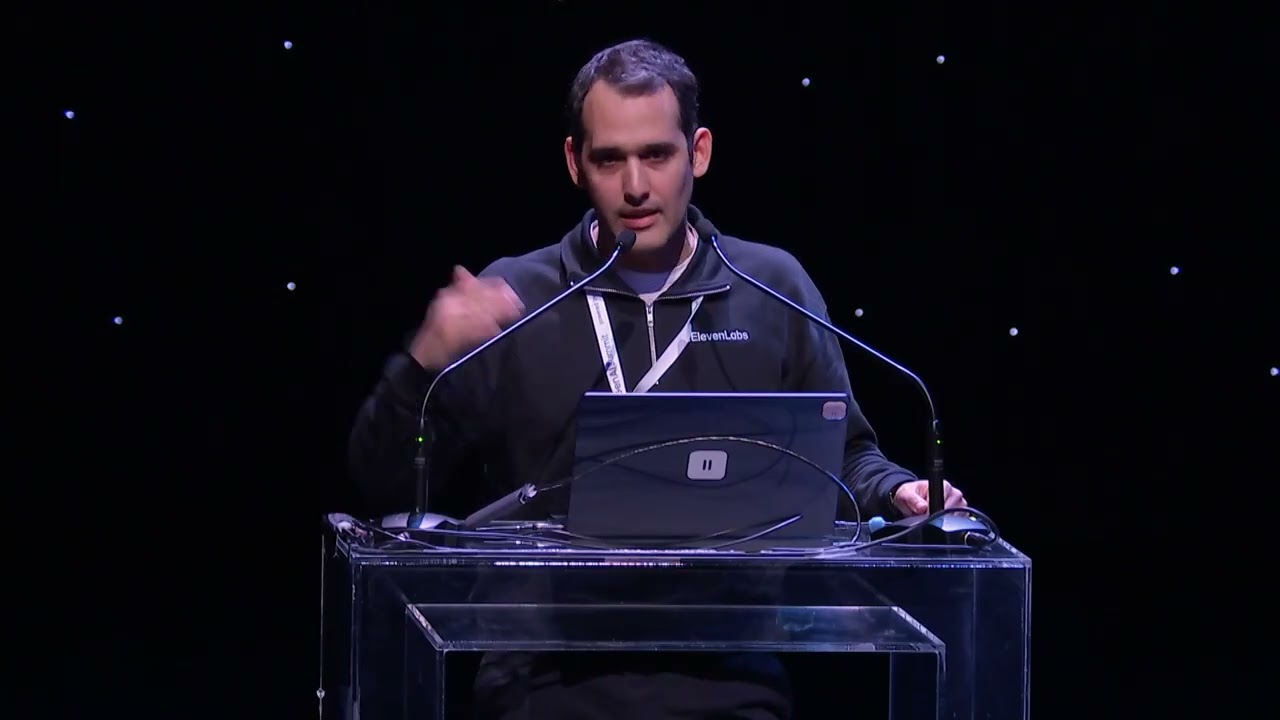
See the live demonstration of AI voice technology in action, including the remarkable interaction with an AI Aristotle at the 7:30 mark. The presentation showcases both the creative potential and practical business applications of this transformative technology.
Key Takeaways
Voice AI is transforming business operations and customer experiences across industries. The technology has moved beyond novelty to deliver measurable ROI through cost reduction, quality improvement, and operational scalability.
In summary: AI voice agents provide 24/7 multilingual support at 80% lower cost than human teams, preserve brand voice across languages with 95% accuracy, and represent the next evolution of human-technology interaction through natural conversation interfaces.
Frequently Asked Questions
Common questions about voice AI technology
AI voice agents provide three key benefits for businesses: 24/7 customer service availability, multilingual support without hiring additional staff, and consistent brand voice across all interactions.
They can handle thousands of simultaneous conversations while maintaining quality, reducing operational costs by up to 80% compared to human-only support teams. This scalability is particularly valuable for businesses with fluctuating demand or global customer bases.
- Always available customer service across time zones
- Instant multilingual capabilities without translation delays
- Consistent messaging and brand personality enforcement
Modern AI voice platforms use advanced neural networks that can understand and generate speech in hundreds of languages and dialects. They preserve unique vocal characteristics including accent, emotional tone, and speech patterns.
This technology allows for authentic localization of content while maintaining the speaker's original vocal identity. A company spokesperson can "speak" Japanese with the same vocal qualities as their native English, creating a consistent brand experience globally.
- Neural networks analyze and replicate subtle vocal nuances
- Preserves emotional tone and speaking style across languages
- Supports regional dialects and niche language variants
Voice AI is being adopted across multiple industries with diverse use cases. Education uses it for personalized tutoring at scale, while banking deploys it for cost-effective customer service that maintains human-like quality.
Government applications include policy communication and public service information delivery. In healthcare, the technology assists with voice restoration for patients and provides companionship for elderly care. Gaming companies create interactive characters with unique personalities and dialogue.
- Banking: 24/7 customer support and fraud detection
- Healthcare: Voice restoration and patient monitoring
- Education: Personalized language learning and tutoring
Leading voice AI platforms now achieve 95%+ accuracy in speech recognition and generation for major languages. Performance varies by dialect and audio quality, but continuous learning systems improve through real interactions.
Enterprise implementations typically include human oversight during initial deployment, with most achieving full automation within 3-6 months. Accuracy continues to improve as models process more diverse voice samples and conversation scenarios.
- Near-human accuracy for common languages
- Continuous improvement through machine learning
- Human-in-the-loop during initial deployment phases
Enterprise voice AI platforms implement multiple security layers to protect sensitive data and prevent unauthorized access. Voice biometrics authenticate users, while encrypted communications secure all interactions.
Deterministic workflow gates control sensitive actions like financial transactions, requiring explicit policy compliance. Strict data governance policies ensure compliance with GDPR, HIPAA, and other regulations. Audit logs record all interactions for accountability and analysis.
- Voice biometric authentication
- End-to-end encryption for all communications
- Compliance with major data protection regulations
Advanced voice agents combine large language models with deterministic workflow controls to handle increasingly complex scenarios. They can access CRM data to provide personalized responses, process refunds within policy limits, and recognize when human intervention is required.
These systems use conversation history to maintain context across interactions, achieving first-contact resolution rates comparable to human agents. The most sophisticated implementations can handle 80-90% of inquiries without escalation.
- Contextual understanding across conversation history
- Policy-aware decision making for sensitive actions
- Seamless escalation to human agents when needed
Businesses track multiple key performance indicators to evaluate voice AI success. Customer satisfaction scores (CSAT) measure interaction quality, while operational metrics like average handling time and first-contact resolution rate assess efficiency.
Cost per interaction and call volume capacity demonstrate scalability benefits. Leading platforms provide real-time analytics dashboards and A/B testing capabilities to continuously optimize agent performance against business objectives.
- Customer satisfaction (CSAT) scores
- First-contact resolution rates
- Cost per interaction metrics
GrowwStacks specializes in designing and deploying custom voice AI solutions tailored to specific business needs. Our team handles the complete implementation process from use case identification to system integration and performance optimization.
We offer free consultations to assess suitability and develop implementation roadmaps. Our solutions integrate with your existing CRM and business systems while maintaining strict security and compliance standards. Ongoing monitoring ensures continuous improvement aligned with your business objectives.
- Custom voice agent design and deployment
- Seamless CRM and business system integration
- Free consultation and implementation roadmap
Ready to Transform Your Customer Experience with Voice AI?
Don't let language barriers and staffing limitations constrain your growth. Voice AI delivers 24/7 multilingual support at 80% lower cost than traditional contact centers.