How to Securely Accept Payments From AI Agents Using the Agentic Commerce Protocol
As AI agents evolve from browsers to buyers, sellers face new challenges: How do you trust an autonomous buyer? How do you process payments securely while maintaining control? The Agentic Commerce Protocol (ACP) solves these problems with Stripe-powered Shared Payment Tokens that define exactly how, when, and how much AI agents can spend.
The Agent Payment Problem
Traditional e-commerce systems weren't designed for autonomous AI buyers. When an AI agent attempts to make a purchase, sellers face three critical challenges: establishing trust in the transaction, ensuring payment security, and maintaining control over the purchase parameters. Without a standardized protocol, each seller would need to build custom solutions to verify agent identities, validate payment methods, and prevent unauthorized spending.
The Agentic Commerce Protocol solves these problems by introducing Shared Payment Tokens (SPTs) - digital tokens that define exactly how much an agent can spend, in what currency, and for how long. These tokens are validated through Stripe's secure infrastructure, giving sellers confidence in agent transactions while maintaining full control over spending limits.
Key insight: ACP doesn't require sellers to rebuild their checkout systems. Instead, it provides a standardized layer that makes existing Stripe integrations "agent-ready" with minimal changes.
How ACP Works: Shared Payment Tokens
Shared Payment Tokens (SPTs) are the foundation of the Agentic Commerce Protocol. Each SPT contains three critical parameters: the maximum spending amount, the allowed currency, and the token's expiration time. When an AI agent initiates a purchase, it presents this token to the seller's system along with the order details.
The seller's system validates the SPT through Stripe's API before processing the payment. This validation checks that the transaction amount doesn't exceed the token's limit, that the currency matches, and that the token hasn't expired. Only after successful validation does the system create a Payment Intent and complete the transaction.
Implementation note: SPTs can be single-use or multi-use, allowing flexibility for different agent shopping scenarios while maintaining security through strict spending controls.
Setting Up Your Stripe Account for ACP
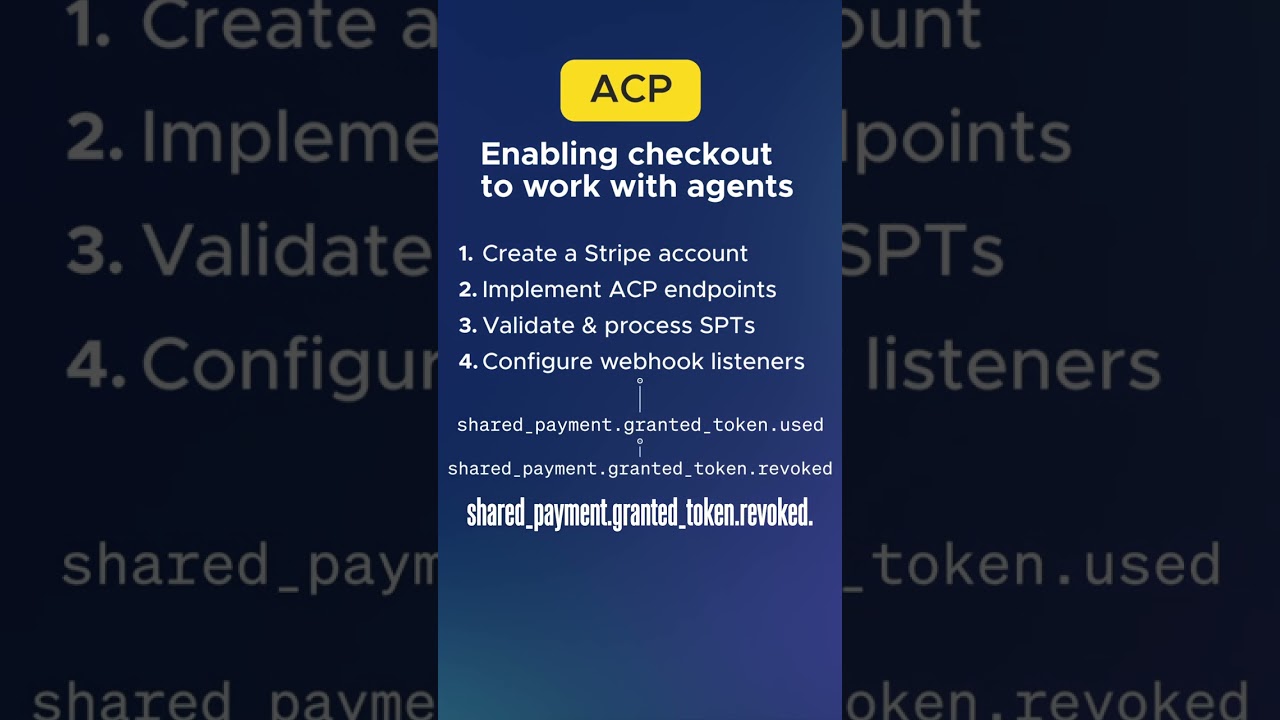
Preparing your Stripe account for ACP involves three key steps. First, ensure you have a platform account configured - this serves as your agent-ready storefront where you'll manage checkouts and validate SPTs. Second, enable the Shared Payment Tokens feature in your Stripe dashboard under the "Payments" settings. Third, generate API keys with appropriate permissions for SPT validation and payment processing.
At 1:15 in the tutorial video, Allison demonstrates the exact Stripe dashboard settings needed for ACP integration. Pay special attention to the webhook configuration section, where you'll specify the endpoints for receiving real-time updates about token usage and revocations.
Implementing ACP Endpoints
Your system needs to implement four core endpoints that agents will call during the purchase flow. The checkout creation endpoint initiates the transaction and returns available payment options. The update endpoint allows agents to modify cart contents before finalizing. The payment completion endpoint processes the transaction using the validated SPT. Finally, the cancellation endpoint handles abandoned or rejected purchases.
Each endpoint should return standardized responses that agents can parse automatically. For example, successful checkout creation might return a JSON object containing the checkout ID, available SPTs, and item details, while payment completion would return the transaction confirmation and receipt URL.
Validating Shared Payment Tokens (SPTs)
SPT validation happens through a dedicated Stripe API call that checks three critical factors: the token's spending limit versus the purchase amount, the currency compatibility, and the token's expiration status. The validation endpoint should return clear success/failure responses with detailed error messages when applicable, allowing agents to adjust their requests or seek new tokens when needed.
For maximum security, implement token validation as a separate microservice that can be scaled independently during peak shopping periods. This ensures that validation latency doesn't impact your main checkout flow while maintaining robust security checks on every agent transaction.
Webhook Monitoring for Real-Time Updates
Configure your system to listen for two crucial Stripe webhooks: sharedpayment.grantedtoken.used and sharedpayment.grantedtoken.revoked. The first notifies you when an SPT is successfully used in a transaction, allowing you to update inventory and fulfillment systems. The second alerts you when a token becomes invalid, either through expiration or manual revocation by the token's owner.
These webhooks enable your system to maintain accurate records of agent activity without polling Stripe's API. Implement proper webhook signature verification to ensure the notifications are genuine, and set up retry logic for failed delivery attempts to prevent missed updates.
Building Resilience: Error Handling
Agent transactions can fail for various reasons: expired tokens, declined payments, or canceled checkouts. Your ACP implementation should handle these scenarios gracefully by returning standardized error responses that agents can parse and act upon. For example, an expired token response might include a suggested renewal flow, while a declined payment could trigger the agent to seek alternative payment methods.
Consider implementing a circuit breaker pattern for your payment processing service to prevent cascading failures during Stripe API outages. This ensures your system remains responsive even when external dependencies experience issues, providing better reliability for agent transactions.
Testing Your ACP Integration
Before going live, thoroughly test your ACP integration in Stripe's sandbox environment. Create test SPTs with various limits and expiration times, then simulate complete agent purchase flows including checkout creation, updates, and payment completion. Verify that your webhook listeners correctly process notifications and that your system maintains accurate records of all transactions.
Pay special attention to edge cases like concurrent purchases using the same SPT, expired token renewals, and partial fulfillment scenarios. The more comprehensive your testing, the smoother your production rollout will be when handling real agent transactions.
Watch the Full Tutorial
For a complete walkthrough of ACP implementation, watch the video tutorial where Allison demonstrates each step from Stripe account setup to SPT validation. At 2:30, she shows how to test webhook delivery and handle common error scenarios that might occur during agent transactions.
Key Takeaways
The Agentic Commerce Protocol represents the future of AI-driven commerce, enabling secure transactions between sellers and autonomous agents. By implementing ACP with Stripe's Shared Payment Tokens, you can safely accept payments from AI buyers while maintaining control over spending limits and transaction parameters.
In summary: ACP provides a standardized way to validate agent payments through SPTs, requires implementing specific endpoints for the purchase flow, and relies on webhooks for real-time updates. Proper testing in Stripe's sandbox ensures your integration handles all transaction scenarios reliably.
Frequently Asked Questions
Common questions about the Agentic Commerce Protocol
The Agentic Commerce Protocol (ACP) is a standardized framework that enables secure transactions between sellers and AI agents. It uses Stripe-powered Shared Payment Tokens (SPTs) that define spending limits, currencies, and validity periods for autonomous buyers.
This protocol allows sellers to safely accept payments from AI agents without rebuilding their checkout systems, providing a secure bridge between traditional e-commerce platforms and the emerging world of agent-driven commerce.
- Standardized protocol for agent transactions
- Uses Stripe's secure infrastructure
- Maintains seller control through spending limits
Shared Payment Tokens (SPTs) are digital tokens that define the parameters for agent transactions. Each SPT specifies the maximum amount an agent can spend, the allowed currency, and the token's expiration time.
When an agent makes a purchase, the seller validates the SPT through Stripe's API before processing the payment. This validation ensures the transaction amount doesn't exceed the limit, the currency matches, and the token hasn't expired.
- Define spending limits and validity periods
- Validated through Stripe's API
- Can be single-use or multi-use
ACP requires implementing several key endpoints that agents call during purchases: creating checkouts, sending updates, completing payments using SPTs, and handling cancellations.
These endpoints form the communication backbone between your system and AI agents, enabling the complete purchase flow while maintaining security and control over the transaction parameters.
- Checkout creation endpoint
- Update endpoint for cart modifications
- Payment completion endpoint
- Cancellation endpoint
Webhook monitoring is critical for ACP because it keeps your system synchronized with agent activity in real-time. Key events to monitor include sharedpayment.grantedtoken.used and sharedpayment.grantedtoken.revoked.
These webhooks notify you when payments are made or when tokens become invalid, allowing your system to maintain accurate records and prevent unauthorized transactions. Without webhooks, you'd need to poll Stripe's API constantly for updates.
- Real-time transaction notifications
- Token revocation alerts
- Prevents unauthorized spending
ACP implementations should include robust error handling for declined payments, expired tokens, or canceled checkouts. The system should return clear, standardized responses that allow agents to automatically recover from failures.
This might involve requesting a new SPT, notifying the human user, or retrying the transaction with adjusted parameters. Well-designed error handling ensures smooth agent transactions even when issues arise.
- Standardized error responses
- Automatic recovery flows
- User notification systems
Before launching an ACP integration, thoroughly test all components in Stripe's sandbox environment. This includes testing agent checkouts, SPT validation, payment processing, and webhook delivery.
The goal is to ensure your system handles every step of the ACP flow predictably and securely before processing real transactions. Test edge cases like concurrent purchases and partial fulfillments to verify system resilience.
- End-to-end purchase flow testing
- SPT validation scenarios
- Webhook delivery verification
Implementing ACP prepares your business for the future of agent-driven commerce by enabling secure transactions with autonomous buyers. Benefits include increased sales from AI agents, reduced fraud risk through controlled spending limits.
ACP also provides the ability to scale transactions without rebuilding your payment infrastructure. Early adopters position themselves to capitalize on the growing ecosystem of AI-powered commerce as more consumers delegate shopping to agents.
- New revenue from agent transactions
- Reduced payment fraud
- Future-proof payment infrastructure
GrowwStacks helps businesses implement the Agentic Commerce Protocol by building custom integrations with Stripe that support SPT validation and agent transactions. Our team handles the technical implementation of ACP endpoints, webhook configuration, and payment processing logic.
We ensure your system can safely accept payments from AI agents while maintaining full control over transaction parameters. Our implementations include comprehensive testing and documentation to guarantee a smooth rollout.
- Custom ACP endpoint development
- Stripe integration and SPT validation
- Webhook configuration and monitoring
- Free consultation to assess your needs
Ready to Accept Payments From AI Agents?
Every day you wait is another day your business misses out on AI-driven sales. GrowwStacks can implement the Agentic Commerce Protocol for your Stripe integration in as little as 2 weeks, letting you safely transact with autonomous buyers while maintaining full control.