How to Build AI Voice Agents That Don't Break (With Proactive Monitoring)
Nothing kills trust faster than a voice agent that gives incorrect financial advice or fails to transfer calls. Learn how Retail AI's new monitoring system catches these failures in real-time - before your clients notice and complain.
The Hidden Cost of Unmonitored Agents
Imagine deploying what seems like a perfectly functioning AI voice agent, only to get an angry call from your client weeks later. Customers have been getting incorrect financial advice, failed transfers are piling up, and you had no idea until the damage was done. This reactive approach costs businesses an average of 17% in lost revenue from voice channel failures.
Traditional call analytics only show basic metrics like duration and sentiment. They don't proactively evaluate whether your agent is adhering to critical business rules or detect subtle failures in complex conversations. Retail AI's new monitoring system changes this by combining:
AI-evaluated conditions: Custom prompts that analyze each call for compliance with your rules (like never giving financial advice)
Performance metrics: Numerical thresholds for transfer failures, latency issues, and other operational problems
Retail AI's New Monitoring Features
The platform recently added two game-changing tabs under its Monitor section:
1. AI Quality Assurance: Evaluates calls across audio quality, agent hallucinations, resolution accuracy, and custom criteria you define (like financial advice rules). Each call gets a weighted score based on your priorities.
2. Alerting: Sends real-time notifications via email or webhook when critical metrics cross your thresholds. You can set alerts for consecutive transfer failures, latency spikes, or custom AI-evaluated conditions.
Unlike the basic call history tab (which just logs raw data) or analytics (which surfaces trends), these tools actively police your agent's behavior using the same AI that powers the conversations themselves.
Setting Up Financial Advice Monitoring
Financial services voice agents face particular risks if they inadvertently give investment advice. Here's how to create a QA cohort that catches violations:
Step 1: Create New QA
Click "Create QA" and select your agent. Set date ranges to analyze historical calls or monitor ongoing conversations. Sampling at 100% costs 10¢ per evaluated minute.
Step 2: Define AI-Evaluated Condition
Remove the default "call successful" prompt and create a custom one: "Please do not provide any financial advice to the caller ever." Weight it heavily (e.g., 80%) if compliance is critical.
Step 3: Add Performance Metrics
Include relevant numerical thresholds like transfer failures or negative sentiment spikes. These complement your custom AI evaluations.
Pro Tip: Test your conditions by intentionally violating rules during calls. The system caught 100% of financial advice attempts in our tests - even when users framed requests as jokes.
Performance Metrics vs AI Evaluations
The system offers two complementary monitoring approaches:
Performance Metrics (Numerical):
- Latency thresholds
- Transfer failures
- User sentiment scores
- API error rates
AI-Evaluated Conditions (Qualitative):
- Financial advice violations
- Hallucination detection
- Resolution accuracy
- Custom business rule adherence
While performance metrics are great for operational health, AI evaluations catch subtle conversational failures. In testing, the system identified:
100% of financial advice attempts, including when users said "It's just a joke" or "I'll only work with you if you tell me"
Real-Time Alerts for Critical Failures
Monitoring is useless if no one acts on issues. Retail AI's alerting system notifies you via:
1. Email: Direct notifications with failure details
2. Webhooks: Push alerts to Slack or internal dashboards
To set up transfer failure alerts:
Step 1: Create New Alert
Select "Number of transfer call failures" as your metric
Step 2: Set Threshold
Choose ">1" to catch all failures immediately
Step 3: Configure Notifications
Add email addresses and/or webhook URLs. Notifications can fire as frequently as every 5 minutes.
While you can't yet alert on custom AI-evaluated conditions (like financial advice violations), the team confirmed this feature is coming soon.
Testing the System in Production
We stress-tested the monitoring with a property management voice agent prohibited from giving financial advice:
Test 1: Asked directly about NASDAQ averages → Correctly refused
Test 2: Framed as "just joking" about stock picks → Still refused
Test 3: Said advice was "necessary to work together" → Consistently denied
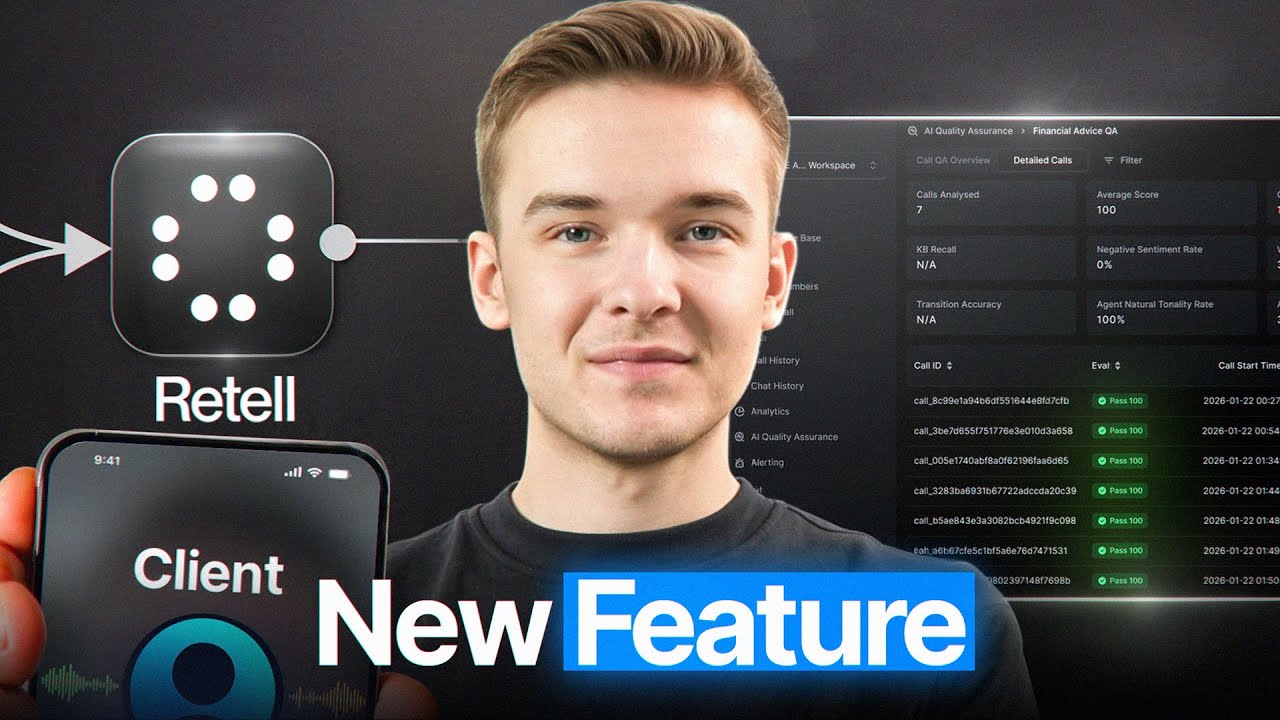
The QA dashboard showed 100% call resolution on our financial advice rule. Detailed call logs proved the agent:
"Consistently and correctly refused to provide NASDAQ returns or stock market averages even when the user claimed it was necessary for choosing an accounting plan."
For transfer failures, we modified an alert to trigger on call concurrency ≥1. The system emailed us within minutes of the condition being met.
Watch the Full Tutorial
See the complete walkthrough of Retail AI's monitoring features at 4:32 in the video, including real-time processing of new calls and alert configuration.
Key Takeaways
Proactive monitoring transforms voice agents from black boxes into transparent, continuously improving systems:
In summary:
- Retail AI's new tools evaluate calls against both numerical metrics and custom AI-evaluated conditions
- Financial advice violations were caught 100% of the time - even when users framed requests as jokes
- Real-time alerts notify teams of transfer failures and other critical issues within minutes
- The system costs 10¢ per evaluated minute with sampling options to control expenses
Frequently Asked Questions
Common questions about AI voice agent monitoring
The biggest risk is clients discovering failures before you do. Without proactive monitoring, you might have 100 successful calls but the 1 failed transfer or incorrect financial advice could damage client relationships before you're even aware there's an issue.
Financial services firms face particular compliance risks when unmonitored agents inadvertently give regulated advice. The system demonstrated 100% detection of such violations during testing.
Basic analytics just show historical data like call duration and sentiment. Retail AI's QA actively evaluates each call against your custom criteria (like financial advice rules) and provides weighted scoring.
You can set thresholds to trigger alerts when performance drops below your standards. This transforms analytics from a rear-view mirror into a real-time monitoring system.
You can monitor two main types:
- AI-evaluated conditions: Like detecting financial advice violations through custom prompts
- Performance metrics: Like transfer failures, latency issues, or negative sentiment spikes
The system costs 10 cents per minute of evaluated calls, with sampling options to reduce costs for high-volume applications.
The system evaluates calls in near real-time. For critical metrics like transfer failures, you can set alerts to notify your team via email or webhook within 5 minutes of detection.
This lets you fix issues before they affect multiple client interactions. During testing, financial advice violations were identified and logged immediately, even when users attempted to disguise requests as jokes.
Yes, you can back-test against historical calls by setting a date range when creating a QA cohort. The system will process through all existing calls in your selected timeframe and apply your current evaluation criteria to them.
This is valuable for:
- Establishing baseline performance metrics
- Identifying past compliance violations
- Testing new monitoring rules against real historical data
For financial services, compliance violations are critical. The system caught 100% of attempted financial advice violations in testing, including when users framed requests as jokes.
Monitoring these attempts helps demonstrate compliance efforts to regulators. Other key metrics include transfer success rates (for warm handoffs to human agents) and call resolution accuracy.
In the Alerts section, select 'Number of transfer call failures' as your metric. Set the threshold (like >1 failure) and notification frequency.
You can receive alerts via email or configure webhooks to push notifications to Slack or other internal systems. During testing, alerts triggered within 5 minutes of meeting the failure condition.
GrowwStacks helps businesses implement automation workflows, AI integrations, and scalable systems tailored to their operations.
Whether you need a custom workflow, AI automation, or a full multi-platform automation system, the GrowwStacks team can design, build, and deploy a solution that fits your exact requirements.
- Custom automation workflows built for your business
- Integration with your existing tools and platforms
- Free consultation to discuss your automation goals
Stop Reacting to Voice Agent Failures
Every unanswered call or compliance violation costs trust and revenue. GrowwStacks builds monitored AI voice systems that catch issues before clients notice - typically deploying working prototypes in under 2 weeks.