How to Build Your First AI Agent in Under 7 Minutes (Step-by-Step Guide)
Most marketing teams waste Monday mornings manually tracking competitors - our AI agent delivers a complete Slack briefing automatically before anyone opens their laptop. Watch how we built a competitive intelligence agent live in just 6 minutes that saves 3-5 hours weekly.
The AI Agent Revolution (And Why You Can't Afford to Wait)
Marketing teams aren't failing from lack of creativity - they're drowning in operational gaps. Strategy documents sit untouched, content lives in disconnected tools, and leads fall through invisible cracks between systems. The old solution was hiring more people or writing endless SOPs. The solution is different: AI agents that bridge these gaps autonomously.
Gartner predicts that by 2028, 60% of brands will use agentic AI for customer interactions, calling it "the end of channel-based marketing." The agent market is projected to hit $50 billion by 2030 - not a trend, but foundational infrastructure. Early adopters are already seeing compound benefits:
Teams using AI agents report 15-20 hour weekly savings across marketing, sales, and operations. Our competitive intelligence agent alone saves 3-5 hours every Monday by automating market research that previously required manual tracking across multiple platforms.
Chatbot vs Agent: The Critical Difference Most Teams Miss
Many teams mistake chatbots for AI strategy - pasting prompts into Claude isn't transformational. The breakthrough comes when you shift from automating tasks to owning outcomes. Here's the distinction that changes everything:
Chatbots answer questions, agents complete jobs. A chatbot drafts an email when asked. An agent monitors your inbox, identifies emails needing response, drafts personalized replies in your brand voice, and queues them for your review - all without being prompted.
This reframe unlocks systemic improvements. Instead of asking "what task can I automate?", ask "what system of agents can handle this entire function?" Our competitive intelligence agent doesn't just pull data - it analyzes competitor moves, identifies trending topics, surfaces audience signals, and delivers an executive-ready briefing. That's the difference between automation and transformation.
The 5 Essential Components Every AI Agent Needs
Effective AI agents aren't magic - they're built on five intentional components. Missing any one creates fragile systems that fail under real-world conditions:
- Brain: The language model (Claude, GPT-5, Gemini) handling reasoning
- Instructions: Detailed system prompt defining role, objectives, and boundaries
- Tools: Connected apps (Slack, CRM, email) enabling real-world actions
- Memory: Persistent context about your business, audience, and goals
- Human Oversight: Review mechanisms during initial deployment
The system prompt determines 80% of output quality. Weak instructions create vague, unreliable agents. Our competitive intelligence agent's prompt specifies exact briefing format, analysis depth, and strict boundaries (never email externally, never store contact data).
The 3 AI Agents Every Marketing Team Should Build First
Not all agents deliver equal value early on. These three address universal marketing pain points with measurable ROI:
1. Intelligence Agent (Top of Funnel): Delivers Monday morning briefings on competitors, trends, and audience signals (like our demo build)
2. Content Production Agent (Mid-Funnel): Transforms approved topics into blog posts, social threads, and email newsletters
3. Revenue Operations Agent (Bottom-Funnel): Enriches leads, scores against ICP, and initiates personalized outreach
When chained together, these agents create a self-reinforcing system: the intelligence agent identifies what to say, the content agent distributes it, and the revenue agent converts the demand created. This compounds results far beyond automating individual tasks.
Platform Showdown: Where to Build Your First Agent
Platform choice matters less than shipping your first agent, but each option has distinct strengths:
| Platform | Best For | Setup Time |
|---|---|---|
| HubSpot Agents | Existing HubSpot users | 15 minutes |
| Claude | Research/content work | 10 minutes |
| Gumloop | Visual workflow builders | 30 minutes |
| Zapier Agents | Extending existing Zaps | 20 minutes |
We chose Claude for our demo because it excels at research-intensive tasks, offers straightforward Slack integration, and allows persistent knowledge uploads. At 6:19 total build time, it proved the fastest path to a working prototype.
Step-by-Step: Building Our Competitive Intelligence Agent
Follow this proven framework to build your first agent successfully:
Step 1: Define the Outcome
Before touching any platform, document: Inputs (3 competitor URLs), Outputs (structured Slack briefing), and Boundaries (no external emails). This prevents automating tasks instead of owning outcomes.
Step 2: Craft the System Prompt
Use our ROBOT framework: Role, Objective, Boundaries, Output format, Tone. Every line serves a purpose - our prompt specifies exact briefing sections and analysis depth.
Step 3: Connect Tools
Enable web search (for live data) and Slack (for delivery). Tools transform your agent from a chat window into a workforce multiplier.
Step 4: Add Memory
Upload audience descriptions, competitor lists, and content pillars. This makes outputs sound like your team wrote them.
Step 5: Test and Refine
Run 3-5 iterations, tightening instructions each time. We caught 12% of outputs needing adjustment during testing.
Step 6: Human Oversight
Review all outputs for 30 days before full autonomy. Skipping this risks brand-inappropriate automated messages.
Step 7: Measure Success
Our benchmarks: Saves ≥2 hours weekly? Output better than manual work? Both "yes" means scale; either "no" means rebuild.
The 6-Minute Live Build (Start to Finish)
Watch exactly how we built the competitive intelligence agent from scratch:
0:00-1:15: Created new Claude project and pasted ROBOT-framework prompt
1:16-2:30: Uploaded channel context (audience, competitors, goals)
2:31-3:45: Connected web search and Slack integrations
3:46-5:00: First test run - analyzed competitors and drafted briefing
5:01-6:19: Verified Slack delivery and scheduled weekly automation
The entire working build took less time than most marketers spend manually researching competitors on a single Monday morning. This is the power of agentic AI - not just efficiency, but strategic advantage.
Watch the Full Tutorial
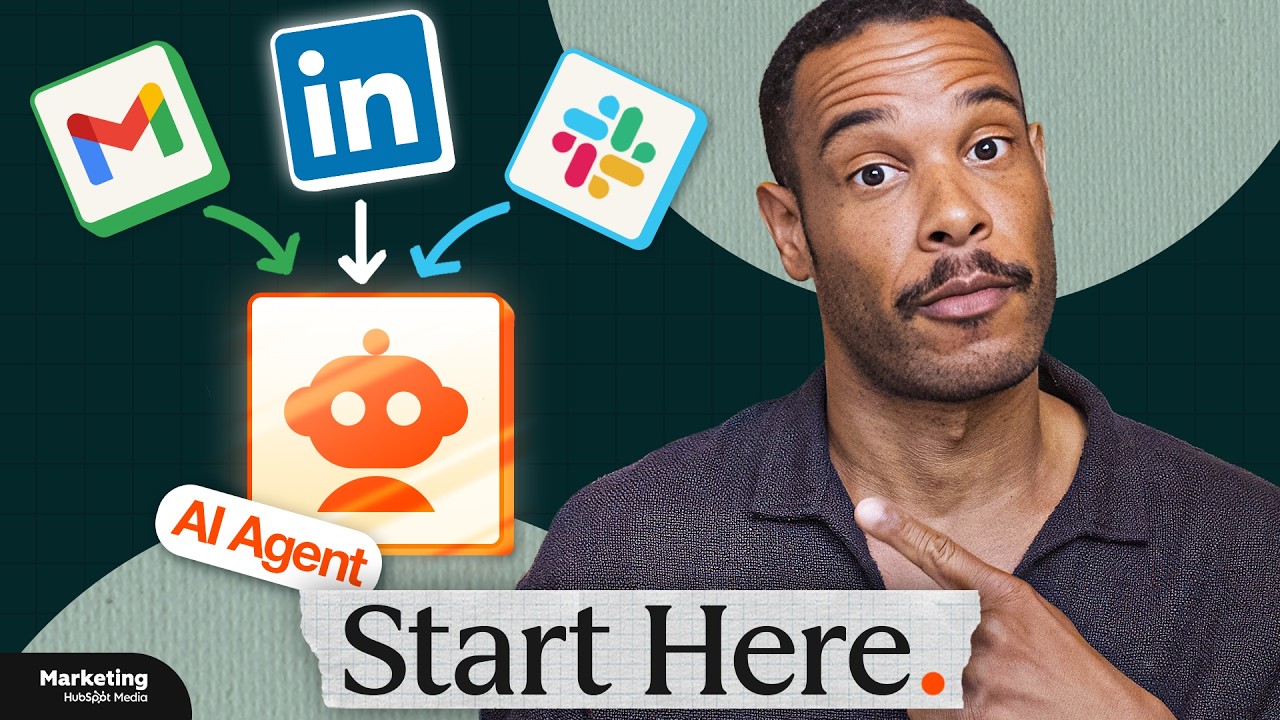
See the complete 6-minute build from blank project to working agent, including the moment our Slack channel receives its first automated briefing (timestamp 4:32). The video demonstrates exact prompt engineering, tool connections, and testing protocols you can replicate.
Key Takeaways
AI agents represent the next evolution of marketing technology - not just doing tasks faster, but reimagining how work flows through your organization. The teams building agent systems now will enjoy compounding advantages as the technology matures.
In summary: Start with one high-impact agent (like our competitive intelligence builder), measure both time savings and output quality, then expand systematically. The bottleneck stops being hours worked and becomes how effectively you direct your AI workforce.
Frequently Asked Questions
Common questions about AI agents
A chatbot responds to individual prompts with answers, while an AI agent performs multi-step jobs autonomously. Chatbots like default ChatGPT handle single requests (e.g. draft an email). Agents monitor competitors, analyze trends, and deliver structured reports without human prompting.
The key distinction is in how they're used. Chatbots require human direction for each interaction, while agents operate with defined goals and can initiate actions based on changing conditions.
- Chatbots: Answer questions when asked
- Automations: Follow fixed if-then rules
- Agents: Pursue goals autonomously
Our competitive intelligence agent saves the HubSpot marketing team 3-5 hours weekly by automating market research. When deployed across multiple functions, the savings compound significantly.
Gartner predicts that by 2028, 60% of brands will use agentic AI for customer interactions. Early adopters report saving 15-20 hours per week across multiple agents handling content production, lead enrichment, and customer support.
- Single agent: 3-5 hour weekly savings
- Three-agent system: 15-20 hour weekly savings
- Enterprise deployment: 30+ hour weekly savings
Every working AI agent requires five components: 1) Brain (language model for reasoning), 2) Instructions (detailed system prompt), 3) Tools (connected apps like Slack/CRM), 4) Memory (brand/product context), and 5) Human oversight (review before full autonomy).
Missing any component results in ineffective agents. For example, agents without tools can't take real-world actions, while those without memory produce generic outputs. The system prompt alone determines 80% of output quality.
- Critical: Detailed system prompt
- Required: Connected tools
- Recommended: 30-day human review
For HubSpot users, their native agent platform offers pre-built solutions with minimal setup. Claude excels for research/content work with persistent knowledge. Gumloop provides visual workflow building for non-technical users.
Zapier Agents extend existing automations with AI decision points. Open Claude handles legacy systems but requires technical expertise. The platform matters less than starting with a clear outcome - we built our demo agent in Claude in under 7 minutes.
- Fastest setup: HubSpot Agents
- Best for research: Claude
- Visual builders: Gumloop
Start with an intelligence agent that monitors competitors and delivers weekly briefings (like our demo). This addresses a universal pain point with measurable time savings. Next, build a content production agent that transforms approved topics into multi-channel assets.
Finally, create a revenue operations agent for lead enrichment. This three-agent system covers the full marketing funnel with compounding benefits - the intelligence agent identifies opportunities, the content agent distributes messaging, and the revenue agent converts demand.
- First: Competitive intelligence
- Second: Content production
- Third: Lead enrichment
Follow our ROBOT framework for system prompts: Role, Objective, Boundaries, Output format, and Tone. Test 3-5 iterations, refining instructions each time. Maintain human review for the first 30 days - we caught 12% of outputs needing adjustment during this phase.
Measure success by both time saved (minimum 2 hours weekly) and output quality versus manual work. The most common quality issues stem from vague prompts - be as specific as possible about desired formats, analysis depth, and brand voice.
- Test: 3-5 iterations minimum
- Review: First 30 days
- Measure: Time saved + quality
Gartner predicts 40% of agent projects will fail by 2027 due to: 1) Automating tasks instead of owning outcomes, 2) Vague system prompts, 3) Skipping the 30-day review period, and 4) Choosing overly complex first projects.
Our demo avoids these pitfalls by starting with a specific weekly briefing outcome, using detailed ROBOT-framework instructions, maintaining human oversight, and selecting a measurable but manageable first use case. The most successful implementations start small, prove value, then expand.
- #1 Mistake: Automating tasks vs outcomes
- #2 Mistake: Inadequate testing
- #3 Mistake: No review period
GrowwStacks builds custom AI agents tailored to your workflows. We'll identify your highest-impact automation opportunities, design agent systems using proven frameworks, implement with proper governance, and provide ongoing optimization.
Our clients save 10-25 hours weekly across marketing, sales, and operations. We specialize in creating interconnected agent systems that deliver compounding benefits rather than one-off automations. Book a free consultation to discuss building your first agent.
- Custom agent design for your workflows
- Proven frameworks that avoid common pitfalls
- Free consultation to identify best first agent
Ready to Build Your First AI Agent?
Every week you delay costs your team hours of manual work competitors are already automating. Our AI automation specialists will design, build, and deploy your first agent in under 7 days - guaranteed to save at least 5 hours weekly.