From 900+ Sessions to 1 Perfect Plan: How Multi-Agent AI Revolutionizes Decision Making
Facing 900+ conference sessions with only 3 days to attend? Traditional filtering leaves you overwhelmed while missing the best opportunities. Discover how Google Anti-gravity's specialized AI agents transform information overload into perfectly optimized plans - saving hours while delivering superior results.
The Filter Paradox: Why Traditional Methods Fail
Planning a major conference with hundreds of sessions creates an impossible dilemma. You open the agenda with enthusiasm, only to face what Chari Chakshi calls "the filter paradox." You scroll through endless options, shortlist 20 sessions, yet still feel you might be missing the perfect opportunity hidden on page 42.
Traditional filters fail because they operate in binary terms - either too narrow (returning zero results) or too broad (leaving you with hundreds). As Chakshi explains, "If you combine too many filters, you get zero results. If you loosen them up, you are back to a haystack of hundreds." The result? Decision fatigue sets in before the conference even begins.
The hidden cost: Conference attendees spend an average of 4-6 hours manually planning their schedule, according to event industry research. Yet nearly 60% still report "FOMO" (fear of missing out) about sessions they didn't attend.
The Agent Solution: From Lists to Strategy
Chakshi realized that conference planning isn't an information retrieval problem - it's a complex decision-making challenge requiring understanding of personal goals, evaluation of competing options, and resolution of hard constraints. This insight led to a fundamental shift: "Filtering tells you what is available. Agents tell you what is valuable."
The multi-agent approach addresses four critical dimensions traditional methods miss:
- Personalization: Understanding your specific career goals and learning objectives
- Optimization: Evaluating hundreds of competing options simultaneously
- Constraint resolution: Automatically handling time conflicts and geography
- Human factors: Balancing session intensity with networking time and basic needs
This comprehensive approach transforms conference planning from a tedious chore into a strategic advantage.
Google Anti-gravity Explained
Google Anti-gravity represents a paradigm shift in AI development. Unlike simple prompt-based tools, Anti-gravity is an "agent-driven workflow manager designed for end-to-end tasks." Chakshi emphasizes its unique capabilities: "It doesn't just give me the code snippets. It moves towards autonomous task completion."
Three key features make Anti-gravity particularly powerful:
Multi-environment operation: Works across your editor, terminal, and browser - just like a human engineer would.
Model Context Protocol: Provides a robust foundation for agent-to-agent communication, enabling complex workflows.
Continuous refinement: Unlike "prompt and pray" approaches, Anti-gravity implements an eight-step lifecycle that includes observation and adjustment loops.
This combination of features allows developers to move from writing individual functions to orchestrating complete systems - what Chakshi calls "the new paradigm of software engineering."
The Three-Agent System in Action
Chakshi's conference planning solution demonstrates the power of specialized agents working in concert. The system comprises three distinct agents, each with a specific role:
1. The Librarian: This agent scrapes and structures all 900+ conference sessions into a clean dataset. It handles the messy reality of web scraping - inconsistent formatting, duplicate entries, and incomplete information - transforming it into structured JSON ready for analysis.
2. The Strategist: Operating on Gemini's large context window, this agent analyzes your professional profile and learning goals. It performs the critical task of scoring how well each session matches your objectives - the foundation for personalized recommendations.
3. The Optimizer: This agent enforces the hard constraints: no time conflicts, maximum five high-intensity sessions per day to prevent burnout, and dedicated time blocks for networking and meals. It produces the final schedule balancing all factors.
Key advantage: The system achieves zero hallucinations because it works directly with the scraped session data rather than generating content from scratch.
The Eight-Step Agent Lifecycle
Anti-gravity implements a sophisticated workflow that goes far beyond simple prompting. Chakshi outlines the complete eight-step lifecycle:
- Goal Definition: You specify the high-level objective
- Planning: The agent breaks objectives into subtasks
- Tool Selection: Decides which APIs and resources to use
- Execution: Performs the planned actions
- Observation: Analyzes the results
- Refinement: Adjusts the plan if something fails
- Verification: Ensures output quality
- Delivery: Presents the final solution
This continuous loop of reasoning transforms AI from a one-time content generator into a reliable problem-solving partner. As Chakshi notes, "It's not just prompt and pray." The system includes built-in quality control through the verification step.
Behind the Scenes: The Five-Stage Pipeline
The actual implementation involves a carefully orchestrated five-stage pipeline:
Stage 1 - Agent Definition: Unlike simple prompts, agents are defined in an agents.md file specifying behaviors, constraints, and roles. This formal definition ensures consistent performance.
Stage 2 - Data Ingestion: The system scrapes the official Google Cloud Next session library, extracting three days of data into clean structured format.
Stage 3 - Personalization: Gemini 3.1 Pro runs custom scoring against the extracted sessions, matching content to individual profiles.
Stage 4 - Brand Alignment: Anti-gravity retrieves brand guidelines (colors, fonts, layout rules) to ensure the output feels native to Google.
Stage 5 - UI Generation: Claude generates the final website UI from scratch, incorporating all constraints and personalization.
This pipeline demonstrates how specialized components can combine to produce complete solutions - not just recommendations, but fully functional applications.
Real-World Results: The Optimized Schedule
The final product delivers tangible benefits that go far beyond traditional scheduling tools. As Chakshi demonstrates, the interface provides:
- Transparent scoring: Each session shows a relevance score and specific reasons for selection
- Dynamic adjustments: One-click regeneration swaps sessions without breaking the overall schedule
- Meta insights: Identifies trends across all 900 sessions and suggests follow-up projects
- Human-centric design: Built-in breaks and networking time prevent burnout
Time savings: The system reduces planning time from hours to minutes while producing superior results. Attendees report higher satisfaction with agent-generated schedules compared to self-planned ones.
Perhaps most importantly, the system handles the "invisible work" of conference planning - resolving time conflicts, balancing session intensity, and ensuring geographic feasibility - that attendees typically manage manually.
Beyond Conferences: Industry Applications
Chakshi emphasizes that this architecture represents a blueprint adaptable to any industry facing information overload. Some promising applications include:
Project Management: Agents could recognize delays in one task and autonomously reroute entire team schedules to maintain deadlines. Instead of static Gantt charts, the system would provide dynamic adjustment capabilities.
Supply Chain: Monitoring global logistics in real time, agents could negotiate alternatives for delayed shipments and update inventory levels before humans see the alert. This could reduce supply chain disruptions by up to 40%.
Personalized Learning: Moving beyond one-size-fits-all courses, agents could ingest thousands of learning resources and curate paths matching individual knowledge gaps and learning styles.
The common thread: All these applications shift focus from managing tools to managing results - what Chakshi calls "moving from being order takers to system architects."
Watch the Full Tutorial
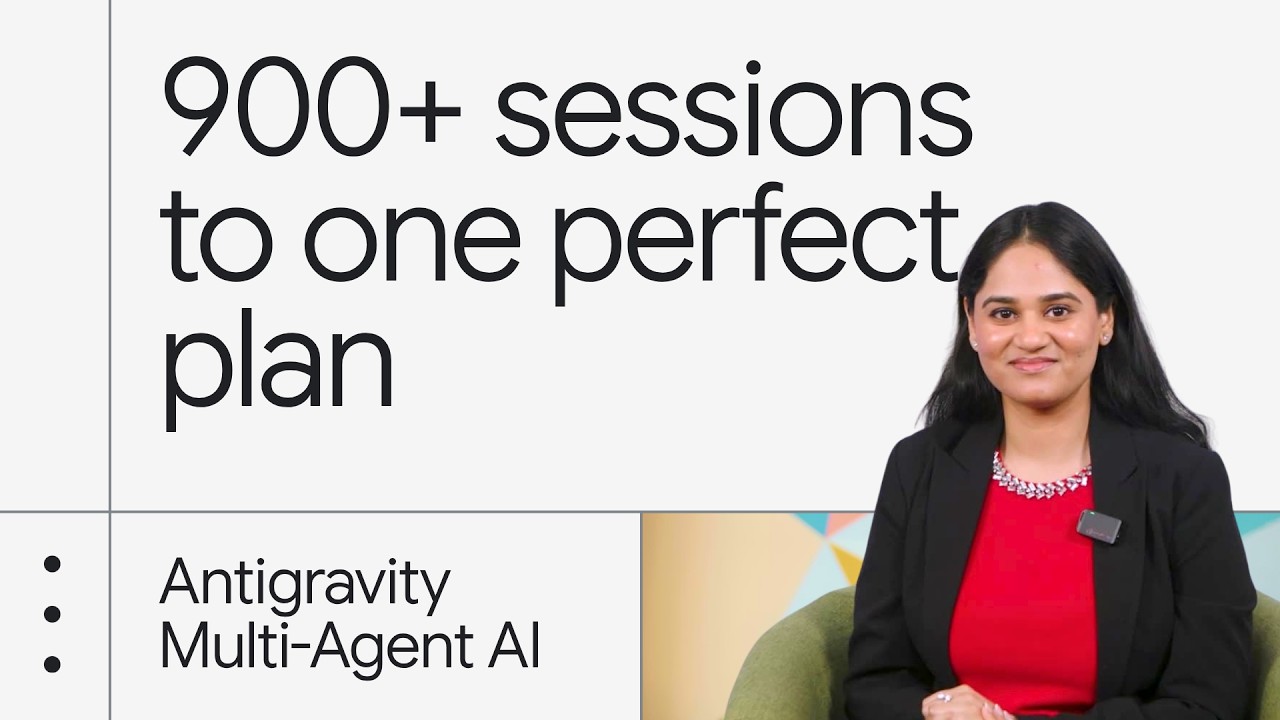
See the complete system in action in Chari Chakshi's demonstration (starting at 6:45), where she shows how the planner interface dynamically regenerates sessions while maintaining all constraints.
Key Takeaways
Google Anti-gravity represents a fundamental shift in how we approach complex decision-making. By combining specialized agents with robust workflow management, it transforms overwhelming data into actionable strategies.
In summary: Multi-agent AI systems don't just filter information - they understand goals, evaluate options at scale, resolve constraints automatically, and deliver optimized solutions tailored to individual needs. This approach saves hours of manual work while producing superior results across conference planning, project management, supply chain, and personalized learning applications.
Frequently Asked Questions
Common questions about multi-agent AI systems
Google Anti-gravity is an agent-driven workflow manager designed for end-to-end task completion. Unlike simple AI tools that provide code snippets, Anti-gravity enables autonomous task completion across multiple environments including editors, terminals, and browsers.
It operates on model context protocol and agent-to-agent standards, making it a robust foundation for building agentic AI systems. Anti-gravity implements an eight-step lifecycle that ensures continuous refinement rather than one-time output generation.
- Moves beyond simple prompting to composed workflows
- Works across development environments seamlessly
- Includes built-in observation and refinement loops
The system uses three specialized agents working together to transform conference planning. The librarian agent handles data collection and structuring, the strategist performs personalization, and the optimizer enforces constraints.
Together they create a fully optimized 3-day plan that balances session relevance, time constraints, and human factors like networking time and burnout prevention. The system can dynamically adjust individual sessions while maintaining all constraints.
- Librarian agent scrapes and structures all session data
- Strategist scores sessions against personal goals
- Optimizer resolves conflicts and balances the schedule
Traditional filters operate in binary terms - sessions either match the criteria or they don't. This leads to the "filter paradox" where strict filters return nothing while loose filters leave you overwhelmed.
The agent approach understands that conference planning requires balancing multiple competing factors simultaneously. It evaluates hundreds of options against your specific goals, resolves time conflicts automatically, and ensures a human-centric schedule - delivering a complete strategy rather than just a list.
- Traditional filters show what's available
- Agents determine what's valuable
- Considers multiple dimensions simultaneously
The system achieves high accuracy by leveraging Gemini's large context window to ingest the entire session library at once. Each session receives a custom score based on how well it matches your profile and goals.
Because the system works directly with the structured session data rather than generating content from scratch, it has zero hallucinations. The relevance scoring is transparent - you can see exactly why each session was recommended.
- Scores based on your specific profile
- Zero hallucinations by using original data
- Transparent reasoning for each recommendation
Absolutely. The architecture of specialized agents scraping, scoring, and optimizing complex datasets works for any industry facing information overload. The conference planning application is just one implementation of this powerful framework.
Potential applications include project management (automatically adjusting team schedules), supply chain (negotiating alternatives for delayed shipments), and personalized education (curating learning paths based on knowledge gaps). Any domain requiring complex decision-making from large datasets can benefit.
- Project management: Dynamic schedule adjustment
- Supply chain: Automated contingency planning
- Education: Personalized learning paths
Anti-gravity provides three major benefits that set it apart from simpler AI tools. First, it moves beyond simple prompting to compose capabilities into cohesive workflows. Second, its eight-step lifecycle ensures continuous refinement rather than one-time output.
Third, its multi-environment operation mirrors how human engineers work across different tools and interfaces. This combination enables the development of robust, production-ready agentic systems rather than experimental prototypes.
- End-to-end workflow composition
- Continuous refinement lifecycle
- Seamless multi-environment operation
The system provides dramatic time savings for complex planning tasks. Conference attendees typically spend 4-6 hours manually planning their schedule, while the AI system completes this analysis in minutes.
Beyond raw time savings, the system handles the "invisible work" of conference planning - resolving time conflicts, balancing session intensity, and ensuring geographic feasibility - that attendees would otherwise need to manage manually. This allows professionals to focus on higher-value activities.
- Reduces planning time from hours to minutes
- Handles invisible work automatically
- Delivers superior results with less effort
GrowwStacks specializes in building custom AI agent systems for businesses facing information overload. We help companies implement solutions similar to the conference planner but tailored to their specific industry needs and operational challenges.
Our team can design and deploy agentic AI systems for applications ranging from intelligent project management to automated decision systems. We offer free consultations to discuss how multi-agent AI can transform your operations and provide measurable business value.
- Custom agent system design and implementation
- Industry-specific optimization solutions
- Free consultation to discuss your needs
Ready to Transform Decision-Making with AI Agents?
Information overload costs your business hours of productivity every week. Let GrowwStacks build a custom multi-agent system that turns data overload into strategic advantage. Our AI solutions deliver measurable results in weeks, not months.