OpenAI Just Killed SaaS: Why Salesforce & Workday Are Panicking
The trillion-dollar enterprise software industry is facing its biggest disruption yet. Autonomous AI agents that execute complex workflows are replacing traditional per-user SaaS models, threatening the very foundation of companies like Salesforce and Workday. Learn how this revolution will change how your business operates.
The AI Agent Revolution Has Arrived
For years, business AI has been trapped in chat windows - helpful assistants that wait patiently for our commands. That era is ending. We're now entering the age of autonomous AI coworkers that don't just respond to prompts but execute complex, multi-step workflows independently.
This shift represents more than just another tech upgrade - it's a fundamental transformation of how work gets done. AI agents can be given goals like "Find our top sales leads from last quarter, draft personalized outreach emails, and schedule intro meetings for next week" and complete the entire process without human intervention.
The key difference: Traditional AI tools are like interns waiting for instructions. AI agents are like experienced employees who understand your business and take initiative to get work done.
From Chat to Action: The Capabilities Overhang
Despite having incredibly powerful AI models, businesses have been limited by what experts call the "capabilities overhang" - the gap between what AI can theoretically do and how we can safely integrate it into critical business systems.
This is why platforms like OpenAI's Frontier are so crucial. They provide the infrastructure needed to safely connect AI agents to core business systems with proper governance and oversight. It's like finally being able to take a Formula 1 car out of the parking lot and onto the racetrack where it belongs.
OpenAI's Frontier: The Operating System for AI Agents
Frontier isn't just another AI product - it's an entire platform designed to create what OpenAI calls a "semantic layer" across an organization. This shared brain gives every AI agent in a company the same deep understanding of how the business works.
The platform is built on four key pillars:
- Shared Context: Creates durable institutional memory by connecting to all data systems
- Agent Execution: Where the work actually gets done
- Evaluation System: Continuous feedback loop for agent improvement
- Governance: Ensures security, permissions, and auditability
Real-world validation: Major companies like State Farm are already using Frontier in production, demonstrating that this technology is ready for enterprise deployment even in heavily regulated industries.
The AI Agent Platform Wars: Three Competing Visions
The shift to AI agents has sparked a fierce battle among tech giants, each with fundamentally different strategies for how these systems should be deployed:
1. OpenAI's Neutral Orchestrator: Aims to be the Switzerland of AI platforms, working with all software providers
2. Salesforce's Vertical Integration: Embedding agents deep within their own ecosystem
3. Microsoft's Horizontal Approach: Weaving agents across their entire 365 suite
This competition isn't just about features - it's about controlling what could become the new center of the computing universe for the next decade.
The Tech Making AI Agents Possible
Two key technologies are enabling AI agents to interact with business systems:
Model Context Protocol (MCP): Acts like a USB-C port for AI - a universal standard that lets any AI model connect to any application or data source. Without this standardization, we'd be stuck with a chaotic mess of custom connectors.
Computer-Using Agents: These can visually interface with software through screenshots, analyzing UI elements and controlling applications with virtual mouse/keyboard input. This means they can work with any software without requiring custom integrations.
The Staggering Business Impact
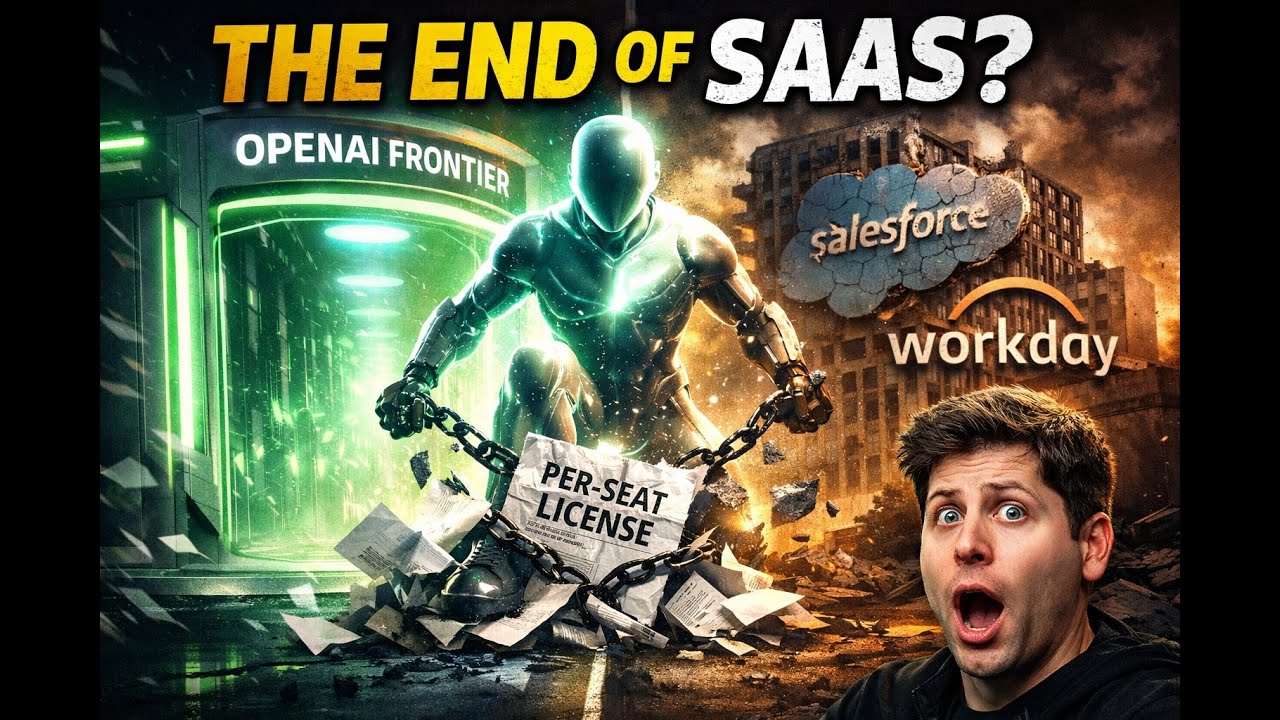
The implications for enterprise software are profound. The traditional per-user licensing model that has powered the SaaS industry for decades is being disrupted by outcome-based computing.
Why pay for 20 user licenses when one AI agent can handle all the data entry and reporting for an entire team? Analysts believe this new agentic economy could capture up to 30% of the current enterprise software market - representing an existential threat to companies like Salesforce and Workday.
Sam Altman's vision: "The future of work isn't about humans being replaced. It's about humans being promoted to managers and conductors of AI agent teams."
The Future of Work: Humans as Conductors
This revolution isn't just about adopting new tools - it requires fundamentally rethinking how organizations operate. Businesses need to become "AI native," restructuring teams and workflows around human-AI collaboration.
The most successful companies will be those that learn to orchestrate teams of AI agents to achieve goals that were previously impossible. Humans will focus on high-level strategy while AI handles implementation - a partnership that could unlock unprecedented productivity and innovation.
Watch the Full Tutorial
For a deeper dive into how AI agents work and their implications for business, watch the full video explanation (starting at 2:15 for a detailed look at Frontier's architecture).
Key Takeaways
The AI agent revolution represents a fundamental shift in how businesses will operate. Traditional SaaS models are being disrupted as autonomous AI coworkers can now execute complex workflows that previously required multiple human users.
In summary: 1) AI agents autonomously complete multi-step workflows 2) Platforms like Frontier provide the infrastructure for safe deployment 3) This disrupts traditional per-user licensing models 4) Businesses must restructure to become "AI native" organizations.
Frequently Asked Questions
Common questions about this topic
An AI agent is an autonomous system that can execute multi-step tasks without constant human direction. Unlike chatbots that wait for prompts, AI agents can be given complex goals and complete entire workflows independently.
They integrate with business systems, analyze data, and take actions like human coworkers would - from identifying sales leads to scheduling meetings to generating reports.
- Autonomous operation without constant supervision
- Ability to handle multi-step, complex workflows
- Integration with multiple business systems and data sources
Traditional SaaS companies rely on per-user licensing models where businesses pay monthly fees for each employee using the software. AI agents disrupt this by potentially replacing multiple human users.
One agent can handle work that previously required 20 user licenses, shifting the payment model from per-seat to outcome-based computing. Analysts predict this could capture 30% of the enterprise software market.
- Disruption of per-user licensing models
- Shift to outcome-based pricing
- Potential 30% market share loss for traditional SaaS
Frontier is OpenAI's enterprise platform that serves as an operating system for AI agents. It creates a semantic layer across an organization - essentially a shared brain that gives every AI agent deep contextual understanding of business operations.
The platform has four key components: shared context (institutional memory), agent execution environment, evaluation system for continuous learning, and governance for security and compliance.
- Shared context creates organizational memory
- Execution environment where work gets done
- Continuous learning through evaluation
- Governance ensures security and compliance
AI agents use two key technologies to interact with software. The Model Context Protocol (MCP) acts like a universal translator, standardizing how AI connects to different apps and data sources.
Computer-using agents can visually interface with software through screenshots, analyzing UI elements and controlling applications with virtual mouse/keyboard input - allowing them to work with any software without custom integrations.
- MCP provides standardized connections
- Visual interface works with any application
- No need for custom API integrations
The three main strategies emerging are fundamentally different approaches to deploying AI agents in enterprises. OpenAI is pursuing a neutral orchestrator model, aiming to work with all software providers without favoring any particular ecosystem.
Salesforce is taking a vertically integrated approach with Agent Force, embedding agents deeply within their own CRM ecosystem. Microsoft is focusing on horizontal integration through Agentic OS, weaving agents across their entire 365 product suite.
- OpenAI: Neutral platform working with all providers
- Salesforce: Vertical integration within CRM
- Microsoft: Horizontal across 365 suite
Yes, major companies like State Farm are already using OpenAI's Frontier platform in production environments. This represents a significant validation of the technology's readiness for enterprise deployment.
State Farm's adoption is particularly noteworthy because as a heavily regulated insurance company, their use demonstrates confidence in the platform's security and compliance capabilities, which are crucial for regulated industries.
- State Farm using Frontier in production
- Validation in regulated industry
- Demonstrates security and compliance readiness
AI agents will fundamentally transform work by shifting human roles from task executors to managers and orchestrators of AI teams. As Sam Altman describes it, humans will become conductors of AI agent symphonies.
This means focusing on high-level strategy while agents handle implementation details. It represents a complete restructuring of workflows and organizational structures to leverage human-AI collaboration for maximum impact.
- Humans shift to strategic roles
- Managing teams of AI agents
- Fundamental restructuring of workflows
GrowwStacks specializes in helping businesses implement AI agent workflows tailored to their specific operations. We design and deploy custom AI agent solutions that integrate seamlessly with your existing systems while ensuring enterprise-grade security and compliance.
Our team provides strategic guidance on restructuring workflows for the AI agent era, helping you identify the highest-impact opportunities for automation and human-AI collaboration. We offer a free consultation to assess your organization's readiness for this transformation.
- Custom AI agent workflow design
- Secure integration with existing systems
- Free consultation to assess opportunities
Ready to Transform Your Business with AI Agents?
Every day without AI agents puts your business at a competitive disadvantage. GrowwStacks can help you deploy custom AI agent solutions in weeks, not months, with our proven implementation framework.