OpenAI Symphony: The Future of AI-Powered Development Workflows
Development teams are drowning in tickets while struggling to maintain quality. OpenAI's Symphony framework offers a radical solution - autonomous AI agents that manage your issue tracker and generate code while you focus on what matters most. Discover how this spec-first approach could transform your development process and potentially increase productivity by 500%.
What Is OpenAI Symphony?
Development teams today face an impossible challenge - the backlog keeps growing while maintaining quality becomes increasingly difficult. Traditional approaches to managing tickets and generating code simply can't keep up with modern demands. OpenAI's Symphony represents a fundamental shift in how we approach software development.
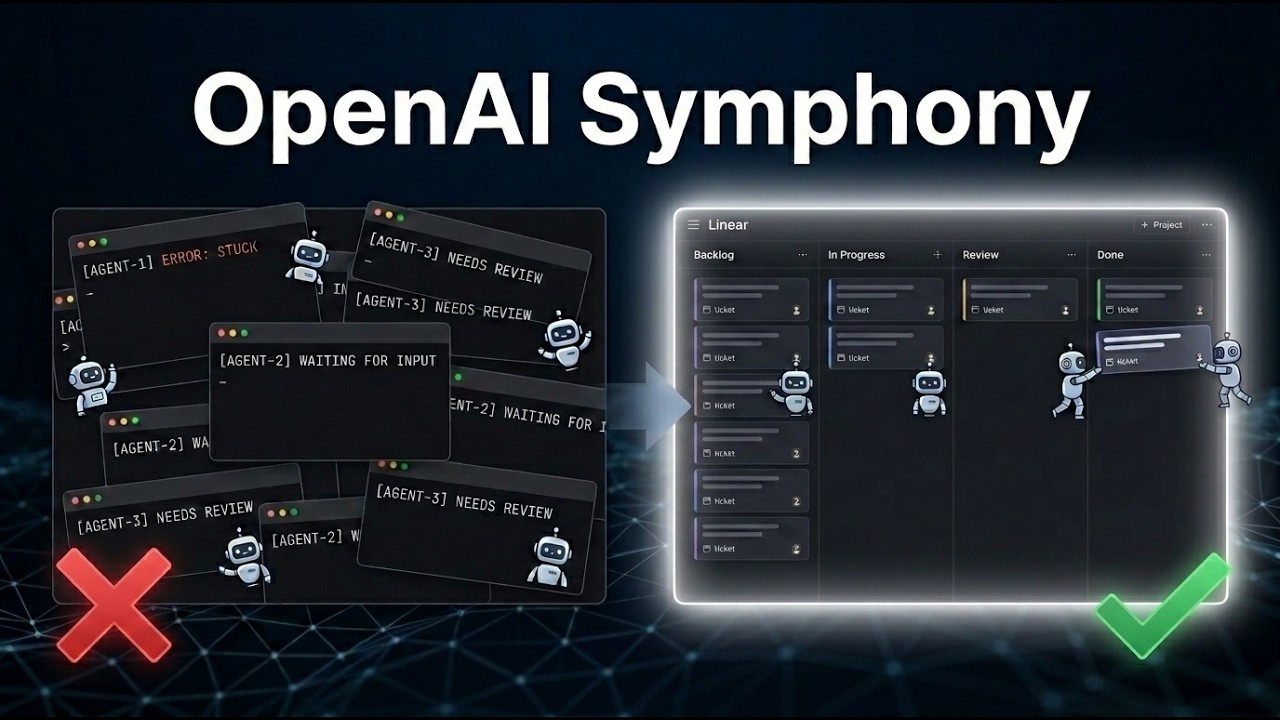
Symphony is a multi-agent orchestration framework that automates the entire development workflow from ticket management to code generation. Instead of manually assigning tasks or writing every line of code, developers using Symphony manage just the start and end of the coding lifecycle - defining requirements and reviewing completed work.
The key innovation: Symphony agents automatically scan your issue tracker (like Linear), read ticket descriptions, begin work, and continue iterating until the task is complete. They then create pull requests ready for human review, effectively turning your issue tracker into an autonomous development pipeline.
How Symphony Works: The Spec-First Approach
What makes Symphony particularly interesting is that OpenAI didn't release it as a finished product. Instead, they published a specification document - essentially saying "here's how this should work, now go build it." This spec-first approach has several advantages for development teams.
The Symphony specification outlines how agents should interact with issue trackers, manage their workflow, and report progress. Teams can implement the spec using their preferred tools and languages, with OpenAI providing a reference implementation in Elixir to demonstrate the concept. This flexibility means Symphony can adapt to different tech stacks and workflows.
Key architectural insight: Symphony follows a declarative programming model where you specify what you want (in your tickets) rather than how to achieve it. The agents handle the implementation details, allowing developers to focus on outcomes rather than process.
Getting Started with Symphony
Implementing Symphony in your workflow requires setting up a few key components. The process begins with configuring your issue tracker (Linear in the reference implementation) to work with Symphony agents.
First, you'll need to create a Linear project and note its project slug (distinct from your organization slug). Then generate an API token with appropriate permissions so Symphony can access your tickets. The reference implementation uses these credentials to poll Linear for tickets in specific statuses (like "To Do") that indicate work should begin.
The Symphony workflow file is where you define how agents should interact with your project. This includes:
- The project slug from your issue tracker
- Which statuses trigger agent work
- Polling frequency for new tickets
- Git commands for repository access
- Configuration for your chosen agent harness (like Codex)
Security note: The reference implementation includes a warning that agents run without usual guardrails. For production use, consider solutions like virtual workspaces (Vivo) to sandbox agent execution and mitigate security risks.
Demo: Symphony in Action
Seeing Symphony work reveals its true potential. When a ticket moves to a monitored status (like "To Do"), an agent automatically picks it up and begins work. The reference implementation provides a dashboard showing active agents and their status.
As agents work on tickets, they update the issue tracker with their progress. Each agent creates a detailed plan of action in the ticket comments, breaking the work into subtasks and marking them complete as it progresses. This creates visibility into the AI's thought process and current focus.
One particularly powerful feature is how Symphony handles dependencies between tickets. If you specify that one ticket blocks another, agents will automatically pause work on the dependent ticket until the blocker is resolved. This maintains logical workflow progression without human intervention.
Quality consideration: The output quality depends heavily on your chosen agent harness. The reference implementation uses Codex with GPT, which produces generally good results, but teams should establish their own quality benchmarks.
The 500% Productivity Claim
OpenAI reports internal teams using Symphony-like systems have seen a 500% increase in landed pull requests. This staggering improvement comes from several factors working in concert.
First, Symphony enables true parallel processing of development tasks. While humans struggle with context switching between multiple tickets, AI agents can work on dozens simultaneously without losing focus. Second, the system eliminates the overhead of manually assigning and tracking work - agents self-assign based on ticket status.
Perhaps most significantly, Symphony lets developers focus exclusively on high-value activities - defining clear requirements and conducting thorough reviews. The mundane middle steps of implementation are handled automatically, freeing human creativity for where it matters most.
Implementation tip: To maximize Symphony's benefits, invest time in writing clear, detailed ticket descriptions. The quality of your inputs directly impacts the quality of the AI's outputs.
The New Bottleneck: Code Review
While Symphony dramatically increases code production, it reveals a new challenge - human review becomes the limiting factor. When AI generates code 5x faster, humans still review at human speed, creating pressure that can compromise quality.
This bottleneck manifests in several ways. Reviewers may rush through pull requests, leading to rubber-stamped approvals. Without having written the code themselves, reviewers lack deep context about implementation decisions. The sheer volume of changes can overwhelm teams, causing important issues to slip through.
The solution isn't to slow down code generation but to enhance review capabilities. Future systems will need to provide better visibility into AI decision-making and automate more of the verification process while maintaining human oversight where it's most valuable.
Key insight: The next frontier in AI-assisted development isn't generating more code - it's generating more confidence in the code being produced.
How Symphony Compares to Similar Tools
Symphony isn't the first attempt at automating development workflows. Tools like Apparent (formerly AutoClaude) offer similar functionality through a more productized approach. However, Symphony's spec-first philosophy offers distinct advantages.
Where commercial products lock you into specific implementations, Symphony's open specification allows customization to your exact workflow. You can swap out components - using Jira instead of Linear, or Claude instead of Codex - while maintaining the same fundamental architecture.
This flexibility comes with increased implementation complexity but pays dividends in long-term adaptability. Teams can evolve their Symphony implementation as their needs change or as new agent technologies emerge, future-proofing their automation investment.
Adoption consideration: The reference implementation provides a great starting point, but teams should plan to customize it for their specific needs and security requirements.
Future Directions for AI-Assisted Development
Symphony represents just the beginning of how AI will transform software development. The most impactful innovations will focus on closing the trust gap - giving teams confidence in AI-generated code without exhaustive manual review.
Emerging solutions aim to provide visual verification through screenshots or live previews of changes. Others propose using masked production data to create more realistic test environments. The ideal system would combine these approaches, offering:
- Visual confirmation of UI changes
- Automated tests with production-like data
- Clear documentation of the AI's decision process
- Metrics on code quality and potential risks
These enhancements would address the current review bottleneck while maintaining (or even improving) code quality. The result would be truly scalable AI-assisted development where both quantity and quality can increase simultaneously.
Forward-looking insight: The teams that succeed with AI-assisted development will be those that focus as much on verification and trust as they do on generation and speed.
Watch the Full Tutorial
For a complete walkthrough of setting up Symphony and seeing it in action, watch the full video tutorial. At 8:45, you'll see how the dashboard updates in real-time as agents pick up and work on tickets, providing visibility into the autonomous development process.
Key Takeaways
OpenAI Symphony represents a fundamental shift in how we approach software development. By automating the middle stages of the coding lifecycle, it allows developers to focus on what humans do best - understanding problems and evaluating solutions - while AI handles the implementation details.
In summary: Symphony's spec-first approach offers flexibility, its autonomous agents provide scalability, and its focus on human oversight maintains quality. While code review remains a challenge, solutions are emerging that will allow teams to realize the full potential of AI-assisted development.
Frequently Asked Questions
Common questions about OpenAI Symphony
OpenAI Symphony is a multi-agent orchestration framework that automates software development workflows by managing tickets in issue trackers like Linear and assigning AI agents to complete them.
The agents automatically scan for open tickets, read descriptions, work on them until completion, and create pull requests. This allows developers to focus on requirements definition and code review while the AI handles implementation.
- Automates ticket management and code generation
- Works with popular issue trackers like Linear
- Open specification allows custom implementations
Symphony integrates through a workflow file that specifies project details and active states it should monitor. It polls the issue tracker (like Linear) for tickets in specified statuses and automatically assigns agents to work on them.
The reference implementation uses Elixir but can be adapted to other languages. You configure which statuses trigger work, how often to check for new tickets, and which agent harness to use (like Codex).
- Configure through a declarative workflow file
- Flexible enough to work with different tech stacks
- Reference implementation available in Elixir
OpenAI reports a 500% increase in landed pull requests using Symphony-like systems. The framework allows parallel processing of multiple tickets without human intervention, significantly increasing development throughput.
Beyond raw productivity numbers, Symphony changes how teams work by letting humans focus on high-value activities (requirements and review) while AI handles implementation. This can lead to better solutions and more thoughtful reviews.
- 500% more pull requests landed
- Parallel processing of multiple tickets
- Humans focus on high-value work
Symphony agents run with full permissions by default, which introduces security risks. The reference implementation includes a warning about running without usual guardrails.
Solutions like virtual workspaces (Vivo) can help mitigate risks by sandboxing agent execution. Teams should carefully consider permission levels and implement safeguards before deploying Symphony in production environments.
- Agents run with full permissions by default
- Reference implementation includes security warning
- Sandboxing solutions recommended for production use
While similar in concept to tools like Apparent (formerly AutoClaude), Symphony differs in being a spec-first framework rather than a complete product. This allows more flexibility in implementation and integration with different agent harnesses and issue trackers.
Commercial products may offer more polished UIs out of the box, but Symphony's open approach lets teams customize it to their exact needs and evolve it as their requirements change.
- Spec-first vs product-first approach
- More flexibility in implementation
- Easier to customize for specific needs
While code generation has improved dramatically, the new bottleneck is review. Humans still review code at human speed, creating pressure when AI generates code 5x faster. This can lead to rushed reviews, bugs slipping through, and context switching problems.
The solution isn't to slow down generation but to enhance review capabilities through better tooling and processes that maintain quality at scale.
- Human review becomes the limiting factor
- Pressure can compromise review quality
- Solutions must enhance rather than restrict
Future solutions need to address the trust gap in AI outputs through better visibility (like live previews) and realistic test data (masked production data). Closing this feedback loop will be crucial for truly scaling AI-assisted development without compromising quality.
The most successful systems will combine automated generation with enhanced verification capabilities, giving teams confidence in AI outputs while maintaining the productivity benefits.
- Better visibility into AI decision-making
- Realistic test environments with production data
- Automated verification alongside generation
GrowwStacks helps businesses implement AI automation workflows tailored to their development processes. Whether you need to integrate Symphony-like functionality with your existing tools or build custom AI-assisted workflows, our team can design, build, and deploy solutions that fit your requirements.
We offer free consultations to discuss your automation goals and how AI can accelerate your development cycles while maintaining quality. Our experts can help you navigate the technical and organizational challenges of adopting these transformative technologies.
- Custom AI workflow implementation
- Integration with your existing tools
- Free consultation to discuss your needs
Ready to Transform Your Development Workflow with AI?
While AI-generated code is impressive, implementing it effectively requires careful planning and integration. Let GrowwStacks help you harness the power of Symphony and similar frameworks to accelerate your development while maintaining quality.