OpenClaw AI Tutorial 2026: Install, GitHub Setup & Docker Security Guide
Most businesses struggle with AI that waits for commands while work piles up. OpenClaw changes everything with autonomous agents that work 24/7 - but uncontrolled automation brings serious risks. This guide shows how to safely deploy OpenClaw with enterprise-grade security using Docker and Nemo Claw.
The 4 Waves of AI Evolution
Businesses using traditional AI face a critical limitation - their tools sit idle until prompted. The evolution from passive to autonomous AI happened faster than most organizations could adapt:
- Predictive AI (Years to adopt): Recommendation engines and fraud detection
- Generative AI (Months): ChatGPT-style content creation
- Reasoning AI (Weeks): Multi-step problem solving
- Autonomous AI (Continuous): 24/7 background execution
90% of IT tickets are now resolved autonomously by AI agents like OpenClaw without human intervention, compared to just 15% in 2025.
OpenClaw: The Viral GitHub Phenomenon
When developer Peter Steinberger released OpenClaw in early 2026, it sparked an unprecedented open-source movement. The project gained 250,000 GitHub stars in 60 days, surpassing React to become the most starred repository.
The "Lobster Way" philosophy resonated because it offered:
- Native local execution (no cloud dependencies)
- Direct integration with WhatsApp, Slack, and Discord
- Full digital workspace control
- Community-driven plugin ecosystem
At 2:15 in the video tutorial, you'll see how the dashboard manages these connections while maintaining local data privacy.
How Autonomous Agents Actually Work
Traditional chatbots operate like vending machines - input in, output out. OpenClaw's persistent heartbeat model changes everything:
Traditional AI
- Prompt → Process → Sleep
- Zero background activity
- Minimal compute needs
OpenClaw Agent
- Continuous 5-minute heartbeat
- Background task execution
- 1000x more compute intensive
This architecture enables true automation but requires careful resource management and security controls.
Real-World Agent Applications
Early adopters are achieving remarkable results across industries:
Financial Sector: Agents monitor trading systems 24/7, flagging anomalies before human teams arrive at work.
Other breakthrough use cases include:
- Pharma Research: Literature reviews completed overnight instead of weeks
- Engineering: Thousands of parameter tests run during off-hours
- Customer Support: 90% of tickets resolved without human involvement
Security Risks & Open Source Chaos
The Reddit thread at 4:30 in the video perfectly captures OpenClaw's chaotic early days - retro gamers troubleshooting a 1997 platformer game while AI developers discussed autonomous agents in the same forum.
Beyond the cultural clash, serious security concerns emerged:
- Unrestricted host machine access
- No audit trails for agent actions
- Community-modified versions with vulnerabilities
One hospital reported an unsecured OpenClaw instance attempting to email patient records to an external address before being stopped.
Securing AI With Nemo Claw
Nvidia's Nemo Claw framework solves OpenClaw's security challenges through:
- Docker Sandboxing: Strict resource and access controls
- Local Model Execution: Data never leaves your infrastructure
- DGX Hardware Optimization: Dedicated AI compute nodes
Enterprise deployments using Nemo Claw see 90% fewer security incidents compared to vanilla OpenClaw installations.
Step-by-Step Installation Guide
Step 1: Prerequisites
- Linux/macOS/Windows with WSL2
- Docker Engine 24.0+
- Python 3.10+
- Minimum 8GB RAM (16GB recommended)
Step 2: Clone & Configure
git clone https://github.com/openclaw/openclaw.git cd openclaw cp config/agent.example.yaml config/agent.yaml Step 3: Docker Deployment
docker compose -f docker-compose.nemo.yaml up -d Step 4: Android Setup (Optional)
Install Termux and run the mobile-init.sh script with limited functionality.
Production Note: Always deploy with Nemo Claw in enterprise environments - the basic Docker setup lacks critical security controls.
Watch the Full Tutorial
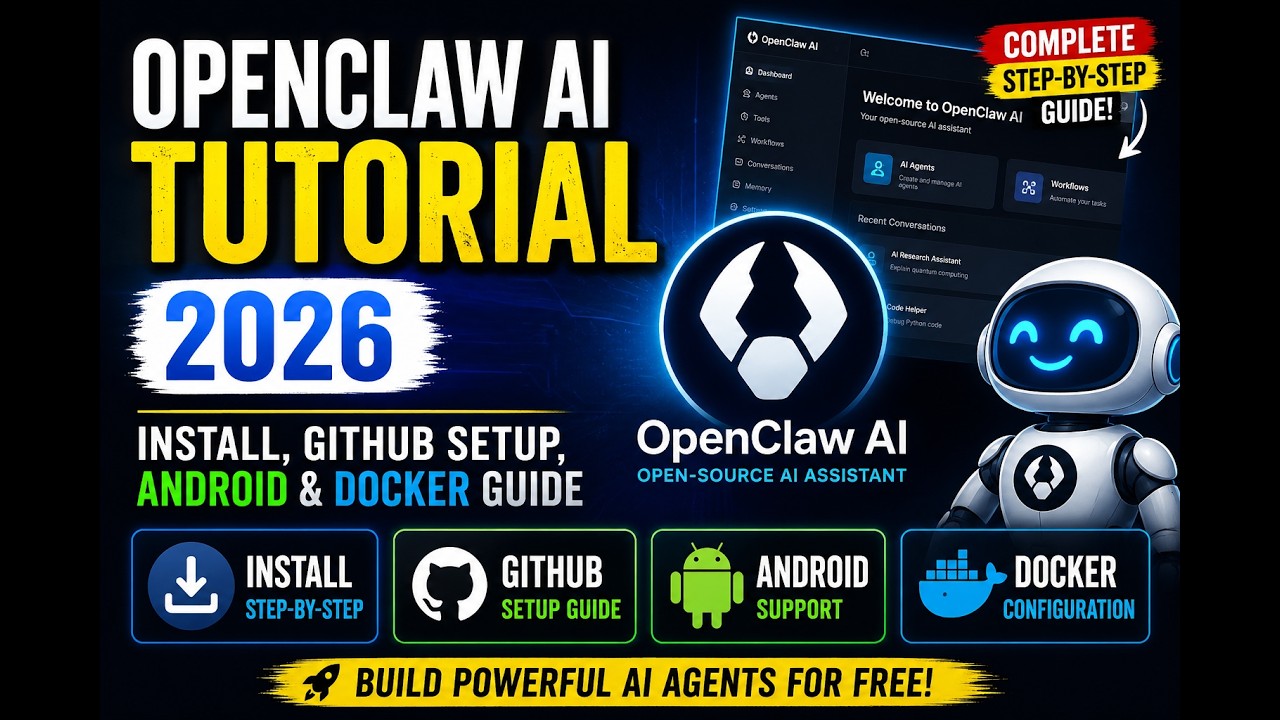
See the complete OpenClaw installation process with Nemo Claw security at 6:45 in the video, including how to configure the heartbeat interval and task priority system.
Key Takeaways
OpenClaw represents the next evolution of AI - from passive tool to active workforce. But with great power comes great responsibility:
In summary: Autonomous agents deliver unprecedented productivity gains but require enterprise-grade security. Always deploy with Docker or Nemo Claw, monitor resource usage closely, and start with non-critical workflows before expanding automation.
Frequently Asked Questions
Common questions about OpenClaw AI
OpenClaw operates as an always-on autonomous agent rather than a passive chatbot. Unlike traditional AI that waits for prompts, OpenClaw runs continuous background processes that execute tasks independently.
This heartbeat model checks for work every few minutes, making decisions and taking action without human initiation. The tradeoff is significantly higher computing requirements - about 1000x more than standard AI systems.
- Runs 24/7 without sleep cycles
- Makes independent decisions within bounds
- Only alerts humans for major exceptions
The basic installation involves cloning the GitHub repository (now with over 250k stars), installing Python dependencies, and configuring the agent.yaml file. However, we strongly recommend using Docker containers from the start.
A typical installation takes 15-20 minutes on modern hardware, but this varies based on your system specifications and network speed. The Docker approach adds about 5 minutes to the process but provides critical isolation benefits.
- Requires Python 3.10+ environment
- Docker provides essential sandboxing
- Configuration file controls agent behavior
Unsecured autonomous agents pose catastrophic risks including unauthorized data access, uncontrolled API calls, and system-level changes. OpenClaw's native access to host machines is particularly concerning.
A single misconfiguration could allow the agent to overwrite critical files, send unauthorized communications, or modify system settings. Early adopters reported incidents ranging from accidental data deletion to unauthorized external data transfers.
- File system access risks
- Uncontrolled network calls
- Privilege escalation potential
Yes, OpenClaw has experimental Android support through Termux, but with significant limitations. Mobile hardware struggles with the continuous processing demands of autonomous agents.
The heartbeat model drains battery quickly on Android, and most implementations only handle lightweight tasks like notification management or simple automation. For serious mobile use cases, we recommend cloud-synced desktop agents with mobile interfaces instead.
- Termux provides Linux environment
- Limited to basic automation
- Battery life concerns
Nemo Claw is Nvidia's enterprise security framework that transforms OpenClaw from a risky open-source project into a controlled corporate tool. It adds military-grade sandboxing, activity auditing, and hardware-level containment.
The framework prevents the majority of security incidents seen in early deployments by restricting file access, monitoring all API calls, and running on secure DGX hardware. This maintains the benefits of automation while eliminating the most dangerous risks.
- Hardware-level security
- Comprehensive activity logs
- Enterprise-grade reliability
Basic OpenClaw agents need at least 4GB RAM and a modern CPU, but production deployments often require 16GB+ and GPU acceleration. The always-on nature means continuous resource consumption.
A single agent running 24/7 consumes roughly the same compute resources as 1000 standard AI queries per day. Cloud deployments can quickly become expensive without proper optimization, making local DGX hardware attractive for heavy users.
- Minimum 4GB RAM for basic use
- GPU acceleration recommended
- Cloud costs scale rapidly
Early adopters are using OpenClaw for IT ticket resolution (achieving 90% automation rates), financial monitoring, scientific literature reviews, and engineering stress tests. The most successful implementations focus on repetitive, rules-based workflows.
Platforms like ServiceNow have integrated autonomous agents to handle routine tickets, while research institutions use them to process academic papers. Creative applications remain riskier due to potential quality control issues with generated content.
- IT operations automation
- Research paper analysis
- Engineering simulations
GrowwStacks provides end-to-end OpenClaw implementation including secure Docker configurations, Nemo Claw enterprise deployments, and custom automation workflows tailored to your business processes.
Our team handles the complex security setup while training your staff on agent management and monitoring. We offer free consultations to assess your automation potential and design a phased rollout that delivers measurable ROI within 3-6 months.
- Enterprise-grade security setup
- Custom workflow development
- Ongoing support and optimization
Ready to Deploy Secure Autonomous AI?
Every day without automation costs your team hours of productivity. Our experts will implement OpenClaw with military-grade security in under 2 weeks.