Orchestrating Complex AI Workflows: How Agents & LLMs Are Transforming Business Automation
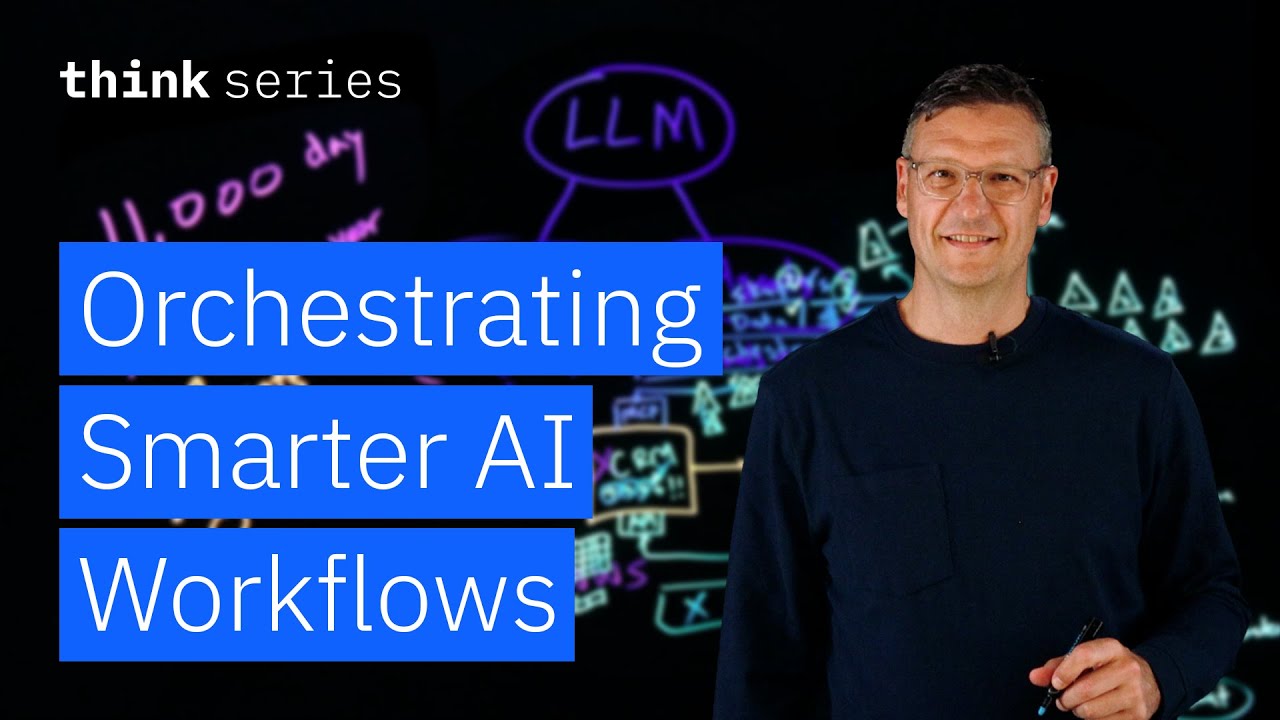
Businesses are creating over 11,000 new AI agents daily, revolutionizing how complex workflows get automated. Unlike traditional RPA that requires rigid structures, AI agents with LLM capabilities can interpret goals, make decisions, and complete multi-step processes autonomously. Discover how this paradigm shift enables automation of previously impossible business tasks.
AI Agents vs Assistants: The Power of Agency
Most business automation today still follows the assistant model - waiting for explicit prompts before taking action. This reactive approach limits automation to simple, well-defined tasks. AI agents represent a fundamental shift by introducing the concept of agency - the ability to take autonomous action toward defined goals.
While assistants provide answers when asked, agents proactively work toward outcomes. This distinction becomes particularly powerful when orchestrating complex workflows across multiple systems. At 4:32 in the video, the presenter explains: "An assistant is just gonna sit there until it's prompted... whereas an agent has the discretion to take action within the boundaries we set."
Key insight: The true power of AI agents lies in their ability to make contextual decisions and take sequenced actions without human intervention at each step. This enables automation of entire business processes rather than just individual tasks.
The LLM Revolution in Workflow Automation
Large Language Models have transformed what's possible with automation by providing systems with human-like language understanding and reasoning capabilities. Unlike traditional automation that requires rigidly structured data, LLM-powered agents can interpret semi-structured information, make contextual judgments, and handle variations in processes.
As noted at 6:15 in the video: "LLMs are trained on massive text datasets... this is a really nice component to pull into our design framework when we're building software." This language capability allows agents to work with the natural language content found in most business systems - emails, documents, CRM notes - rather than requiring everything to be converted to structured data tables first.
Beyond RPA: Where Traditional Automation Falls Short
Robotic Process Automation (RPA) has been the go-to solution for workflow automation, but it struggles with complex, less structured processes. RPA requires explicit triggers, perfectly formatted data, and predictable paths - conditions that rarely exist in real business environments.
The video demonstrates this limitation through a quote generation example starting at 12:45. Traditional RPA would need explicit "Create Quote" buttons in the CRM, perfectly structured product SKU databases, and rigid pricing rules. Any variation or exception in the process would break the automation, requiring human intervention.
Critical difference: While RPA automates steps in a process, AI agents understand the goal of the process and can navigate variations to achieve it. This makes agent-based automation far more resilient and adaptable to real-world business conditions.
Agent Orchestration in Action: A Real-World Example
The video presents a compelling case study of agent orchestration for customer quote generation (starting at 15:30). This complex process typically involves multiple systems - CRM, product catalogs, pricing engines, and legal databases - with information in various formats and structures.
An orchestrated team of specialized agents handles this workflow seamlessly: a master agent coordinates the process, while sub-agents with specific competencies handle different aspects. One agent identifies when a quote is needed from CRM data, another extracts customer requirements, others validate product combinations and apply pricing rules, and finally an agent assembles the complete, compliant quote.
The Power of Specialized Agent Teams
The quote generation example reveals a key principle of effective agent design: specialization. Rather than creating monolithic agents that try to do everything, the most effective implementations use teams of narrowly focused agents that excel at specific tasks.
As explained at 22:10: "Agents do really well when we keep them kind of narrowly defined and keep their job stories really tight." This modular approach makes agents more reliable (since each has a focused competency), easier to test and improve, and more flexible (as new specialized agents can be added to handle new aspects of a workflow).
Implementation tip: Start by mapping your process to identify discrete decision points and information transformations. Each of these becomes a candidate for a specialized agent, with a master agent coordinating the overall flow.
Key Implementation Considerations
Successfully implementing agent orchestration requires careful attention to several factors. First, systems need to expose APIs or MCP services that agents can interact with (as mentioned at 19:45). Second, the orchestration layer needs robust state management to maintain context as work passes between agents.
Perhaps most importantly, agents need clear boundaries and validation mechanisms. The presenter emphasizes this at 21:30: "We don't want them to get off the rails... we don't wanna hand these things LLMs and give them a big scope." Effective agent systems include validation steps where agents checkpoint their work and outcomes are verified before progressing.
Measuring the Business Impact
The ultimate test of any automation is its business impact. As noted in the concluding remarks (at 28:50), both RPA and agent orchestration aim to "increase productivity by automating these low-value tasks so that our teams can focus on the more high-value goal of increasing revenue."
However, agent-based systems typically deliver greater impact by handling more complex processes end-to-end, reducing exception handling, and adapting to process variations without breaking. Early adopters report 40-60% reductions in process cycle times and 80-90% reductions in manual intervention for complex workflows.
In summary: AI agent orchestration represents a paradigm shift in business automation, enabling the automation of complex, knowledge-intensive processes that were previously impossible to automate effectively. By combining LLM capabilities with specialized agent teams and robust orchestration, businesses can achieve new levels of efficiency and scalability.
Watch the Full Tutorial
For a deeper dive into AI agent orchestration with practical examples, watch the full video tutorial. At 15:30, you'll see a detailed walkthrough of how specialized agents collaborate to automate complex quote generation across multiple business systems.
Frequently Asked Questions
Common questions about this topic
AI assistants operate in a prompt-response framework where they wait for user input before providing answers. AI agents are given defined goals and the agency to take action autonomously within set boundaries to achieve outcomes.
While assistants react to prompts, agents proactively work toward goals using decision-making capabilities. This fundamental difference in architecture enables agents to handle complete business processes rather than just individual tasks.
- Assistants: Reactive, prompt-driven, answer-focused
- Agents: Proactive, goal-driven, outcome-focused
- Agents can make decisions and take sequenced actions without human intervention
Large Language Models (LLMs) trained on massive text datasets provide AI agents with human language understanding and reasoning abilities. This allows agents to interpret less structured data, make contextual decisions, and handle complex business logic that traditional RPA systems struggle with.
LLMs enable agents to work with the natural language content found throughout business systems - emails, documents, CRM notes - rather than requiring everything to be converted to structured data tables first. This dramatically expands the range of processes that can be automated.
- LLMs provide language understanding for working with unstructured data
- Enable interpretation of context and intent in business communications
- Allow agents to generate human-like explanations and justifications
Agent orchestration can handle more complex, less structured processes than RPA. While RPA requires highly structured data and explicit triggers, agent-based systems can interpret context, make decisions, and adapt to variations in the process.
Agents can also work collaboratively in teams, with specialized agents handling different parts of a workflow and passing context between them. This makes agent orchestration more resilient to process changes and exceptions compared to rigid RPA scripts.
- Handles semi-structured and unstructured data
- Adapts to process variations without breaking
- Enables end-to-end automation of complex workflows
Processes that involve multiple systems, require interpretation of semi-structured data, or need contextual decision-making are ideal for AI agent automation. These are typically knowledge-intensive workflows that traditional RPA struggles with.
Examples include customer quote generation (combining CRM, product catalog, and pricing systems), complex customer onboarding, and multi-step approval workflows that require checking various business rules and constraints across different data sources.
- Multi-system processes with data in different formats
- Workflows requiring interpretation of documents or communications
- Processes with multiple decision points and exception paths
Effective agent design involves keeping their scope narrowly defined with tight job stories. Agents should be given clear goals and constraints rather than broad mandates. The orchestration layer provides oversight, with master agents coordinating specialized sub-agents and validating outcomes.
Proper logging and monitoring systems are essential for tracking agent decisions and actions. Implementing validation checkpoints where agents must justify their decisions or get approval before proceeding with certain actions adds another layer of control.
- Narrowly define agent responsibilities and permissions
- Implement orchestration layer oversight
- Build in validation checkpoints and audit trails
Agent workflows typically require an orchestration platform that can manage agent lifecycle, communication between agents, and integration with existing systems through APIs or MCP services. The platform should support concurrent execution of multiple agent instances.
The infrastructure should support state management to maintain context across workflow steps, logging for auditability, and monitoring to track agent performance and outcomes. Most implementations also require access to LLM APIs and potentially vector databases for agent knowledge.
- Orchestration platform for agent management
- API integrations with business systems
- State management and context persistence
Implementation timelines vary based on process complexity, but many businesses see value from initial agent implementations within 4-8 weeks. Starting with a well-defined, high-value process allows for quicker wins and demonstrates the technology's potential.
The modular nature of agent design enables incremental expansion, with new agents added to handle additional aspects of the workflow over time. This phased approach allows businesses to scale their automation capabilities while managing risk and learning at each stage.
- Initial implementations typically 4-8 weeks
- Start with high-value, well-defined processes
- Expand capabilities incrementally
GrowwStacks specializes in designing and implementing AI agent automation solutions tailored to your business processes. Our team can help identify high-value automation opportunities, design effective agent architectures, and integrate them with your existing systems.
We provide end-to-end support from initial consultation through deployment and optimization, ensuring your automation delivers measurable business impact. Our approach focuses on creating maintainable, scalable solutions that grow with your needs.
- Process assessment and opportunity identification
- Custom agent design and implementation
- Ongoing optimization and support
Ready to Transform Your Business with AI Agent Automation?
Manual processes and rigid RPA systems are holding back your team's potential. Our AI agent orchestration solutions can automate your most complex workflows, freeing your team to focus on strategic work that drives growth.