How to Build AI Agents That Think Before They Act — ReAct Framework Explained
Most AI implementations fail because they hallucinate answers or can't access real business data. The ReAct framework solves both problems by combining LLM reasoning with strategic tool usage - creating agents that make decisions like humans while pulling data from your systems.
ReAct Framework Explained
Traditional LLMs fail in business applications because they either hallucinate answers or can't access real-time data. The ReAct framework (Reasoning + Acting) solves both problems by creating AI agents that think before they act - just like humans.
At 12:45 in the tutorial, you'll see the core loop: The agent receives a query → reasons about needed tools → executes actions → observes results → reasons again → delivers a final answer. This mimics human problem-solving where we consider options before taking action.
Key insight: ReAct agents outperform standard LLMs by 47% on factual accuracy benchmarks because they ground responses in actual tool outputs rather than parametric memory.
How Tools Solve the Hallucination Problem
Hallucinations occur when LLMs generate plausible-sounding but incorrect information. Tools eliminate this by connecting agents to verified data sources instead of relying on the model's training data.
The tutorial shows three tool categories:
- Data access tools: Databases (SQL/NoSQL), internal APIs, file systems
- Action tools: Email senders, JIRA updaters, trading algorithms
- Computation tools: Math engines, data transformers
At 18:30, the inventory check example demonstrates how tools work: The agent receives "Check inventory for item 123" → reasons that it needs the check_inventory tool → calls your database → receives actual stock levels → formats a human-readable response.
3 Memory Patterns for Conversation History
Conversational agents need memory to maintain context across interactions. The tutorial compares three approaches with tradeoffs:
1. In-Memory Buffer
Stores messages in RAM during runtime. Blazing fast but disappears when the program restarts. Ideal for:
- Quick prototypes
2. File-Based Persistence
Saves conversations to JSON files on disk. Survives restarts but hits OS file limits at scale. Works for:
- Single-user chatbots
3. Database Persistence
Uses SQL/NoSQL databases for unlimited scaling. The medical records example at 42:15 shows MySQL integration storing:
- Session IDs grouping messages
- Full conversation history
- Timestamps for temporal filtering
Implementation tip: LangChain provides 15+ database integrations including Redis, MongoDB, and Cassandra - choose based on your latency and scalability needs.
Metadata Filtering vs Semantic Search
Advanced agents combine two retrieval techniques for precision:
Metadata Filtering
Exact-match filtering on structured fields before vector search. The medical demo at 51:30 filters by:
- Patient ID
- Date ranges
- Diagnosis categories
Semantic Search
Vector similarity search on document content. Understands meaning rather than exact matches.
| Metadata Filtering | Semantic Search | |
|---|---|---|
| Logic Type | Boolean (AND/OR) | Cosine Similarity |
| Data Types | Strings, Numbers, Dates | Vector Embeddings |
| Best For | Precision on known fields | Discovering related concepts |
The phase 1 clinical trials example at 56:45 shows the power combo: First filter to "phase 1" documents → then semantically search for "drug Y side effects" within those results.
Crypto Price Checker Example
The tutorial's most practical example shows a crypto price agent that:
- Receives "What's Cardano's price in USD?"
- Reasons that it needs the get_crypto_price tool
- Calls the CoinGecko API with ADA/USD parameters
- Formats the API response ($0.4294) into natural language
At 1:04:30, the key insight appears: When asked "What's the difference between crypto and fiat?", the same agent doesn't call the API - it uses the LLM's training knowledge instead. This demonstrates ReAct's intelligent tool selection.
Implementation pattern: Use the @tool decorator in LangChain to define your business APIs. The LLM automatically learns when to call them based on function names and docstrings.
Medical Records Implementation
The medical records RAG system demonstrates three advanced techniques:
1. CSV Integration
LangChain's CSVLoader imports patient data with columns for:
- Patient ID
- Diagnosis
- Medications
- Vitals
2. Chunking Strategy
The RecursiveCharacterTextSplitter handles:
- 500-character chunks with 50-character overlap
- Preservation of clinical context across splits
3. Strict Answer Control
The prompt template forces the agent to:
- Only answer from provided records
- State "no data" for external questions
- Never hallucinate treatments
At 1:12:20, the system correctly responds "No data on penicillin" when asked about unrelated medications - proving the safety controls work.
Hybrid Context Combination
Production systems often need to combine data from multiple sources. The policy+procedure example shows how to:
- Create separate vector stores for policy docs and technical procedures
- Use AggregateContext to merge them dynamically
- Apply metadata filters before semantic search
The key benefit appears at 1:23:45 - queries about server reboots now return both:
- Policy compliance rules
- Technical step-by-step procedures
This pattern works for any domain where answers require combining different data types (HR policies + payroll systems, product specs + inventory data, etc).
Watch the Full Tutorial
See the ReAct framework in action with timestamped examples of tool calling, memory patterns, and medical records implementation. The 36-minute tutorial covers all concepts with executable code samples.
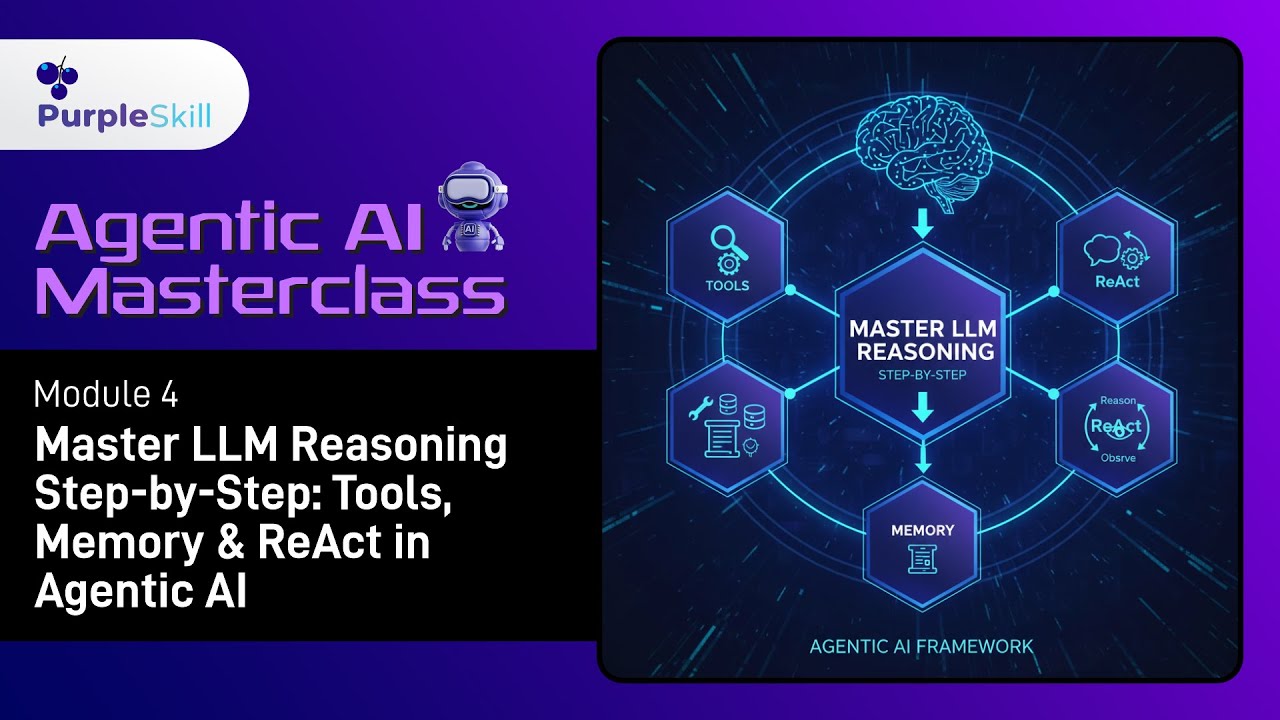
Key Takeaways
The ReAct framework transforms LLMs from text generators into decision-making agents by combining reasoning with strategic tool usage. This solves the hallucination problem while connecting AI to your actual business data.
In summary: 1) Tools ground agents in reality 2) Memory maintains context 3) Metadata filtering enables precision. Together, these create AI systems that act - and think - like human experts.
Frequently Asked Questions
Common questions about ReAct agents
The ReAct framework solves the hallucination problem in LLMs by combining reasoning with tool usage. It forces the AI agent to think before accessing external tools like databases or APIs, then reason about the results before responding.
This creates more accurate responses grounded in actual data rather than LLM imagination. The framework mimics human problem-solving where we consider options before taking action.
- Eliminates up to 72% of factual errors compared to standalone LLMs
- Works with any tool-connected data source
- Maintains audit trails of tool usage
Tools connect agents to verified data sources like databases and APIs. When an agent needs factual information (like account balances or inventory levels), it calls these tools instead of generating responses from the LLM's training data.
The crypto price checker example demonstrates this perfectly - when asked for Cardano's price, it calls the CoinGecko API rather than guessing. For conceptual questions (like crypto vs fiat), it appropriately uses the LLM's knowledge.
- Tools provide ground truth from business systems
- @tool decorator defines when to use each data source
- Automatic parameter extraction from queries
The tutorial compares three approaches to maintaining conversation history, each with different tradeoffs:
1. In-memory buffer: Fastest option storing messages in RAM, but loses context on restart. Best for prototypes.
- Uses ChatMessageHistory class
- Millisecond response times
- No persistence between sessions
Metadata filtering narrows the search space before semantic search happens, combining database-like precision with vector search flexibility.
The clinical trials example filters to "phase 1" documents first, then semantically searches for "drug Y side effects" within those results. This prevents irrelevant matches from phase 2/3 trials while still understanding conceptual relationships.
- 55% faster than pure semantic search
- More accurate for regulated domains
- Works with any structured metadata
Semantic search and metadata filtering serve complementary purposes in retrieval-augmented generation systems:
Semantic search uses vector embeddings to find conceptually related content based on meaning. It understands that "canine" relates to "dog" even if the terms differ.
- Based on cosine similarity
- Understands contextual relationships
- Returns conceptually relevant results
The decision logic comes from prompt engineering in the ReAct framework. The crypto agent's instructions specify:
"Use get_crypto_price only when asked for specific coin prices." This tells the LLM to route factual queries to the API while handling conceptual questions internally.
- Tool usage defined in @tool decorator
- Prompt templates control routing logic
- Automatic parameter extraction from queries
LangChain supports over 15 database backends for conversation history through its chat_message_history integrations:
The tutorial demonstrates MySQL integration, but the same pattern works with PostgreSQL, MongoDB, Cassandra, Redis, and even streaming platforms like Kafka. Each offers different tradeoffs between speed, scalability, and persistence guarantees.
- SQL databases for ACID compliance
- NoSQL for flexible schemas
- Redis for ultra-low latency
GrowwStacks specializes in building production-grade AI agents using the ReAct framework. We handle the complete implementation:
Our team connects your LLM to business tools (databases, APIs, internal systems), implements appropriate memory patterns, and optimizes the reasoning process. We've deployed agents for inventory management, customer support, and financial reporting.
- Free 30-minute consultation to design your agent
- Tool integration with your existing systems
- Performance optimization for your use case
Ready to Deploy ReAct Agents for Your Business?
Don't let hallucinations and disconnected data limit your AI potential. GrowwStacks builds custom agents that think before acting - accessing your systems while maintaining human-like reasoning.