Building a Self-Hosted AI Voice Agents Platform: Complete Walkthrough
Most businesses struggle with implementing AI voice agents that handle complex call flows while maintaining security and cost control. This platform enables fully self-hosted solutions with no-code builders, client portals, and protection against bot attacks - all while giving you complete control over LLM providers and pricing models.
AI Agent Creation Features
Creating effective AI voice agents requires balancing simplicity with powerful customization options. Many platforms force you to choose between rigid templates or overwhelming technical configurations. This platform solves that with a tiered approach that grows with your needs.
The agent creation form starts with essential settings: name, operation mode (JAMINA Live API or separate STT/LLM/TTS), and language selection. What sets it apart is the cost calculation system that lets you define provider costs per minute, token, or other units - critical for businesses managing client billing.
Key integration options: Connect to knowledge bases (Pinecone, Supabase, Weaviate), set ambient sounds for realism, enable video input for web calls, and configure turn detection to start generating responses before users finish speaking.
No-Code Call Flow Builder
Traditional IVR systems are notoriously difficult to modify, often requiring developer intervention for simple changes. The visual call flow builder changes this with drag-and-drop nodes that handle complex logic without coding.
The builder includes standard nodes (start, connect agent, conversation routing) alongside powerful business tools: conditional extract value, transfer to human, press digit, send email, and schedule callback. At 4:35 in the video, you can see the new IVR menu node being developed for traditional DTMF ("press 1") navigation.
Unique feature: Export call flows as JSON and have LLMs like ChatGPT generate new flows from natural language instructions. This blends no-code simplicity with AI-powered customization.
Security & Bot Protection
As AI voice agents become more common, so do attacks designed to waste tokens and inflate costs. The platform includes several security measures that go beyond basic authentication.
The most notable is the phrase repetition detector that identifies potential bot attacks. When the same or similar phrase is repeated three times, the agent issues a verification challenge. If the caller fails to respond correctly, the call terminates automatically. This protection is configurable through a similarity threshold parameter.
Implementation tip: Combine this with cost protection timeouts to create multiple layers of defense against malicious or malfunctioning callers.
Cost Management Tools
Managing costs across multiple providers and clients is a pain point for any voice AI implementation. The platform provides granular control at both the technical and business levels.
At the provider level, you define costs per unit (second, minute, token, etc.) for accurate calculation. For clients, you can add percentage markups (e.g., 20% above provider costs) that automatically reflect in their portals. The system tracks both your actual costs and client-facing charges.
Business advantage: Client portals show not just costs but ROI metrics like "human equivalent hours saved," making the business value tangible for your customers.
Client Portals & Metrics
Client visibility is often an afterthought in AI solutions, treated as simple log displays rather than business tools. This platform builds client-facing analytics from the ground up.
Beyond standard metrics (calls over time, cost trends), you can define custom KPIs specific to each client's use case. The example in the video (7:45) shows a hotel tracking beverage orders through voice commands. These custom metrics feed into dashboards that clients can access while you control exactly what data they see.
Customization depth: Each portal element can be toggled on/off per client, and the entire interface can be rebranded to match your company's look and feel.
Human Agent Escalations
Even the best AI agents sometimes need human intervention. Traditional systems handle this through simple call transfers that often lead to dropped calls or long hold times.
The platform implements intelligent escalation paths. Calls can route to specific phone numbers or through sequenced human agents (trying each until one answers). Human agents are organized into departments with configurable fallback messages when no one is available. At 9:20 in the video, you can see the interface for managing agent availability status.
Operational benefit: The system maintains context during transfers, so human agents see the full conversation history and any extracted values (order details, customer issues, etc.).
Self-Hosting & Licensing
Many businesses need AI solutions they can run on their own infrastructure for compliance or performance reasons. While not open source, this platform embraces self-hosting with extensive export capabilities.
The license key (required to run agents) can be activated in your environment. Even without an active license, all configuration data remains accessible. As shown at 11:05, you can export agents, call flows, and conversation histories - critical for businesses that want to avoid vendor lock-in.
Implementation note: Backup systems currently require manual operation but will soon support automated scheduling for complete data protection.
Watch the Full Tutorial
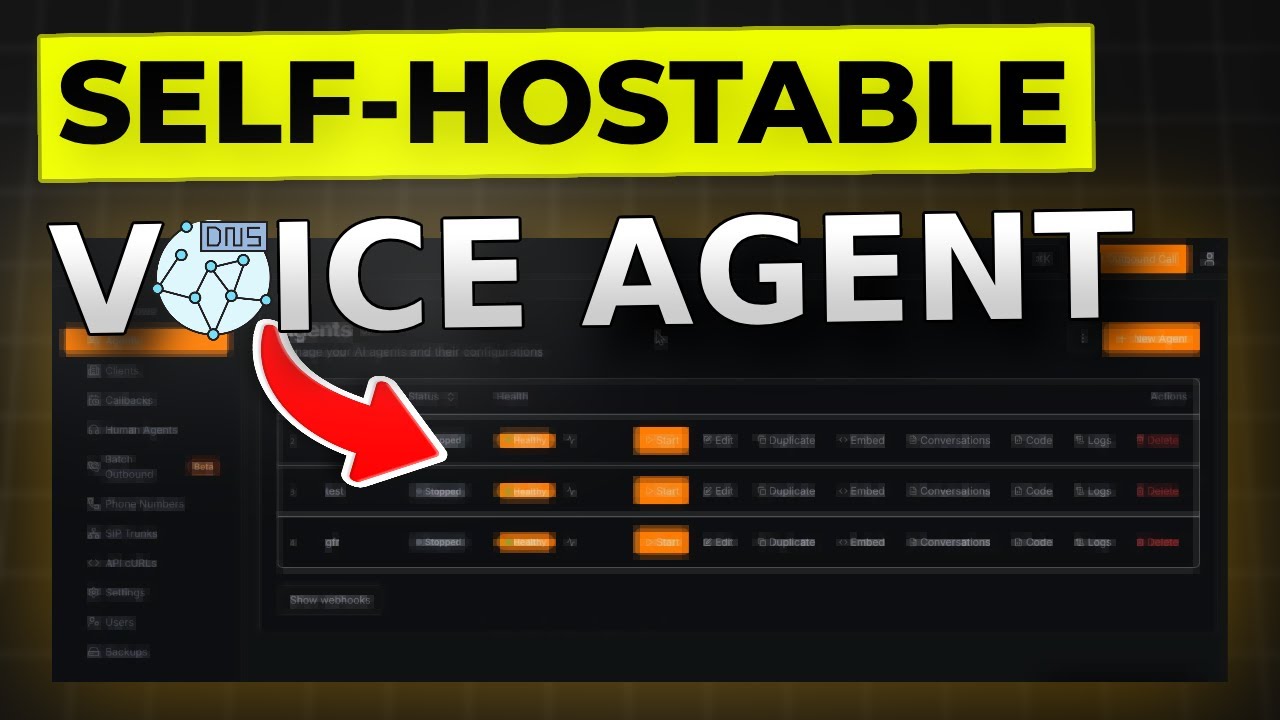
For a complete walkthrough of all platform features, including the call flow builder in action and client portal customization, watch the full video tutorial below. At 6:30, you'll see a detailed demonstration of the security features in action against simulated bot attacks.
Key Takeaways
This self-hosted AI voice agent platform combines enterprise-grade features with business-friendly tools rarely seen in single solutions. From the no-code call flow builder to client-facing ROI dashboards, it's designed for companies that want to deploy AI voice solutions at scale while maintaining full control.
In summary: The platform provides complete agent creation tools, sophisticated call routing, robust security, transparent cost management, and white-label client portals - all with the flexibility of self-hosting and extensive export capabilities.
Frequently Asked Questions
Common questions about this topic
The platform includes agent creation with multiple LLM/TTS providers, call flow builders with no-code nodes, client portals with cost tracking, and security features like bot detection.
It supports both voice and video calls with screen sharing capabilities, along with full self-hosting options. The system is designed for businesses that need to deploy AI voice solutions at scale while maintaining control over costs and integrations.
- No-code visual call flow builder with conditional logic
- Client-facing portals with custom metrics and branding
- Protection against bot attacks and token waste
The system includes advanced security measures that detect repeated phrases from potential bots. When the same or similar phrase is detected three times, the agent issues a verification challenge.
This challenge-response system helps distinguish between legitimate callers and automated attacks. The similarity threshold is configurable, allowing businesses to balance security with user experience based on their specific risk profile.
- Phrase repetition detection with adjustable sensitivity
- Customizable challenge words for verification
- Automatic call termination for failed challenges
The platform provides granular cost tracking at both the provider and client levels. You can define provider costs per minute, token, or other units to accurately calculate expenses.
For client billing, the system supports percentage markups (e.g., 20% above provider costs) that automatically reflect in client portals. These portals display not just costs but also ROI metrics like "human equivalent hours saved" to demonstrate business value.
- Flexible cost units (per minute, token, etc.)
- Automatic markup calculations for client billing
- Cost trend analysis and forecasting tools
The platform connects with various knowledge bases including Pinecone, Supabase, and Weaviate for enhanced agent capabilities. It supports custom API integrations through HTTP tools with authentication.
For telephony, it works with multiple SIP trunk providers while maintaining flexibility for custom implementations. The system also includes SMTP integration for email functionality and webhook support for real-time notifications.
- Knowledge base connections for information retrieval
- SIP trunk compatibility for telephony
- Webhook and email integration for notifications
The visual call flow builder uses a drag-and-drop interface with various node types for different functions. These include agent connections, conditional routing, value extraction, and human transfers.
A unique feature is the ability to export flows as JSON and have LLMs generate new flows from natural language instructions. This combines no-code simplicity with AI-powered customization, making complex workflows accessible to non-technical users.
- Drag-and-drop interface for visual flow creation
- Specialized nodes for common telephony functions
- AI-assisted flow generation from natural language
The platform provides comprehensive analytics including conversation transcripts, call recordings, and post-call evaluations. The timeline debugging tool helps identify issues in complex call flows.
Client portals display standard metrics like cost over time and calls by agent, along with custom KPIs tailored to specific business needs. These can track anything from product orders to customer satisfaction indicators.
- Full conversation history with search capabilities
- Custom metric tracking for business-specific KPIs
- ROI calculations comparing AI to human equivalent costs
The system supports multiple transfer methods: directly to phone numbers, specific human agents, or entire departments. When transferring to departments, it sequences through agents until one answers.
All transfers maintain full conversation context, so human agents see the interaction history and any extracted values. Departments can be configured with fallback messages when no agents are available, preventing dropped calls.
- Sequenced transfers through department agent lists
- Context preservation with full conversation history
- Configurable fallback options when agents are unavailable
GrowwStacks specializes in implementing AI voice agent solutions tailored to your specific business needs. We handle the technical implementation so you can focus on your operations.
Our services include custom call flow design, system integration with your existing tools, security configuration, and analytics dashboard setup. We ensure the solution delivers measurable business value from day one.
- Custom workflow design for your use cases
- Integration with your existing systems and data
- Ongoing optimization based on performance metrics
Ready to Implement AI Voice Agents in Your Business?
Manual call handling is expensive and scales poorly, while off-the-shelf AI solutions often lack the customization your business needs. GrowwStacks builds tailored voice agent solutions that integrate seamlessly with your operations - typically deployed in under 30 days.