Speech to Action: Building the Next Generation of Voice AI Agents
Most voice AI systems today feel robotic and frustrating - interrupting customers, missing context, and failing to take real actions. Deepgram's Flux technology changes this with production-grade agents that understand natural conversation patterns and respond in under 300 milliseconds. Discover how Fortune 100 companies are deploying these solutions today.
The Unique Challenges of Voice AI
Voice interactions introduce complexities that text-based systems never encounter. When customers interact with voice AI, they bring evolutionary expectations - humans naturally multitask, take conversational turns, express emotion, and synthesize context in real time. Current systems struggle with these fundamentals.
Deepgram's engineering team identified three core challenges in production voice AI: perception quality (accuracy), cost efficiency, and real-time performance. As Chris Effand explains in the presentation, "Voice is not text with audio - it introduces things like turn-taking, intonation, and creates a much deeper human interaction."
Key insight: Traditional voice systems lose 15,000 distinct vocal variations when converting "hello" to text - flattening emotion, pacing, and context that humans naturally perceive.
The consequences of getting this wrong are severe. Without proper turn-taking logic and interruption handling, voice agents become frustrating audio tour guides that hand customers off to other departments. This explains why so many enterprise voice implementations fail to deliver on their promise.
How Flux Changes the Game
Deepgram's Flux represents a breakthrough in conversational speech recognition. Unlike traditional approaches that force a trade-off between speed and accuracy, Flux delivers both simultaneously with sub-300ms response times and best-in-class transcription quality.
The secret lies in its fused architecture. Flux integrates turn detection directly into the speech recognition model, providing:
- Live transcripts during conversations (not just after)
- Confidence thresholds for real-time decision making
- Ability to prepare responses while the user is still speaking
This creates experiences previously impossible with voice AI. Agents can now naturally flow with conversations rather than waiting for artificial pauses. The technical demonstration (timestamp 12:45) shows how Flux maintains accuracy while dramatically reducing latency compared to competing solutions.
Real-World Applications Across Industries
Deepgram's technology powers over a billion voice interactions daily across multiple industries. These aren't theoretical applications - they're production systems handling critical customer interactions:
Healthcare
Medical transcription systems using Flux achieve 98% accuracy while maintaining HIPAA compliance. The real-time capabilities allow doctors to focus on patients rather than documentation.
Financial Services
Call centers leverage Deepgram's voice agents to handle routine inquiries while seamlessly escalating complex cases. The system detects frustration in customer voices to trigger appropriate responses.
Food Service
Crispy Cream's drive-through implementation demonstrates Flux's ability to handle noisy environments while accurately capturing complex orders - reducing errors by 40% compared to human operators.
Enterprise adoption: Twilio and Salesforce have integrated Deepgram's voice agent API into their platforms, enabling thousands of businesses to deploy conversational AI without building custom infrastructure.
Production Requirements for Voice AI
Moving from voice AI prototypes to production introduces significant technical challenges. Teams must consider:
Latency Requirements
Sub-500ms end-to-end response times are essential for natural conversations. This requires tight orchestration between speech and reasoning layers - not just fast models.
Compliance Needs
Healthcare and financial services demand on-premises or air-gapped deployments. Deepgram supports all major deployment models including private cloud and hybrid architectures.
Observability
Production systems need millisecond-level visibility into performance bottlenecks. Deepgram's stack exposes intermediate states for debugging while maintaining security.
The presentation outlines a clear maturity path for voice AI implementations - from prototype (focus on speed) to production (focus on accuracy) to scale (focus on orchestration). Each stage introduces new requirements that Flux addresses.
New Metrics for Measuring Success
Traditional word error rate fails to capture what matters in voice agent experiences. Deepgram introduced VAQI (Voice Agent Quality Index) to track:
Interruption Rate
How often the agent cuts off the user mid-sentence. Flux reduces this by 60% compared to baseline systems.
Response Coverage
Whether answers actually address user questions rather than deflecting. Context preservation is key.
Latency Distribution
Consistency matters more than averages - spikes degrade experience more than slightly higher consistent times.
These metrics align with what customers actually care about - fluid, natural conversations that solve problems rather than create frustration. Enterprises using VAQI report 3x faster improvement cycles compared to traditional approaches.
Neuroplex: The Future of Speech-to-Speech
While Flux represents today's state-of-the-art, Deepgram is already pioneering the next generation with Neuroplex - true speech-to-speech architecture that eliminates text conversion entirely.
Current "speech-to-speech" systems actually cascade through text, losing emotional and contextual nuance. Neuroplex preserves:
- Intonation and pacing throughout conversations
- Emotional context across turns
- Subtle vocal cues that convey meaning
The technical demonstration (timestamp 16:20) shows how Neuroplex maintains vocal attributes that traditional systems flatten. This enables more natural, emotionally intelligent interactions that customers prefer.
Coming soon: Deepgram plans to integrate Neuroplex with Flux's turn-taking capabilities, creating voice agents that understand not just what you say, but how you say it.
Watch the Full Tutorial
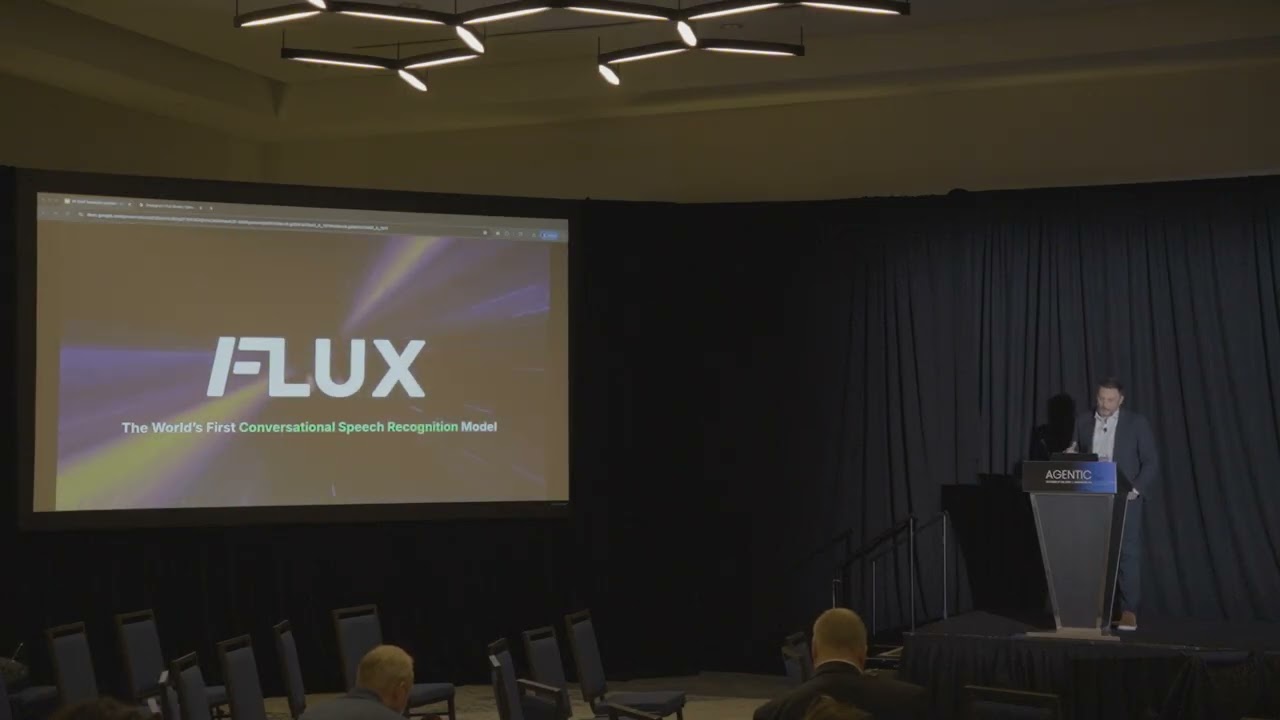
See Flux in action during the live demonstration (starting at 12:45) where it handles rapid-fire conversation with sub-300ms response times. The video also showcases Neuroplex's ability to preserve vocal nuance that traditional systems lose.
Key Takeaways
Voice AI represents both tremendous opportunity and unique technical challenges. Deepgram's approach through Flux and Neuroplex provides a roadmap for enterprises looking to deploy production-grade solutions:
In summary: Successful voice AI requires specialized infrastructure for real-time performance, built-in conversation intelligence, and deployment flexibility. Flux delivers this today while Neuroplex points to an even more natural future beyond text conversion.
Frequently Asked Questions
Common questions about voice AI agents
Voice AI introduces unique challenges like turn-taking, intonation, and emotional context that text-based systems don't handle. Human conversations involve interruptions, context synthesis, and real-time responses that require specialized infrastructure.
Deepgram's Flux model addresses these with sub-300ms response times and built-in turn detection. Unlike chat interfaces, voice systems must handle noisy environments, multilingual speakers, and conversational dynamics that text systems can ignore.
- Voice preserves emotional cues through tone and pacing
- Conversations flow bidirectionally with natural interruptions
- Real-time performance requirements are significantly stricter
Major industries deploying voice AI include healthcare (medical transcription), financial services (call centers), food service (drive-through ordering), and enterprise sales platforms.
Over 1 billion voice interactions occur daily in enterprises, with Crispy Cream and Salesforce among early adopters using Deepgram's technology. These implementations demonstrate voice AI's ability to handle high-volume, error-sensitive interactions where human operators struggle.
- Healthcare: Real-time medical documentation
- Financial services: Compliant call center automation
- Retail: Drive-through order accuracy
Flux is Deepgram's conversational speech recognition model featuring integrated turn detection and sub-300ms response times. Unlike traditional systems that force a trade-off between speed and accuracy, Flux delivers both simultaneously.
The technology enables live transcripts during conversations so agents can prepare responses while the user is still speaking. This creates more natural interactions compared to systems that wait for artificial pauses before responding.
- Fused architecture combines transcription with conversation intelligence
- 250ms turn detection with confidence thresholds
- Maintains Nova 3's best-in-class transcription accuracy
Beyond traditional word error rate, Deepgram's VAQI (Voice Agent Quality Index) measures interruption rate, latency, and response coverage. These metrics better reflect real-world user experience.
Enterprise-grade solutions require sub-500ms end-to-end response times and robust interruption handling to maintain natural conversation flow. VAQI provides actionable insights into where systems fail to meet human expectations.
- Interruption rate: Should be below 5%
- Latency: Consistent sub-500ms responses
- Response coverage: Answers actually solve user problems
Production voice AI solutions must support public cloud, private cloud, on-premises, and air-gapped deployments. Deepgram offers all these options with global coverage across North America, EU, and Asia Pacific regions.
This flexibility meets strict compliance requirements in healthcare and financial services. Enterprises can deploy voice agents where their data lives while maintaining performance and security standards.
- Public cloud: Fastest implementation
- Private cloud: Enhanced security
- Air-gapped: Maximum isolation for sensitive data
The next frontier is true speech-to-speech architecture that preserves emotional and contextual nuance without converting to text. Deepgram's Neuroplex model maintains intonation, pacing and emotion throughout conversations.
This represents a shift from today's cascade approach that loses important vocal attributes during text conversion. Early implementations show promise for more emotionally intelligent voice agents that customers prefer interacting with.
- Preserves 15,000 vocal variations in a single word
- Maintains context across conversation turns
- Enables more natural emotional responses
The three hardest problems in production voice AI are perception quality (accuracy), cost efficiency, and real-time performance. Orchestration between speech and reasoning layers becomes critical at scale.
Teams also need full observability into latency spikes and mis-turns that can degrade user experience. Deepgram's stack provides millisecond-level monitoring throughout the voice pipeline to identify and resolve bottlenecks.
- Maintaining sub-500ms latency at scale
- Handling multilingual, noisy environments
- Meeting compliance requirements globally
GrowwStacks specializes in implementing production-grade voice AI solutions using Deepgram and other leading platforms. We design custom voice agents tailored to your industry requirements, handling everything from real-time transcription to business logic integration.
Our team ensures sub-500ms response times and natural conversation flow. We've deployed voice solutions for healthcare providers, financial institutions, and retail chains - each optimized for their specific use case and compliance needs.
- Custom voice agent design and deployment
- Deepgram Flux and Neuroplex integration
- Free 30-minute consultation to assess your needs
Ready to Deploy Production-Grade Voice AI?
Every day without voice automation costs your business missed opportunities and frustrated customers. GrowwStacks implements Deepgram-powered solutions in as little as 4 weeks - with guaranteed sub-500ms response times and 98%+ accuracy.