How to Engineer Context for Voice AI Agents That Remember Conversations
Most AI implementations fail at maintaining context across conversations - either forgetting critical details or becoming overwhelmed by irrelevant information. The breakthrough comes from context engineering: designing the complete workspace where your AI agent operates, including its memory architecture, tool integrations, and knowledge retrieval systems.
The Evolution from Prompt to Context Engineering
In , building effective AI agents requires moving beyond simple prompt engineering to comprehensive context engineering. Where models once focused on crafting the perfect input instruction, modern implementations must design the complete workspace where the agent operates.
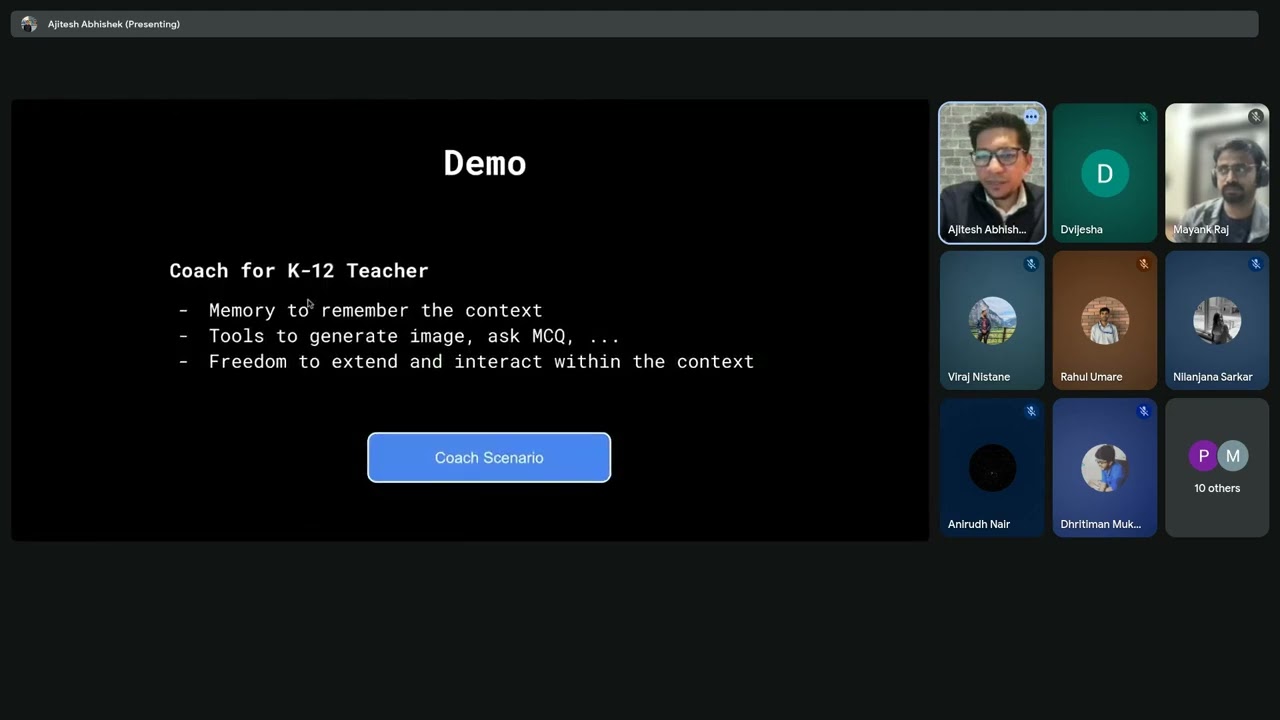
The demo agent shown in our tutorial maintains context across sessions, remembers user preferences, and intelligently uses tools like image generation and MCQ creation - all while operating within optimal token budgets. This is only possible through deliberate context architecture.
Key Insight: Research shows accuracy improves when carefully controlling what enters the agent's context window rather than stuffing all available information. Even with million-token contexts, selective context engineering delivers better outcomes.
Hybrid Memory Architecture in Practice
The breakthrough in our demo comes from its two-tier memory system. Critical details like user identity and session state live in the system prompt ("super memory"), while detailed conversation history and reference materials reside in retrievable storage.
This architecture solves the fundamental tension in voice AI: maintaining continuity without overwhelming the context window. The agent remembers that "Ajitesh" returned for a second coaching session and recalls their previous discussion points, while keeping the bulk of historical data available for just-in-time retrieval.
Implementation Tip: Structure your memory system to preserve 3 types of information across sessions: 1) User identity and core preferences 2) Critical session state 3) Reference pointers to detailed history.
System Prompt Patterns That Work
Effective system prompts follow three proven patterns demonstrated in our implementation:
1. Structured Role Definition
Using markdown or XML tags, clearly define the agent's role, personality, and boundaries. Our coaching agent specifies its teaching style, response format, and interaction boundaries in a structured prompt that remains consistent across sessions.
2. Flow State Management
Break conversations into distinct phases with transition rules. Our demo defines greeting, situation presentation, MCQ handling, and wrap-up as separate states with clear handoff points.
3. Realistic Resistance Modeling
Human conversations involve natural resistance and teachable moments. We explicitly program these interaction patterns: "Don't accept explanations at surface value - probe 2-3 layers deep" and "Identify breakthrough criteria for each coaching scenario."
Tool Integration and Just-in-Time Knowledge
The demo agent seamlessly integrates multiple tools while maintaining conversation flow. Key implementation insights:
Tool Registration Patterns
Each tool requires three components: 1) System registration 2) Prompt instructions on when/how to use 3) Implementation logic. Our image generation tool includes examples of when visual aids enhance coaching.
Knowledge Retrieval Strategy
Large reference materials belong in retrievable knowledge bases, not system prompts. We keep coaching manuals and procedures in a RAG (Retrieval Augmented Generation) system that the agent queries only when needed, adding just 300-500ms latency per retrieval.
Critical Rule: Never put more than 10,000 tokens (≈40,000 words) in system prompts. Everything else should be retrievable via knowledge bases with proper metadata pointers in the main prompt.
When to Use Sub-Agent Patterns
For conversations exceeding 20 minutes or involving multiple distinct phases, consider breaking your agent into specialized sub-agents:
1. Conversation Phase Specialization
Our demo could be split into greeting, coaching, and wrap-up agents, each with focused context windows. They would pass session notes rather than maintain full history.
2. Tool Specialization
Agents dedicated to complex tools (like our MCQ generator) can operate with optimized prompts for that single function.
3. Error Recovery
Specialized recovery agents can handle off-track conversations without polluting the main agent's context.
This architecture pattern has become standard in implementations requiring long, complex interactions while maintaining performance.
Voice AI Context Implementation Checklist
Based on our successful implementations, here's the context engineering checklist we use at GrowwStacks:
Core Components
- Structured system prompt with role/flow definition
- Hybrid memory architecture (super + referential)
- Tool registration with usage guidelines
- Knowledge base with retrieval pointers
Optimization Pass
- Verify no single component exceeds 10K tokens
- Test conversation continuity across 5+ sessions
- Measure tool usage latency (target <500ms)
- Validate guardrails catch 95%+ edge cases
Pro Tip: Always start with minimal viable context and expand deliberately. It's easier to add necessary elements than remove accumulated cruft.
Watch the Full Tutorial
See the complete implementation walkthrough from the live workshop, including timestamped breakdowns of the memory architecture (12:45), tool integration (18:30), and sub-agent patterns (32:15).
Key Takeaways
Effective voice AI agents require moving beyond simple prompt engineering to comprehensive context design. The patterns demonstrated here enable natural, continuous conversations while maintaining performance.
In summary: 1) Design the complete agent workspace 2) Implement hybrid memory architecture 3) Structure system prompts for clarity 4) Use sub-agents for complex flows 5) Keep most context retrievable rather than loaded.
Frequently Asked Questions
Common questions about voice AI context engineering
Context engineering refers to designing the complete workspace for an AI agent including system prompts, tools, knowledge bases and memory architecture.
Unlike traditional prompt engineering which focuses only on input instructions, context engineering considers all elements that shape how the agent operates across multiple interactions.
Voice AI agents require context engineering because they handle multi-turn conversations where maintaining context across sessions is critical.
Research shows accuracy improves when carefully controlling what enters the agent's context window rather than stuffing all available information. Proper context engineering enables natural conversation flow while efficiently using the available token budget.
The three core components are: 1) System prompts defining role and behavior 2) Tools registration and instructions 3) Memory architecture including session history and referential knowledge.
Effective context engineering balances these components based on the agent's specific use case and conversation patterns.
Modern AI agents use hybrid memory architectures. Critical details like user identity and session state are maintained in the system prompt (super memory), while detailed conversation history and knowledge reside in referential memory that the agent accesses just-in-time.
This balances performance with context preservation across sessions.
Key practices include: Using markdown/XML structure for clarity, putting only essential persistent context in prompts, defining conversation flows with clear stages, and incorporating realistic human behaviors like resistance handling.
Avoid putting large datasets or procedures in system prompts - these belong in knowledge bases.
Sub-agent architectures become necessary when conversations exceed 20 minutes or involve multiple distinct phases.
Each sub-agent handles one part of the conversation with focused context, passing notes to the next agent. This prevents context overload and maintains specialization for different conversation stages.
Despite models supporting million-token contexts, best practice is to summarize periodically and maintain only essential context.
Key techniques include: Automatic summarization of past conversations, hierarchical memory structures, and just-in-time retrieval of reference materials. This maintains accuracy while controlling token usage.
GrowwStacks specializes in building custom voice AI agents with advanced context engineering. We design and implement: Hybrid memory architectures, optimized tool integrations, conversation flow design, and knowledge retrieval systems tailored to your specific use case.
Our team handles the complex engineering so you can focus on the agent's purpose and user experience.
- Custom memory architectures for your use case
- Optimized tool integration strategy
- Free consultation to discuss your agent requirements
Ready to Build Voice AI Agents That Remember?
Context engineering separates basic chatbots from truly intelligent assistants. Our team at GrowwStacks has implemented these patterns across education, healthcare, and customer service voice agents - delivering 60-80% improvement in conversation continuity metrics.