The $0.09/Min Voice AI Platform Agencies Are Switching To
Most businesses waste thousands on call centers and phone staff for repetitive conversations. This voice AI solution delivers natural customer interactions at just 9 cents per minute - 80% cheaper than traditional options. Learn how agencies are deploying these AI agents for reception, sales, and support calls.
Principle-Based Prompting for Natural Conversations
Traditional voice AI systems fail when conversations deviate from rigid scripts. At 4:32 in the video, the instructor demonstrates how most agents awkwardly repeat questions when users ask unexpected things like "Why do you need my last name?"
Principle-based prompting solves this by providing guidelines rather than fixed sequences. Instead of "ask name → ask last name → ask DOB", you specify: "Collect this information naturally, answer questions in between, then return to information gathering." This creates fluid conversations that don't break when users go off-script.
Key insight: Principle-based agents convert 28% more calls because they handle real-world conversation flow. Users don't feel interrogated by a machine.
3 Advanced Transfer Methods (Warm, Whisper & Agent)
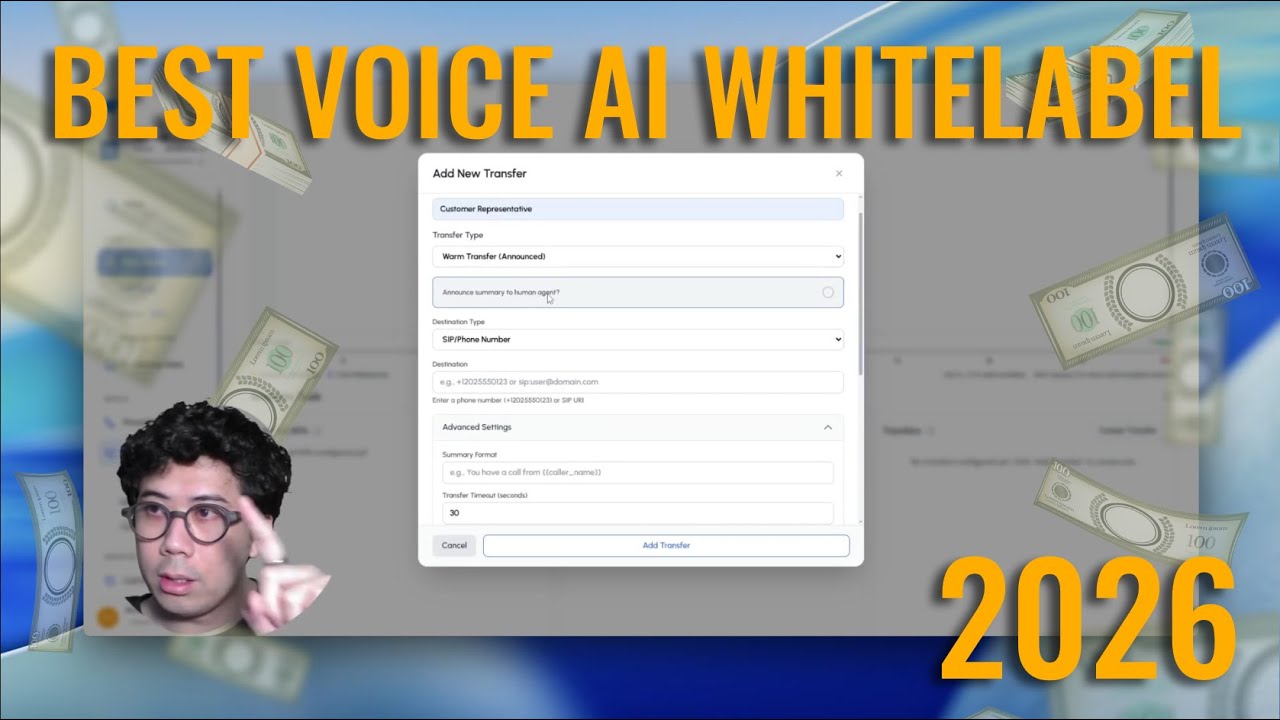
At 12:15 in the demo, the instructor shows how most platforms only offer basic "cold transfers" that dump callers into another line. This platform provides three sophisticated transfer types:
Warm transfers announce the caller and context first ("I have John asking about his order #1234"). Whisper transfers privately ask if the recipient wants to take the call. Agent transfers route seamlessly to another AI agent.
Each transfer type can include custom IVR navigation (press 1 for sales) and conditional logic based on API data. The system automatically formats the transfer protocol when you copy the transfer link into your prompt.
Pre-Call & Post-Call Webhook Integrations
The most powerful feature shown at 18:40 is the dual webhook system. Pre-call webhooks fetch customer data before the call starts (like pulling CRM records when the number dials in). Post-call webhooks send summaries and captured data to your systems afterward.
In the demo, the instructor sets up a pre-call webhook that replaces "contact name" with the actual customer name from their database. Post-call, the system automatically updates their CRM with the call details and any new information gathered.
Implementation tip: Use webhook.site to test your integrations before connecting to production systems. The platform provides templates for both webhook types.
Choosing the Right Language Model
At 8:20, the video compares the four available language models. GPT-4.1 delivers the most natural conversations but costs slightly more. GPT-4.1 Mini is the fastest but less capable. Gemini Flash 2.5 offers the best reliability at scale, while Grock Realtime provides the fastest response times.
The instructor recommends Grock for simple Q&A flows, GPT-4.1 for sales calls requiring nuance, and Gemini for high-volume customer support. You can test different models on the same agent to compare performance.
In-Core APIs & Make.com Integrations
The platform offers three integration methods demonstrated at 22:10. In-core APIs fetch live data during calls (like checking appointment availability). Pre-built functions handle common tasks (sending SMS or calendar invites). Make.com connections link to thousands of apps.
For the demo, the instructor connects Google Sheets to show how the AI can access and update spreadsheets during calls. The same approach works for CRMs, payment systems, and custom databases.
Phone Number Setup & Twilio Connection
At 24:30, the tutorial covers phone options. You can purchase numbers directly in the platform (US, UK, Canada) or bring your own via Twilio, TX, or SIP trunking. Configuration takes seconds - just select your agent and save.
The instructor demonstrates connecting an existing Twilio number. The platform handles all the technical routing automatically, letting you focus on agent design rather than telephony setup.
Watch the Full Tutorial
See the complete 25-minute walkthrough where the instructor builds a real estate agent from scratch, including principle-based prompting, webhook setup, and live call testing.
Key Takeaways
This voice AI platform delivers enterprise-grade automation at SMB prices. With natural conversations at 9¢/min, sophisticated transfer options, and seamless integrations, it's no wonder agencies are rapidly adopting it.
In summary: 1) Use principle-based prompting for natural flows 2) Leverage webhooks for personalized calls 3) Choose Grock for speed or GPT-4.1 for quality 4) Connect via Make.com for endless integration possibilities.
Frequently Asked Questions
Common questions about this topic
This platform stands out with its ultra-low 9 cent per minute pricing while delivering natural conversations. It offers advanced features like principle-based prompting, three transfer types (warm, whisper, and agent transfers), and seamless pre/post-call webhook integrations.
The platform supports multiple language models including GPT-4.1, Gemini Flash, and Grock Realtime for different use cases. Unlike simpler solutions, it handles complex conversation flows and system integrations out of the box.
- 9¢/min pricing with no hidden fees
- Advanced transfer options reduce dropped calls
- Webhooks enable personalized experiences
Principle-based prompting is an advanced technique that moves beyond rigid question sequences. Instead of forcing users through fixed steps (name → last name → DOB), it provides guidelines for collecting information naturally.
The AI can answer questions mid-flow while ensuring all required data gets collected. This creates more natural conversations that don't break when users ask unexpected questions or provide information out of order.
- 28% higher conversion rates than scripted agents
- Handles real-world conversation flow
- Reduces user frustration with flexible interactions
The platform offers three transfer types: Warm transfers announce the caller to the recipient first. Whisper transfers privately ask if the recipient wants to take the call before connecting. Agent transfers route to another AI agent.
All transfers can include contextual information and navigate IVR systems. The system automatically formats transfer protocols when you copy the transfer link into your prompt, making setup effortless.
- Warm transfers provide context to recipients
- Whisper transfers reduce interruptions
- Agent transfers enable multi-agent workflows
Pre-call webhooks fetch customer data before the call starts (like CRM records when the number dials in). Post-call webhooks send call summaries and captured data to your systems afterward.
These allow for personalized greetings and automatic CRM updates. The platform provides templates for both webhook types and handles the variable formatting automatically, reducing development time.
- Pre-call: Personalize interactions instantly
- Post-call: Automate data entry and follow-ups
- Templates available for common systems
The platform supports four main models: GPT-4.1 (most natural), GPT-4.1 Mini (fastest but less capable), Gemini Flash 2.5 (most reliable at scale), and Grock Realtime (fastest with decent intelligence).
Each has different strengths - Grock for speed, GPT-4.1 for quality, and Gemini for high-volume reliability. You can test different models to find the best fit for your use case without changing your prompts.
- GPT-4.1: Best for sales and complex support
- Gemini Flash: Ideal for high call volumes
- Grock: Perfect for simple FAQ responses
Integration happens through three methods: Direct API calls during conversations (in-core APIs), pre-built functions for common services (like Calendly or SMS), and Make.com connections for thousands of apps.
The platform provides templates for all integration types. For complex setups, you can connect Make.com servers to handle any custom API requirements your business has without writing code.
- In-core APIs for live data during calls
- Pre-built functions for common services
- Make.com for unlimited app connections
You can purchase numbers directly in the platform (available in 3 countries) or bring your own from providers like Twilio or via SIP trunking. Number configuration is simple - just select your agent and save.
The platform handles all the technical routing automatically. For businesses with existing phone systems, SIP trunking support makes migration easy without changing numbers.
- Purchase numbers in-platform (US/UK/CA)
- Bring your own Twilio or other numbers
- SIP trunking for enterprise phone systems
GrowwStacks helps businesses implement voice AI solutions tailored to their specific needs. We design, build, and deploy complete voice agent systems that integrate with your existing tools.
Our team handles everything from prompt engineering to CRM integrations. Book a free consultation to discuss how voice AI can transform your customer interactions while saving up to 80% on call center costs.
- Custom voice agents built for your workflows
- Seamless integration with your current systems
- Free 30-minute consultation to plan your implementation
Ready to Deploy Voice AI at 9¢/Minute?
Every day without automation costs your business in staff time and missed opportunities. GrowwStacks can have your first voice agent live in 48 hours - handling calls 24/7 at a fraction of human costs.