Why Your RAG Chatbot Fails Users (And How to Fix It)
Your chatbot demo impresses everyone with fluent answers - then fails catastrophically with real users. The problem isn't your LLM or documents. It's the hidden decision-making behaviors users expect but your system lacks. Here's how to diagnose and fix reliability issues before they damage trust.
The Hidden Failure Mode of RAG Chatbots
Your chatbot sounds brilliant in demos - answering quickly, quoting documents perfectly. Then a real user asks a slightly messy question, and suddenly it's confidently wrong. Worse, you can't predict when it will fail until after it's already damaged trust.
The core misconception? Believing that connecting an LLM to document search automatically creates a helpful assistant. This assumption fails because real user questions are incomplete, documents contradict each other, and the bot must answer anyway - producing articulate but unreliable responses.
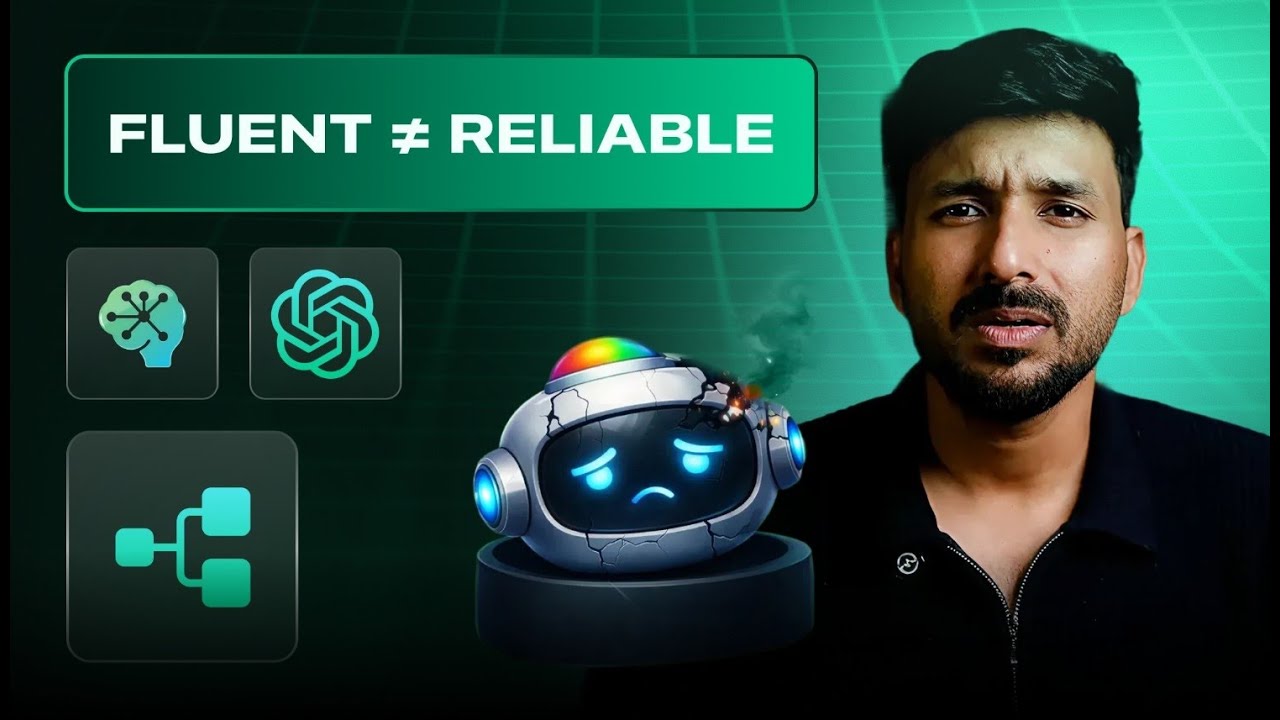
The critical insight: Users don't care how good the answer sounds. They care whether it's consistent, properly sourced, and admits uncertainty when appropriate. Most chatbot failures occur because teams build pipelines that produce fluent text rather than systems that make useful decisions.
The 3-Layer Framework for Reliable Chatbots
Diagnose nearly every chatbot failure by analyzing these three critical layers:
1. Retrieval
Did the system find the specific information needed to answer this exact question? Not just related content - the precise evidence required. Most retrieval systems fail by returning "close enough" results rather than definitive answers.
2. Reasoning and Assembly
Given the retrieved information, did the bot combine it correctly? Did it follow constraints, apply the right policies, and avoid mixing incompatible sources? Many hallucinations occur when the system forces an answer from weak or contradictory context.
3. Answer Behavior
The tone and safety layer: Does it ask clarifying questions when prompts are unclear? Does it cite sources properly? Does it refuse when documentation doesn't cover the query? Teams spend 80% of their effort polishing this layer while neglecting the first two.
Key distinction: When a chatbot fails, it's rarely the model inventing information. More often, the system quietly provides partial or conflicting context while still demanding a definitive answer - guaranteeing a failure.
A Real-World Failure Story
Consider an internal HR support chatbot connected to policy documents. It handles simple queries like "How do I reset my password?" perfectly. Then an employee asks: "I'm traveling next week. Can I expense airport parking and meals if it's a client visit?"
The system retrieves a travel policy snippet about meals and an outdated finance FAQ about parking. The LLM merges them into a confident "Yes" with official-sounding conditions. The employee submits the expense. Finance rejects it. Now:
- The employee thinks the chatbot is useless
- Finance considers it a compliance risk
- The team blames the model's reliability
But the real failure points were:
- No clarifying questions about office location or policy version
- No prioritization of authoritative documents
- No conflict flagging between sources
- No uncertainty admission when information was incomplete
This wasn't an AI problem - it was a system design problem. The chatbot needed rules for handling uncertainty, not just better prompts.
5 Common Chatbot Implementation Mistakes
These recurring errors explain most production failures:
1. Treating Search Results as Truth
Assuming the top few retrieved chunks answer the question when they might only be vaguely related.
2. Ignoring Contradictions
Blending conflicting documents into smooth but incorrect answers rather than flagging disagreements.
3. No Clear Fallback Behavior
Answering with certainty when evidence is weak instead of admitting uncertainty or asking for clarification.
4. Optimizing for Demo Success
Testing only with clean prompts rather than messy real user questions that reveal system weaknesses.
5. Shipping Without Monitoring
Failing to track drift as documents, policies, and terminology evolve until complaints accumulate.
The pattern: Focusing on answer fluency rather than decision quality. Users remember the one wrong answer more than twenty correct ones.
Practical Steps to Fix Your Chatbot
Implement these improvements before touching your tech stack:
1. Define "Helpful" Specifically
Write concrete success criteria like "User completes task without escalation" or "Answer includes policy section and date." Product thinking beats model tuning.
2. Design the Question Flow
Decide when to answer, ask clarifying questions, or refuse requests. Trust comes from managing uncertainty, not answering everything.
3. Unify Your Knowledge Base
Identify authoritative documents, handle versions, and resolve conflicts upstream. Otherwise, the bot will resolve them downstream by guessing.
4. Test With Real User Prompts
Collect messy questions with partial context, slang, and multiple intents. Verify retrieval accuracy, reasoning correctness, and response behavior separately.
5. Plan Your Monitoring
Establish a weekly review of sample conversations. Categorize failures as retrieval, reasoning or behavior issues before making fixes.
Remember: Consistency creates trust. A slightly less "smart" but reliable chatbot outperforms a brilliant but unpredictable one.
How to Test Your Chatbot Before Deployment
Effective testing requires simulating real user behavior:
1. Collect Edge Cases
Gather actual user questions that broke previous systems - partial information, slang, multi-part queries.
2. Create Conflict Scenarios
Intentionally introduce documents that contradict on key points. Verify the bot flags conflicts rather than blending them.
3. Test Uncertainty Handling
Ask questions where the knowledge base has partial coverage. The bot should admit gaps rather than guess.
4. Verify Clarification Requests
Use ambiguous prompts to ensure the bot recognizes when it needs more information.
5. Check Source Attribution
Confirm answers cite the most authoritative and current documents available.
Testing tip: Focus on the system's decision-making process, not just answer quality. A correct answer from flawed reasoning will fail in production.
What to Monitor After Launch
Simple but critical metrics to track:
1. Retrieval Accuracy
Sample questions to verify the system finds the right documents, especially for policy-sensitive queries.
2. Conflict Resolution
Track how often documents disagree and whether the bot handles it appropriately.
3. Clarification Rate
Monitor how often the bot requests more information versus guessing.
4. Source Authority
Ensure answers prioritize the most current and official documents.
5. User Correction Feedback
Implement easy ways for users to flag incorrect answers for review.
Critical practice: Weekly manual review of sample conversations. No automated metric replaces human evaluation of decision quality.
Watch the Full Tutorial
See the complete breakdown of chatbot failure modes and fixes in the original video tutorial (timestamp 2:15 covers the 3-layer framework in detail).
Key Takeaways
Building reliable chatbots requires shifting from fluency-focused to decision-focused design. Users will forgive occasional "I don't know" answers but remember every confident mistake.
In summary: 1) Diagnose failures using the 3-layer framework, 2) Design for uncertainty management before answer quality, 3) Test retrieval and reasoning separately from response formatting, and 4) Monitor decision quality as rigorously as answer fluency.
Frequently Asked Questions
Common questions about this topic
RAG chatbots fail not because the AI is dumb, but because the system design lacks critical decision-making behaviors. Most implementations focus on producing fluent text rather than useful decisions.
The chatbot retrieves documents and generates answers without properly handling contradictions, uncertainty, or incomplete information - leading to confident but incorrect responses.
- They treat search results as definitive answers
- They blend conflicting sources smoothly
- They answer when they should ask or refuse
The three critical layers are: 1) Retrieval - finding the right information to answer the specific question, 2) Reasoning - correctly combining retrieved information while following constraints, and 3) Answer Behavior - managing tone, citations, and uncertainty appropriately.
Most teams spend 80% of their time polishing layer 3 while neglecting the first two layers. This creates chatbots that sound good but make poor decisions.
- Retrieval failures cause wrong answers
- Reasoning failures create hallucinations
- Behavior failures damage trust
Most hallucinations aren't random fabrications but result from the system handing weak or contradictory context to the LLM while still demanding a final answer.
To prevent this, design clear rules for when the chatbot should answer, ask clarifying questions, or refuse to respond. Also implement source conflict resolution and version control in your knowledge base.
- Identify authoritative source documents
- Flag when retrieved information conflicts
- Train the bot to say "I need more information"
The most common mistake is treating search results as truth and ignoring contradictions. When documents disagree, many chatbots average them into a smooth but incorrect answer rather than flagging the conflict.
Another critical error is having no clear fallback behavior - the bot answers with certainty even when evidence is weak. This destroys user trust faster than any other failure mode.
- Assuming top search results are correct
- Blending conflicting information
- Answering when uncertain
Test with messy real-world prompts including partial contexts, slang, and multi-intent questions. Evaluate three aspects separately: retrieval accuracy, reasoning correctness, and response behavior.
Collect edge cases where users might break the system and verify the bot handles uncertainty appropriately rather than guessing. Focus on decision quality over answer fluency during testing.
- Use ambiguous and incomplete prompts
- Introduce conflicting documents
- Verify clarification requests
Implement a weekly review of sample conversations to categorize failures into retrieval, reasoning or behavior issues. Track policy version conflicts, unanswered questions where the bot should have clarified, and instances where authoritative documents were overlooked.
Focus on consistency metrics before optimizing for intelligence. The most important metric is user trust, which comes from reliability rather than brilliance.
- Weekly conversation sampling
- Source conflict frequency
- Clarification request rate
Treat your knowledge base as a single source of truth by identifying authoritative documents, handling version control, and establishing conflict resolution rules. Structure content to minimize ambiguity and tag documents with metadata about their applicability.
Most importantly, ensure the system knows when to say 'I'm not sure' rather than guessing. A smaller but well-organized knowledge base outperforms a large but conflicting one.
- Document version control
- Authority tagging
- Conflict resolution protocols
GrowwStacks specializes in building production-ready AI systems that prioritize reliability over fluency. We design chatbot architectures with the three critical layers - retrieval, reasoning and behavior - to ensure consistent, trustworthy performance.
Our team implements conflict resolution protocols, uncertainty management, and monitoring systems tailored to your specific domain requirements. We focus on decision quality first, then optimize answer quality.
- Custom reliability frameworks
- Knowledge base structuring
- Ongoing monitoring systems
Next step: Book a free 30-minute consultation to discuss your specific chatbot challenges and how we can help implement a trustworthy solution.
Build a Chatbot Users Actually Trust
Every confident wrong answer erodes user trust faster than you can rebuild it. GrowwStacks designs AI systems that prioritize reliability first - ensuring your chatbot makes good decisions before crafting perfect responses.