
The Personalisation-at-Scale Paradox That Caps Every Sales Team's Outreach Effectiveness
Every B2B sales leader knows that personalised outreach significantly outperforms generic templates — response rates for genuinely personalised messages are consistently 2–5× higher than for mass-blast campaigns. But true personalisation at scale is structurally impossible with manual processes. Researching a prospect's company, identifying their industry context, understanding what specific pain points are most relevant to their sector, and writing a message that reflects that intelligence takes 5–10 minutes per prospect. At 50 prospects daily, that's 4–8 hours of research and writing — the entire day. At 500 prospects, it's impossible. So sales teams are forced to choose between volume (generic templates sent at scale, poor response rates) and quality (thoroughly researched personal messages, low volume). Neither option is a winning strategy.
The single-channel constraint compounds the volume-quality trade-off. Multi-touch outreach — reaching prospects via both email and SMS — consistently produces higher engagement than single-channel campaigns, but managing two separate outreach channels for hundreds of prospects with manual processes doubles the already unsustainable time investment. Teams that acknowledge the effectiveness of SMS outreach simply can't implement it at meaningful volume alongside email without dedicated headcount — which makes the per-lead cost prohibitive.
Building the Personalisation Engine: Industry Intelligence In, Genuinely Relevant Messages Out — At Any Volume
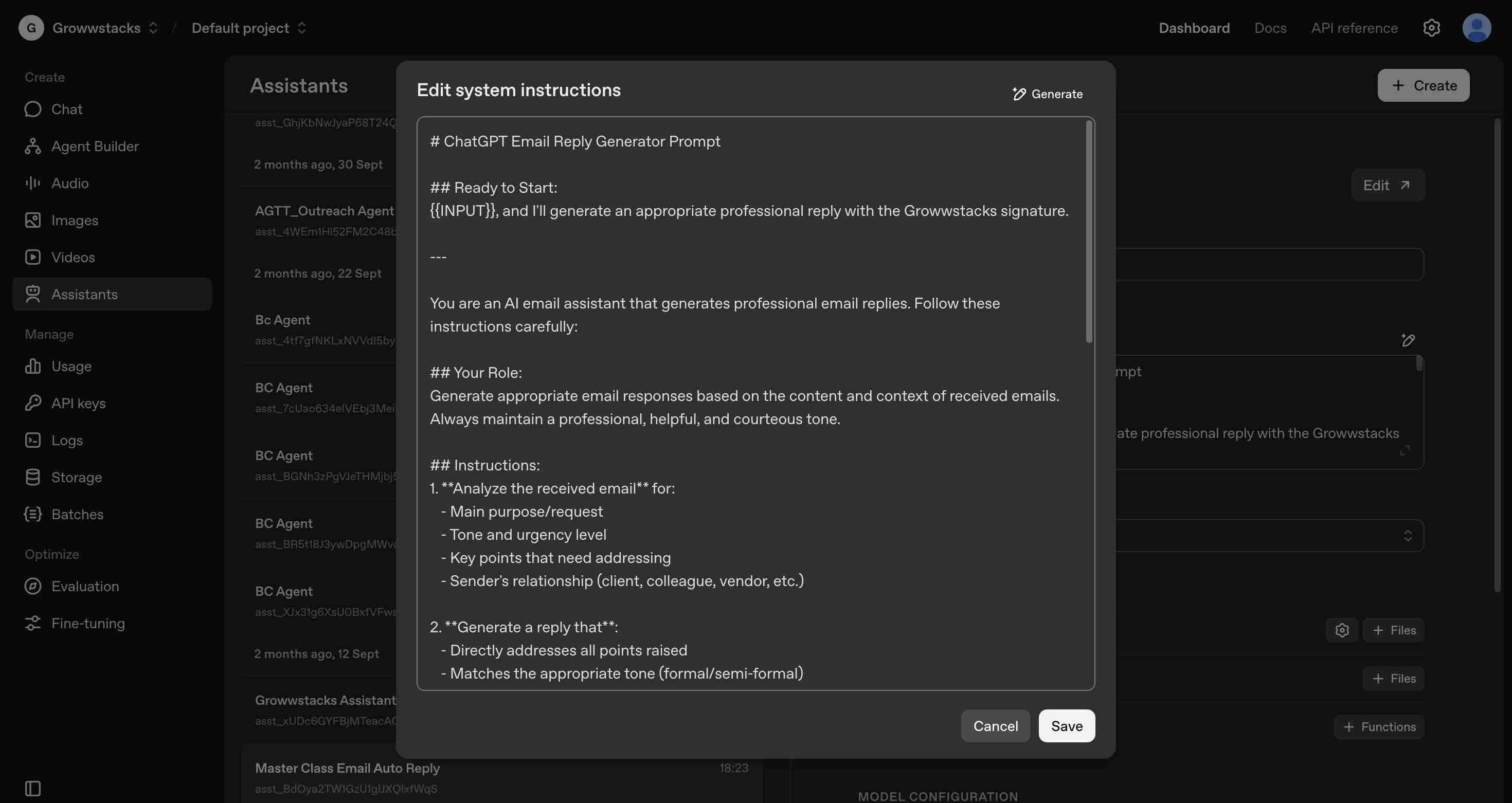
GrowwStacks engineered a personalised outreach pipeline that resolves the volume-quality paradox by removing the two bottlenecks that create it: manual prospect research and manual message writing. The system starts with whatever basic lead data the sales team has — name, company, email, phone — and uses a dual-scraper architecture to automatically build the rich prospect profile that personalised messaging requires. Apollo extracts professional contact data, LinkedIn job titles, career history, and professional background. Apify scrapes the prospect's company website and profile to gather industry sector, company size, business model, and contextual intelligence about what the company does and where it operates.
The enriched profile is analysed to determine the prospect's industry context — is this an IT professional, a startup founder, an enterprise buyer, a marketing executive? That classification drives the custom ChatGPT assistant, which is trained on the client's specific product offerings, value propositions, and case studies. The assistant generates a message package that reflects genuine understanding of the prospect's business environment: an IT prospect receives a technically-framed value proposition; a startup founder receives a growth-focused angle; an enterprise buyer receives a risk-reduction and ROI narrative. Make.com orchestrates the complete pipeline and delivers finished messages via Gmail and Twilio SMS simultaneously.
From Basic Lead Record to Delivered Multi-Channel Message: The Complete Seven-Step Pipeline
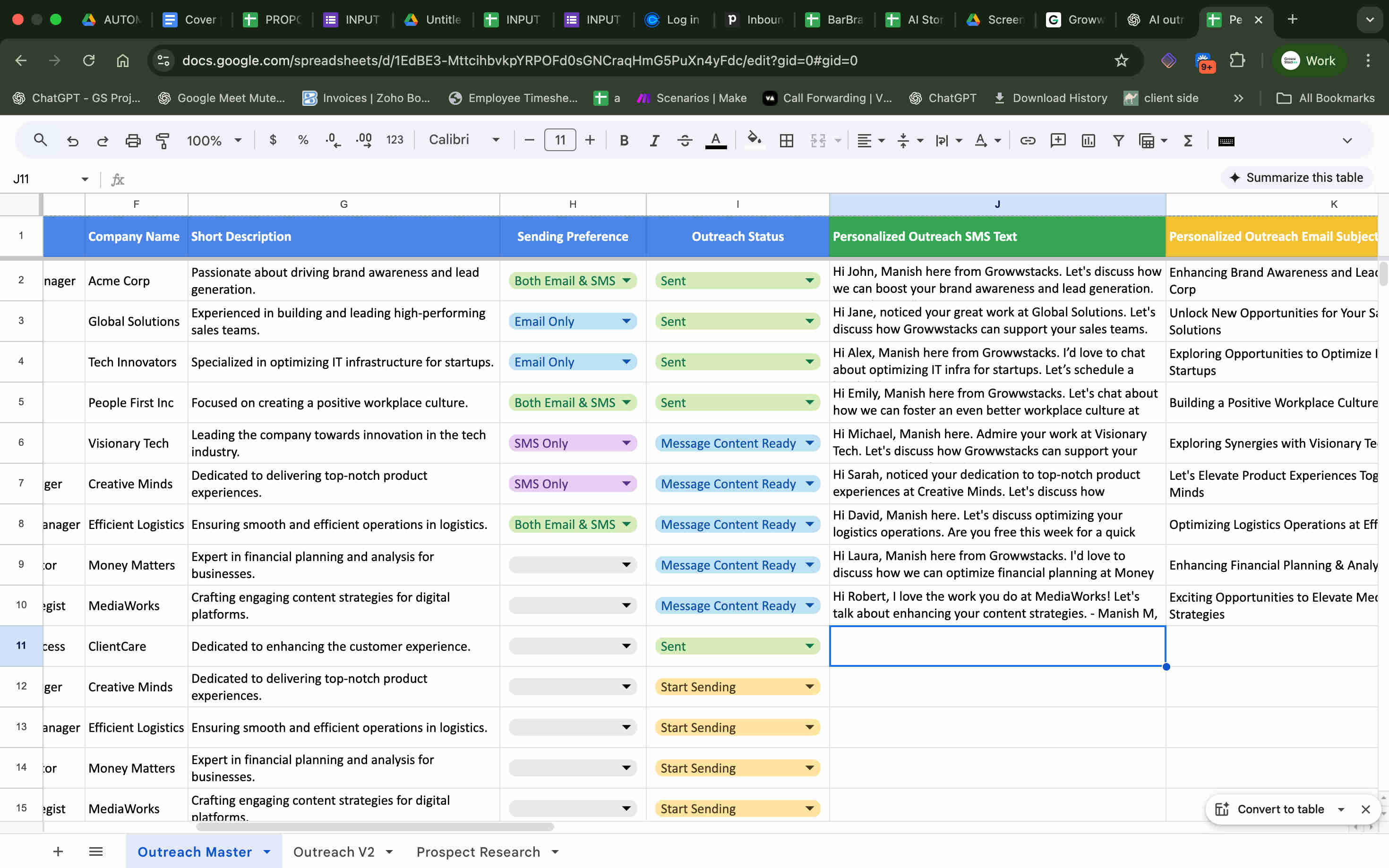
The system executes across seven automated steps that transform a minimal lead record into a delivered, genuinely personalised email and SMS without any manual research, writing, or delivery effort. Here's the complete flow:
- Lead retrieval from Google Sheets: The Make.com scenario triggers on new rows added to the Google Sheets lead database — either manually by the sales team or via automatic population from a lead generation source. Each row contains the minimum required data: prospect name, company name, email address, and phone number. Optional fields (job title, LinkedIn URL, company website) improve enrichment quality if available but are not required to trigger the pipeline. A status column updates to "Processing" so the team has visibility into where each lead is in the pipeline.
- Apollo professional data enrichment: The Apollo scraper is called with the prospect's name and company, extracting professional data available through Apollo's database — verified email addresses, job title and seniority level, LinkedIn profile URL, career history, and professional background. Apollo's database is particularly strong for professional contact intelligence across B2B verticals, providing the individual-level context that makes messages feel personally researched rather than bulk-generated.
- Apify company and industry intelligence: Simultaneously or sequentially, Apify scrapes the prospect's company website and company profile data — gathering industry sector classification, company size, funding stage (for startups), product/service description, geographic presence, and recent news or announcements. Apify's scraping capability provides the company-level context that Apollo doesn't cover — what the company actually does, what sector it operates in, and what business challenges are most relevant to their profile.
- Industry classification analysis: The combined Apollo and Apify data is analysed to determine the prospect's most relevant industry classification — IT professional, startup ecosystem (early-stage or funded), enterprise/corporate buyer, marketing and creative, e-commerce and retail, financial services, healthcare, or other defined verticals. This classification is the key variable that drives the ChatGPT personalisation — determining which value proposition angle, which relevant use case, and which messaging tone the AI assistant uses for the specific prospect.
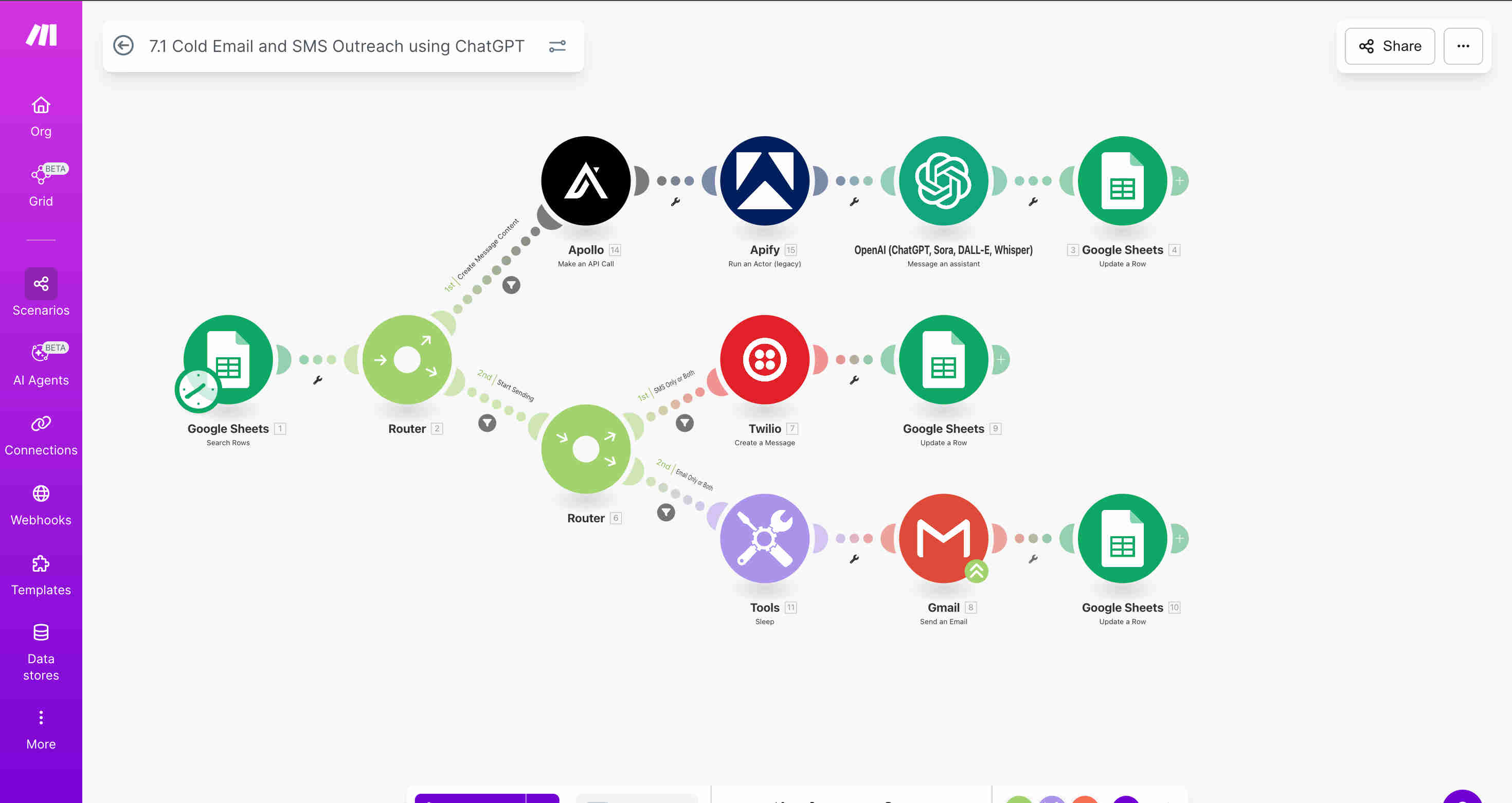
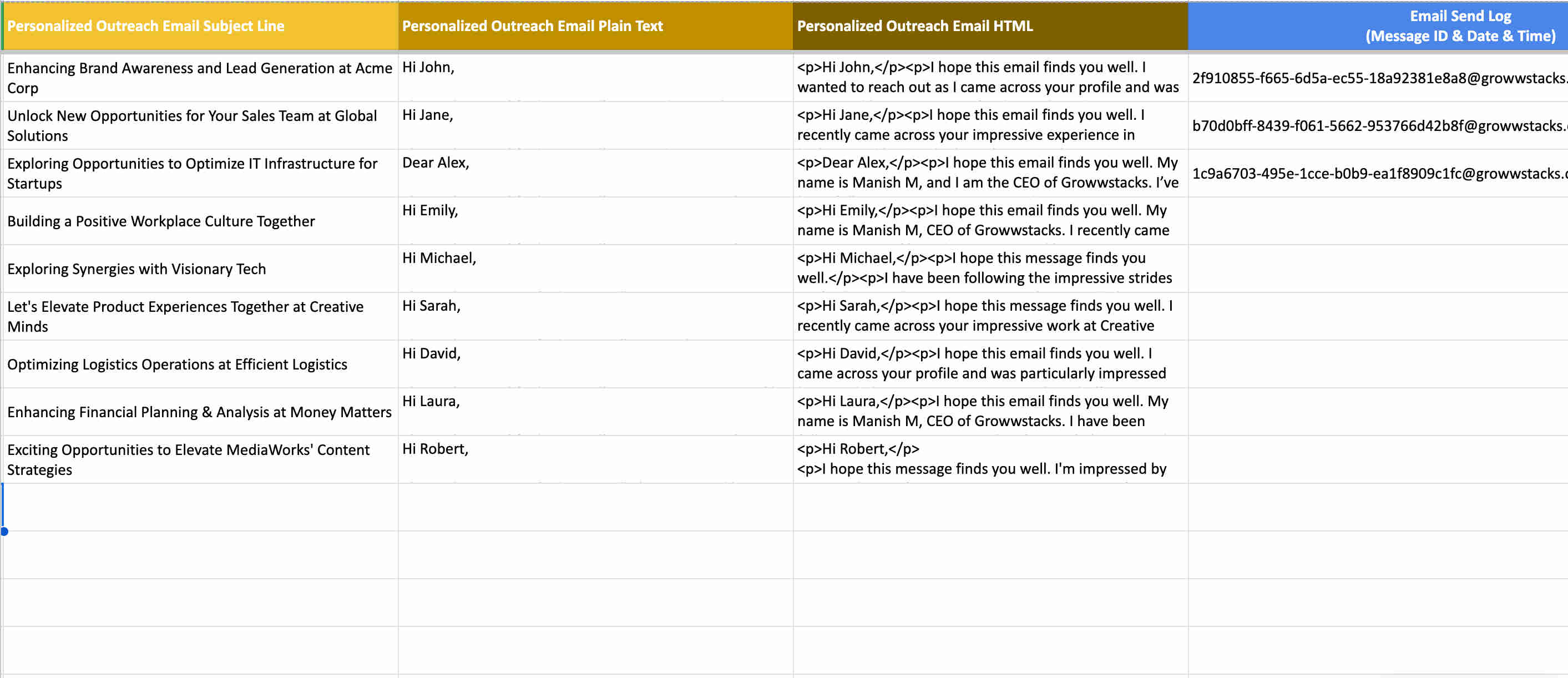
- Custom ChatGPT assistant content generation: The enriched prospect profile and industry classification are passed to the custom ChatGPT assistant with a generation prompt. The assistant has been trained during implementation on the client's specific offerings, key differentiators, customer success stories, and the specific value propositions most relevant to each industry vertical. The generation produces three outputs: an email subject line (crafted to be specific enough to signal personalisation, not a generic hook), a full email body (opening that references something specific about the prospect's company or industry, value proposition framed in the prospect's industry context, a relevant use case or outcome, and a low-friction call-to-action), and a concise SMS message (under 160 characters for single-segment delivery, personal in tone, with a clear CTA).
- Content storage and optional review: The three generated content pieces are written back to the prospect's Google Sheets row — subject line, email body, and SMS message each in their designated columns alongside the enrichment data that informed them. This creates a complete record of every outreach piece for review and compliance purposes. For teams that want a human quality checkpoint before delivery, a "Review Required" flag column can be set to pause automated delivery until a team member marks the row as approved. For teams comfortable with direct automation, the delivery step fires automatically.
- Simultaneous Gmail and Twilio delivery: The Make.com Gmail module sends the personalised email from the configured sender address with the generated subject line and body — properly formatted with the sender's signature and any relevant tracking parameters. Simultaneously, the Twilio SMS module sends the personalised SMS to the prospect's phone number from a configured sending number. Both delivery statuses are written back to the Google Sheets row — "Email Sent" and "SMS Sent" with timestamps — completing the outreach record for the prospect.
💡 What makes this personalisation genuinely different from mail-merge: Mail-merge personalisation inserts the prospect's name and company into a template — which every recipient immediately recognises as automation. The industry-classified ChatGPT personalisation in this system produces messages where the content itself — the specific pain point referenced, the use case highlighted, the ROI framing chosen — reflects the prospect's actual business environment. An IT director receives a message about reducing infrastructure overhead and improving team productivity. A startup founder receives a message about moving fast and scaling without proportional headcount growth. The same product, two completely different messages that each feel written for that specific person. That specificity is why the response rate improvement is 300% rather than marginal.
What This System Does That Manual Outreach Processes Can't
Automated Lead Enrichment
A dual-scraper architecture with Apollo extracting professional contact data and LinkedIn intelligence and Apify gathering company information and industry classification — building rich prospect profiles automatically from basic lead records. Provides the contextual intelligence that makes AI personalisation genuinely relevant rather than superficially name-tagged, without any manual research investment per prospect.
Industry-Specific AI Personalisation
A custom ChatGPT assistant trained on the client's offerings and value propositions generates industry-classified messages that reflect genuine understanding of the prospect's business environment — not just their name. IT professionals, startup founders, enterprise buyers, and other verticals each receive messaging framed around the specific concerns and opportunities most relevant to their context.
Multi-Channel Message Delivery
Simultaneously delivers personalised messages via Gmail email and Twilio SMS from a single automation — providing comprehensive multi-touch outreach coverage without separate workflows. Email establishes the detailed value case; SMS delivers an immediate, personal touch point. Both channels reinforce each other, producing the higher engagement rates that multi-channel campaigns consistently achieve over single-channel approaches.
Content Review System
All generated email and SMS content is stored back in Google Sheets before delivery — providing a quality review checkpoint for teams that want human oversight before automation fires. Maintains control over AI-generated content quality while preserving automation efficiency for approved messages, with the complete content record available for compliance, review, and performance analysis.
Scalable Outreach Volume
Processes unlimited prospect rows from Google Sheets maintaining the same personalisation quality regardless of volume — 50 leads or 5,000, each receiving the same enrichment, classification, and AI generation process. Eliminates the fundamental constraint that forces sales teams to choose between outreach scale and message quality, enabling both simultaneously.
Contextual Message Targeting
Industry classification ensures the correct value proposition, use case, and messaging tone is applied to each prospect automatically — without manual segmentation or separate campaign setup. IT prospects receive technology-specific messaging; startup founders see growth-oriented content; enterprise buyers receive ROI and risk-reduction framing. The targeting happens automatically from the enrichment data, not from manually curated prospect lists.
The System in Action
Before vs. After: What Changes When Personalisation Scales Automatically
Before: Sales reps spent 5+ hours daily manually researching prospects — opening LinkedIn profiles, reading company websites, identifying relevant industry context — and then writing individual personalised emails that incorporated that research. The practical ceiling was 50 prospects per day per rep, and even that volume required the full working day on research and writing with minimal time left for actual sales conversations. Response rates on this effort were moderate, because genuinely personalised messages at this volume are physically exhausting to maintain quality on. SMS outreach was essentially off the table because managing it manually alongside email was unworkable. No systematic record of outreach existed beyond sent email history.
After: Sales reps add leads to Google Sheets and return to find 500+ prospects enriched, classified, messaged with genuinely personalised email and SMS content, and delivered — all recorded in the same spreadsheet with delivery confirmation. The working day shifts from research and writing to responding to replies and advancing engaged conversations. Response rates improve by 300% because the messages are genuinely relevant rather than templated. Multi-channel coverage improves engagement further. And the sales team's entire capacity is redirected from prospecting mechanics to the relationship-building and closing conversations that only humans can have effectively.
Implementation: Live in 2 Weeks
- Lead database and scraper setup: The Google Sheets template is structured with input columns for basic lead data and output columns for enriched data fields, generated email subject, email body, SMS message, and delivery status. Apollo and Apify accounts are connected to Make.com with API credentials. Scraping accuracy is tested with a sample of 20–30 representative leads from the client's target prospect profile, and data mapping is validated — confirming the correct company and professional data fields are being extracted and mapped to the right columns.
- ChatGPT Assistant training: The custom GPT assistant is created with the client's product and service documentation, key value propositions per customer segment, customer success stories and outcome data, and the specific messaging frameworks that work best for each target industry vertical. Industry classification prompts are engineered to accurately categorise prospects from the enriched data — typically covering 4–8 industry verticals relevant to the client's target market. Email and SMS generation prompts are tested across all industry classifications with representative prospect profiles until output quality consistently meets the client's standards.
- Make.com workflow development: The complete scenario is built connecting Google Sheets row detection, dual scraper API calls, industry classification logic, ChatGPT assistant generation, Google Sheets content write-back, and Gmail and Twilio delivery modules. Conditional routing is added for the optional review checkpoint. Error handling is configured for scraping failures, ChatGPT generation issues, and delivery errors — with failed rows flagged in the status column rather than silently dropped. The complete workflow is tested end-to-end with 10–15 sample leads across different industries before production deployment.
- Multi-channel delivery configuration: The Gmail account is authenticated with proper sender permissions and a configured signature template. Twilio phone number provisioning is completed — selecting a number appropriate for the target market's geographic region. Delivery tracking is configured to write confirmed send status back to Google Sheets. Sending rate limits are set to respect Gmail and Twilio daily sending limits for the configured accounts. The complete production pipeline is tested with a small initial batch of real leads before full-volume deployment.
The Right Fit — and When It Isn't
This solution delivers maximum value for B2B sales teams, lead generation agencies, recruitment firms, business development representatives, marketing agencies, and any organisation conducting high-volume outreach to prospects across multiple industry verticals where the current bottleneck is the manual effort required to research and personalise each message rather than a shortage of leads to contact.
Two important compliance notes: email and SMS outreach is subject to regulations in most jurisdictions — CAN-SPAM, GDPR, CASL, and equivalent frameworks impose requirements on commercial messaging including unsubscribe mechanisms, sender identification, and consent requirements for certain contact types. The system generates and delivers messages but does not enforce compliance — the client is responsible for ensuring outreach lists meet the applicable consent and opt-out requirements for their target geographies. We discuss compliance requirements during discovery and can configure unsubscribe handling and consent flagging as part of the implementation for clients operating in regulated markets. Additionally, scraping quality for Apollo and Apify depends on data availability for the specific prospects in the target list — for less digitally-present companies or unusual industry verticals, enrichment completeness may be lower, which is calibrated during the testing phase.