
The Speed-to-Contact Gap That Kills Outbound Sales ROI
Sales research is unambiguous on one point: the time between a lead entering your pipeline and the first contact attempt is the single largest driver of conversion rate variance. A lead contacted within 5 minutes converts at rates dramatically higher than one contacted hours or days later — not because the product changed, but because the prospect's attention and intent did. Yet the typical outbound sales team operates on a manual process where a rep reviews the lead queue, prioritizes calls, dials, and leaves voicemails at some point during their working day — a process that builds in delays of hours or days by design.
The compounding problems are well-documented: 40–50% of leads are lost to slow response alone. Reps who do call face inconsistent quality — a rep at the end of a long day brings different energy than one at the start. Generic follow-up emails sent to every lead regardless of the conversation outcome waste the team's credibility with uninterested prospects. Manual CRM updates take hours weekly and are chronically incomplete. And as lead volume grows, the manual process doesn't scale — adding leads means adding headcount, which adds cost rather than efficiency.
Building the Sales Engine: Every Lead Called in Seconds, Every Outcome Handled Automatically
GrowwStacks engineered a complete outbound sales follow-up system across three coordinated Make.com scenarios, built around one non-negotiable design principle: every lead must be contacted within seconds of capture, and every conversation outcome must trigger the appropriate next action without human involvement. The system uses VAPI for the voice AI layer — selected for its natural conversational quality on sales discovery calls — and ChatGPT to analyze the post-call transcript and classify interest level, enabling intelligent routing that sends emails only to qualified prospects rather than broadcasting to every lead regardless of outcome.
Monday.com serves as the CRM backbone, providing the webhook trigger that fires the VAPI call and receiving status updates across every possible call disposition: not answered, answered and interested, answered and not interested. The result is a CRM that updates itself accurately on every lead without a rep ever opening it for data entry — while simultaneously routing qualified prospects to a personalized email follow-up that arrives while the conversation is still fresh.
From Lead Capture to CRM-Updated Outcome: The Complete Three-Scenario Flow
The system operates across three coordinated Make.com scenarios that together cover the complete lead follow-up lifecycle. Here's the full sequence across all three workflows:
- Scenario 1 — Lead scraping and database population: An automated scraping workflow retrieves new leads from the Outreach sales engagement platform. An iterator processes each lead individually, adding contact details — name, phone number, email, company name — to the Google Sheets lead database with an initial status flag that prevents duplicate processing on subsequent runs. This sheet serves as the staging area before CRM transfer.
- Scenario 2 — CRM transfer and call trigger: The second scenario reads leads from Google Sheets and transfers each one to Monday.com, creating a contact item with all extracted fields. The moment the Monday.com item is created, a webhook fires triggering the VAPI AI voice agent to place an outbound call to the lead's phone number — typically within seconds of the item creation. Google Sheets status is simultaneously updated to "called" to maintain synchronization across both databases.
- VAPI voice conversation: The VAPI AI agent conducts a natural sales discovery conversation — introducing the product or service, asking qualifying questions, and gauging the lead's interest and fit. The agent is configured during implementation with your specific sales script, objection handling responses, and qualification criteria. Every conversation is recorded and an end-of-call report generated, which triggers Scenario 3 via webhook.
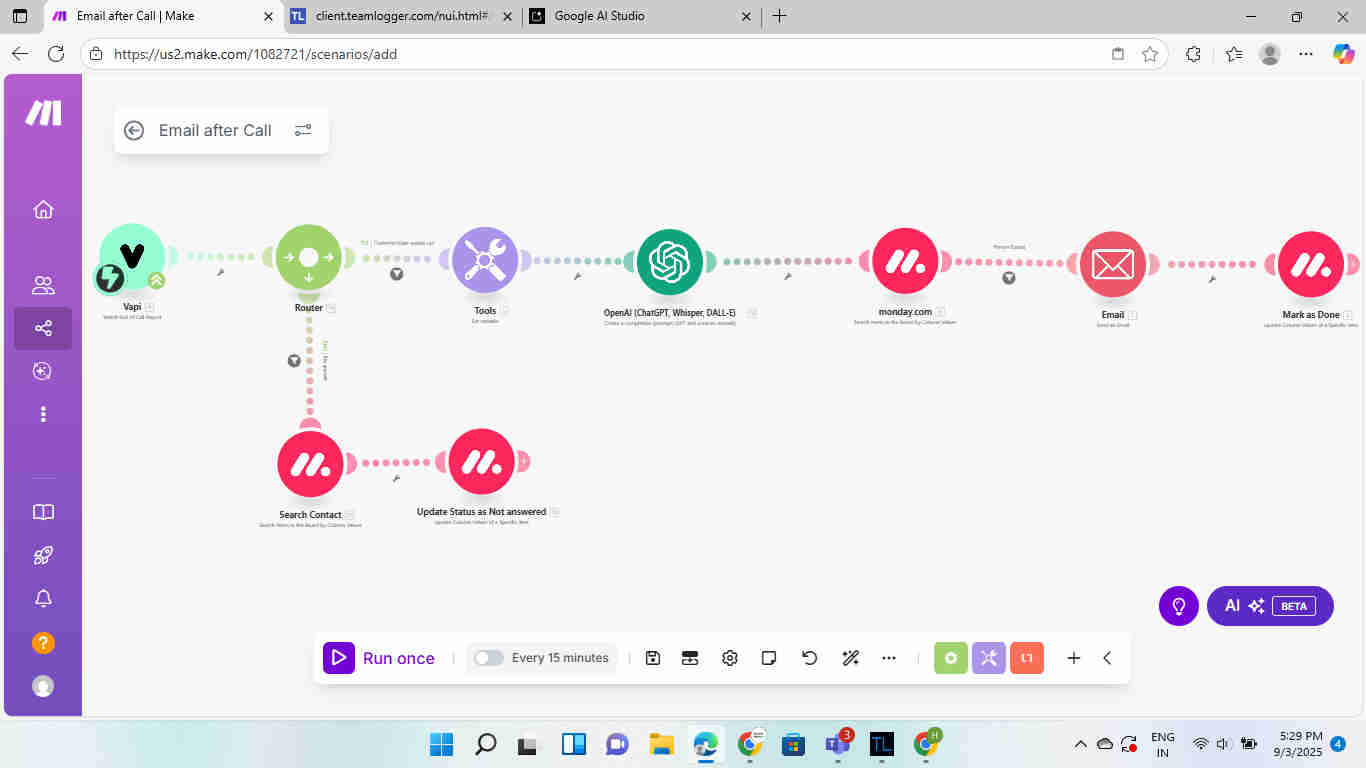
- Scenario 3 — Post-call analysis and routing: The end-of-call webhook from VAPI arrives at Make.com Scenario 3, containing the conversation outcome, transcript, and call disposition. A router module immediately branches into three distinct paths based on what happened during the call.
- Path A — Not answered: When the lead didn't pick up, the system searches the Monday.com contact item and updates the status field to "Not Answered." No email is sent. The CRM record is flagged for a human rep to schedule a retry attempt at a different time, with the call attempt logged for context.
- Path B — Answered and interested: When the lead answered and ChatGPT's transcript analysis determines they expressed genuine interest, two actions fire simultaneously: a personalized business opportunity email is sent via Gmail with a sales pitch tailored to the conversation context, and the Monday.com status is updated to "Interested" — flagging the lead as a priority for human rep engagement and detailed qualification follow-up.
- Path C — Answered and not interested: When the lead answered but ChatGPT determines they expressed no interest, the Monday.com status is updated to "Not Interested" and the workflow terminates without sending an email. This prevents the team from wasting follow-up effort or goodwill on prospects who have explicitly declined, and keeps the pipeline clean of leads that have already disqualified themselves.
.png?updatedAt=1768972660531)
💡 The routing logic that prevents wasted effort: The "Not Interested" path is as important as the "Interested" path. Without it, teams either send follow-up emails to every lead regardless of outcome (damaging deliverability and conversion rates) or rely on reps to manually review call transcripts before deciding whether to follow up — recreating the exact manual bottleneck the automation was built to eliminate. The three-path routing ensures every outcome receives the precisely appropriate response with zero human decision-making required.
What This System Does That a Manual Sales Team Can't
Instant Lead Calling
VAPI AI voice agent calls leads within seconds of Monday.com item creation — not hours or days later. The speed-to-contact improvement alone accounts for 50% more captured opportunities, since leads contacted within minutes convert at dramatically higher rates than those reached after the prospect's attention has moved elsewhere.
ChatGPT Interest Analysis
AI analyzes call transcripts automatically, classifying each conversation as interested or not interested without a human listening to a single recording. Eliminates manual call review entirely, enabling accurate qualification-based routing that improves follow-up efficiency and prevents effort waste on disqualified prospects.
Conditional Email Follow-Up
Personalized business opportunity emails are sent via Gmail only to leads classified as interested by ChatGPT analysis — never to uninterested contacts. This targeted approach improves email conversion rates by 35% and preserves sender reputation by eliminating the generic blast-to-all approach that erodes both deliverability and prospect trust.
Automatic CRM Status Updates
Monday.com status fields update automatically across every call disposition — not answered, interested, not interested — without manual CRM entry. Reps open their CRM and find an accurate, current picture of every lead's status without spending hours on data entry that's frequently incomplete or entered days after the actual call.
Multi-Scenario Orchestration
Three coordinated Make.com workflows handle lead scraping, CRM transfer with call triggering, and post-call analysis with conditional routing — each independently reliable and together covering the complete lead follow-up lifecycle. Complex multi-system coordination runs invisibly with proper data flow and status synchronization maintained automatically.
Unlimited Lead Scaling
The system handles 10 or 10,000 leads identically — VAPI places calls in parallel, Make.com processes webhooks at scale, and ChatGPT analyzes transcripts without queuing. Adding lead volume adds zero marginal headcount, fundamentally changing the economics of outbound sales by decoupling capacity from team size.
The System in Action
.png?updatedAt=1768972660744)

Before vs. After: The Outbound Sales Operation Transformation
Before: Sales teams manually called leads with delays of hours or days after capture, losing 40–50% of opportunities to slow response. Call quality varied by rep availability and energy. Generic follow-up emails went to every lead regardless of conversation outcome, diluting conversion rates and eroding sender reputation. CRM updates were entered manually — hours late, frequently incomplete, and a consistent source of pipeline reporting inaccuracy. Adding lead volume meant adding headcount, making scaling a cost decision rather than a system decision.
After: Every lead is called within seconds of capture by an AI voice agent that delivers a consistent, high-quality discovery conversation at any hour without fatigue or mood variance. Call outcomes are analyzed automatically and routed to the appropriate next action — interested leads receive a personalized email while the conversation is still fresh, not-interested leads are cleanly disqualified, not-answered leads are flagged for retry. Monday.com CRM updates itself accurately on every disposition without a rep touching it. Lead volume scales to any level without proportional headcount increases.
Implementation: Live in 8 Weeks
The system's three-scenario architecture, multi-platform integration, and conditional routing logic require a structured build process to reach reliable production performance at scale.
- Lead source integration: The Outreach platform API is connected to Make.com for automated lead scraping. The Google Sheets template is structured with columns for all contact fields and status tracking. The automated scraping schedule is configured and tested with sample leads to validate data completeness and field mapping accuracy before downstream integration is built.
- Monday.com CRM setup: The Monday.com board is designed with the client directory structure — contact items, phone, email, business name, and the status fields that will be updated by the automation across all three call disposition paths. The webhook that triggers when new items are created is configured and tested. Field mapping between Google Sheets and Monday.com is validated end-to-end.
- VAPI voice agent configuration: A phone number is provisioned and the AI agent is configured with your specific sales personality, discovery conversation flow, qualification questions, and objection handling responses. End-of-call reporting webhooks are established to trigger Scenario 3. Call quality and natural conversation flow are tested with sample conversations before any live leads are processed.
- ChatGPT interest analysis: Prompts are engineered to analyze VAPI call transcripts and classify interest level accurately. Email generation prompts are developed to produce personalized follow-up messages that reference the conversation context. Classification logic is tested across a range of simulated conversation outcomes — including edge cases like ambiguous responses — to ensure routing accuracy before production deployment.
- Multi-scenario assembly and deployment: All three scenarios are assembled with complete data flow, status synchronization between Google Sheets and Monday.com, router logic for all call disposition paths, Gmail integration, and comprehensive error handling. End-to-end testing simulates the full lead lifecycle from Outreach scraping through email delivery and CRM update. Production deployment includes monitoring dashboards tracking call success rates, interest classification accuracy, and email delivery confirmation.
The Right Fit — and When It Isn't
This solution delivers maximum ROI for B2B sales teams, lead generation agencies, real estate brokerages, financial services, insurance agencies, SaaS companies, and any organization running high-volume outbound lead calling where speed-to-contact directly affects conversion rates and manual follow-up processes are creating capacity constraints on growth.
One important consideration: VAPI voice AI is optimized for structured sales discovery conversations with clear qualification criteria. It performs best when the conversation has a defined flow — introduction, qualification questions, pitch, close for next step — and where leads are expected to engage in a phone conversation as part of the sales process. For industries where phone cold-calling is uncommon or where prospects require extensive technical pre-qualification before any conversation, a different initial outreach channel may be more effective. We assess your specific lead profile and industry norms during discovery to confirm this system is the right fit before scoping the build.