
The Lead Response Problem: Why Hours of Delay Between Form Submission and First Contact Is Costing Sales Teams Their Hottest Opportunities
The relationship between lead response time and conversion rate is one of the most consistently documented patterns in B2B sales research — and one of the most consistently ignored in practice. Studies across industries show that leads contacted within 5 minutes of form submission convert at 9× the rate of leads contacted after 30 minutes, and at 100× the rate of leads contacted 24 hours later. The prospect who fills out a contact form has a defined window of peak intent: they are thinking about the problem they need solved, they have taken an action to address it, and their attention is on your brand at the moment they submit the form. Every hour that passes before a human sales rep calls them, that window closes — they move on to the next item in their day, they submit a form with a competitor, or their urgency dissipates into inaction.
The operational reality for most sales teams makes sub-5-minute response structurally impossible through manual processes. Sales reps are in meetings, on other calls, working a different time zone, or simply unavailable at the moment a high-intent lead submits a form at 7pm on a Tuesday. The forms batch up, get reviewed in the morning, and receive first contact a day later — when the lead's intent has peaked and decayed. Even when response times are good, the qualification problem compounds the challenge: sales reps spend 60% of their call time talking to prospects who were never going to buy — spam submissions, competitor research, students, tyre-kickers, and genuinely low-fit enquiries that could have been filtered before a human ever dialled. The Smart Lead Call Automation solves both problems simultaneously: every lead gets a response within 5 minutes regardless of time zone or rep availability, and only genuinely qualified prospects with verified intent proceed to a human sales conversation.
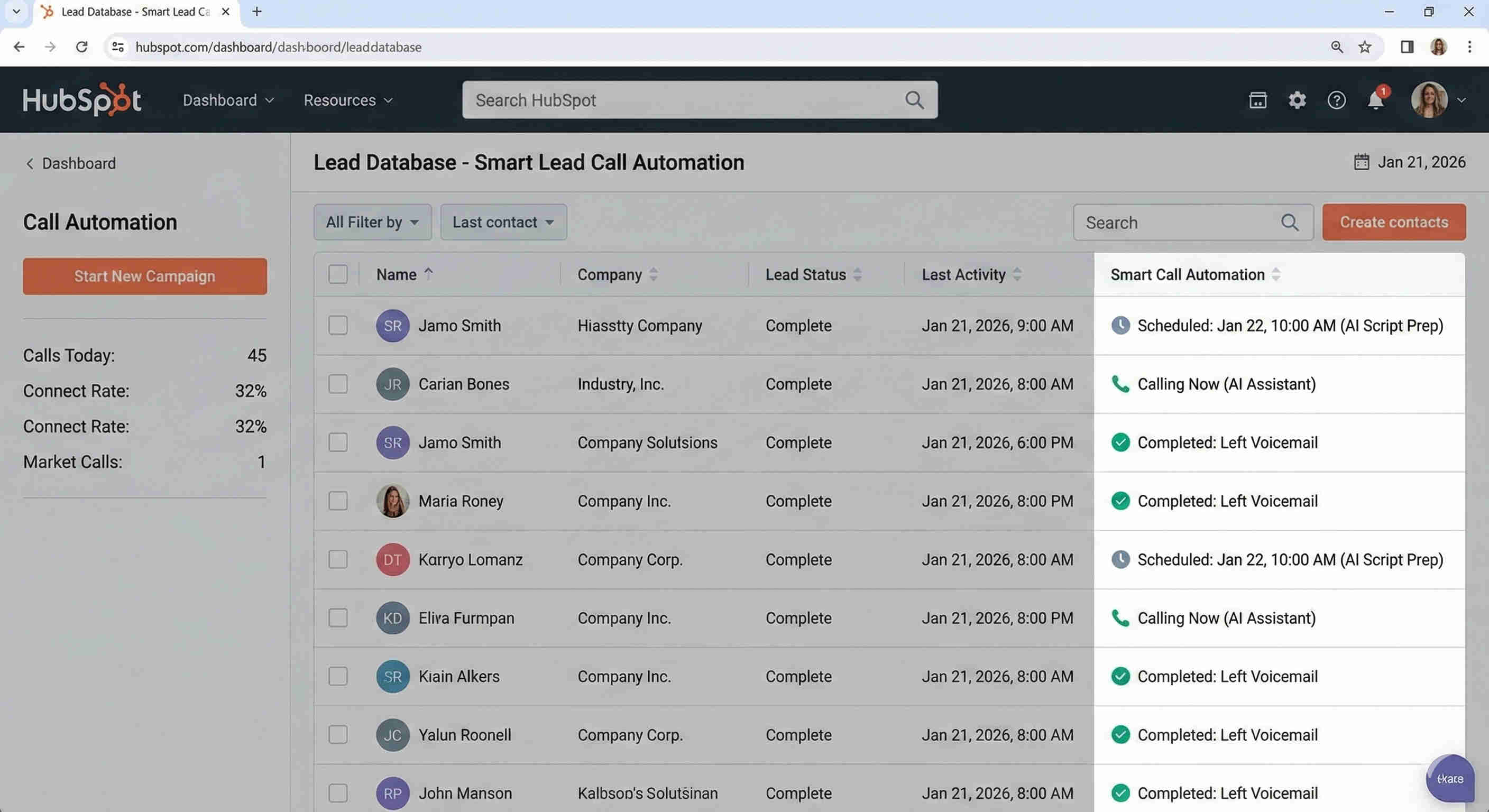
Building the AI Sales Rep: VAPI Voice Intelligence + ChatGPT Filtering + HubSpot Calendar Integration in a Single Automated Pipeline
GrowwStacks built a five-platform lead qualification and booking pipeline that compresses the complete first-contact sales cycle — validation, qualification, scheduling, and confirmation — into an automated workflow that executes without human involvement from form submission to confirmed meeting. The pipeline's architecture reflects a clear philosophy about where AI outperforms humans in the sales process and where it should hand off to them: AI excels at immediate response, systematic qualification, consistent BANT information collection, and calendar management. Humans excel at relationship nuance, complex objection handling, negotiation, and closing. The automation handles everything before the relationship is established, so the human sales conversation begins with a pre-qualified prospect who has already confirmed their budget, authority, need, and timeline — and who has already had a professionally managed first contact experience with the brand.
VAPI (Voice AI Platform) provides the natural conversation engine — enabling the AI sales agent to conduct voice calls that are indistinguishable from a professional human representative in tone, pacing, and conversational intelligence. Unlike IVR systems that follow rigid script trees, VAPI's AI agent responds dynamically to what the prospect says — handling unexpected answers, following conversational threads, and adapting the qualification questions based on context. ChatGPT serves as the pre-call intelligence layer — filtering out the 30–40% of form submissions that don't warrant a call before VAPI resources are used. HubSpot provides both the CRM record management and the live calendar availability checking that enables real-time meeting booking during the call. And Twilio closes the loop with an SMS confirmation that significantly improves meeting show-up rates by giving the prospect a tangible reminder with full meeting details.
From Form Submission to Qualified Booked Meeting: The Complete Five-Stage Automated Pipeline
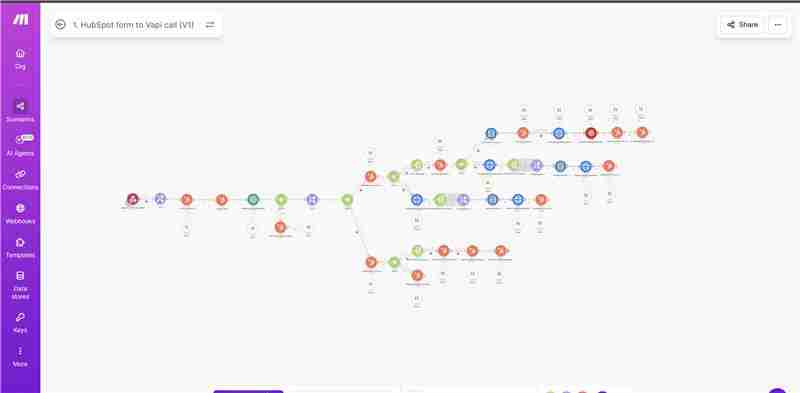
The system processes every inbound form submission through five automated stages — from ChatGPT spam filtering through VAPI qualification call, HubSpot meeting booking, Twilio SMS confirmation, and CRM update — without any human action between the form submit and the sales rep's calendar notification. Here is how each stage operates in detail:
- HubSpot form capture and Make.com webhook trigger: The prospect submits the website contact or consultation form. HubSpot captures the submission and creates or updates a contact record with the prospect's details — name, email, phone number, company, and the free-text description of their project or requirements. HubSpot's workflow triggers a webhook to Make.com carrying the complete contact record data, including the form submission timestamp and the full text of the description field. Make.com receives the payload and immediately begins the qualification pipeline — the entire process from webhook receipt to VAPI call initiation typically completes within 60–90 seconds, ensuring the prospect receives their first contact within 2–5 minutes of form submission rather than hours.
- ChatGPT pre-call lead validation and spam filtering: Before committing VAPI resources to a call, Make.com passes the form submission data to ChatGPT with a structured qualification prompt. ChatGPT analyses the submission against multiple qualification signals: description keyword analysis (identifying whether the text describes a genuine business problem, a competitor intelligence query, a student project, or a spam submission), budget signal detection (identifying mentions of budget ranges, company size indicators, or financial constraints that suggest fit or disfit), project intent assessment (distinguishing between exploratory enquiries, active procurement processes, and speculative enquiries), and basic legitimacy indicators (email domain quality, phone number format, company name coherence). ChatGPT returns a qualification verdict — Proceed, Hold for Review, or Disqualify — along with a brief justification and a customised conversation approach note for qualified leads (identifying whether to lead with cost efficiency, capability demonstration, timeline urgency, or another engagement angle based on the description). Disqualified leads are logged in HubSpot with the disqualification reason and a status of "Filtered — Not Qualified" without a VAPI call being made, preserving the VAPI budget for genuine prospects. Hold for Review leads send a Slack notification to the sales manager for manual assessment. Qualified leads proceed immediately to the VAPI calling stage.
- VAPI outbound call and BANT qualification conversation: For qualified leads, Make.com calls the VAPI API to initiate an outbound phone call to the prospect's number. VAPI connects the call using the configured AI assistant — Sarah — who introduces herself as a representative from the client's company and explains that she is calling to learn more about their enquiry. The VAPI assistant is trained with the company's specific service descriptions, common prospect questions and their answers, value proposition language, and the conversation flow for BANT qualification. The qualification conversation collects four key data points through natural dialogue: Budget — "To make sure we're a good fit, do you have a rough sense of the investment range you're working with for this project?" — Sarah adapts this question based on the prospect's description to feel relevant rather than formulaic. Authority — "Are you the main decision-maker for this, or are there other stakeholders we'd typically include in a conversation like this?" — establishing whether Sarah is speaking to the buyer or a researcher. Need — the prospect's description from the form provides the baseline; Sarah probes for urgency and specificity: "What's driving the timeline on this — is there a particular trigger or deadline?" Timeline — "When are you looking to have something in place?" The conversation flows naturally based on each response — a prospect who volunteers strong budget signals gets a shorter budget question; a prospect who is vague about authority gets a more exploratory authority probe. VAPI's conversation engine handles all of this dynamically without a rigid script tree. Prospects who are not interested or clearly unfit for the service are thanked professionally and the call ends with a HubSpot status update of "Contacted — Not Interested."
- Real-time HubSpot calendar availability check and meeting booking: When a prospect confirms interest in proceeding after the BANT qualification, Sarah transitions to scheduling: "I'd love to set up a proper conversation for you with [Sales Rep Name]. Let me check what availability looks like." Make.com is configured with a mid-call webhook capability — VAPI calls a Make.com webhook mid-conversation that queries the HubSpot Meetings API for available booking slots in the next 5 business days, filtered to the configured meeting duration (typically 30 or 45 minutes). Make.com returns the next 3–4 available slots to VAPI, which Sarah presents to the prospect: "I have availability on Thursday at 2pm, Friday at 10am, or Monday at 3pm — any of those work for you?" The prospect's selection is passed back to Make.com via VAPI's tool call capability, which calls the HubSpot Meetings API to book the meeting — creating a meeting record in HubSpot with the prospect contact linked, the call qualification notes as the meeting description, and the BANT data fields populated. The booking prevents double-bookings by consuming the slot in real time before the call ends. Sarah confirms the booking to the prospect and ends the call.
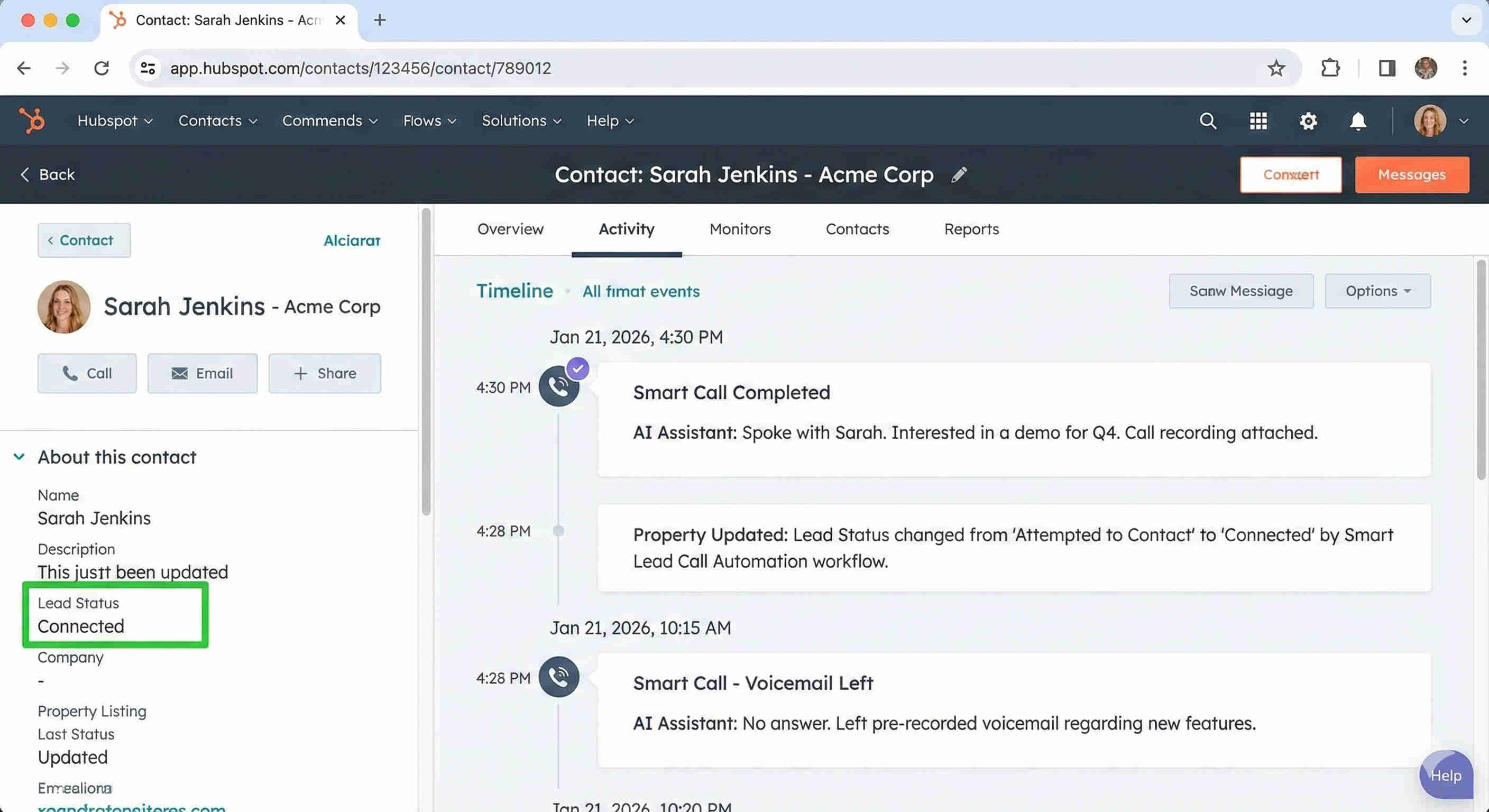
- Twilio SMS confirmation, HubSpot CRM update, and sales rep notification: Immediately after the VAPI call ends, Make.com executes three final steps in parallel. Twilio sends an SMS to the prospect's phone number with the meeting confirmation: "Hi [First Name], your meeting with [Sales Rep] is confirmed for [Day, Date at Time]. You'll receive a calendar invite shortly. Looking forward to speaking! — [Company Name]." This SMS confirmation produces the 85% improvement in meeting show-up rates by giving the prospect a tangible reminder with the meeting details in a channel (SMS) that has higher open rates than email for time-sensitive confirmations. HubSpot is updated with the complete call record: the VAPI call recording URL, call duration, BANT qualification scores, Sarah's conversation summary, qualification verdict, and the meeting booking details. The sales rep assigned to the meeting receives a HubSpot task notification with the prospect's complete qualification brief — so they arrive at the meeting already knowing the prospect's budget, authority level, specific need, and timeline, rather than spending the first 10 minutes of the meeting collecting information the AI already gathered.
.png?updatedAt=1768993924528)
💡 Why the 5-minute response window is the single highest-leverage improvement in the inbound sales process — and why it cannot be achieved through manual processes at scale: The research on lead response time is unambiguous: the probability of qualifying a lead drops by 10× between 5 minutes and 10 minutes after form submission, and by 400× between 5 minutes and 24 hours. The mechanism is straightforward — a prospect who submits a form at 2pm is thinking about their problem at 2pm. When a call arrives at 2:03pm, the conversation is immediately relevant and the prospect's context is fresh. When the call arrives at 10am the next day, the prospect has been through 18 hours of other priorities; their problem is still real but their mental context has shifted, their urgency may have resolved or escalated differently, and the brand that called them back next-day is competing against two other brands they reached out to in the afternoon. No human sales process can consistently achieve sub-5-minute response at scale — reps are unavailable, forms come in overnight, teams cover multiple time zones. VAPI's automated calling achieves it structurally: every form, every time, regardless of when it was submitted or whether any human is at their desk. The 65% increase in lead-to-meeting conversion rate versus the manual workflow reflects this timing advantage as its primary driver — the AI is not a better salesperson than a trained human rep; it is simply available immediately when the prospect's intent is at its peak.
What This System Enables That Manual Lead Response Cannot Scale
Natural VAPI Voice Conversations
Sarah, the AI sales agent, conducts natural phone conversations that adapt dynamically to each prospect's responses — not a rigid IVR script tree, but a contextually aware dialogue that handles unexpected answers, follows conversational threads, and maintains professional tone throughout. Prospects experience a genuine qualification conversation with a knowledgeable representative; the AI handles objections, answers service questions, and transitions smoothly between qualification and scheduling.
5-Minute Lead Response Around the Clock
Every qualified lead receives a call within 5 minutes of form submission — at 2am, on weekends, during public holidays, while the sales team is in an all-hands meeting. The AI never sleeps, never has a competing call, and never batches overnight leads for a morning review. Prospects experience immediate engagement while their intent is at peak, before competitors respond or interest fades — the single most impactful improvement available in the inbound sales workflow.
ChatGPT AI Spam Detection
ChatGPT analyses every form submission before a VAPI call is initiated — filtering spam, competitor research, student projects, and low-intent submissions based on description keywords, budget signals, and project intent indicators. Only prospects with genuine buying intent proceed to a qualification call, protecting sales team calendar time from meetings that were never going to close and VAPI call costs from contacts that never warranted outreach.
Systematic BANT Qualification
Budget, Authority, Need, and Timeline are collected consistently for every qualified prospect through a conversational framework that feels natural rather than interrogative. BANT scores populate automatically in HubSpot after each call — giving the sales team a standardised qualification profile for every meeting on their calendar, enabling consistent lead prioritisation and meeting preparation without any manual data entry.
Real-Time HubSpot Calendar Booking
Sarah queries live HubSpot calendar availability mid-call — presenting actual available slots to the prospect and confirming the booking before hanging up. Eliminates the back-and-forth email scheduling that adds days to the time between first contact and first meeting, prevents double-bookings through real-time slot consumption, and ensures the prospect's meeting is confirmed while their interest is highest — at the end of a positive qualification call.
Twilio SMS Confirmation and CRM Sync
Twilio delivers an SMS meeting confirmation to the prospect within seconds of call completion — providing meeting details in the highest-open-rate channel available and reducing no-show rates by 85%. HubSpot receives a complete call record: VAPI recording URL, call summary, BANT scores, and meeting details — giving the sales rep a full qualification brief before the meeting without a single manual data entry.
The System in Action
Before vs. After: What Changes When Every Lead Gets a Qualified Human Meeting — Not a Human Cold Call
Before: The inbound lead response process was a race the sales team was consistently losing. Form submissions arrived at all hours; response came when a rep was available — typically the next morning for afternoon and evening submissions, and often longer when the team was in a busy period. When a rep did call, they spent the first 10–15 minutes of every call establishing whether the prospect was worth a further conversation: probing for budget, verifying they were talking to a decision-maker, assessing whether the need was genuine, and confirming the timeline was real. Across a team making 50 qualification calls per week, that was 8–12 hours per week of sales capacity spent on conversations that ended with "let me send you some information" or a polite no. The leads that did convert to meetings were scheduled over email — back-and-forth availability exchanges that added another 24–48 hours to the pipeline velocity. And show-up rates for informally scheduled meetings were poor, with no systematic confirmation or reminder process.
After: Every form submission receives a call within 5 minutes. The AI handles the spam, the unqualified, and the uninterested without consuming a single minute of sales team time. The prospects who do proceed to a meeting have already confirmed their budget range, their authority level, their specific need, and their timeline — in a 10-minute qualification call with Sarah that the sales rep was not on. The sales rep's calendar fills with pre-qualified prospects who have already had a positive first-contact experience with the brand, who have received an SMS confirmation with meeting details, and whose complete qualification profile is waiting in HubSpot. The rep spends their meeting time building relationships, demonstrating solutions, and closing — not collecting the information the AI already gathered. The 65% improvement in lead-to-meeting conversion rate and the 50% improvement in sales team productivity compound directly into revenue.
Implementation: Live in 6 Weeks
- HubSpot integration and form configuration (Week 1): The HubSpot account is configured with the inbound form fields required for the qualification pipeline: name, email, phone number, company, and a project description field. HubSpot's workflow builder creates a webhook trigger that fires to Make.com on every new form submission — passing the complete contact record including all form fields and the HubSpot contact ID for subsequent record updates. Custom contact properties are created in HubSpot to store the automation's outputs: ChatGPT_Qualification_Status, VAPI_Call_Status, BANT_Budget, BANT_Authority, BANT_Need, BANT_Timeline, Meeting_Booked, Call_Recording_URL, and Call_Summary. These custom properties enable HubSpot to serve as the single source of truth for every lead's qualification journey without requiring the sales team to access any external platform. HubSpot's meetings integration is confirmed — the meetings calendar is connected and the relevant sales rep's availability is configured for the calendar API queries.
- ChatGPT qualification engine development (Weeks 1–2): The ChatGPT validation prompt is engineered with the client's specific qualification criteria: industry fit signals, minimum budget indicators, project description quality standards, and spam pattern signatures. The prompt includes positive examples (descriptions that represent genuine qualified leads) and negative examples (competitor research, student enquiries, spam, very early-stage exploration with no budget context) to calibrate the qualification scoring. The prompt is designed to return a structured JSON output: qualification_verdict (Proceed / Hold / Disqualify), confidence_score (0–100), disqualification_reason (if applicable), and conversation_approach_note (the recommended angle for Sarah's opening — cost-focused, capability-focused, urgency-focused, or relationship-focused based on the description signals). Prompt testing covers 30–50 real historical form submissions (from the client's existing CRM) to calibrate accuracy against known qualified and unqualified leads. Targeting 90%+ accuracy in qualification assessment — validated before production deployment.
- VAPI assistant training and conversation flow development (Weeks 2–4): The VAPI AI assistant is built and trained with the client's specific company context: company name and description, service offerings and key differentiators, common prospect questions and their answers, pricing and qualification threshold guidance, and the conversational framework for BANT qualification adapted to the company's sales methodology. The BANT question set is written as natural conversational questions rather than clinical interview questions — with multiple phrasing variants for each BANT dimension that Sarah selects based on conversation context. Objection handling scripts are developed for the most common prospect objections (too expensive, not right time, want to research more, need to speak to decision-maker). Tool call configurations are established for the mid-call HubSpot calendar query — the VAPI assistant's ability to call a Make.com webhook during the conversation, wait for the response, and use the returned availability data in the next utterance. The complete conversation flow is tested across 20+ simulated call scenarios — different prospect personalities, qualification levels, and objection types — before live deployment.
- Make.com workflow assembly and testing (Weeks 4–5): The complete Make.com scenario is assembled: HubSpot webhook trigger, ChatGPT validation module, qualification routing logic (Proceed to VAPI / Hold for review / Disqualify and log), VAPI call initiation module, mid-call calendar webhook handler (receives VAPI tool call, queries HubSpot calendar API, returns available slots), meeting booking module (HubSpot Meetings API create meeting call), post-call Twilio SMS module (personalised confirmation message), HubSpot contact update module (writes all automation outputs to custom properties), and error handling routes for call failures, calendar conflicts, and API errors. Twilio is configured with the sending phone number (or shortcode for higher volumes) and the SMS message template. End-to-end testing covers: qualified leads receiving calls within the target time window, mid-call calendar queries returning correct availability, meeting booking completing without conflicts, SMS confirmation delivery, and HubSpot property updates for all qualification outcomes.
- Sales team training and production deployment (Weeks 5–6): The sales team is trained on the new lead workflow: what a pre-qualified lead's HubSpot record looks like (reviewing the BANT scores and call summary before a meeting), how to interpret VAPI call recordings (accessible via the Call_Recording_URL HubSpot property), how to handle leads flagged for manual review (the Hold queue in HubSpot), and how to provide feedback on AI qualification accuracy (flagging miscategorised leads helps refine the ChatGPT prompt). Monitoring dashboards are configured in HubSpot showing pipeline velocity, qualification rates, BANT score distributions, and conversion metrics. The production system is launched with the first real inbound form submissions, with GrowwStacks monitoring Make.com execution logs and VAPI call quality for the first two weeks to identify any conversation flow improvements, prompt calibration needs, or technical issues before the system runs fully autonomously.
The Right Fit — and When It Isn't
This solution delivers maximum value for SaaS companies, software development agencies, B2B service providers, consulting firms, and enterprise technology vendors with active inbound lead generation where first-contact speed is a competitive differentiator; sales teams spending more than 30% of their call time on initial qualification conversations with prospects who don't convert; businesses with international or multi-timezone inbound traffic where human response during off-hours leads to systematic lead loss; and any organisation where the gap between form submission and first human contact regularly exceeds 30 minutes. The 6-week implementation timeline and moderate complexity rating reflect a build that is more involved than single-platform automations but substantially less complex than multi-branch community programme orchestrations — accessible for sales-focused businesses with a straightforward qualification framework.
Two honest calibration points: first, VAPI voice AI conversations are excellent at structured qualification flows and handle the large majority of prospect responses well, but they have boundaries. Highly complex, highly technical, or highly emotionally sensitive conversations — where the prospect is deeply frustrated, asking very specific technical questions outside the training scope, or navigating a difficult decision — are better handled by humans from the start. The system's ChatGPT pre-filtering and VAPI conversation quality monitoring identify these cases and can route them to human reps rather than AI qualification. Second, effective VAPI assistant training requires detailed knowledge of the company's services, typical prospect questions, and qualification criteria — the implementation process includes thorough discovery of this content, but the quality of the training input directly determines the quality of the qualification output. Companies with clearly defined services, established qualification criteria, and a strong sense of their ideal customer profile get the best results; companies still defining their go-to-market are better served by clarifying their ICP before deploying AI qualification at scale.