
The Problem: The Blind Spots of Manual Quality Assurance in Customer Operations
For multi-location service brands and customer relations teams, phone-based interactions represent the front line of brand reputation. However, a major operator managing customer calls across 7 distinct business locations or departments was drowning in manual call audits. Hundreds of booking requests, service inquiries, and support calls flowed through their GoTo VoIP system every single day. Managers could only spot-audit less than 10% of calls by hand, days late, leaving the vast majority of agent behavior unreviewed.
This manual gap created major vulnerabilities. Agents often missed standard script checkpoints (like asking for contact details or making promotional offers), which directly impacted customer conversion and retention. Crucially, customers frequently spoke credit card and CVV details aloud. These details sat unredacted inside call recordings, presenting a severe **PCI compliance and security risk**. Lastly, unanswered calls and voicemails were mixed in with actual conversations, cluttering logs and distorting performance metrics.
The Solution: Nightly Automatic Call Ingestion & AI Audits
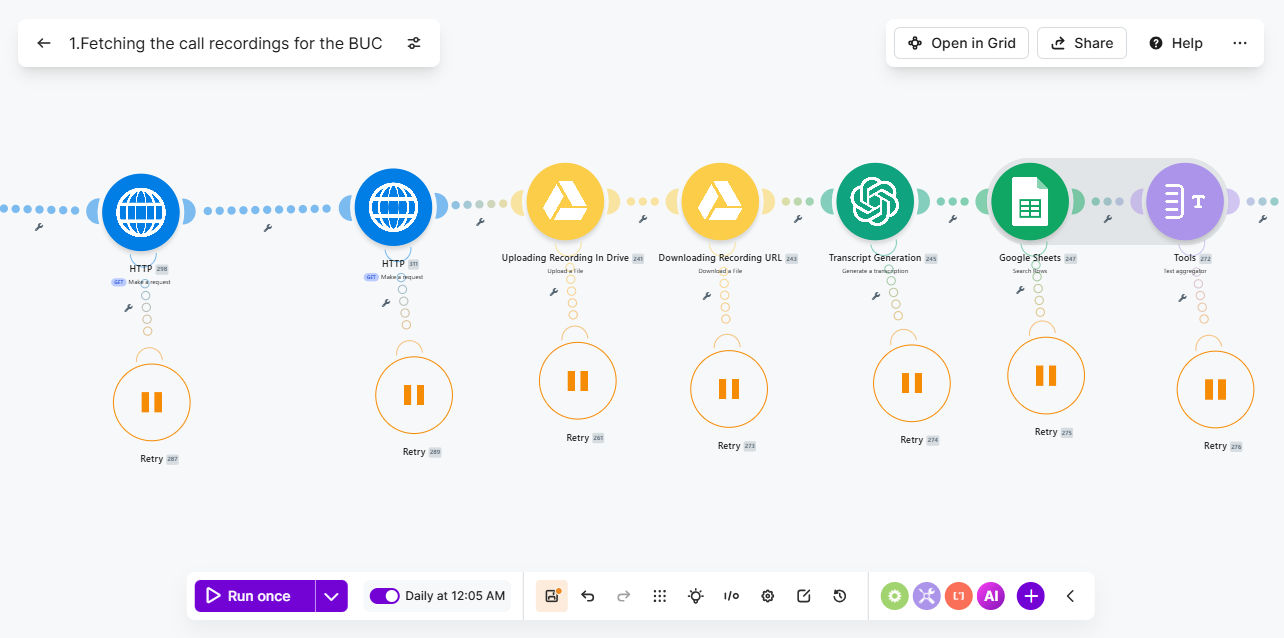
GrowwStacks engineered a nightly two-scenario Make.com pipeline that runs at 12:05 AM to automate the entire QA workflow. Scenario 1 retrieves the previous day's recordings from GoTo, isolates answered calls from voicemails, redacts spoken card details, uploads raw files to Google Drive, transcribes them with OpenAI Whisper, and scores script adherence using GPT-4 against a 5-point rubric. Results are written to a master Google Sheet separated by location-specific tabs.
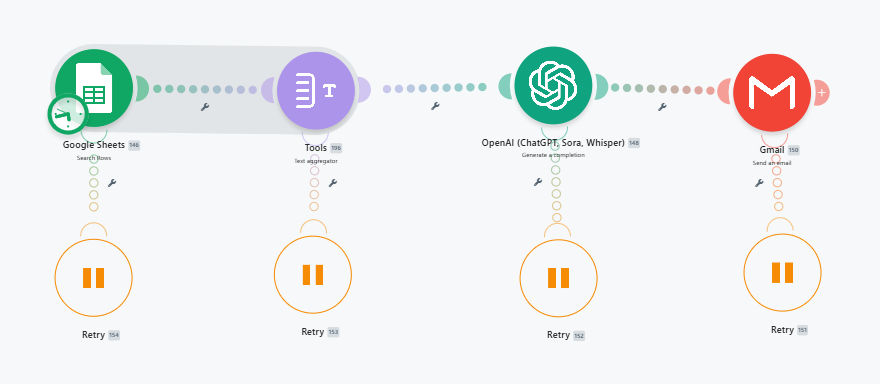
Exactly 30 minutes after Scenario 1 concludes, Scenario 2 triggers. It aggregates the audit metrics for the day and sends operations managers a daily recap email detailing calls audited, average performance scores, and compliance flags. This ensures managers wake up to a complete call quality summary without opening a single dashboard.

How It Works — Step-by-Step AI Call Audits
The system uses two interconnected scenarios to fetch, analyze, score, log, and report call quality automatically:
- GoTo Audio Retrieval: Scenario 1 runs nightly at 12:05 AM, pulling GoTo recordings, filtering out call connections under 15 seconds, and isolating voicemails.
- PCI CC Redaction: The audio file is scanned to identify spoken credit card numbers and CVV codes, which are redacted from the recording file and subsequent transcripts.
- OpenAI Whisper Transcription: The redacted audio is sent to OpenAI Whisper to generate high-accuracy transcripts of the customer-agent dialogue.
- Fuzzy Agent Roster Matching: The workflow extracts the speaking agent's name. If an agent mispronounces their name, uses a nickname, or if Whisper misspells it, the system runs fuzzy-matching algorithms against a location-specific roster database to ensure the correct agent gets credited.
- GPT-4 Rubric Scoring: GPT-4 evaluates the transcript against a five-point rubric:
- Opening: Professional greeting and branding.
- Information Gathering: Collecting contact details and customer needs.
- Offer: Presenting rates, promo offers, and booking or service options.
- Closing: Clear next steps and polite wrap-up.
- Total Score: A compiled audit score out of 100.
- Multi-Location Sheet Logging: Results, scores, flag triggers (e.g., missed script items), transcript summaries, and Google Drive audio links are written to the master spreadsheet.

Daily Manager Summaries & Dashboard Tabs
Every morning at 12:35 AM (thirty minutes after Scenario 1 finishes), Scenario 2 collects yesterday's metrics from all locations. It formats a clean, responsive summary email for each manager listing: total calls handled, audited count, compliance flags raised, and average scores. This email lands in inboxes by 7:00 AM, allowing managers to inspect call quality metrics immediately as their workday starts.
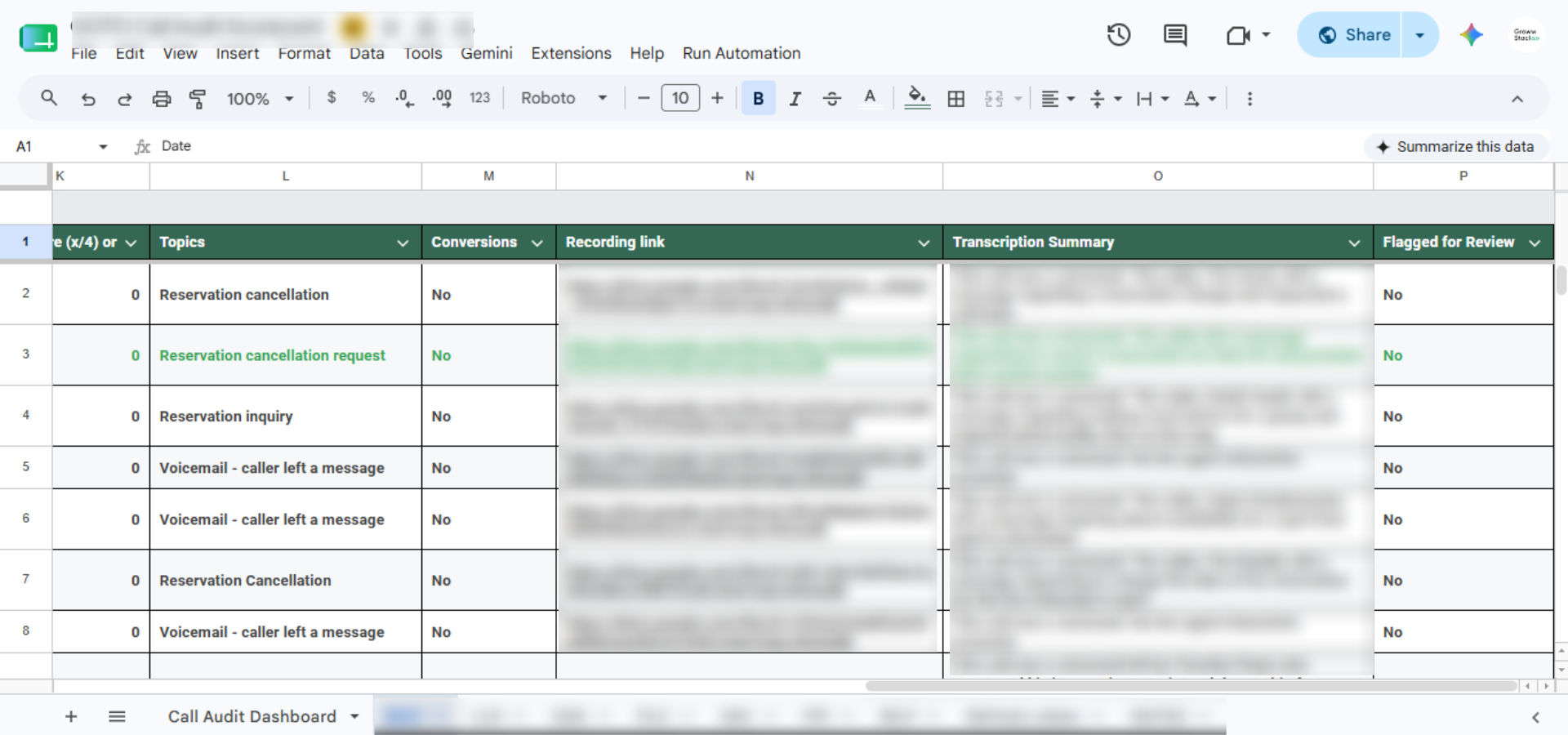
All data is logged to a centralized Google Sheet. Individual tabs organize data for each of the 7 locations (BUC, LLR, OAK, PLC, VAC, PIP, WLP), while a unified Call Audit Dashboard tab tracks high-level conversion flags, call topics, average agent scores, and includes direct links to transcripts and audio files.
💡 Unified Operations: Managing all 7 locations under a single, centralized Make.com pipeline dramatically simplified maintenance, lowered API usage costs, and provided executive management a single source of truth for company-wide customer relations.
What This System Does That Manual Process Can't
Automatic PCI Redaction
Scans and redacts credit card and CVV details from voice files and transcripts, eliminating manual security risks.
Fuzzy Roster Matching
Resolves short names and pronunciations against active rosters, assigning audits to correct profiles automatically.
Multi-Location Dashboard
Centralizes metrics across 7 locations or branches into individual tabs and a unified dashboard, showing portfolio-wide trends.
Consistent AI Rubric
Applies the exact same objective scoring standards to all transcripts, eliminating subjective auditor bias.
Inbox Delivery by 7 AM
Delivers clean, actionable summaries directly to manager inboxes daily, saving hours of manual data hunting.
100% Audio Audits
Ensures that every answered customer call is analyzed, not just a small spot-audited subset.
Before vs. After: Company-Wide Quality Control & Compliance
Before: Managers manually reviewed fewer than 10% of customer calls. Compliance issues went unnoticed, credit card data remained unredacted in audio logs, and reports were delayed by days.
After: 100% of customer calls are audited nightly. Spoken credit card details are automatically redacted, scores are updated in a central Google Sheet, and managers get inbox recaps by 7:00 AM — saving hours of admin work.
Implementation: Live in 3 Weeks
- VoIP Connection: Configured webhook connection with GoTo developer portal to fetch daily call audio.
- Redaction Rules: Designed audio-scanning scripts to identify and redact credit card strings.
- Whisper Integration: Connected OpenAI Whisper to transcribe the redacted call audio.
- Rubric Prompting: Structured and tested GPT-4 prompts to score transcripts according to customized compliance rubrics.
- Report Scheduling: Built Scenario 2 to collect, format, and email performance summaries.
The Right Fit — and When It Isn't
This solution is perfect for call centers, retail chains, medical networks, service agencies, and customer relations teams handling high call volumes across multiple locations or departments. It guarantees compliance and script tracking without human overhead.
However, it may not be necessary for teams receiving fewer than 10 calls a day where manual quality reviews are quick. Additionally, highly custom call center environments that require real-time, in-call alerts should use live coaching tools instead of nightly post-call audits.