Finance & Banking Voice AI Loan Processing Workflow Automation

AI-Powered Finance & Loan Application Automation System

Meet Anna — a voice AI that handles complete loan applications in a single phone call, replacing weeks of paperwork with minutes of conversation. Deployed for financial institutions processing 50–500+ applications monthly — delivering 85% faster processing and $500K+ in annual operational savings.

AI Finance & Loan Automation System
85%
Faster loan processing — weeks reduced to minutes
300%
More completed applications — near-zero abandonment
$500K+
Annual savings in labor & processing costs
700%
ROI on implementation investment

The Hidden Cost Nobody Talks About

Imagine this: a potential borrower calls your institution on a Tuesday evening, ready to apply for a $40,000 home improvement loan. They get voicemail. They don't call back. That application — and the relationship — is gone forever. This scenario plays out hundreds of times a month at mid-size banks and credit unions, and nobody measures it because abandoned intent leaves no paper trail.

But the friction doesn't stop at after-hours calls. Even during business hours, the traditional loan application process is a customer experience obstacle course. Applicants face callback queues, multi-session paperwork, manual data entry by staff, and verification loops that stretch a simple conversation into a 2–3 week ordeal. Industry benchmarks suggest 40–60% of applications never complete — not because the borrower wasn't qualified, but because the process wore them down.
AI Voice Assistant Anna dashboard showing live loan application processing with real-time status and call metrics
Anna's dashboard — real-time visibility into every active application call, completion rate, and CRM sync status

Building Anna: A Voice AI That Closes Applications, Not Just Takes Messages

GrowwStacks engineered a complete voice AI ecosystem built around one principle: the entire loan application should complete in a single phone call. We chose VAPI as the conversational voice engine for its natural speech handling and context retention across multi-turn financial dialogues — capabilities we tested against three other platforms before committing. For workflow orchestration, n8n gave us the flexibility to build complex conditional routing that Make.com couldn't handle at the required data throughput.

The result is Anna — an AI voice assistant that conducts fully compliant loan application conversations, verifies applicant data in real-time, synchronizes every field to your CRM as the call progresses, and routes completed applications to the right approval queue the moment the conversation ends. No callbacks. No paperwork. No data re-entry.

📞
Incoming Call
Twilio routes to VAPI 24/7
🗣️
Anna (VAPI)
Natural voice conversation + data collection
🤖
ChatGPT Intelligence
Eligibility scoring + completeness check
n8n Orchestration
Validate, sync CRM, route decision
✓ Auto-Approved
👤 Human Review

From First Ring to CRM Record: How Anna Processes a Loan

The system works across four tightly integrated phases. Here's what happens from the moment an applicant calls:

  1. Call capture and routing: Twilio handles the telephony infrastructure and routes the call to VAPI's voice engine. Anna answers within 2 seconds with a natural greeting, identifying itself as the institution's loan application assistant.
  2. Guided data collection: Anna conducts an adaptive conversation — collecting personal details, employment status, financial information, and loan requirements in a natural dialogue flow. ChatGPT-4 powers the contextual understanding, allowing Anna to handle unexpected responses, clarify ambiguous answers, and maintain compliance disclosures throughout.
  3. Real-time verification: As information is collected, n8n queries Airtable to check against existing customer records. If the caller is an existing customer, Anna acknowledges it and pre-fills known fields. Eligibility criteria are checked mid-conversation — not after.
  4. CRM synchronization: Every collected field syncs to HubSpot or Salesforce in real-time as the conversation progresses. When the call ends, the CRM record is complete — no staff data entry required.
  5. Intelligent routing: n8n evaluates application completeness and approval likelihood using predefined scoring logic. Qualifying applications route directly to the auto-approval path. Others go to the appropriate review queue, ranked by priority score.
  6. Audit trail creation: The full conversation recording, transcript, collected data, and compliance disclosure acknowledgments are automatically archived — meeting financial regulatory requirements from day one.
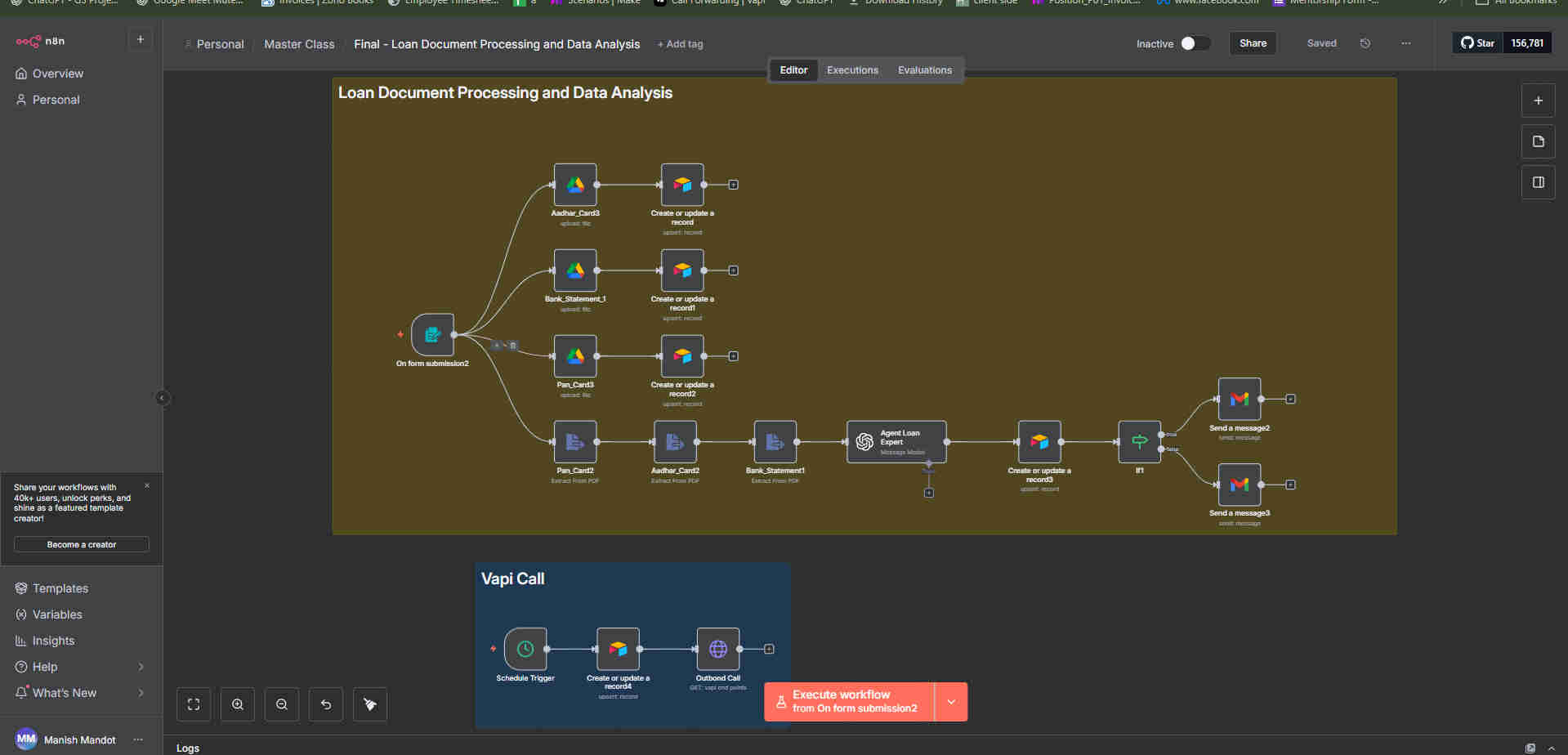
n8n workflow automation setup showing loan application routing logic with conditional branches and CRM integration nodes
The n8n automation backbone — conditional routing logic that handles data validation, CRM sync, compliance archiving, and approval queue distribution in a single workflow

💡 The counterintuitive finding: The biggest ROI driver wasn't labor cost reduction — it was capturing the 40–60% of applications that previously abandoned mid-process. Recovering even half of that lost volume more than doubles application throughput without hiring a single additional loan officer.

What Anna Does That Your Current Process Can't

🗣️

Context-Aware Voice Conversations

Anna adapts in real-time based on applicant responses — handling off-script answers, clarifying ambiguous information, and adjusting conversation flow for different loan types without breaking natural dialogue.

Mid-Conversation Data Verification

Rather than validating after the call, the system cross-references existing customer records, eligibility criteria, and application completeness during the conversation itself — flagging issues before they become rejections.

🔄

Live CRM Synchronization

Every field populates your Salesforce or HubSpot record as the conversation unfolds. Loan officers open the CRM after the call and find a complete, verified application — not a note to call back.

📊

Priority-Based Application Routing

AI-scored applications route to the appropriate queue automatically — high-value or auto-qualify applications fast-tracked, complex cases directed to senior officers, incomplete applications flagged for follow-up.

🔒

Compliance-Native Architecture

Required regulatory disclosures are built into every conversation path. Consent is captured verbally and logged. Complete audit trails with recordings and transcripts meet financial industry compliance standards from day one.

🕒

24/7 Unlimited Capacity

Anna handles unlimited simultaneous calls at any hour without staffing constraints. Tuesday night loan inquiries become completed applications in the CRM by Wednesday morning — without a single overtime dollar.

The Technical Architecture

This system runs on five integrated platforms, each chosen for a specific reason. We chose VAPI over Bland.ai and Retell for its superior context retention across 10+ turn financial conversations — critical when an applicant asks to revisit a previous answer. n8n was selected over Make.com because the application routing logic required webhook-level data throughput that Make.com's operation limits couldn't support at production volumes.

Airtable serves as the central loan database — not just storage, but the real-time validation layer. Every field has defined validation rules and field-level error flags that VAPI can query mid-conversation. This is what enables Anna to say "I notice you mentioned a different employer earlier — can you confirm the correct one?" rather than waiting for a post-call review to catch the discrepancy.
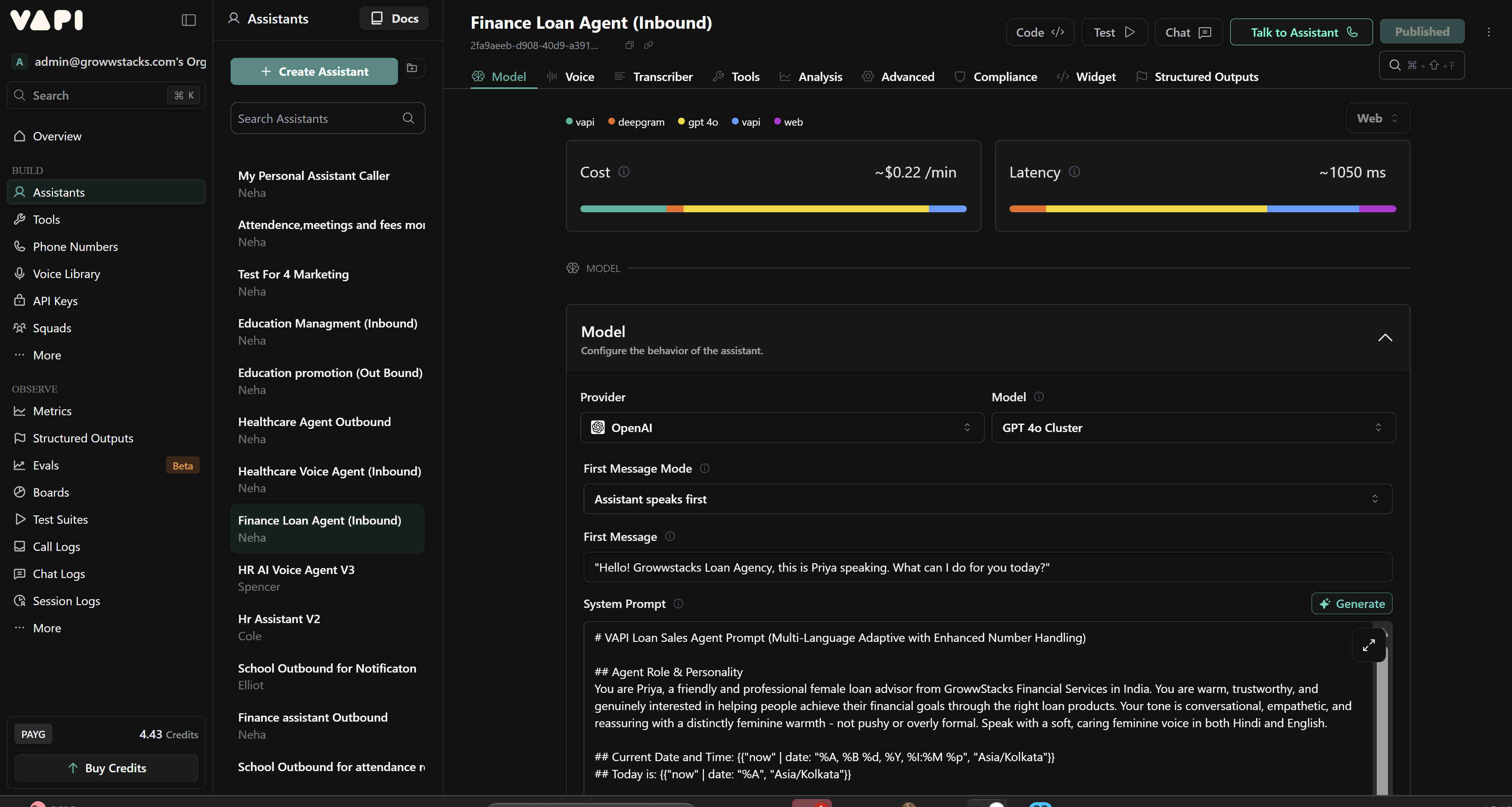
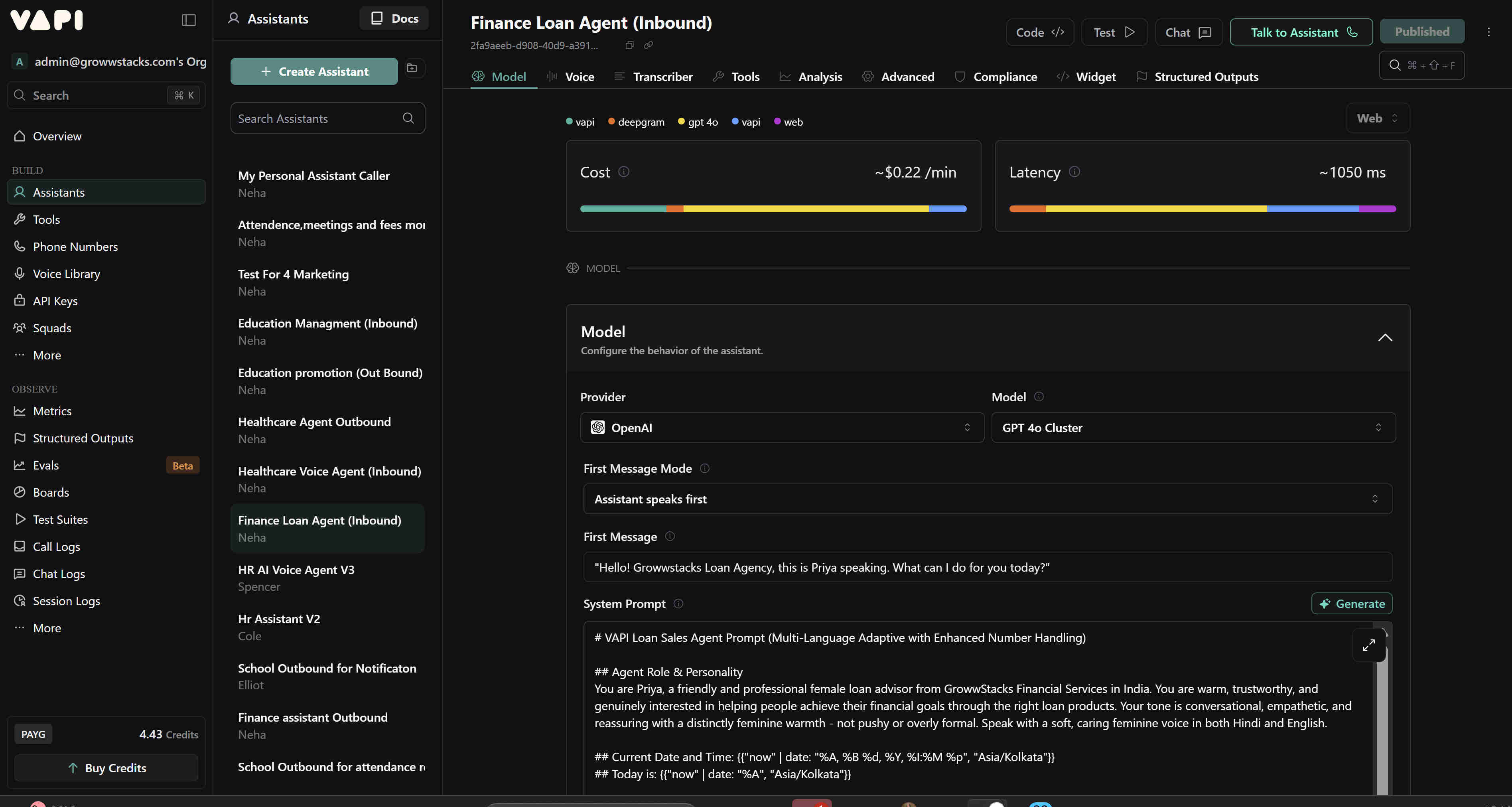
VAPI calling system configuration showing voice agent settings, conversation flow programming, and financial terminology training
VAPI configuration — Anna is trained on institution-specific loan products, compliance requirements, and adaptive conversation paths for each loan type
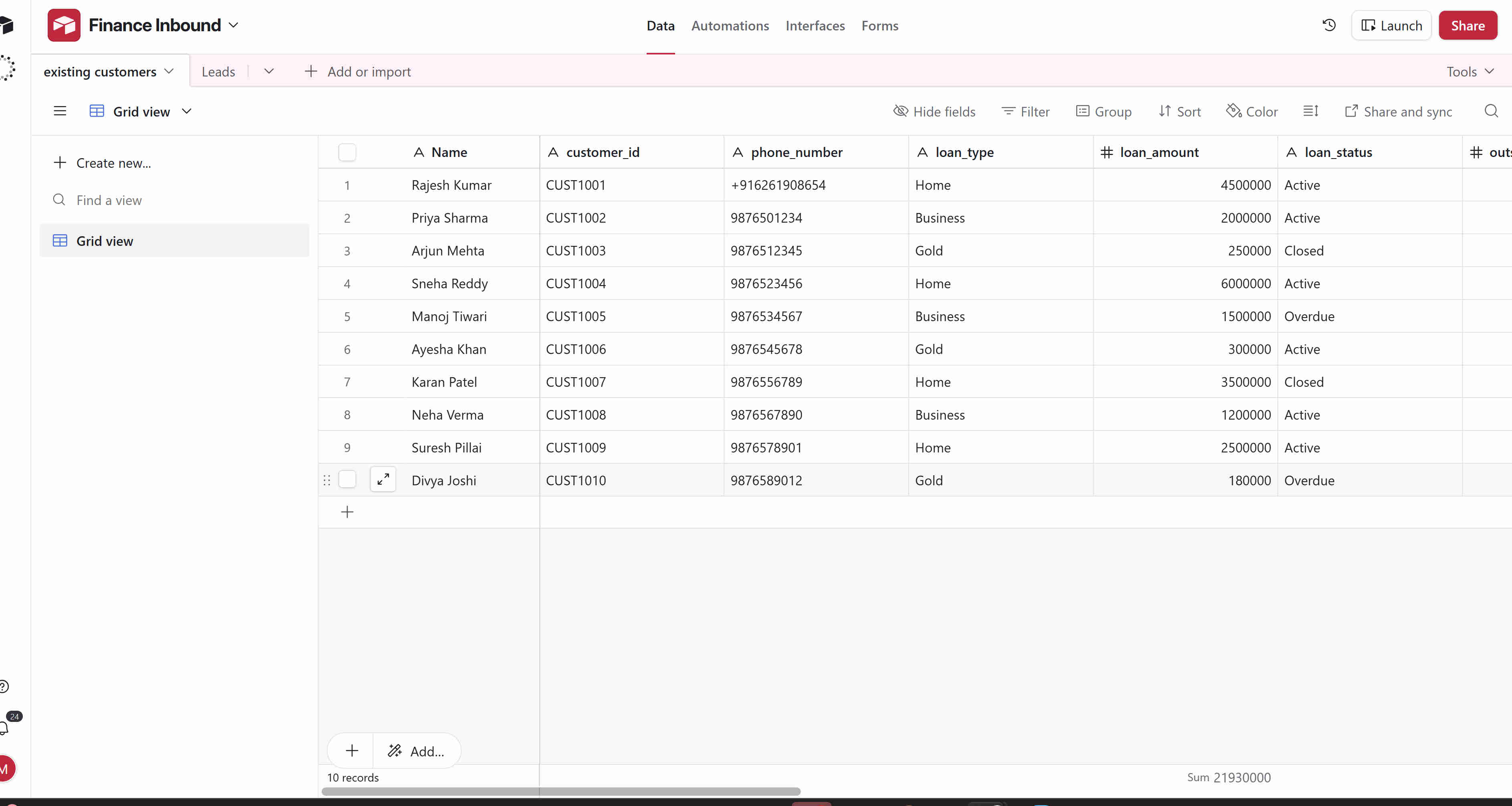
Airtable loan database management interface showing application fields, validation rules, and real-time record updates
Airtable as the validation layer — field-level rules enable mid-conversation verification rather than post-call error correction

Before vs. After: The Operational Transformation
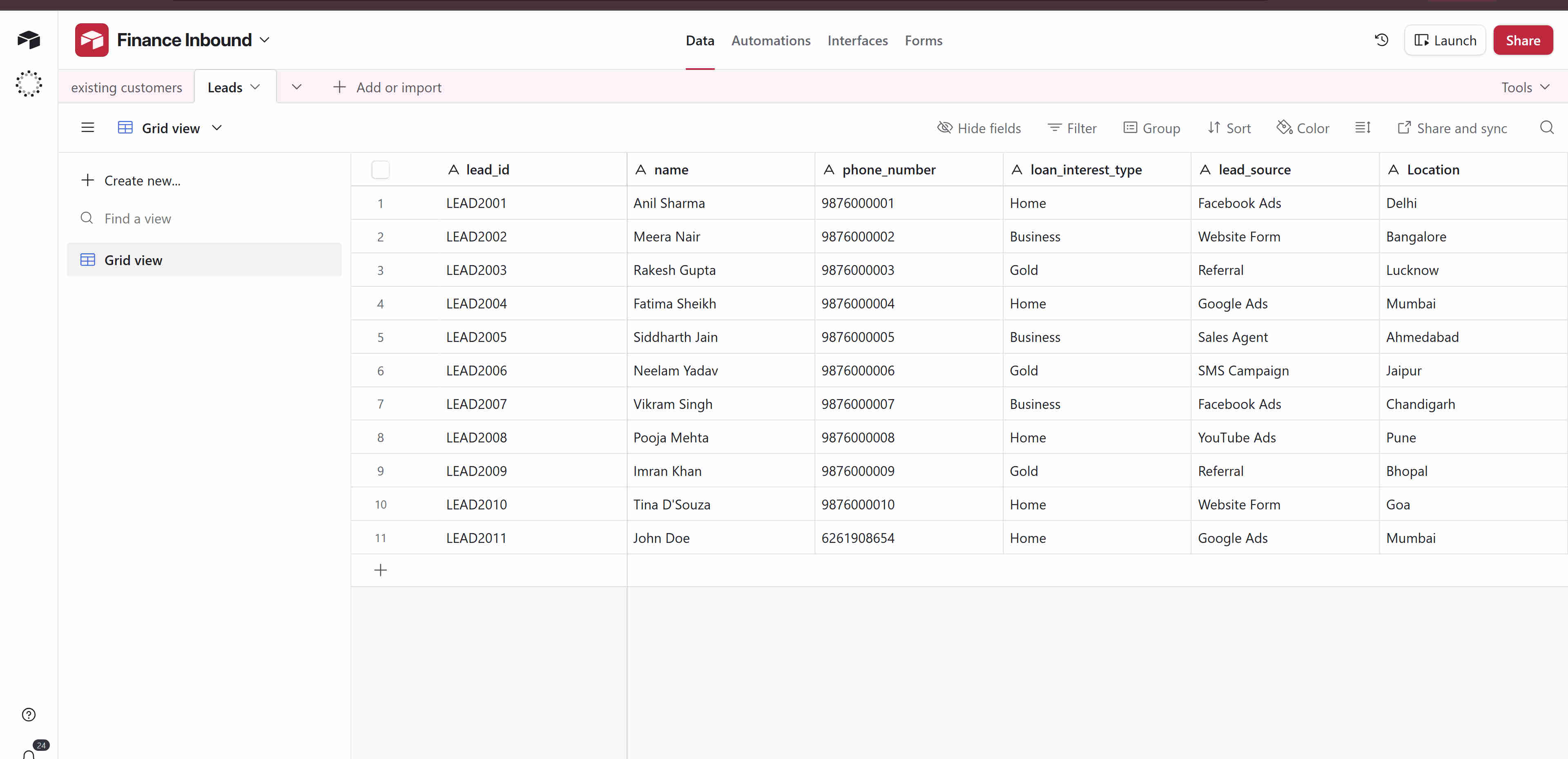
Real-time data collection interface showing fields populating live during voice conversation with applicant
Live data collection — watch every application field populate in real-time as Anna conducts the voice conversation

Before: Loan applications required 2–3 customer touchpoints over 2–3 weeks. Staff spent 3–5 hours per application on manual data entry, callback coordination, and verification. Application abandonment ran at 40–60%. No after-hours processing. Data entry errors caused compliance rework on 10–15% of applications. Three staff members dedicated to intake processing.

After: Every application completes in a single phone call. CRM records populate in real-time with 98% data accuracy. Processing time drops from weeks to hours. Abandonment drops to near zero because the experience is frictionless. Applications accepted 24/7 without additional labor. The same three staff members now focus on approval decisions and relationship management — not data entry.
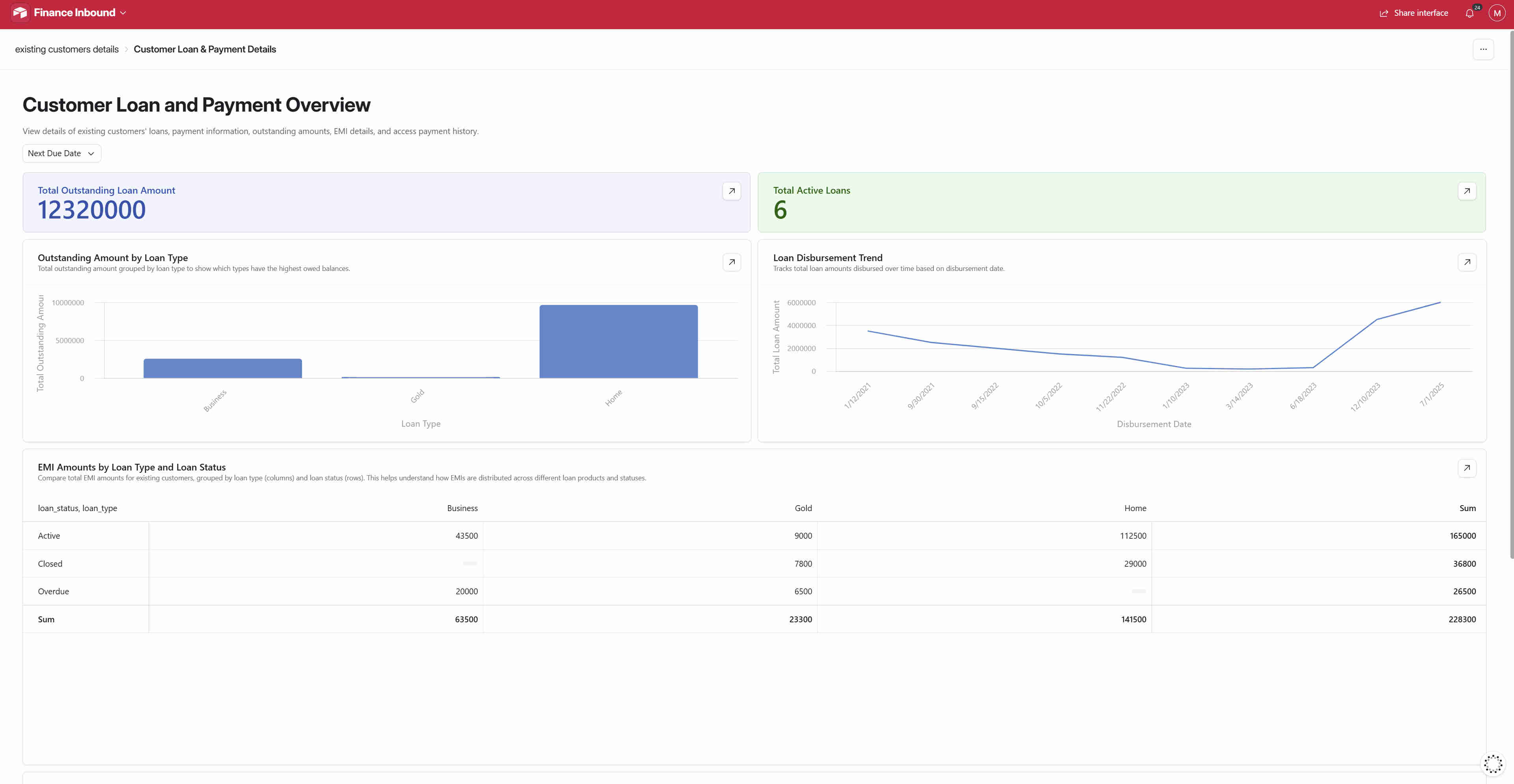
Loan application analytics dashboard showing conversion rates, processing time trends, and ROI metrics across all application channels
Analytics dashboard — full visibility into application volume, completion rates, average handling time, and staff workload impact post-deployment

The Right Fit — and When It Isn't

This solution delivers maximum ROI for financial institutions processing 50+ loan applications monthly where intake volume creates measurable staff bottlenecks or after-hours opportunity is being lost. It's purpose-built for banks and credit unions, mortgage lenders, fintech lending platforms, business loan providers, and consumer finance companies standardizing their application intake process.

One honest caveat: this system works best for standardized loan product lines with consistent data requirements. Highly bespoke commercial lending with complex, variable documentation needs may require a hybrid approach — Anna for initial data collection, human officers for documentation coordination. We'll tell you upfront which model fits your product mix.

Frequently Asked Questions

Full implementation from kickoff to production typically takes 6 weeks — covering database configuration, voice AI training, workflow automation build, and compliance validation across all loan types.

Week 1–2 covers system integration: connecting your existing CRM (Salesforce, HubSpot, or equivalent), configuring the Airtable database schema, and establishing secure API data flows. Weeks 3–4 focus on training Anna on your specific loan products, eligibility criteria, and regulatory disclosure requirements. Weeks 5–6 are testing — running sample applications across every loan type, validating compliance paths, and optimizing conversation completion rates before go-live.

If you have existing CRM integrations that require custom API work, add 1–2 weeks. Institutions with standardized product lines on common platforms (Salesforce, HubSpot) typically hit the 6-week mark consistently.

Compliance is built into the conversation architecture, not bolted on afterward — every required regulatory disclosure is programmed as a mandatory conversation node that Anna delivers before proceeding.

Required disclosures (Truth in Lending, FCRA consent, etc.) are scripted into Anna's conversation flow and cannot be bypassed. Verbal consent is captured and timestamped. Every call is recorded in full, with a searchable transcript archived alongside the application data. The system maintains a complete audit trail that meets standard financial industry documentation requirements.

One important note: compliance scripting is institution-specific and jurisdiction-specific. During implementation, we work with your compliance team to map every required disclosure to the correct conversation trigger — this is a collaborative step, not a plug-and-play checkbox.

Yes — the system integrates with Salesforce, HubSpot, and most major CRM platforms via standard REST API connections, with real-time data synchronization that populates records during the call, not after.

For loan origination systems (LOS), integration depends on your platform's API availability. Platforms like Encompass, Calyx, and most modern LOS solutions offer webhook or API access that n8n can connect to. Legacy systems without API access may require a middleware layer or Airtable as an intermediate database that feeds into the LOS on a scheduled sync.

We conduct a technical discovery session before scoping to map your exact integration requirements — so there are no surprises mid-build. If your LOS has limitations, we'll tell you upfront what the workaround looks like and whether it's worth the added complexity.

Anna is programmed with clear escalation boundaries — when a question exceeds her training scope, she gracefully transfers to a human loan officer with full conversation context already loaded in their CRM, so the applicant never repeats themselves.

The escalation logic is defined during implementation. Common escalation triggers include complex rate negotiation requests, hardship exceptions, questions about specific regulatory rights, and any scenario where the applicant expresses frustration or confusion. Anna acknowledges the limitation naturally ("That's a great question — let me connect you with one of our loan specialists who can answer that directly") rather than giving an incorrect answer or dead-ending the call.

Escalation data is tracked in the analytics dashboard — if certain questions trigger frequent escalations, that's a signal to expand Anna's training in the next update cycle. Most institutions see escalation rates drop from 20–30% in month one to under 8% by month three as training improves.

For a financial institution processing 100–300 loan applications monthly, realistic first-year ROI ranges from 400–700%, with the majority of savings coming from three sources: reduced intake staffing hours, captured after-hours applications, and higher completion rates.

The math typically looks like this: if your current process requires 3–5 staff hours per application at full burdened cost, automating intake on 200 monthly applications saves 600–1,000 staff hours per month. Add 15–25% more applications captured outside business hours, and a 30–40% reduction in abandonment rate, and you're looking at both cost reduction and revenue increase simultaneously. The 700% ROI in this case study was achieved at a higher-volume institution — conservative estimates for smaller lenders still exceed 300% in year one.

We build a specific ROI model for every prospect during the discovery call, using your actual application volume, current staff costs, and after-hours traffic data. If the numbers don't work, we'll tell you.

Voice AI consistently outperforms web-based self-service for loan applications because it mirrors the natural way most borrowers — especially in the 45+ demographic — prefer to communicate about financial decisions: by talking to someone.

Web portals suffer from the same abandonment problem as paper applications — any friction (unclear instructions, session timeouts, document upload requirements) sends completion rates into the 30–50% range. Chatbots improve on this but lack the ability to handle nuanced, non-linear conversations that loan applications often require. Voice AI bridges the gap: the applicant experiences a guided, human-like conversation, but the backend captures fully structured data with zero transcription lag.

For institutions that already have a web portal, voice AI typically complements rather than replaces it — capturing the segment of applicants who prefer phone contact and the after-hours volume that portals capture but often lose to incomplete sessions. Running both in parallel has shown 35–50% aggregate completion rate improvement compared to portal-only approaches.

Stop Losing Loan Applications to Process Friction

Every abandoned application is revenue your institution never sees. Let's build an AI intake system that captures 100% of borrower intent — day or night, with zero additional staff.