The Problem
Many marketing teams spend countless hours each week manually compiling performance reports. This involves extracting data from multiple platforms like Google Analytics, Google Ads, and Meta Ads, then manually formatting the data into spreadsheets or presentations. This process is not only time-consuming but also prone to errors, leading to inaccurate insights and delayed decision-making.
The manual approach also makes it difficult to compare current performance with previous periods, such as year-over-year growth. This lack of historical context hinders the ability to identify trends and optimize marketing strategies effectively. Furthermore, generating AI-powered summaries of the data is nearly impossible without significant manual effort.
The Solution
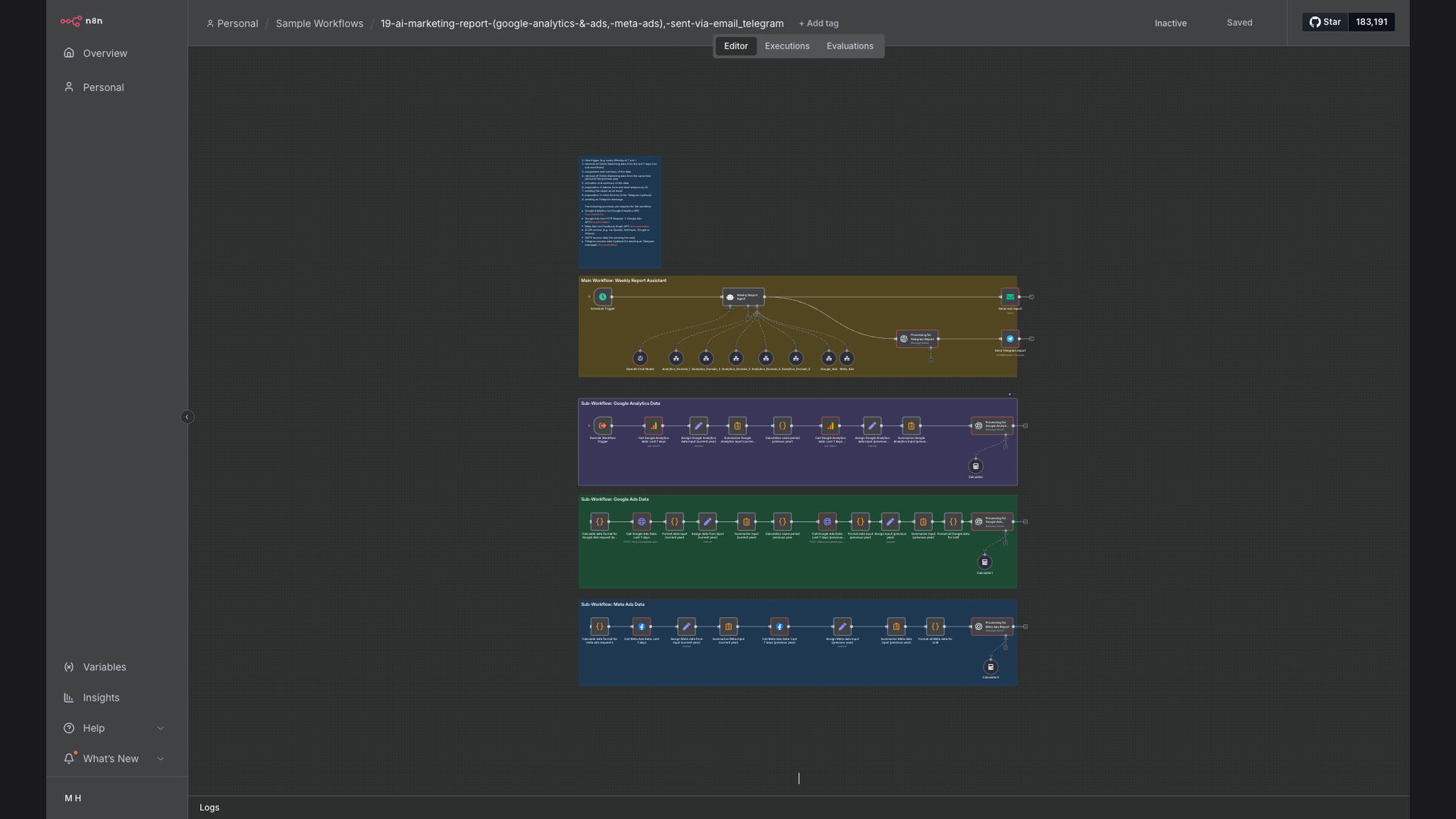
The solution is a fully automated workflow built with n8n that generates weekly AI-powered marketing reports. This system automatically extracts data from Google Analytics, Google Ads, and Meta Ads. It then consolidates the data, formats it into HTML tables, and uses AI to generate summaries of the key insights. Finally, the workflow delivers the reports via email and Telegram.
This tech stack was chosen for its ability to seamlessly integrate with the required data sources and its flexibility in data transformation and delivery. n8n provides a robust platform for building complex workflows, while Google Sheets offers a convenient way to store and manipulate the data. The AI integration allows for automated insights, and email/Telegram provide versatile delivery options.
How It Works — Automated Data Consolidation and Reporting
This workflow automates the entire process of generating marketing reports, from data extraction to delivery.
- Data Extraction: The workflow starts by extracting data from Google Analytics, Google Ads, and Meta Ads using their respective APIs.
- Data Consolidation: The extracted data is then consolidated into a single data structure, making it easier to process and format.
- HTML Formatting: The consolidated data is formatted into HTML tables, which provide a clean and organized way to present the information.
- AI Summary Generation: An AI model is used to generate summaries of the key insights from the data, highlighting important trends and patterns.
- Email Delivery: The HTML report and AI summary are sent via email to the designated recipients.
- Telegram Alert: A brief summary of the report is also sent via Telegram, providing a quick overview of the key findings.
- Year-over-Year Comparison: The workflow compares current performance with the previous year, identifying areas of growth and decline.
💡 Insight title: This automation significantly reduces the time spent on manual reporting, freeing up marketing teams to focus on more strategic activities. It also ensures that reports are accurate and delivered on time, providing timely insights for decision-making.
What This System Does That Manual Process Can't
Automated Time Savings
Eliminates hours of manual data collection and formatting, freeing up valuable time for strategic tasks.
Improved Accuracy
Reduces the risk of human error in data handling, ensuring that reports are accurate and reliable.
Timely Insights
Provides frequent and timely insights, enabling quicker responses to market changes and trends.
AI-Powered Summaries
Generates automated summaries of key insights, highlighting important trends and patterns in the data.
Versatile Delivery
Delivers reports via email and Telegram, providing flexible access to information for different users.
Scalable Solution
Easily scales to accommodate growing data volumes and reporting needs, ensuring long-term value.
Before vs. After: Automated Insights vs. Manual Drudgery
Before: Marketing team spent 10-15 hours per week manually compiling reports, often with errors and delays.
After: Reports are generated automatically in under 60 seconds, with AI-powered summaries and accurate data.
Implementation: Live in 3 Weeks
- Planning & Setup: Define reporting requirements, configure API access to Google Analytics, Ads, and Meta Ads.
- Workflow Design: Design the n8n workflow to extract, consolidate, and format the data.
- AI Integration: Integrate an AI model to generate summaries of the key insights.
- Testing & Refinement: Test the workflow thoroughly and refine it based on feedback.
- Deployment & Training: Deploy the workflow and train the marketing team on how to access and interpret the reports.
The Right Fit — and When It Isn't
This solution is ideal for marketing teams that spend a significant amount of time manually compiling performance reports. It's also a good fit for teams that want to leverage AI to gain deeper insights from their data and improve decision-making. The system is particularly valuable for businesses that manage multiple domains and channels, as it can consolidate data from various sources into a single report.
However, this solution may not be the right fit for very small businesses with limited marketing data or those that don't require frequent performance reports. In such cases, the manual approach may be sufficient. Additionally, businesses that lack the technical expertise to configure and maintain the workflow may need to seek external assistance.