The Problem
Recruiting and HR teams face a significant challenge in manually screening large volumes of CVs. This process is not only time-consuming but also prone to human error, leading to potential oversights of qualified candidates. The traditional method of reviewing each CV individually is inefficient and costly, often delaying the hiring process and impacting overall productivity.
Furthermore, ensuring consistent evaluation criteria across all candidates is difficult with manual reviews. This can result in biased decisions and a lack of standardized assessment, making it harder to identify the best-fit candidates objectively. The need for a more streamlined, accurate, and unbiased candidate evaluation process is critical for modern HR departments.
The Solution
The solution is an AI-powered workflow built with n8n that automates the extraction of key information from submitted CVs. This workflow leverages OpenAI's capabilities to analyze candidate qualifications against predefined job requirements, ensuring a standardized and objective evaluation process. The extracted and analyzed data is then stored in Google Sheets for easy access and reporting.
This tech stack was chosen for its flexibility, scalability, and cost-effectiveness. n8n provides a robust platform for building and managing complex workflows, while OpenAI offers powerful AI capabilities for natural language processing and data analysis. Google Sheets serves as a convenient and accessible repository for storing and visualizing candidate data, making it easy for HR teams to track and manage the hiring process.
How It Works — Automated Candidate Screening Process
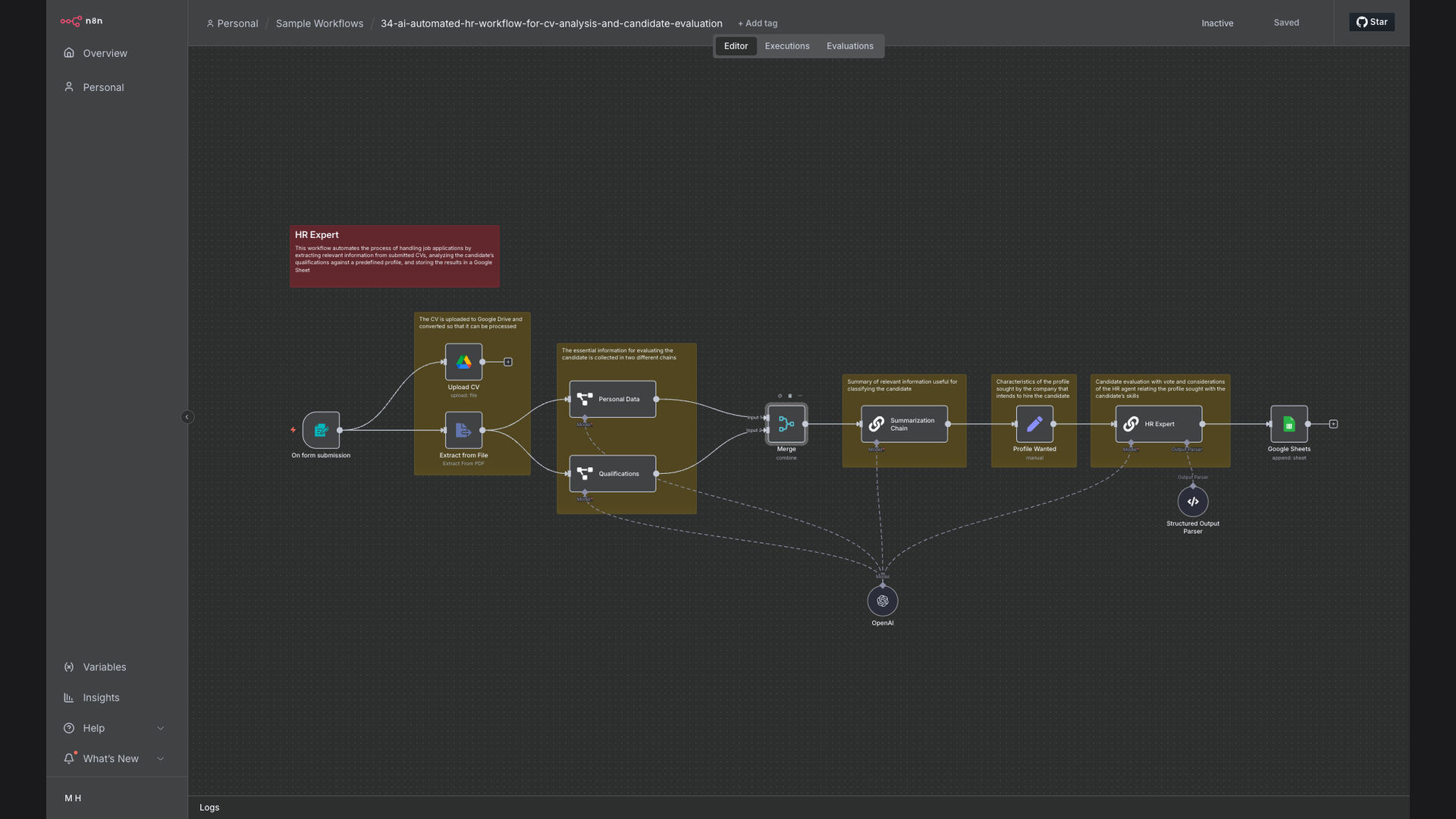
The workflow automates the entire candidate screening process, from CV submission to data storage and analysis.
- CV Submission: Candidates submit their CVs through a designated channel, such as an online application form or email.
- Data Extraction: The workflow automatically extracts key information from the CV, including name, contact details, education, work experience, skills, and qualifications.
- AI Analysis: The extracted data is then sent to OpenAI for analysis, where it is compared against predefined job requirements and evaluation criteria.
- Qualification Scoring: OpenAI assigns a qualification score to each candidate based on their alignment with the job requirements.
- Data Storage: The extracted data and qualification scores are stored in Google Sheets for easy access and reporting.
- Candidate Ranking: Candidates are ranked based on their qualification scores, allowing HR teams to quickly identify the most promising candidates.
- Automated Notifications: Automated notifications are sent to HR teams when new CVs are submitted or when candidate scores meet certain thresholds.
💡 Efficiency Boost: Automating CV analysis saves significant time and resources, allowing HR teams to focus on more strategic tasks such as interviewing and onboarding.
What This System Does That Manual Process Can't
Saves Time
Automates the time-consuming task of manually reviewing CVs, freeing up HR staff for other priorities.
Ensures Accuracy
Reduces the risk of human error in data extraction and analysis, ensuring more accurate candidate evaluations.
Promotes Objectivity
Applies standardized evaluation criteria, minimizing bias and promoting fair candidate selection.
Increases Efficiency
Streamlines the entire candidate screening process, accelerating the hiring timeline and improving overall productivity.
Provides Insights
Offers valuable data and analytics on candidate qualifications, enabling data-driven decision-making.
Integrates Seamlessly
Connects with existing HR systems and tools, such as applicant tracking systems (ATS) and CRM platforms.
Before vs. After: Streamlined Candidate Evaluation
Before: Manual CV screening took an average of 15 minutes per CV, resulting in significant delays and resource constraints.
After: Automated CV analysis reduces processing time to under 1 minute per CV, enabling faster and more efficient candidate evaluation.
Implementation: Live in 3 Weeks
- Requirements Gathering: Define job requirements, evaluation criteria, and data extraction parameters.
- Workflow Design: Design the n8n workflow, including data extraction, AI analysis, and data storage steps.
- Integration & Testing: Integrate the workflow with existing HR systems and tools, and conduct thorough testing to ensure accuracy and reliability.
- Deployment: Deploy the workflow to a production environment and train HR staff on how to use the system.
The Right Fit — and When It Isn't
This solution is ideal for organizations that receive a high volume of CVs and need to streamline their candidate screening process. It is particularly well-suited for companies looking to improve the accuracy, objectivity, and efficiency of their hiring practices. The workflow can be customized to meet the specific needs of different industries and job roles.
However, this solution may not be the right fit for organizations with very low CV volumes or those that require highly specialized, subjective evaluations. In such cases, a more manual approach may be more appropriate. Additionally, organizations that lack the technical expertise to manage and maintain the workflow may need to consider alternative solutions or seek external support.