The Problem
Content creators and marketers often struggle with identifying trending topics that resonate with their ideal customer profile (ICP). Manually sifting through Google Trends data is time-consuming and inefficient, often leading to missed opportunities. Furthermore, ensuring that content ideas align with the specific interests and values of privacy-conscious, mid-career decision-makers presents a significant challenge.
The traditional content creation process involves hours of manual research, brainstorming sessions, and content scoring. This not only drains resources but also increases the risk of creating content that fails to capture the attention of the target audience. The lack of a streamlined, automated system results in inconsistent content quality and missed opportunities to engage with potential customers effectively.
The Solution
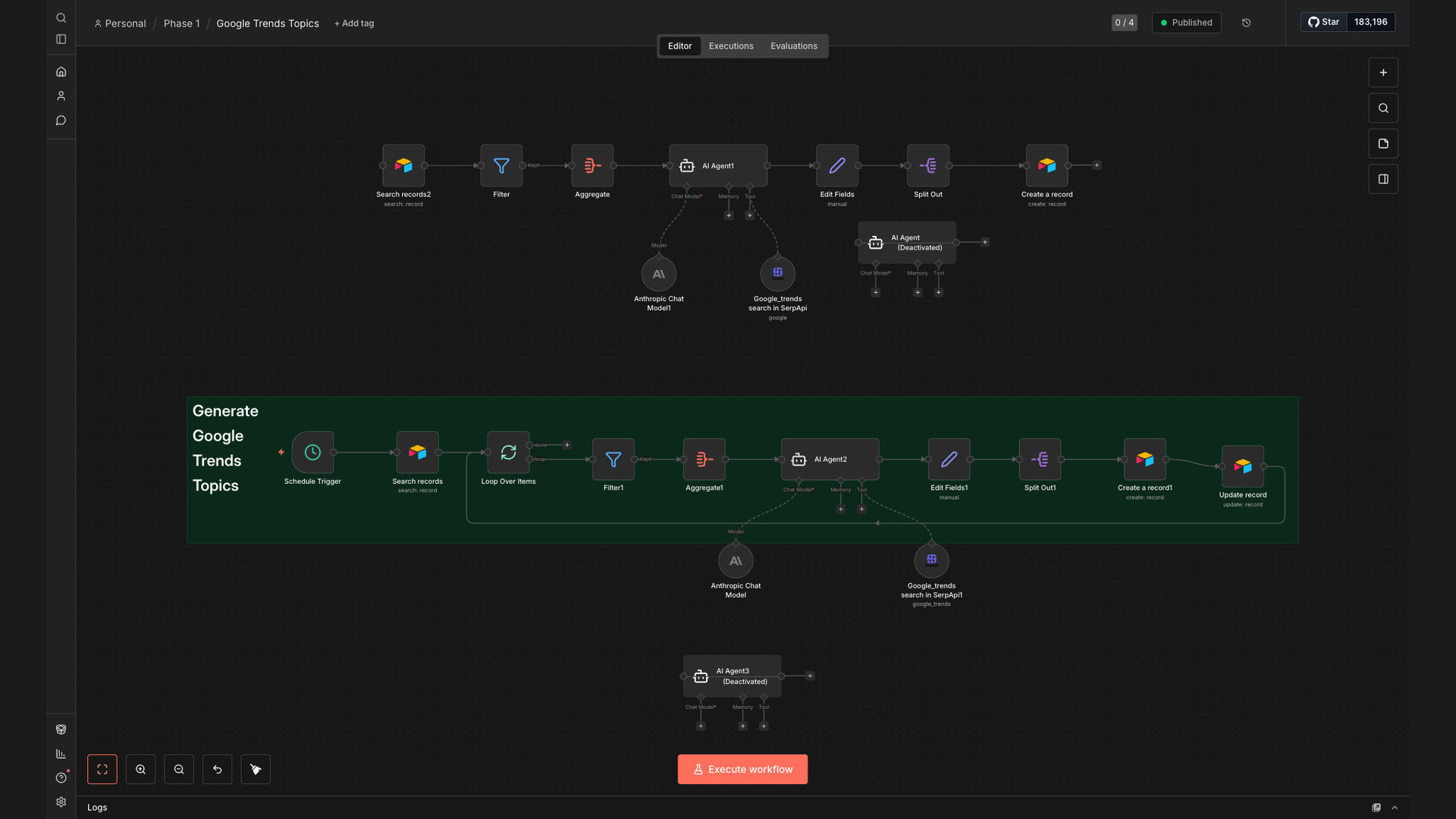
We developed an automated workflow that extracts trending topics from Google Trends, filters them based on relevance to privacy-conscious mid-career decision-makers, and generates content ideas using AI. The system then scores these ideas against six predefined criteria, ensuring that only high-quality, ICP-aligned topics are selected for content creation.
This solution leverages n8n as the primary automation platform, integrating with Google Trends for data extraction, OpenAI for content idea generation, and Airtable for data storage and management. The choice of this tech stack ensures scalability, flexibility, and seamless integration with existing marketing tools, providing a comprehensive content automation solution.
How It Works — Streamlining Content Creation with Automation
This automated workflow simplifies the content creation process, ensuring that only relevant and high-scoring topics are selected for content development.
- Extract Trending Topics: The workflow begins by extracting the latest trending topics from Google Trends using the n8n platform.
- Filter for ICP Relevance: The extracted topics are then filtered based on predefined criteria to ensure relevance to privacy-conscious, mid-career decision-makers.
- Generate Content Ideas: Using OpenAI, the system generates content ideas for each filtered topic, providing a range of potential angles and formats.
- Score Content Ideas: Each content idea is scored against six criteria, including relevance, originality, and potential impact, to identify the most promising topics.
- Store High-Scoring Topics: The high-scoring topics are then stored in Airtable, creating a centralized repository of content ideas for future use.
- Automate Content Brief Creation: The system automatically generates content briefs for the selected topics, providing writers with a clear outline and key points to cover.
- Schedule Content for Publication: The workflow integrates with social media scheduling tools to automate the publication of content across various platforms.
💡 Data-Driven Content Strategy: By automating the topic discovery and content idea generation process, content creators can ensure that their content strategy is data-driven and aligned with the interests of their target audience.
What This System Does That Manual Process Can't
Speed & Efficiency
Automated topic discovery and content idea generation significantly reduce the time and effort required for manual research and brainstorming.
ICP Alignment
Filtering topics based on predefined criteria ensures that content is always relevant to the target audience, increasing engagement and conversion rates.
AI-Powered Creativity
Leveraging OpenAI for content idea generation unlocks new creative possibilities and ensures a diverse range of content angles and formats.
Data-Driven Decisions
Scoring content ideas against predefined criteria provides a data-driven approach to content selection, ensuring that only high-quality topics are pursued.
Centralized Repository
Storing high-scoring topics in Airtable creates a centralized repository of content ideas, making it easy to access and manage content strategy.
Scalability
The automated workflow can easily scale to accommodate increasing content demands, ensuring that content creation remains efficient and effective.
Before vs. After: Streamlined Content Creation
Before: Content creators spent 10-15 hours per week on manual topic research, resulting in inconsistent content quality and missed opportunities to engage with the target audience.
After: The automated workflow reduced topic research time by 90%, increased content output by 5x, and ensured that all content is aligned with the interests of privacy-conscious, mid-career decision-makers.
Implementation: Live in 4 Weeks
- Discovery & Planning: We began by conducting a thorough analysis of the client's content creation process, target audience, and business goals. This phase involved identifying key performance indicators (KPIs) and defining the criteria for ICP-aligned content.
- Workflow Design & Development: Based on the discovery phase, we designed an automated workflow that integrates with Google Trends, OpenAI, and Airtable. This phase involved configuring the n8n platform, developing custom scripts, and testing the workflow to ensure accuracy and efficiency.
- Testing & Optimization: We conducted rigorous testing of the automated workflow to identify and resolve any issues. This phase involved optimizing the workflow for speed, accuracy, and scalability.
- Deployment & Training: Once the workflow was fully tested and optimized, we deployed it to the client's environment and provided training to the content creation team. This phase involved ensuring that the team was comfortable using the new system and able to leverage its full potential.
The Right Fit — and When It Isn't
This automated content creation system is ideal for businesses that want to streamline their content creation process, ensure alignment with their target audience, and improve the quality and consistency of their content. It is particularly well-suited for organizations targeting privacy-conscious, mid-career decision-makers.
However, this system may not be the right fit for businesses that lack a clear understanding of their target audience or that are unwilling to invest in the necessary technology and training. It also may not be suitable for organizations that require highly customized or niche content that cannot be easily generated using AI.