The Problem
Content researchers and marketers are constantly bombarded with information. Manually sifting through numerous web articles to extract key insights is a time-consuming and inefficient process. This often leads to missed opportunities and delayed decision-making.
The need to stay updated with the latest trends and research requires a solution that can quickly digest and summarize large volumes of content. Without automation, professionals spend countless hours reading and note-taking, which diverts their attention from more strategic tasks and hinders their overall productivity.
The Solution
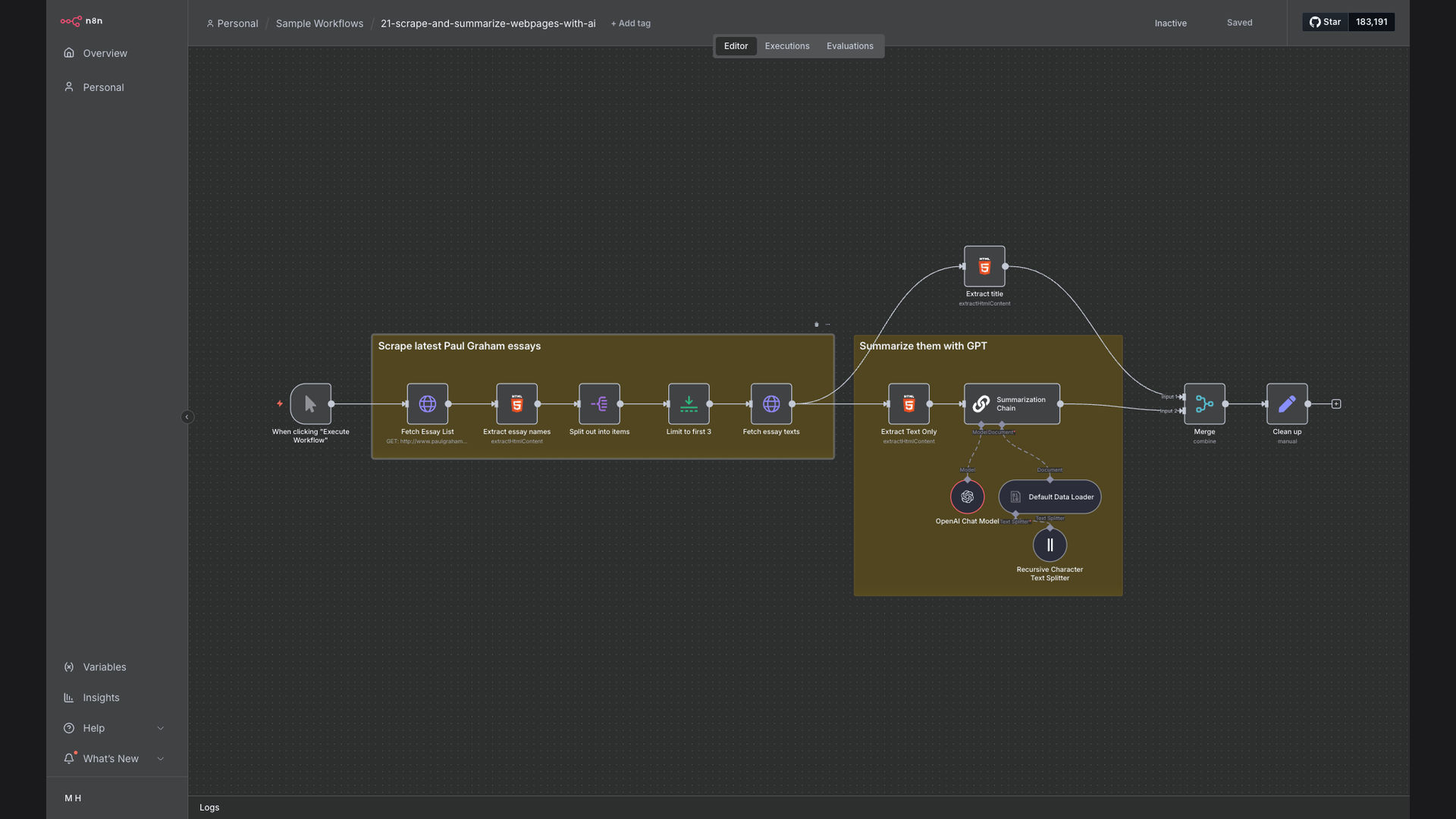
We built an automated workflow using n8n that scrapes content from specified web pages, extracts the relevant text, and leverages OpenAI's GPT models to generate concise summaries. This system eliminates the need for manual reading and note-taking, providing users with instant insights.
The choice of n8n as the primary platform was driven by its flexibility, scalability, and ability to seamlessly integrate with OpenAI's API. The webhook trigger allows for real-time processing, ensuring that summaries are generated as soon as new content is available. This combination provides a robust and efficient solution for content summarization.
How It Works — Real-time Content Summarization
This workflow automates the process of extracting and summarizing content from web pages, delivering instant insights to users.
- Webhook Trigger: The workflow is initiated by a webhook, allowing for real-time processing of new content.
- HTTP Request: The system sends an HTTP request to the specified URL to retrieve the webpage content.
- HTML Extract: The HTML content is parsed to extract the relevant text, removing unnecessary markup.
- OpenAI Integration: The extracted text is sent to OpenAI's GPT-4o model for summarization.
- AI Summary Generation: GPT-4o generates a concise summary of the content, highlighting the key points.
- Notification: The summary is sent to the user via email or other notification channels.
- Review & Share: The user reviews the summary and shares it with their team or network.
💡 Efficiency Boost: By automating web scraping and AI summarization, users can process significantly more content in less time, leading to better-informed decisions and increased productivity.
What This System Does That Manual Process Can't
Speed
AI-powered summarization delivers insights in seconds, far faster than manual reading.
Automation
Set it and forget it. The workflow runs automatically, freeing up valuable time.
Scalability
Process hundreds of articles without increasing manual effort.
Accuracy
AI identifies and summarizes the most important information, reducing the risk of missing key details.
Versatility
Works with a wide range of websites and content types.
Instant Alerts
Receive summaries directly via email or other notification channels.
Before vs. After: Real-time Content Summarization
Before: Content researchers spent 5+ hours per day manually reading and summarizing articles, struggling to keep up with the volume of information.
After: With automated web scraping and AI summarization, they now process the same amount of content in under an hour, freeing up time for strategic tasks.
Implementation: Live in 2 Weeks
- Requirements Gathering: We worked with the client to identify their specific content sources and summarization needs.
- Workflow Design: We designed the n8n workflow to scrape content, extract text, and integrate with OpenAI's GPT-4o model.
- Testing and Refinement: We conducted thorough testing to ensure the accuracy and efficiency of the summarization process.
- Deployment: The workflow was deployed to the client's n8n instance, with ongoing monitoring and support.
The Right Fit — and When It Isn't
This solution is ideal for content researchers, marketers, and knowledge workers who need to quickly digest multiple web articles without manual reading. It's particularly beneficial for those who need to stay updated with the latest trends and research in their industry.
However, this solution may not be suitable for websites with complex JavaScript-driven content or those that actively block web scraping. In such cases, alternative methods may be required to extract the necessary information.