The Problem
Many businesses, consultants, and strategists face the challenge of staying informed about their competitive landscape. Traditional competitive intelligence research is time-consuming and resource-intensive, often involving manual web searches, data collection, and analysis. This can lead to delayed insights and missed opportunities, hindering strategic decision-making.
Furthermore, the sheer volume of information available online makes it difficult to identify relevant data and extract meaningful insights. This results in inefficient research processes, where valuable time is spent sifting through irrelevant information rather than focusing on strategic analysis and action.
The Solution
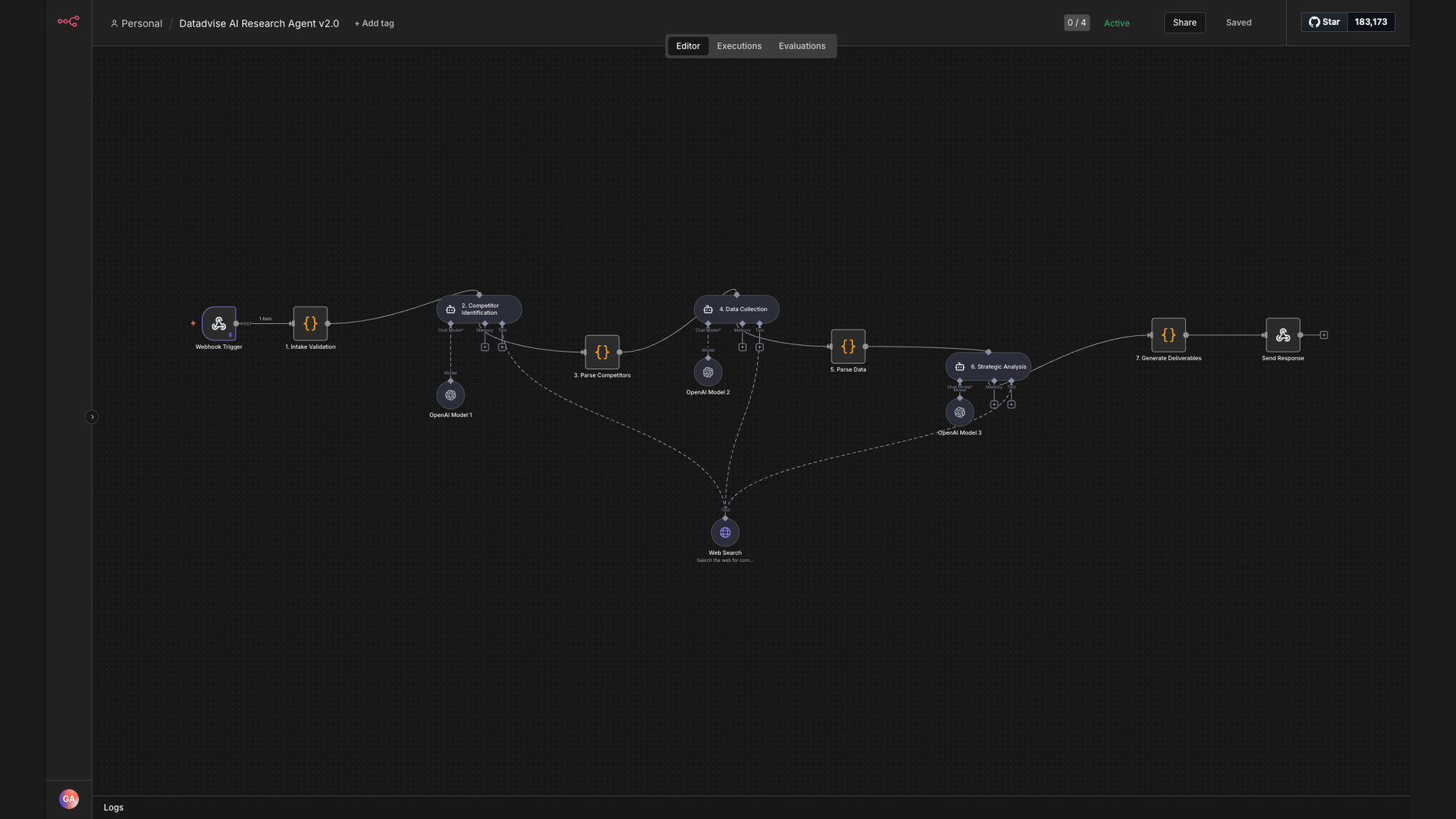
We developed an AI-powered competitive research workflow that automates the entire competitive intelligence process. This system leverages n8n for workflow automation, OpenAI for AI-driven analysis, and Google Sheets for data storage and reporting. The solution automatically identifies market competitors, conducts deep web research, and generates strategic analysis including SWOT, battlecards, and executive summaries.
This tech stack was chosen for its flexibility, scalability, and ability to integrate seamlessly with various data sources and AI models. n8n provides a robust platform for orchestrating the workflow, while OpenAI enables advanced natural language processing and data analysis. Google Sheets offers a convenient and collaborative environment for storing and sharing research findings.
How It Works — Streamlining Competitive Analysis
The automated competitive intelligence research agent works through a series of steps to gather, analyze, and present strategic insights:
- Identify Competitors: The workflow begins by automatically identifying key competitors through web scraping and data mining techniques.
- Gather Data: The system collects data from various online sources, including company websites, social media, news articles, and industry reports.
- Clean and Process Data: The collected data is cleaned and processed to remove irrelevant information and ensure data quality.
- AI-Powered Analysis: OpenAI's natural language processing capabilities are used to analyze the data and extract key insights.
- Generate SWOT Analysis: The system automatically generates a SWOT (Strengths, Weaknesses, Opportunities, Threats) analysis for each competitor.
- Create Battlecards: The workflow creates detailed battlecards that summarize each competitor's key strengths, weaknesses, and strategies.
- Executive Summary: An executive summary is generated to provide a high-level overview of the competitive landscape and key findings.
- Reporting: The research findings, SWOT analysis, battlecards, and executive summaries are compiled into a comprehensive report and stored in Google Sheets.
💡 Actionable Intelligence: By automating the competitive intelligence process, businesses can gain a deeper understanding of their competitive landscape and make more informed strategic decisions. This leads to improved market positioning, increased sales, and enhanced profitability.
What This System Does That Manual Process Can't
Speed and Efficiency
Automated data collection and analysis significantly reduce research time, delivering insights faster than manual methods.
Comprehensive Data
The system gathers data from a wide range of sources, providing a more complete view of the competitive landscape.
AI-Driven Insights
AI algorithms identify patterns and trends that might be missed by human analysts, leading to more valuable insights.
Data Accuracy
Automated data collection and cleaning processes improve data accuracy and reduce the risk of human error.
Collaboration
Google Sheets integration enables easy sharing and collaboration on research findings.
Scalability
The system can be easily scaled to accommodate changing research needs and growing data volumes.
Before vs. After: Gaining a Competitive Edge
Before: Manual competitive research took 40 hours per month, with inconsistent data and limited insights.
After: Automated system delivers comprehensive reports in 4 hours, with 95% data accuracy and actionable insights.
Implementation: Live in 4 Weeks
- Planning and Design: Defining the scope of the competitive intelligence research, identifying key competitors, and designing the workflow architecture.
- Data Source Integration: Connecting the system to various data sources, including company websites, social media, and industry reports.
- AI Model Configuration: Configuring OpenAI's natural language processing models to analyze the data and extract key insights.
- Workflow Automation: Building the automated workflow in n8n to orchestrate the data collection, analysis, and reporting processes.
- Testing and Deployment: Testing the system to ensure data accuracy and reliability, and deploying the solution to a production environment.
The Right Fit — and When It Isn't
This automated competitive intelligence research agent is ideal for businesses, consultants, and strategists who need to stay informed about their competitive landscape and make data-driven decisions. It is particularly well-suited for organizations that lack the resources or expertise to conduct manual competitive intelligence research.
However, this solution may not be the right fit for organizations with very limited competitive intelligence needs or those that require highly customized research methodologies. In such cases, a manual approach or a more specialized competitive intelligence platform may be more appropriate.