The Problem
SEO professionals and website owners face the challenge of manually auditing websites for on-page SEO issues. This process is time-consuming, requiring significant effort to analyze various factors like keyword usage, meta descriptions, heading structure, and content quality. Furthermore, keeping up with the latest SEO best practices and implementing them across numerous web pages can be overwhelming.
The traditional approach to SEO auditing often involves using multiple tools and spreadsheets to gather and analyze data. This fragmented process can lead to inefficiencies, errors, and delays in identifying and addressing critical SEO issues. The lack of a streamlined, automated solution makes it difficult to maintain consistent SEO performance and achieve optimal search engine rankings.
The Solution
The solution is an automated on-page SEO audit workflow built using n8n, OpenAI, and web scraping techniques. This system automates the process of extracting website content, analyzing SEO elements, and generating comprehensive audit reports. By leveraging the power of AI and automation, users can significantly reduce the time and effort required to perform thorough SEO audits.
This workflow uses n8n as the primary automation platform, orchestrating the data flow between web scraping tools, OpenAI's language models, and Google Sheets for report generation. The integration of OpenAI allows for sophisticated content analysis, identifying areas for improvement in terms of readability, keyword optimization, and overall SEO effectiveness. The use of webhooks enables real-time triggering of audits, ensuring that websites are continuously monitored for SEO issues.
How It Works — Streamlining SEO Audits with Automation
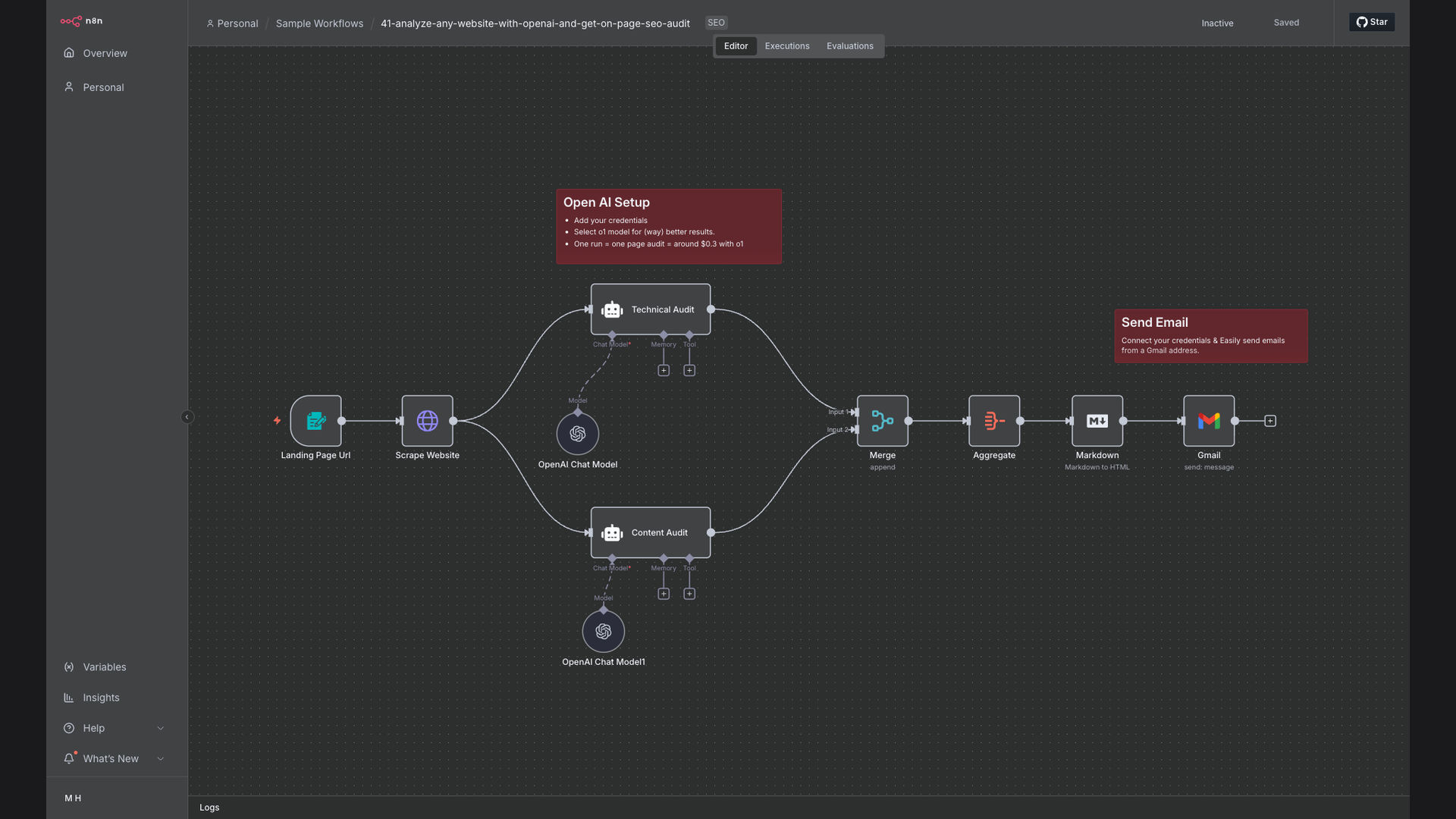
This automated SEO audit workflow simplifies the process of analyzing website content and identifying areas for improvement. Here's a step-by-step breakdown of how it works:
- Web Scraping: The workflow begins by scraping the content of the target webpage using a web scraping tool. This includes extracting text, headings, meta descriptions, and other relevant SEO elements.
- Data Extraction: The scraped data is then extracted and structured for further analysis. This involves cleaning the data and organizing it into a format that can be easily processed by OpenAI.
- OpenAI Analysis: The structured data is sent to OpenAI's language model for analysis. OpenAI evaluates the content based on various SEO factors, such as keyword density, readability, and relevance.
- Technical SEO Checks: The workflow also performs technical SEO checks, such as analyzing the website's structure, internal linking, and mobile-friendliness.
- Content Quality Assessment: OpenAI assesses the quality of the content, identifying areas where it can be improved in terms of clarity, accuracy, and engagement.
- Report Generation: Based on the analysis, the workflow generates a comprehensive SEO audit report. This report includes actionable insights and recommendations for improving the website's SEO performance.
- Email Delivery: The audit report is automatically sent to the user via email, providing them with a detailed overview of the website's SEO strengths and weaknesses.
- Data Storage: The audit data is stored in Google Sheets for future reference and tracking of SEO performance over time.
💡 Actionable Insights: The automated SEO audit workflow provides actionable insights and recommendations for improving website's SEO performance, saving time and effort compared to manual analysis.
What This System Does That [Manual Process] Can't
Time Savings
Automates the entire SEO audit process, reducing the time required from hours to minutes.
AI-Powered Analysis
Leverages OpenAI for sophisticated content analysis and SEO recommendations.
Improved Accuracy
Eliminates human error and ensures consistent, reliable SEO audits.
Automated Reporting
Generates and delivers comprehensive SEO audit reports via email.
Scalability
Easily scales to audit multiple websites and web pages simultaneously.
Data-Driven Insights
Provides data-driven insights and recommendations for optimizing website content and structure.
Before vs. After: [descriptive subtitle]
Before: Manual SEO audits took approximately 8 hours per website, involving multiple tools and spreadsheets, leading to inconsistent results and delayed implementation of SEO recommendations.
After: Automated SEO audits are completed in under 1 minute per website, providing consistent, data-driven insights and enabling faster implementation of SEO recommendations, resulting in improved search engine rankings and increased organic traffic.
Implementation: Live in 2 Weeks
- Planning and Setup: Define the scope of the SEO audit, identify key SEO elements to analyze, and set up the necessary accounts and tools (n8n, OpenAI, Google Sheets).
- Workflow Configuration: Configure the n8n workflow to scrape website content, extract relevant data, and send it to OpenAI for analysis.
- OpenAI Integration: Integrate OpenAI's language model into the workflow and configure it to analyze the content based on various SEO factors.
- Report Generation: Design the SEO audit report template in Google Sheets and configure the workflow to populate it with the analysis results.
- Testing and Refinement: Test the workflow on a sample website and refine it based on the results, ensuring that it accurately identifies and reports SEO issues.
The Right Fit — and When It Isn't
This automated SEO audit workflow is ideal for SEO professionals, digital marketers, and website owners who want to streamline their SEO audit process and gain actionable insights into their website's SEO performance. It is particularly useful for those who need to audit multiple websites or web pages on a regular basis.
However, this workflow may not be the right fit for those who require highly customized SEO audits or who prefer to perform manual analysis. Additionally, it requires some technical expertise to set up and configure the workflow, although GrowwStacks can provide assistance with implementation and customization.